Share This Page
LACTULOSE Drug Patent Profile
✉ Email this page to a colleague
Which patents cover Lactulose, and when can generic versions of Lactulose launch?
Lactulose is a drug marketed by Apotex, Pai Holdings, Ani Pharms, Apozeal Pharms, Aurobindo Pharma Ltd, Chartwell Rx, Fresenius Kabi, Hikma, Lannett Co Inc, Morton Grove, Paco, Pharm Assoc, Pharmobedient, Taro, Vistapharm Llc, Bajaj, Pai Holdings Pharm, Roxane, and Solvay. and is included in twenty-four NDAs.
The generic ingredient in LACTULOSE is lactulose. There is one drug master file entry for this compound. Twenty-two suppliers are listed for this compound. Additional details are available on the lactulose profile page.
DrugPatentWatch® Litigation and Generic Entry Outlook for Lactulose
A generic version of LACTULOSE was approved as lactulose by PHARM ASSOC on July 30th, 1996.
AI Deep Research
Questions you can ask:
- What is the 5 year forecast for LACTULOSE?
- What are the global sales for LACTULOSE?
- What is Average Wholesale Price for LACTULOSE?
Summary for LACTULOSE
| US Patents: | 0 |
| Applicants: | 19 |
| NDAs: | 24 |
| Finished Product Suppliers / Packagers: | 22 |
| Raw Ingredient (Bulk) Api Vendors: | 1 |
| Clinical Trials: | 167 |
| Patent Applications: | 4,936 |
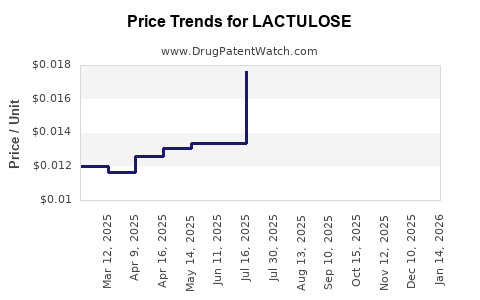
| Drug Prices: | Drug price information for LACTULOSE |
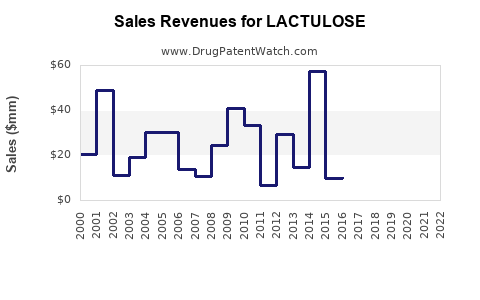
| Drug Sales Revenues: | Drug sales revenues for LACTULOSE |
| DailyMed Link: | LACTULOSE at DailyMed |
Recent Clinical Trials for LACTULOSE
Identify potential brand extensions & 505(b)(2) entrants
| Sponsor | Phase |
|---|---|
| University of Chicago | PHASE1 |
| Qianjiang Central Hospital of Chongqing | NA |
| The Third People's Hospital of Kunming City | NA |
Pharmacology for LACTULOSE
| Drug Class | Osmotic Laxative |
| Mechanism of Action | Acidifying Activity Osmotic Activity |
| Physiological Effect | Stimulation Large Intestine Fluid/Electrolyte Secretion |
Medical Subject Heading (MeSH) Categories for LACTULOSE
Anatomical Therapeutic Chemical (ATC) Classes for LACTULOSE
US Patents and Regulatory Information for LACTULOSE
| Applicant | Tradename | Generic Name | Dosage | NDA | Approval Date | TE | Type | RLD | RS | Patent No. | Patent Expiration | Product | Substance | Delist Req. | Exclusivity Expiration |
|---|---|---|---|---|---|---|---|---|---|---|---|---|---|---|---|
| Apotex | LACTULOSE | lactulose | FOR SOLUTION;ORAL | 074712-001 | Dec 10, 1997 | AA | RX | No | Yes | ⤷ Start Trial | ⤷ Start Trial | ⤷ Start Trial | |||
| Vistapharm Llc | LACTULOSE | lactulose | SOLUTION;ORAL | 074138-001 | Sep 30, 1992 | DISCN | No | No | ⤷ Start Trial | ⤷ Start Trial | ⤷ Start Trial | ||||
| Pai Holdings Pharm | LACTULOSE | lactulose | SOLUTION;ORAL, RECTAL | 074077-001 | Jul 3, 1995 | DISCN | No | No | ⤷ Start Trial | ⤷ Start Trial | ⤷ Start Trial | ||||
| Aurobindo Pharma Ltd | LACTULOSE | lactulose | SOLUTION;ORAL | 074602-001 | Nov 14, 1996 | AA | RX | No | No | ⤷ Start Trial | ⤷ Start Trial | ⤷ Start Trial | |||
| Pai Holdings | LACTULOSE | lactulose | FOR SOLUTION;ORAL | 217914-002 | Mar 14, 2025 | AA | RX | No | No | ⤷ Start Trial | ⤷ Start Trial | ⤷ Start Trial | |||
| >Applicant | >Tradename | >Generic Name | >Dosage | >NDA | >Approval Date | >TE | >Type | >RLD | >RS | >Patent No. | >Patent Expiration | >Product | >Substance | >Delist Req. | >Exclusivity Expiration |
Executive summary: Lactulose is a mature, low-cost, multisource pharmaceutical with limited patent protection and minimal branded pricing power. Its commercial value comes from recurring volume in constipation and hepatic encephalopathy, not exclusivity. The U.S. market is exposed to generic price competition, while international growth is tied to rising diagnosis of liver disease, aging populations, hospital use, and broader access to prescription medicines. Patent-driven generic entry risk is low because the core lactulose composition and principal formulations are long off-patent. Manufacturing concentration, quality compliance, supply continuity, and distribution scale are more important competitive variables than intellectual property.
Lactulose Market Dynamics, Patent Status, FDA Exclusivity, and Financial Trajectory
What is the current market position of lactulose?
Lactulose is a synthetic disaccharide used mainly as an osmotic laxative and as a treatment for reducing intestinal ammonia absorption in patients with hepatic encephalopathy. It is sold as an oral solution, concentrate, and powder for oral solution in some markets.
The commercial market has two demand pools:
| Segment | Primary use | Commercial characteristics |
|---|---|---|
| Constipation | Chronic or episodic bowel regulation | Large patient population, low price, retail and mail-order distribution |
| Hepatic encephalopathy | Reduction of recurrence and treatment of acute symptoms | Lower volume, higher clinical importance, hospital and specialty prescribing |
Lactulose is available under brand names such as Enulose, Constulose, Cephulac, Generlac, and Kristalose, alongside numerous generic products. Brand differentiation is limited because the active ingredient, mechanism, and administration profile are well established.
The product is generally sold as a prescription medicine in the United States. In other jurisdictions, regulatory classification varies, with lactulose available by prescription, pharmacist supply, or over the counter depending on the country.
How large is the lactulose market and what drives revenue?
Published market estimates for lactulose vary significantly because analysts use different definitions. Some count only prescription lactulose, while others include over-the-counter products, hospital sales, private-label products, and international formulations. Reported global market estimates commonly place annual sales in the high hundreds of millions of dollars to approximately $1 billion, but no single figure represents a consistently reported audited market total.
Lactulose revenue is driven by units sold rather than price expansion. The main commercial factors are:
- Rising prevalence of chronic constipation and functional bowel disorders.
- Aging populations with higher medication use and reduced gastrointestinal motility.
- Growth in cirrhosis, nonalcoholic steatohepatitis, alcohol-associated liver disease, and hepatic encephalopathy.
- Hospital protocols that use lactulose as a first-line treatment for hepatic encephalopathy.
- Increased diagnosis and treatment of liver disease in emerging markets.
- Availability of generic oral solutions through retail pharmacies and hospital tenders.
Pricing pressure is persistent. Lactulose has no meaningful composition-of-matter exclusivity, several suppliers can manufacture the finished product, and prescribers generally have limited reasons to select one generic supplier over another. Revenue growth therefore depends on volume growth, geographic expansion, contract wins, and supply reliability.
When does lactulose lose exclusivity?
Lactulose lost meaningful market exclusivity decades ago. The active ingredient was introduced before modern pharmaceutical patent strategies became central to commercial product planning, and the principal oral solution products have long been available from multiple manufacturers.
| Exclusivity category | Lactulose position |
|---|---|
| New chemical entity exclusivity | Expired or not commercially relevant |
| Composition-of-matter patent | No active core patent generally supports U.S. market exclusivity |
| Core oral-solution formulation | Long off-patent |
| Orphan-drug exclusivity | Not applicable to lactulose as a product |
| Pediatric exclusivity | No material current exclusivity identified |
| U.S. generic competition | Established |
| Biosimilar exclusivity | Not applicable |
Lactulose is a small-molecule carbohydrate derivative, not a biologic. Biosimilar regulation does not apply. Competition enters through abbreviated new drug applications, prior approved products, and, depending on product classification, other applicable FDA pathways.
What patents protect lactulose products?
The core lactulose molecule and conventional oral-solution formulations have no commercially meaningful patent barrier in the United States. Current value is more likely to arise from manufacturing know-how, quality systems, packaging, flavoring, concentration control, and supply agreements than from enforceable exclusivity over the active ingredient.
A practical patent review should distinguish between four categories:
- Active-ingredient patents. No material current U.S. protection is generally associated with lactulose itself.
- Formulation patents. Conventional lactulose solutions and powder products are mature dosage forms. Any narrow later-filed claims would need to cover a specific concentration, excipient system, stability profile, or delivery format.
- Method-of-use patents. Broad use of lactulose for constipation or hepatic encephalopathy is old and unlikely to support meaningful exclusivity. Narrow claims involving a defined patient subgroup or dosing regimen could exist in principle, but they would not normally prevent ordinary generic substitution.
- Manufacturing patents. Process claims may protect yield, purification, crystallization, impurity control, or production economics. These rights can affect suppliers without preventing generic finished-dose competition.
Publicly available FDA Orange Book records do not indicate a commercially significant active patent estate for standard lactulose oral-solution products. Patent numbers, expiration dates, and litigation risk should be assessed at the specific product and applicant level because a manufacturer may have separate intellectual property covering packaging, a powder presentation, or a specialized administration system.
What is the Orange Book status of lactulose?
The FDA Orange Book identifies approved drug products and related therapeutic-equivalence information. Standard lactulose oral solutions are established multisource products. The principal regulatory issue is therapeutic equivalence and product quality, not patent clearance.
Key Orange Book implications include:
- Generic lactulose products can compete when they meet applicable FDA quality and approval requirements.
- A product may be listed as therapeutically equivalent even when suppliers differ in concentration presentation, flavor, container size, or labeling details.
- Orange Book patent listings are not the central commercial determinant for standard lactulose.
- The absence of an active listed patent does not eliminate the need to evaluate manufacturing patents, trade secrets, contractual restrictions, or foreign rights.
FDA approval of lactulose products has existed for decades. Brand and generic availability has changed over time as companies discontinued products, transferred approvals, or adjusted commercial priorities. A product remaining approved does not necessarily mean that its original brand is actively promoted or widely distributed.
Are there Paragraph IV challenges for lactulose?
Paragraph IV litigation is not a significant recurring feature of the lactulose market. Paragraph IV certifications are most commercially important when a generic applicant seeks to enter before the expiration of a valuable listed patent. Standard lactulose products generally lack that economic structure.
A lactulose generic applicant is more likely to face:
- FDA deficiency letters concerning chemistry, manufacturing, and controls.
- Questions about impurities, microbial limits, stability, container closure, or concentration.
- Supply interruptions involving active pharmaceutical ingredient or packaging.
- State substitution and reimbursement competition.
- Commercial disputes over distribution or product discontinuation.
The absence of major Paragraph IV activity is itself a market signal. It indicates that the principal barrier to entry is operational execution rather than patent litigation.
What formulations are protected by lactulose patents?
The main commercial presentations are oral solutions and crystalline powder products.
Oral solution
The oral solution is the dominant formulation in many markets. Its technical profile depends on:
- Lactulose concentration.
- Water quality and microbial control.
- pH and impurity profile.
- Container-closure compatibility.
- Flavoring and palatability.
- Stability during storage and shipping.
A formulation patent covering a narrow excipient system could create a product distinction, but it would have limited impact if physicians and pharmacies can substitute standard lactulose solutions.
Powder for oral solution
Powder presentations can offer advantages in portability, packaging, and dose standardization. Kristalose is the best-known U.S. example of a lactulose powder product. Powder products may have greater formulation differentiation than conventional liquids, but their commercial opportunity is limited by patient preference, price, and the availability of inexpensive liquid alternatives.
Hospital and enteral administration
Hospitals may administer lactulose through oral or enteral routes, including nasogastric or feeding tubes when clinically appropriate. These use patterns create operational requirements but do not generally create a separate patent moat.
How strong is the lactulose patent estate?
The patent estate is weak from a branded-product perspective and moderate only in narrow manufacturing or formulation areas.
| Patent factor | Assessment | Commercial impact |
|---|---|---|
| Core molecule | Weak or expired | No protection against generic entry |
| Standard oral solution | Weak | Multiple-source competition |
| Powder formulation | Potentially stronger in narrow claims | Limited product differentiation |
| Manufacturing process | Potentially relevant | Can restrict low-cost supply routes |
| Method of use | Weak for broad indications | Limited substitution protection |
| Trade secrets | Relevant | May affect yield and quality |
| Regulatory exclusivity | Minimal | Does not support premium pricing |
A buyer or licensee should value a lactulose asset on supply economics, regulatory status, geographic registrations, and customer contracts rather than on patent term.
What is the FDA regulatory status of lactulose?
Lactulose is an established FDA-regulated prescription drug in the United States. Its principal labeled uses include treatment of chronic constipation and prevention or treatment of portal-systemic encephalopathy, including hepatic encephalopathy, subject to product-specific labeling.
FDA-related commercial risks include:
- Manufacturing deviations affecting microbial quality or assay.
- Inconsistent viscosity or concentration.
- Container leakage or crystallization.
- Labeling differences between constipation and hepatic encephalopathy indications.
- Product discontinuation or transfer of marketing applications.
- Shortages caused by low-margin manufacturing economics.
Lactulose is not generally exposed to the clinical-development risk associated with a new drug. The regulatory burden is concentrated in maintaining compliant commercial manufacturing and preserving reliable supply.
Which companies compete in the lactulose market?
Competition is fragmented. Market participants have included branded-product owners, generic manufacturers, contract manufacturers, hospital suppliers, and regional pharmaceutical companies. Commercial availability differs by country and changes when companies discontinue or transfer products.
Recognized U.S. product names include Enulose, Constulose, Cephulac, Generlac, and Kristalose. The competitive field also includes manufacturers selling lactulose solution under generic labels or private labels.
Competitive advantages are based on:
- Consistent product quality.
- FDA-compliant manufacturing.
- Reliable API sourcing.
- National wholesaler access.
- Hospital contracts.
- Retail pharmacy coverage.
- Competitive bottle sizes and pricing.
- Ability to maintain inventory during supply disruptions.
No single company has a durable monopoly over the standard U.S. lactulose market.
What patent litigation affects lactulose?
There is no widely recognized, market-defining U.S. patent litigation campaign comparable to disputes involving high-value specialty drugs. Litigation exposure is more likely to arise from:
- ANDA approval disputes involving a narrow formulation or process patent.
- Trade-secret claims involving manufacturing methods.
- Contract disputes between manufacturers and distributors.
- Product-liability claims involving dosing or administration.
- Regulatory disputes over approval transfers or labeling.
The low average selling price of lactulose reduces the economic incentive to pursue extensive patent litigation. A patent owner would have to show that the claimed product supports enough incremental revenue to justify litigation costs, a difficult proposition in a highly substitutable generic market.
Are there licensing deals involving lactulose?
Lactulose is not generally associated with major current licensing transactions. Licensing is more likely to involve:
- Regional distribution rights.
- Transfer of an approved application.
- Contract manufacturing.
- Private-label supply.
- Hospital or government procurement agreements.
- Rights to a specialized powder or delivery presentation.
A transaction involving lactulose should be evaluated as a manufacturing and distribution deal rather than a traditional innovation licensing transaction. Important diligence points include minimum purchase obligations, regulatory ownership, API source approval, quality agreements, change-control rights, and termination provisions.
What is the financial trajectory for lactulose?
Lactulose has a defensive but low-growth financial profile.
Historical trajectory
The product moved from branded prescription therapy to a multisource generic category. Revenue shifted from brand premiums to unit-based sales. In the United States, this transition compressed prices but expanded availability.
Current trajectory
Current sales are supported by recurring demand in constipation and hepatic encephalopathy. Hepatic encephalopathy provides a more clinically anchored revenue base because lactulose remains embedded in treatment protocols. Constipation contributes broader volume but faces competition from polyethylene glycol, fiber products, stimulant laxatives, stool softeners, and newer prescription agents.
Forward trajectory
The base case is low-single-digit global growth in volume, with flat or declining prices in mature markets. Higher growth is more likely in emerging markets where diagnosis and treatment of cirrhosis are expanding and access to established medicines is improving.
| Driver | Expected effect |
|---|---|
| Aging population | Positive volume |
| Rising liver disease burden | Positive, especially in hospital use |
| Generic competition | Negative pricing |
| OTC and nonprescription substitutes | Negative in constipation |
| Hospital procurement | Positive volume, negative margin |
| Manufacturing consolidation | Could support pricing temporarily |
| Supply disruption | Short-term revenue opportunity for available suppliers |
| New oral therapies for constipation | Competitive pressure |
| Greater use in emerging markets | Positive geographic expansion |
Company-level lactulose revenue is rarely disclosed separately because it is usually grouped within generic, gastrointestinal, or hospital portfolios. Investors should use shipment volume, contract awards, product availability, and net price rather than brand prescription data alone.
What generic entry risks exist for lactulose?
Generic entry risk is structurally high because entry has already occurred. The relevant risk for an incumbent is additional supplier entry, price erosion, and account displacement.
Generic launch scenarios
| Scenario | Likely outcome |
|---|---|
| New standard oral-solution supplier | Incremental price erosion and wholesaler competition |
| Low-cost overseas supplier | Pressure on tender and retail pricing |
| Powder-product entrant | Limited substitution unless pricing is aggressive |
| Manufacturing disruption at a major supplier | Temporary share gains for available products |
| Hospital contract loss | Rapid volume decline for the displaced supplier |
| Quality warning or recall | Short-term share transfer, possible long-term reputational damage |
The most serious commercial threat is not a patent-based launch. It is a lower-cost supplier with adequate FDA compliance, reliable API access, and wholesaler reach.
How does lactulose compare with competing constipation drugs?
| Product class | Main advantage | Main limitation versus lactulose |
|---|---|---|
| Lactulose | Established efficacy, low cost, hepatic encephalopathy utility | Gas, bloating, taste, dose titration |
| Polyethylene glycol | Broad constipation use and favorable tolerability for many patients | Limited role in hepatic encephalopathy |
| Stimulant laxatives | Rapid effect and low cost | Cramping and episodic use concerns |
| Fiber products | Nonprescription availability | Variable efficacy and tolerability |
| Lubiprostone, linaclotide, plecanatide | Prescription options for selected chronic conditions | Higher cost and narrower use |
| Stool softeners | Familiarity and low cost | Limited efficacy in many constipation settings |
Lactulose retains a differentiated role in hepatic encephalopathy. In ordinary constipation, its competitive position is weaker because patients and clinicians can choose multiple inexpensive alternatives.
What geographic markets are most attractive?
The United States is mature, price competitive, and regulated through established prescription channels. Europe has broad generic availability and national reimbursement pressure. Emerging markets may offer stronger unit growth but introduce currency, registration, tender, local manufacturing, and distribution risks.
The most attractive geographic strategy is usually regional diversification:
- Maintain U.S. and European supply for quality-sensitive and hospital accounts.
- Expand in markets with increasing cirrhosis and limited access to specialty liver medicines.
- Use local distribution or contract manufacturing where registration and tender rules favor domestic participation.
- Protect supply continuity because a single out-of-stock event can transfer pharmacy and hospital accounts to competitors.
What manufacturing and intellectual-property barriers affect lactulose?
Manufacturing is more important than patent protection. The relevant barriers include:
- Consistent production of high-purity lactulose.
- Control of related sugars and degradation products.
- Stable concentration in liquid products.
- Microbiological control.
- Packaging that withstands storage and transport.
- Approved API and finished-dose sites.
- Validated analytical methods.
- Ability to scale production without batch failures.
Process know-how can support a cost advantage even when the final product is legally unprotected. However, trade secrets and process patents generally do not stop a capable competitor from entering through an alternative manufacturing route.
Key Takeaways
- Lactulose is a mature, multisource pharmaceutical with little meaningful current product exclusivity.
- The standard oral solution is long off-patent and exposed to generic price competition.
- No biosimilar risk exists because lactulose is a small-molecule drug.
- Paragraph IV litigation is not a central feature of the market.
- Hepatic encephalopathy provides the strongest clinical franchise; constipation provides broader volume but more substitutes.
- Revenue is volume-driven and typically not disclosed separately by manufacturers.
- Global growth is likely to be modest, with stronger unit expansion in emerging markets.
- Manufacturing quality, supply reliability, hospital contracts, and distribution reach matter more than patents.
- A lactulose acquisition or licensing deal should be valued as a generic supply and distribution asset.
- Generic launch risk is already structural; future pressure will come from additional suppliers and price erosion.
FAQs About Lactulose Market and Patent Risk
Does lactulose have a composition-of-matter patent?
No commercially meaningful U.S. composition-of-matter exclusivity remains for standard lactulose products.
Is lactulose protected by an Orange Book patent?
Standard lactulose products do not generally rely on an active Orange Book patent to prevent generic competition. Product-specific records must be reviewed for any narrow formulation or process listing.
Can a company launch a lactulose generic under Paragraph IV?
A Paragraph IV strategy would matter only if an applicant challenges an active listed patent. For standard lactulose, the more relevant route is ordinary generic approval and therapeutic-equivalence competition.
Is lactulose a high-growth pharmaceutical market?
No. Lactulose is a stable, mature market with modest volume growth and persistent price pressure. Growth prospects are stronger in emerging markets and in hepatic encephalopathy demand than in mature constipation markets.
What is the main investment risk for a lactulose manufacturer?
The principal risk is margin compression caused by generic competition, followed by manufacturing disruption, API supply problems, regulatory noncompliance, and loss of hospital or wholesaler contracts.
References
-
U.S. Food and Drug Administration. (2024). Approved drug products with therapeutic equivalence evaluations: The Orange Book. https://www.fda.gov/drugs/drug-approvals-and-databases/orange-book-data-files
-
U.S. Food and Drug Administration. (n.d.). Drugs@FDA: FDA-approved drugs. https://www.accessdata.fda.gov/scripts/cder/daf/
-
U.S. Food and Drug Administration. (n.d.). Lactulose prescribing information. FDA labeling database.
-
American Association for the Study of Liver Diseases. (2014). Hepatic encephalopathy in chronic liver disease: 2014 practice guideline. Hepatology, 61(2), 642-659.
-
National Institute of Diabetes and Digestive and Kidney Diseases. (n.d.). Treatment for constipation. https://www.niddk.nih.gov/health-information/digestive-diseases/constipation/treatment
-
World Health Organization. (2023). Global status report on alcohol and health and treatment of substance use disorders. World Health Organization.
More… ↓
