Last updated: July 30, 2026
Haloperidol is a mature, multi-source generics market with limited near-term IP-driven pricing power. The financial trajectory is driven by (1) steady demand tied to psychiatry and inpatient use, (2) chronic headwinds from low-cost generic price compression, (3) supply stability and substitution dynamics across oral and injectable presentations, and (4) residual branded pockets only where formulary placement and distribution economics keep older products alive. Patent and regulatory barriers are generally low because the drug is long out of regulatory exclusivity for most jurisdictions; the competitive landscape is dominated by wholesale generic manufacturers and pharmacy benefit manager (PBM) contracting.
Haloperidol market size and demand drivers: What makes sales move?
Haloperidol demand tracks to use in core indications and clinical setting mix: inpatient acute agitation/psychosis, emergency psychiatry, and chronic schizophrenia in specific patients who respond well to first-generation antipsychotics. While second-generation antipsychotics capture much outpatient schizophrenia volume, haloperidol remains a durable option in hospitals where clinicians need predictable efficacy, rapid titration options, and multiple routes of administration.
Where demand is concentrated: inpatient vs outpatient and route mix
Key demand levers include:
- Injectable use: haloperidol injection is typically the higher-acuity channel, linked to ED and inpatient psychiatric/medical admissions.
- Oral use: tablets and oral solutions remain widely used for maintenance in patients with established tolerability.
- Formulary and substitution: branded or higher-priced legacy SKUs lose share quickly when PBMs open bidding or when pharmacy reimbursement changes.
Clinical and payer constraints affecting utilization
Sales are sensitive to:
- Safety labeling and practice standards: torsades risk management and monitoring requirements can influence prescribing behavior, especially where QT-prolongation avoidance is emphasized.
- Guideline alignment: contemporary guidelines often prioritize atypicals for many outpatient cases, shifting relative growth toward older, protocol-driven inpatient use.
Business implication: volume should remain resilient, but revenue per unit continues to compress as low-cost generics maintain preference in contracted channels.
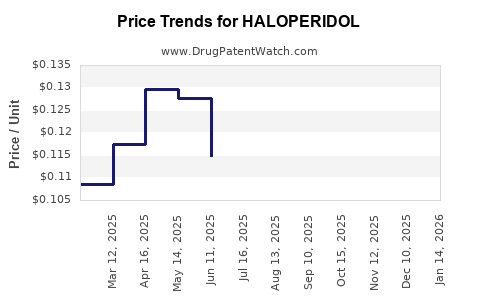
How do haloperidol prices evolve over time? What drives generic price erosion?
For mature generics, the financial trajectory is shaped less by innovation and more by pricing mechanics:
- AWP to net price decay: list price remains sticky relative to net prices; net discounts expand as competition intensifies.
- Manufacturer churn and supply: procurement economics and manufacturing reliability affect who wins contracts. A stable, low-cost supplier gains sustained volume.
- Channel mix: hospital formularies often switch to the lowest-cost SKU within therapeutic interchange frameworks, with limited clinical differentiation.
Typical market outcomes for generics like haloperidol
- Margin compression for manufacturers without strong cost advantages.
- Short-lived pricing rebounds when supply tightness occurs, then normalization after capacity returns.
- SKU rationalization: fewer NDCs dominate when payers streamline formularies.
Business implication: revenue tends to track unit demand, with net price as the main downside risk. Expect relative stability in units, persistent decline in net realization as competitive intensity stays high.
Who competes in haloperidol? Which companies win market share?
Haloperidol is widely distributed as generics across major US distributors, with numerous manufacturers covering tablets, oral solutions, and injections. Market share generally consolidates among suppliers with:
- reliable manufacturing for all covered strengths,
- competitive hospital group purchasing organization (GPO) pricing,
- large-scale distribution and fast NDC replenishment.
Competitive structure: generics-led and contract-driven
- Hospital procurement: procurement officers choose based on GPO price, logistics, and bid outcomes.
- Retail pharmacy substitution: generic A-rated products win quickly when reimbursement favors lower net cost.
- Institutional tenders: injection products can see more concentrated winners due to service-level requirements and lot availability.
Business implication: financial returns concentrate in manufacturers with robust cost position and stable supply across injection plus oral strengths.
Haloperidol financial trajectory: What do revenue and profitability trends look like?
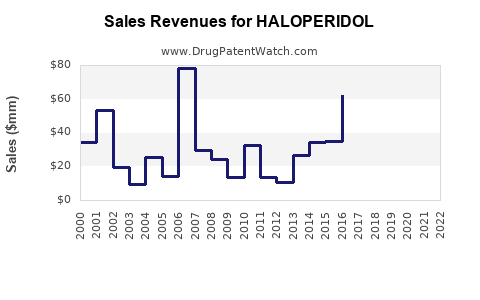
Revenue: units steady, dollars pressured
A mature generic’s revenue profile usually shows:
- stable or slowly growing units, linked to demographics and institutional usage,
- falling or flat net price, tied to competitive contracting and PBM/GPO pressure.
Profitability: depends on manufacturing cost, procurement wins, and supply
Profit drivers include:
- manufacturing yield and batch consistency,
- procurement contract duration,
- ability to hold shelf/NDC availability during supply disruptions,
- minimizing specialty customer service and handling costs for injectables.
Business implication: overall industry profitability for haloperidol is structurally capped by price compression, with episodic gains for firms that secure lower-cost manufacturing and win large procurement cycles.
What is the Orange Book status of haloperidol? When does exclusivity end?
Haloperidol is a legacy product that is not typically associated with active, blocking regulatory exclusivities in the US for current multi-source formulations. In practical terms, the US market functions as a mature generic environment: new entrants do not face meaningful regulatory exclusivity for haloperidol itself, and competition is mainly driven by manufacturing capability and commercial contracting rather than patent-driven timing.
Patents vs regulatory exclusivity: the operative barrier is usually absent
For market access and pricing, the limiting factors for haloperidol generally become:
- generic equivalence approvals,
- supply continuity,
- contract award decisions,
- occasional litigation around specific formulation-specific or manufacturing-specific patents, but those are usually not strong enough to materially shift broader market timing.
Business implication: for financial trajectory planning, treat haloperidol as an exclusivity-light asset with low monopoly rent.
What patents protect haloperidol? How strong is the patent estate?
For a long-discontinued active substance like haloperidol, the main actionable patent estate issues, if any, tend to be:
- formulation-specific (e.g., specific concentration stability/performance improvements),
- manufacturing-process (e.g., controlled-release or sterile manufacture refinements),
- method-of-use only if tied to a later specific regimen and jurisdiction.
In most scenarios, these patents do not materially block multiple generic entrants because the molecule is widely known and already off any long-running blocking term.
How to think about IP risk for haloperidol commercialization
- IP risk is most relevant when a company targets a differentiated presentation (specific injection presentation, packaging format, or stability-optimized product).
- For conventional tablets and standard injections, the practical barrier tends to be low because multiple ANDA products already exist.
Business implication: financial modeling should treat generic entry risk as ongoing and structurally high, not a one-time event.
What generic entry risks exist for haloperidol? Are Paragraph IV challenges likely?
Paragraph IV challenges are not a recurring market-shaping event for haloperidol’s molecule-level exclusivity because the drug is already generic and mature. Instead, entry risks manifest via:
- new ANDAs for specific NDC presentations,
- replacement of incumbent suppliers in contracts,
- occasional disputes tied to formulation or device/packaging differences.
Business implication: market entry friction is mainly commercial and manufacturing, not a patent fight that delays generic penetration.
Haloperidol formulations and delivery systems: Do injections and tablets trade differently?
Injection vs oral: different pricing and contracting behavior
- Injection tends to have tighter supply and higher service-level requirements; outages can cause short spikes in effective pricing when hospital contracts scramble for supply.
- Oral tends to be more interchangeable and sees faster price matching across pharmacy channels.
Stability, sterility, and manufacturing: cost structure differences
- Sterile injectable manufacturing adds cost complexity, and that can temporarily support higher margins for suppliers with proven sterile capacity.
- Oral solid dose is simpler and often sees faster commoditization.
Business implication: if assessing financial upside by category, injection can be a relative margin pocket during supply constraints, while oral is usually more consistently price-compressed.
Litigation and settlements: What patent cases affect haloperidol markets?
Haloperidol’s market is generally characterized by broad multi-source competition rather than a single, ongoing monopoly protected by litigation. Where litigation exists, it tends to be presentation-specific and does not typically pause supply at scale across all NDCs.
Business implication: treat litigation as idiosyncratic and NDC-specific, not as a whole-molecule exclusivity driver.
FDA regulatory pathway dynamics: How do ANDAs shape the competitive cycle?
New competition for haloperidol primarily arrives through ANDA filings covering existing approved strengths and dosage forms. The cycle typically looks like:
- incremental ANDA approvals add NDCs and reduce net price,
- formulary formularies open to additional suppliers,
- contract bids shift toward lowest net-cost suppliers.
Substitution and switching behavior
- Hospitals and PBMs often standardize on a short list of suppliers.
- Retail pharmacies use automatic substitution when therapeutically equivalent products are available at lower net costs.
Business implication: expect continued competitive layering, with market share moving to suppliers with the lowest delivered cost and highest reliability.
Comparative dynamics: How does haloperidol compare with other antipsychotics in financial exposure?
Compared with newer branded antipsychotics, haloperidol has:
- far lower revenue per unit due to commoditization,
- higher sensitivity to unit volume and contract pricing,
- lower dependence on clinical differentiation and greater dependence on cost competitiveness.
When set against second-generation antipsychotics:
- atypicals can have higher unit price but are also subject to their own patent gradients, which can create short windows of pricing power.
- haloperidol behaves like a consistently discounted class member, with competition more tied to procurement than patent calendars.
Business implication: haloperidol is a cost-volume business, not an innovation pipeline business.
Market scenarios and revenue sensitivity: What happens under different competition/supply conditions?
Scenario A: steady competitive intensity (base case)
- Units stable across inpatient and outpatient channels.
- Net prices continue downward slowly.
- Revenue grows modestly or flattens, driven mostly by volume.
Scenario B: supply disruption for sterile injectables (upside)
- Short-term effective pricing improves for available SKUs.
- Hospital customers switch among suppliers to secure supply; contracts may temporarily widen.
- Manufacturer with stable supply sees margin uplift.
Scenario C: contract repricing (downside)
- PBM/GPO bids reduce net price sharply.
- Incumbent margin compresses even if units hold.
- Revenue can decline if net price fall exceeds unit stability.
Business implication: financial trajectory is most sensitive to procurement contracting cycles and injectables supply stability.
Geographic and payer exposure: Is haloperidol’s trajectory uniform?
- In countries where generics penetration is high and tender-based purchasing is common, price compression is faster.
- In hospital-heavy systems with centralized procurement, supplier contracts dominate.
Business implication: market dynamics are more uniform across geographies with tender-led purchasing and mature generic regulatory regimes.
Key takeaways
- Haloperidol’s financial trajectory is dominated by generic market mechanics: unit demand stability and persistent net price erosion.
- Injectable presentations can offer short-term margin relief during supply constraints, but the base business remains procurement-driven and competitive.
- IP and exclusivity barriers are not a primary timing driver; market entry and share gains come from cost, supply reliability, and contracting.
- Revenue sensitivity concentrates in net pricing (PBM/GPO dynamics) and supply continuity for steriles.
FAQs
1) Why does haloperidol injection pricing fluctuate more than oral tablets?
Injectables are more constrained by sterile manufacturing capacity and supply reliability, so hospital procurement swings can create short-term pricing and margin volatility.
2) What contracting dynamics matter most for haloperidol sales in hospitals?
GPO and group purchasing tenders, bid cycles, and NDC availability drive which suppliers hold formularies and receive consistent purchase orders.
3) How does PBM strategy affect haloperidol net price?
PBMs steer utilization to lowest net-cost equivalents, accelerating price compression for multi-source generics when additional suppliers bid in.
4) Are haloperidol biosimilar dynamics relevant?
No. Haloperidol is a small-molecule drug, not a biologic, so biosimilar frameworks do not apply.
5) What business risks are most material for haloperidol manufacturers?
Manufacturing cost position, sterile supply continuity, and the ability to win and retain long-term institutional contracts at sustainable net prices.
References
- FDA. “ANDA (Abbreviated New Drug Application).” U.S. Food and Drug Administration.
- FDA. “Orange Book: Approved Drug Products with Therapeutic Equivalence Evaluations.” U.S. Food and Drug Administration.