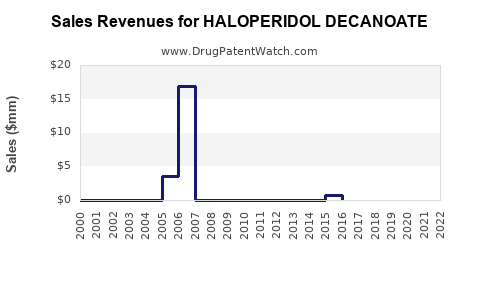
Last updated: July 30, 2026
Haloperidol decanoate is a long-acting injectable (LAI) antipsychotic with exposure primarily in chronic schizophrenia and related psychotic disorders. The commercial trajectory is shaped less by patent exclusivity and more by generic penetration, supply reliability for an injectable sterile product, and payer pressure on low-cost maintenance therapy.
How big is the haloperidol decanoate market and what drives demand?
Answer: Demand tracks chronic schizophrenia prevalence, relapse prevention needs, and adherence barriers that favor LAIs over oral dosing. In practice, growth is constrained by mature status and strong generic competition, with revenue largely influenced by unit price erosion and intermittent supply disruptions that affect short-term fill rates.
Primary demand drivers
- Chronic schizophrenia and long-term psychosis management where monthly LAI dosing is clinically preferred.
- Conversion from oral haloperidol to LAI for adherence issues, homelessness-related follow-up gaps, and institutional care continuity.
- Formulary coverage of generics and substitution policies that limit branded share.
Key demand constraints
- Competitive LAIs (including other first- and second-generation LAIs) that may shift patients even when haloperidol decanoate is cost-advantaged.
- Safety and tolerability considerations that affect persistence, especially extrapyramidal symptoms (EPS) and QT prolongation risk management in real-world care.
- Sterile injectable supply chain fragility: any manufacturing downtime can temporarily create revenue volatility without changing underlying demand.
How is haloperidol decanoate priced in the US and what is the impact on revenue?
Answer: Revenue is highly sensitive to ASP decline because the product is typically dispensed as generic haloperidol decanoate, with pricing pulled down through pharmacy and payer switching.
Pricing and reimbursement mechanics
- Generic LAIs tend to see ASP compression after new entrants and during periods of competitive tendering.
- Medicaid and institutional procurement can drive the lowest-bid dynamics, which pressures manufacturer margin even when prescriptions remain stable.
- Patient out-of-pocket costs can be less relevant than payer tier placement because most use is in settings with managed coverage.
What moves financial results
- Wholesale acquisition cost (WAC) to ASP pass-through declines when additional suppliers win coverage.
- Mix shift between strength/concentration and vial size (depending on how patients are dosed and administered).
- Contracting for group purchasing organizations and state procurement.
What is the competitive landscape for haloperidol decanoate (who competes and why)?
Answer: The competitive set is dominated by generic haloperidol decanoate products plus alternative LAIs that may displace haloperidol decanoate on adherence, side effect profile, or formulary positioning.
Direct competitive substitutes
- Other LAI antipsychotics (second-generation LAIs are commonly favored in formularies due to perceived tolerability).
- Oral antipsychotics, where adherence support is available, can reduce LAI utilization.
- Hospital-administered substitution during shortages can shift share across LAI classes.
Commercial implications
- If formularies tighten toward newer LAIs, haloperidol decanoate faces share erosion even if generic pricing remains low.
- If payer focus is cost minimization for maintenance therapy, haloperidol decanoate retains relevance as a low-cost option.
What is the patent and exclusivity context for haloperidol decanoate that shapes the financial trajectory?
Answer: The long-run commercial outlook is structurally tied to generic availability and the limited role of active exclusivity. The drug’s core chemistry is old, and commercial outcomes are dominated by generic manufacturing capacity, supply continuity, and product-specific patent estates only where formulation, process, or device-related claims exist.
How exclusivity typically affects revenue for mature injectables
- Once core and formulation protection is exhausted, revenue shifts from “new product value” to “market share among generics,” with financial volatility tied to supply and contracting.
- LAI-specific process or formulation patents, if present, can delay direct generic substitution for certain strengths, presentations, or fill-finish processes, but the main market remains generic for haloperidol decanoate.
What generic entry risks exist for haloperidol decanoate and how do they impact forecasts?
Answer: The entry risk is less about “whether” generics can exist and more about whether additional manufacturers expand supply, undercut pricing, and win contracts. Financial forecasting should treat market share as contestable and ASP as a downward variable over time.
Risk factors
- Additional generic approvals can increase supply, raising competitive pressure on pricing and rebates.
- Regulatory inspections and sterile manufacturing compliance can reduce effective supply, temporarily improving pricing for remaining suppliers.
- Shortages can create temporary pricing power or backorder-driven revenue timing effects, followed by normalization when supply returns.
How does FDA status (approval pathway, labeling, and interchangeability) affect haloperidol decanoate sales?
Answer: Most financial impact comes from whether manufacturers maintain continuous supply and whether labeling supports broad substitution under state pharmacy and institutional protocols.
FDA-related commercial mechanisms
- Generic labeling that matches reference product pharmacokinetics and dosing supports interchangeability in practice.
- Sterile product manufacturing changes can trigger FDA scrutiny, causing supply interruption risk.
- Any label modifications affecting dose conversion, maintenance schedules, or warnings can influence utilization patterns and patient acceptance.
When does haloperidol decanoate lose exclusivity, and what does that mean for revenue?
Answer: For a mature molecule like haloperidol decanoate, exclusivity is already largely exhausted in the market, so “loss of exclusivity” primarily manifests as ongoing price erosion as additional generic suppliers enter and negotiate contracts.
Revenue meaning
- The financial trajectory follows generic lifecycle economics: stable-to-declining volumes are possible while ASP declines remain the dominant negative driver unless supply constraints offset pricing pressure.
- Upside typically comes from contracting wins and supply reliability, not from innovation.
How do supply and manufacturing events drive quarterly financial swings?
Answer: LAIs experience disproportionate revenue volatility from sterile manufacturing events because dosing schedules create “no substitute” timing windows for patient care.
Common swing drivers
- Batch failures, sterility assurance issues, or deviations that delay release.
- Capacity constraints in fill-finish or vial/stopper supply.
- Regulatory actions affecting one supplier can shift demand to competitors until they catch up, then prices normalize.
Forecast implications
- Treat reported revenue as a function of both demand stability and supply availability.
- Plan scenario modeling around shortage periods rather than expecting structural demand expansion.
What is the financial trajectory by channel: hospital, long-term care, and outpatient?
Answer: Haloperidol decanoate is used across institutional and outpatient settings, with channel mix influencing net price.
Hospital/institutional
- Procurement contracts and formulary decisions set volume; pricing is sensitive to tender cycles.
- Supply shortages in hospitals can shift administration to whichever supplier can deliver first.
Outpatient
- Prescription fills and pharmacy-level dynamics determine net pricing.
- Patient adherence support programs can support LAI persistence but also compete with other LAIs.
Long-term care
- LAI maintenance fits care models with scheduled administration.
- Net pricing depends on state procurement and managed care pharmacy policies.
What is the reimbursement risk profile for haloperidol decanoate?
Answer: Reimbursement risk is mainly payer-driven rather than clinical-policy driven. For generics, the dominant risk is formularies and preferred drug lists favoring competing LAIs or the lowest net-cost generic option.
Risk points
- Utilization management policies: prior authorization can be triggered when plan preferences shift.
- Step therapy toward preferred LAIs or oral agents.
- Rebate and contract terms that compress net price even when WAC holds.
How does haloperidol decanoate compare commercially with other LAI antipsychotics?
Answer: Haloperidol decanoate typically competes on cost and formulary simplicity rather than on novel differentiation. Second-generation LAIs often have better commercial positioning due to tolerability perceptions and formulary preference.
Commercial comparison framework
- Price: haloperidol decanoate usually offers the lowest cost per month in generic form.
- Clinical perception: side effect profile influences switching behavior.
- Formulary status: preferred positioning for second-generation LAIs can reduce share even when clinical equivalence exists.
- Supply reliability: a single supplier’s disruption can transfer usage quickly to others.
Key business implications for licensing, investing, or litigation involving haloperidol decanoate
Answer: The investment and licensing thesis for haloperidol decanoate is tied to manufacturing scale, regulatory compliance, and contract execution. IP-driven upside is typically limited to narrow product lifecycle claims (process, formulation, or presentation) rather than broad method-of-use dominance.
Actionable implications
- Evaluate site qualification status and sterile manufacturing robustness as the primary risk variable.
- Price and contract strategy matters more than innovation strategy.
- Competitive entry is best modeled as pricing pressure coupled with supply rebalancing rather than as a one-time market shock.
Key Takeaways
- Haloperidol decanoate revenue trajectory is dominated by generic competition, ASP compression, and institutional contracting, not by ongoing exclusivity-driven growth.
- Short-term financial swings are driven by sterile injectable supply continuity and release stability.
- The biggest structural risk is formulary and payer preference for alternative LAIs, which can shift share even when haloperidol decanoate stays cost-advantaged.
- The highest-leverage business factors are manufacturing reliability and contracting execution, not new IP creation.
FAQs
- Does haloperidol decanoate have biosimilar-style substitution dynamics or is it purely generic replacement?
- How do hospital tender cycles affect net revenue for generic haloperidol decanoate?
- What supply chain bottlenecks most often impact long-acting injectable sterile products like haloperidol decanoate?
- Which competitor LAIs most commonly displace haloperidol decanoate in payer formularies?
- How should net price be forecast for haloperidol decanoate when new generic suppliers enter?
References
- FDA Orange Book. Haloperidol decanoate drug products. U.S. Food and Drug Administration.
- FDA Drug Shortages Database. Haloperidol decanoate (and related LAI antipsychotics). U.S. Food and Drug Administration.
- DrugPatentWatch / Generic drug market research summaries (generic competition and LAI dynamics).