Last updated: August 9, 2026
Gabapentin is a mature, multisource generic drug with substantial prescription volume but limited branded pricing power. Pfizer’s Neurontin franchise generated billions of dollars before generic entry, while current value is concentrated in high-volume, low-price generic sales and differentiated formulations such as Gralise and Horizant. The core gabapentin molecule has no meaningful U.S. patent barrier to generic competition. Commercial upside is primarily linked to volume, manufacturing efficiency, formulation differentiation, and regulatory compliance.
What is gabapentin and how is it used?
Gabapentin is an oral gamma-aminobutyric acid analogue approved by the U.S. Food and Drug Administration for postherpetic neuralgia and as adjunctive therapy for partial-onset seizures. It is marketed in immediate-release capsules, tablets, and oral solution. The original branded product was Neurontin, developed by Parke-Davis and later commercialized by Warner-Lambert and Pfizer.
Gabapentin is also widely prescribed off label for conditions including:
- Diabetic peripheral neuropathy
- Radicular and other neuropathic pain
- Fibromyalgia
- Anxiety-related disorders
- Insomnia
- Migraine-associated symptoms
- Alcohol and substance-use-related symptoms
Off-label utilization expanded the addressable market beyond FDA-approved indications. That expansion also created legal and regulatory exposure for the originator, particularly concerning promotion for unapproved pain indications.
How large is the gabapentin market?
The gabapentin market is large by prescription volume and modest by branded revenue. Generic products dominate U.S. dispensing, while the branded franchise has largely disappeared from routine commercial use.
U.S. prescription volume has remained high because gabapentin is inexpensive, familiar to clinicians, available in multiple strengths, and used across several therapeutic settings. IQVIA and other commercial datasets generally rank gabapentin among the most frequently dispensed prescription medicines in the United States, although the precise annual count varies by source, product definition, and inclusion of mail-order and institutional claims.
The market has four economic segments:
| Segment |
Main products |
Commercial profile |
| Immediate-release generic gabapentin |
Capsules, tablets, oral solution |
High volume, low unit price, fragmented suppliers |
| Neurontin |
Brand gabapentin |
Historical franchise; limited current pricing power |
| Gralise |
Extended-release gabapentin |
Protected formulation and once-daily positioning |
| Horizant |
Gabapentin enacarbil |
Prodrug with separate formulation, indication, and patent estate |
The generic segment captures most unit demand. Gralise and Horizant retain higher revenue per prescription but compete against broad generic availability and, in Horizant’s case, other treatments for restless legs syndrome and postherpetic neuralgia.
What was gabapentin’s financial trajectory?
Pfizer’s Neurontin revenue followed the standard small-molecule lifecycle: rapid expansion, peak sales before generic competition, and sharp erosion after loss of exclusivity.
Neurontin revenue before generic entry
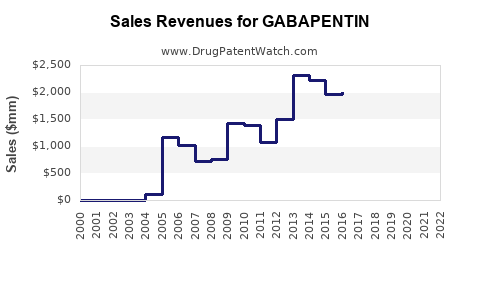
Neurontin became a major Pfizer product during the late 1990s and early 2000s. Pfizer reported Neurontin revenue of approximately $2.7 billion in 2003, shortly before generic competition materially affected the U.S. business [1]. The product’s growth reflected:
- Expansion from epilepsy into neuropathic pain
- Broad physician adoption
- Increasing off-label prescribing
- Multiple strengths and dosage forms
- Limited competition from similarly positioned products before pregabalin’s launch
Pfizer’s financial exposure was concentrated in U.S. sales, where the product had achieved substantial prescribing momentum.
Generic erosion after 2004
Generic gabapentin entered the U.S. market after patent litigation and regulatory review. Once multiple generic manufacturers obtained approval, reimbursement pressure reduced branded Neurontin sales and shifted value to manufacturers with low-cost supply.
The decline was driven by several factors:
- Pharmacy substitution converted prescriptions from brand to generic.
- Payers reduced reimbursement for Neurontin.
- Generic manufacturers competed on price.
- Physicians had little clinical reason to preserve brand use for immediate-release gabapentin.
- The core molecule lacked a durable formulation or delivery-system barrier.
Revenue did not disappear from the therapeutic category. It moved from Pfizer to generic manufacturers, wholesalers, pharmacies, and payers. The market therefore experienced a transfer of economic value rather than a collapse in clinical demand.
Current financial profile
The mature gabapentin market produces recurring revenue through high prescription volume, but the economics are structurally different from those of a branded specialty drug. Generic manufacturers compete through:
- Manufacturing scale
- API sourcing
- Contract manufacturing
- FDA compliance
- Supply reliability
- State and payer formulary access
- Ability to sustain low prices during shortages
Unit margins are generally lower than branded-drug margins. Market share can still be valuable because gabapentin has persistent demand and relatively simple oral dosage forms.
When did gabapentin lose exclusivity?
The original U.S. patent covering gabapentin, U.S. Patent No. 4,024,175, expired in 2000. Later litigation involving use patents delayed or complicated generic commercialization, but it did not create permanent protection for the core compound.
The key exclusivity timeline is:
| Event |
Approximate date |
Commercial effect |
| FDA approval of Neurontin |
1993 |
Originator launch |
| Core compound patent expiration |
2000 |
Core patent protection ended |
| Generic litigation and regulatory disputes |
Early 2000s |
Delayed or shaped market entry |
| Generic gabapentin approvals and launches |
2004 onward |
Rapid price and share erosion |
| Neurontin franchise maturity |
Mid-to-late 2000s |
Generic products became dominant |
| Gralise approval |
2011 |
Extended-release formulation entered |
| Horizant approval |
2011 |
Gabapentin prodrug entered separate market |
FDA exclusivity for the original product did not provide a long-term commercial barrier after the core patent expired. The main strategic value later shifted to formulation-specific products rather than immediate-release gabapentin.
What patents protect gabapentin?
The original gabapentin molecule is no longer protected in the United States by an enforceable blocking patent. The principal patent estate was associated with:
- The gabapentin compound
- Pharmaceutical compositions
- Approved uses
- Dosage and administration concepts
The core compound patent, U.S. Patent No. 4,024,175, expired in 2000. The originator later relied on method-of-use patents and litigation theories to manage generic entry. Those patents did not prevent eventual generic competition.
What formulations are protected by gabapentin patents?
The commercially relevant remaining patent value is associated with differentiated products, not conventional immediate-release gabapentin.
Gralise
Gralise is an extended-release gabapentin tablet developed for once-daily administration in postherpetic neuralgia. Its value proposition is based on modified release and dosing convenience. Patent protection has focused on the extended-release formulation, pharmacokinetic profile, and administration regimen.
Gralise competes with generic immediate-release gabapentin, which is generally less expensive and often dosed more frequently. The formulation may support a premium only where adherence, tolerability, or prescribing preference justifies the additional cost.
Horizant
Horizant contains gabapentin enacarbil, a prodrug designed to improve absorption and provide more predictable exposure. It is approved for moderate-to-severe primary restless legs syndrome and postherpetic neuralgia in adults.
Horizant has a separate product and patent strategy from generic gabapentin. Its protection has focused on the prodrug, formulation, pharmacokinetic characteristics, and approved uses. A generic gabapentin ANDA does not automatically establish substitutability for Horizant because the products contain different active entities and have different FDA approvals.
What is the Orange Book status of gabapentin?
The Orange Book lists FDA-approved prescription products and patents or exclusivities that may affect generic approval. Immediate-release gabapentin has long been subject to generic competition, and the original Neurontin patents no longer block approval of standard generic gabapentin products.
The principal Orange Book implications are:
- Immediate-release gabapentin is available from multiple ANDA holders.
- Core Neurontin patents have expired.
- Any remaining listed patents for differentiated products must be evaluated product by product.
- Gralise and Horizant should not be treated as interchangeable patent or regulatory targets for conventional gabapentin.
- Patent listings for extended-release or prodrug products may affect Paragraph IV timing even when immediate-release gabapentin is fully genericized.
An Orange Book listing does not itself establish infringement. Generic applicants can certify that a listed patent is invalid, unenforceable, or will not be infringed.
Which companies challenged Neurontin patents?
Generic applicants, including Teva and other manufacturers, pursued abbreviated new drug application pathways and challenged or navigated Neurontin-related patent claims. The most important U.S. litigation concerned Warner-Lambert’s efforts to enforce gabapentin method-of-use patents against generic entrants.
In Warner-Lambert Co. v. Apotex Corp., the Federal Circuit addressed infringement theories involving generic labeling and the relationship between approved indications and physician prescribing behavior [2]. The litigation illustrated the difficulty of using method-of-use patents to control a drug with extensive off-label prescribing.
Pfizer also faced major legal exposure over Neurontin promotion. In 2004, Warner-Lambert agreed to pay approximately $430 million to resolve criminal and civil allegations involving off-label promotion of Neurontin [3]. The resolution included allegations that the company promoted uses lacking adequate FDA approval support.
What Paragraph IV challenges and generic launch risks exist?
For standard immediate-release gabapentin, Paragraph IV risk is largely historical because the principal patents have expired. A new manufacturer entering this segment is more likely to face commercial than patent risk.
The main generic launch risks are:
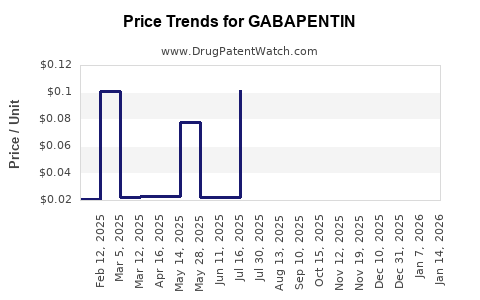
- Price compression after multiple approvals
- API supply interruption
- FDA manufacturing observations
- Product recalls
- Pharmacy benefit manager exclusion
- State substitution rules
- Contract-manufacturing dependence
- Low return on incremental capacity
For Gralise and Horizant, Paragraph IV risk is more material because formulation, prodrug, and method-of-use patents may remain relevant. A challenger would need to assess:
- The FDA’s listed patents.
- The proposed product’s formulation and release profile.
- The scope of the applicant’s Paragraph IV certification.
- Potential 30-month stays under the Hatch-Waxman Act.
- Whether a settlement could establish a licensed or deferred entry date.
- The originator’s ability to secure pediatric, regulatory, or additional-use exclusivity.
How strong is the gabapentin patent estate?
The patent estate is weak for immediate-release gabapentin and stronger, but commercially narrower, for differentiated products.
| Product |
Patent strength |
Generic substitution risk |
Revenue durability |
| Generic immediate-release gabapentin |
Low |
Already high |
Volume-driven |
| Neurontin immediate-release |
Very low |
Very high |
Minimal branded value |
| Gralise |
Moderate formulation protection |
Moderate to high |
Depends on premium retention |
| Horizant |
Moderate to strong relative to generic gabapentin |
Product-specific |
Depends on patent life and reimbursement |
Gabapentin’s core molecule has limited manufacturing complexity. The API is a small molecule with established commercial production, and conventional capsules and tablets do not require advanced delivery technology. Manufacturing barriers are therefore more important for quality and cost control than for exclusivity.
The primary manufacturing risks involve:
- API sourcing concentration
- Impurity control
- Consistency across dosage strengths
- Dissolution and release specifications
- FDA inspection outcomes
- Inventory management during low-margin competition
How does gabapentin compare with pregabalin?
Pregabalin, marketed as Lyrica, is the closest major branded comparator. Both drugs are used for neuropathic pain and seizure-related conditions, but pregabalin was developed as a later-generation molecule with more predictable pharmacokinetics and broader branded positioning.
| Attribute |
Gabapentin |
Pregabalin |
| Original brand |
Neurontin |
Lyrica |
| Core U.S. patent status |
Expired |
Core exclusivity expired; generic competition established |
| Pharmacokinetic predictability |
Lower, dose-dependent absorption |
More predictable |
| Generic availability |
Extensive |
Extensive |
| Main commercial position |
Low-cost volume product |
Former premium branded product, now largely generic |
| Controlled-substance status in U.S. |
Not federally scheduled |
Schedule V |
| Differentiated products |
Gralise, Horizant |
Lyrica CR and other formulation strategies |
Pregabalin generated a later branded revenue cycle for Pfizer, but it also ultimately faced generic entry. Gabapentin remains cheaper and more widely used in many routine prescribing settings. Pregabalin may retain preference where predictable exposure, dosing convenience, or clinical response supports its use.
Is there biosimilar risk for gabapentin?
No biosimilar risk applies to conventional gabapentin. Gabapentin is a chemically synthesized small molecule, not a biologic. Competition proceeds through the FDA’s ANDA pathway for pharmaceutically equivalent generic products.
The relevant competitive threats are:
- Additional ANDA approvals
- Generic price competition
- Authorized generic strategies
- Formulation-specific copies
- Therapeutic substitution with pregabalin
- Nonprescription or compounded alternatives in limited settings
Biosimilar development is therefore not part of the gabapentin investment case.
What licensing deals affect gabapentin?
The principal commercial rights history involves corporate transactions rather than current high-value licensing:
- Parke-Davis developed and marketed Neurontin.
- Warner-Lambert acquired and commercialized the product.
- Pfizer acquired Warner-Lambert in 2000.
- Depomed developed and commercialized Gralise.
- XenoPort developed gabapentin enacarbil, later commercialized as Horizant through partnerships and corporate ownership changes.
For immediate-release gabapentin, licensing value is low because the product is generic and widely available. Licensing economics are more relevant to extended-release delivery systems, prodrugs, branded combinations, and regional distribution rights.
What is the competitive landscape for gabapentin?
The immediate-release market is highly competitive. Leading generic suppliers have included large multinational and specialty generic companies such as Teva, Sandoz, Viatris, Zydus, Sun Pharma, Dr. Reddy’s, and numerous other FDA-approved manufacturers over time.
Competition is shaped by:
- Number of approved ANDAs
- Wholesale acquisition price
- Reimbursement contracts
- Supply reliability
- Manufacturing site history
- Retail and mail-order distribution
- Hospital and institutional purchasing
The product is relatively resistant to sudden clinical obsolescence because it is inexpensive and familiar. Its main threats are price erosion, safety scrutiny, prescribing restrictions, and substitution by pregabalin or newer neuropathic-pain therapies.
What generic entry scenarios exist?
Immediate-release gabapentin
Generic entry is already established. Future entrants are unlikely to cause a major clinical shift but can intensify price erosion and reduce the profitability of smaller suppliers. Manufacturers with efficient API sourcing and reliable FDA compliance have the strongest position.
Gralise
A generic extended-release challenge could produce a sharp price decline if the challenger secures FDA approval and survives patent litigation. The market may still preserve some branded share through physician familiarity and differentiated dosing.
Horizant
Generic entry depends on the product-specific patent estate, regulatory pathway, and the challenger’s ability to reproduce the prodrug formulation. Risk is more technical than for conventional gabapentin, but approval would likely pressure price and market share.
What is gabapentin’s geographic patent coverage?
The core gabapentin patent estate has expired in the United States and other major markets. Geographic differences now arise primarily from:
- National regulatory approval requirements
- Formulation-specific patents
- Local data or market exclusivity
- Manufacturing registrations
- Pricing controls
- Reimbursement systems
- Import and API regulations
The United States is the largest commercial market by prescription volume and has the most developed ANDA framework. Europe, Canada, Japan, and emerging markets have their own generic approval and substitution rules. Patent risk is generally low for standard gabapentin but can remain relevant for branded extended-release products in individual jurisdictions.
Key Takeaways
- Gabapentin is a high-volume, low-price generic market.
- Pfizer’s Neurontin revenue peaked at roughly $2.7 billion before generic erosion.
- The core gabapentin patent, U.S. Patent No. 4,024,175, expired in 2000.
- Generic competition became commercially significant in the United States from 2004 onward.
- Immediate-release gabapentin has minimal remaining patent protection.
- Gralise and Horizant rely on separate formulation, prodrug, and method-of-use strategies.
- Paragraph IV risk is largely historical for conventional gabapentin but remains relevant for differentiated products.
- No biosimilar pathway applies because gabapentin is a synthetic small molecule.
- Current value is driven by prescription volume, manufacturing cost, supply reliability, and regulatory compliance.
- Branded upside is limited unless a company controls a differentiated formulation or delivery technology.
FAQs
Does gabapentin still have market exclusivity?
Conventional immediate-release gabapentin has no meaningful U.S. market exclusivity. Generic products have been available for many years.
Can a generic manufacturer launch gabapentin without challenging a patent?
Yes. For standard immediate-release gabapentin, the key compound patent expired long ago. A manufacturer must still satisfy FDA approval, bioequivalence, labeling, and manufacturing requirements.
Is Gralise the same as generic gabapentin?
No. Gralise is an extended-release gabapentin formulation with different release characteristics and dosing. Generic immediate-release gabapentin is not automatically substitutable for Gralise.
Why is gabapentin financially attractive despite low prices?
The drug has persistent demand, broad prescribing, low manufacturing complexity, and high dispensing volume. Profit depends on scale, supply reliability, and operating efficiency rather than premium pricing.
Could gabapentin be removed from formularies because of misuse concerns?
Formulary restrictions are possible in specific plans or jurisdictions, but broad removal would be difficult because gabapentin is inexpensive, FDA approved for epilepsy and postherpetic neuralgia, and widely used in clinical practice.
References
-
Pfizer Inc. (2004). 2003 annual report. Pfizer Inc.
-
Warner-Lambert Co. v. Apotex Corp., 316 F.3d 1348 (Fed. Cir. 2003).
-
U.S. Department of Justice. (2004). Warner-Lambert agrees to pay $430 million to resolve criminal and civil health care liability relating to off-label promotion of Neurontin. U.S. Department of Justice.
-
U.S. Food and Drug Administration. (1993). Neurontin (gabapentin) prescribing information. FDA.
-
U.S. Food and Drug Administration. (2024). Approved drug products with therapeutic equivalence evaluations: Orange Book. FDA.
-
U.S. Food and Drug Administration. (2011). Gralise (gabapentin) prescribing information. FDA.
-
U.S. Food and Drug Administration. (2011). Horizant (gabapentin enacarbil) prescribing information. FDA.
-
U.S. Patent No. 4,024,175. (1977). 1-Aminomethylcyclohexaneacetic acid. U.S. Patent and Trademark Office.