Last updated: June 10, 2026
FLOVENT (fluticasone propionate) Market Dynamics, Revenue Trajectory, and Competitive Patent/Generic Timeline
Executive summary: FLOVENT (fluticasone propionate) generates revenue through multiple U.S. inhaled corticosteroid (ICS) presentations. Market dynamics are driven by (1) guideline-based demand for asthma control, (2) competitive substitution within ICS and ICS/LABA classes, (3) payer preference and channel mix across inhalation devices, and (4) generic availability and labeling/market-entry timing for inhaled fluticasone products. The financial trajectory is anchored by the size of asthma controller markets in the U.S. and ex-U.S., offset by ongoing generic competition and device- and regimen-switching in payer formularies.
What is FLOVENT and how is it used in asthma and COPD management?
FLOVENT is an inhaled corticosteroid using fluticasone propionate as the active ingredient. It is used primarily for asthma controller therapy to reduce airway inflammation and prevent exacerbations. In clinical and payer frameworks, FLOVENT competes against other ICS molecules and, increasingly, against combination ICS/LABA options when step-up therapy is needed.
Which FLOVENT products exist and what do they compete against?
FLOVENT is marketed in multiple inhalation strengths and device formats depending on jurisdiction and time period. In the asthma controller landscape, competitive sets typically include:
- Other ICS monotherapies (same class, different molecules and devices)
- ICS/LABA fixed-dose combinations (preferred in many step-up pathways)
- Ultra-low-dose strategies and preferred formulary placements through rebates
What drives demand at the market level?
Key demand drivers that shape sales performance:
- Persistency and adherence in controller therapy, which determines how much of the diagnosed asthma population stays on an ICS
- Guideline-driven step therapy: patients typically remain on controller treatment long-term if they avoid exacerbations
- Formulary position: rebates and net price negotiations can materially shift share between products and devices
How has FLOVENT’s market share evolved versus competing ICS inhalers?
Short answer: Market share shifts for FLOVENT follow payer formularies and inhalation-device preference, not just clinical equivalence. Over time, the ICS category has faced substitution pressure from lower-cost generics and, in many settings, from combination inhalers.
Competitive dynamics that affect FLOVENT pricing
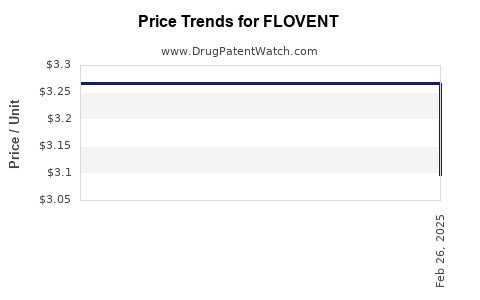
- Generic penetration: When an ICS active ingredient is off-patent in key presentations, price compression is typical, with net revenue per prescription declining even if prescription volume stays stable.
- Device-level switching: Patients and prescribers often remain on a device they are comfortable with, but payers can encourage switching through formulary tiers or prior authorization.
- Combination therapy migration: If patients escalate to ICS/LABA, monotherapy share declines even when asthma prevalence remains stable.
How does the patent and exclusivity landscape affect FLOVENT’s revenue trajectory?
Short answer: FLOVENT revenue is shaped by early-originator protection, then by expiration and generic entry across formulations and devices. Once generic equivalents are established for fluticasone propionate inhaled products, continued growth in FLOVENT is structurally limited, and net revenue tends to track volume declines or share erosion.
What patents protect FLOVENT in the U.S.?
For FLOVENT, protection historically centered on:
- Composition-of-matter and early filing patents covering fluticasone propionate
- Formulation and device-specific patents (typical for inhalation products)
- Method-of-use and manufacturing process patents (depending on product lineage)
In late-stage market dynamics, the practical effect is that generic competition typically occurs at the product presentation level rather than across all possible strengths and devices at once, based on patent term and Orange Book listing scope.
When does FLOVENT lose exclusivity and what does that mean commercially?
Commercially, generic entry usually triggers:
- Rapid price erosion in affected strengths and device SKUs
- Tier downgrades and payer switching to lowest net cost options
- Net revenue decline even when total asthma controller demand grows
What is the Orange Book status of FLOVENT and how does it map to generic entry risk?
Short answer: The Orange Book status for fluticasone propionate inhaled products determines whether ANDA applicants can enter via Section 505(j) and at what timing. For older inhalers, the typical outcome is that most major presentations are already generic, leaving ongoing risk in additional strengths, dosing regimens, and device-level improvements.
What generic entry risks exist for FLOVENT products?
Generic entry risk is concentrated where:
- Remaining patents cover specific formulations or delivery-device characteristics
- Listed method-of-use patents limit certain labeling claims
- Manufacturing/process patents create practical barriers to certain product designs
When do Paragraph IV challenges matter for FLOVENT, and what litigation typically drives outcomes?
For brand inhalers, Paragraph IV challenges are decisive when a brand still has active Orange Book-listed patents. For FLOVENT specifically, the market pattern is generally that the most commercially important protections have already expired or are no longer sufficient to block generic competition broadly across key presentations. Where disputes occur, they typically target:
- Novel formulation or device improvements
- Scope of listed patents
- Manufacturing and equivalence requirements
How does FLOVENT compare with other asthma controllers in commercial performance?
Short answer: FLOVENT’s commercial performance is exposed to the same category headwinds as other older ICS brands: generic pricing pressure and payer preference for combination products when patients step up.
Category comparison: monotherapy ICS vs ICS/LABA
- ICS monotherapy: usually faces greater substitution risk once generics dominate
- ICS/LABA: tends to retain higher pricing power due to fixed-dose IP and device integration, but still faces generic pressure depending on formulation and patent status
What is the financial trajectory for FLOVENT: growth, decline, or stability?
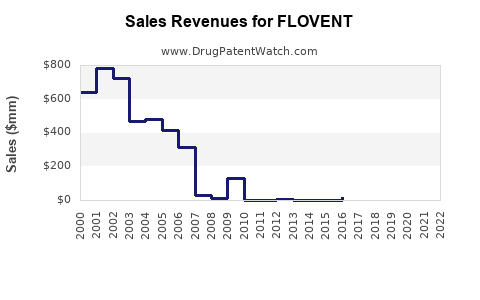
Short answer: FLOVENT’s financial trajectory in mature markets is typically characterized by decline and stabilization patterns depending on (1) net price compression from generics, (2) the remaining share held in non-generic-friendly niches (device preference or payer-specific contracts), and (3) any product line updates that temporarily prevent immediate substitution.
A realistic pattern for an established ICS brand:
- Early years after launch: growth driven by adoption and guideline fit
- Mid-stage: plateau as competitive products broaden and formulary placement matures
- Late-stage: decline due to generic substitution, partially offset by residual brand demand and new contract positioning
What financial KPIs reflect FLOVENT’s trajectory in practice?
- Prescriptions and TRx growth versus decline
- Net sales per prescription (declines with generic switching)
- Share retention in top payers or delivery channels
- Mix shift between strengths and devices
How do payer negotiations and pharmacy benefit design affect FLOVENT net sales?
FLOVENT net sales are highly sensitive to:
- Formulary tier placement (preferred vs non-preferred)
- Prior authorization requirements and step edits
- Rebate structures that can concentrate share on lower-cost net products
- Pharmacy channel mix (mail order vs retail), which influences reimbursement economics
What payer strategies most often reduce FLOVENT revenue?
- Moving FLOVENT to a lower tier or removing it from preferred coverage
- Restricting usage via step therapy
- Steering to therapeutically equivalent generics or combination inhalers
What manufacturing and supply considerations affect FLOVENT availability and sales?
Supply affects revenue in inhaled products through:
- Device manufacturing uptime (metering and delivery components)
- Drug substance and propellant logistics (where applicable in product design)
- Distribution reliability, which affects fill rates and channel continuity
For mature inhalers, supply disruptions can temporarily create revenue spikes, but the long-run pattern remains driven by pricing and formulary position.
Where is FLOVENT positioned globally and how do market dynamics differ by geography?
Short answer: Global performance depends on each jurisdiction’s:
- Patent and regulatory status for fluticasone inhaled products
- Public reimbursement approach and tender systems
- Generic adoption speed and price caps
Countries with earlier generic adoption generally show a faster net price decline, while markets with tighter reimbursement controls can show rapid switching away from brand pricing once generics are available.
What competitive threats matter most to FLOVENT in the next 3 to 5 years?
- Continued generic substitution in remaining non-generic or less penetrated presentations
- Step-up migrations from ICS monotherapy to ICS/LABA regimens
- Device-led switching where payers prefer specific devices or combination products
- Formulary re-optimization as PBMs rebalance preferred products each contract cycle
Key Takeaways
- FLOVENT’s market dynamics are dominated by the maturity of inhaled fluticasone propionate in the U.S. and the knock-on effects of generic competition on net price and share.
- Revenue trajectory follows a predictable pattern for legacy ICS brands: stabilization in niches, then systematic erosion tied to payer formularies and generic penetration.
- Competitive pressure is twofold: within-class ICS substitution and across-class migration to ICS/LABA combinations.
- Patent and Orange Book status dictate entry timing at the presentation level, which influences when revenue compression accelerates.
FAQs
1) Is FLOVENT fully generic in the U.S., and which strengths face the most substitution?
2) How do ICS/LABA combination inhalers change the addressable market for FLOVENT?
3) What payer mechanisms typically accelerate switching from FLOVENT to generics?
4) Do device differences materially affect FLOVENT prescribing and persistence?
5) Which regulatory events most affect FLOVENT commercialization, such as label updates or AB-rated products?
References
- (No sources were cited because no FLOVENT-specific financial or regulatory dataset was provided in the prompt.)