Last updated: August 17, 2026
Deferasirox has shifted from a high-value branded iron-chelation franchise to a largely generic, price-sensitive market. Novartis commercialized Exjade and Jadenu for transfusional iron overload, generating roughly $1 billion in annual sales at peak. Revenue declined as patients migrated from Exjade to Jadenu, competing oral chelators gained share, and generic deferasirox entered major markets. The long-term market remains clinically necessary but financially constrained by small patient populations, monitoring requirements, generic substitution, and limited payer tolerance for premium pricing.
What is deferasirox and which patients use it?
Deferasirox is an oral iron chelator that binds excess iron and promotes its elimination through the feces. It is used primarily in patients with chronic transfusion-related iron overload, including individuals with beta thalassemia, myelodysplastic syndromes, sickle cell disease, and other transfusion-dependent anemias.
The main branded products were:
| Product |
Formulation |
Commercial role |
| Exjade |
Dispersible tablets for oral suspension |
Original Novartis product |
| Jadenu |
Film-coated tablets |
Lower-burden successor formulation |
| Jadenu Sprinkle |
Oral granules |
Pediatric and administration-flexibility product |
| Generic deferasirox |
Tablets and, in some markets, other oral presentations |
Current volume competitor |
The clinical value proposition is oral administration. Deferoxamine, an established chelator, generally requires parenteral administration and has a higher administration burden. Deferiprone is an oral competitor but has different safety monitoring requirements and regulatory positioning.
How large is the deferasirox market?
The global market is fragmented and is not reported consistently as a standalone category by manufacturers. The branded market was substantially larger before generic erosion than it is today.
The principal demand drivers are:
- Growth in transfusion-dependent thalassemia and sickle cell disease populations.
- Increased survival among patients receiving chronic transfusions.
- Greater recognition and monitoring of transfusional iron overload.
- Preference for oral therapy over infusion-based chelation.
- Continued use in countries where branded or authorized generic products retain reimbursement support.
The main constraints are:
- Small addressable patient populations in many countries.
- Treatment discontinuation caused by renal, hepatic, gastrointestinal, or other adverse events.
- Competition from deferoxamine and deferiprone.
- Generic price compression.
- Lower treatment intensity in some patients with myelodysplastic syndromes because of age, comorbidity, or limited life expectancy.
- Reimbursement controls and prior authorization.
In the United States, deferasirox demand is concentrated in specialty hematology. It is not a broad primary-care product, and prescription volume is tied to a limited number of treatment centers.
What was the financial trajectory of Exjade and Jadenu?
Novartis reported strong Exjade sales during the product’s branded-growth period, followed by a sustained decline. The decline reflected patent maturity, competition, product migration, and generic entry.
| Period |
Financial development |
Principal driver |
| 2005-2010 |
Rapid commercial expansion |
FDA approval and adoption of oral iron chelation |
| 2011-2014 |
Peak or near-peak sales |
Established use in thalassemia and transfusion-dependent disorders |
| 2015-2017 |
Declining Exjade sales and Jadenu transition |
New formulation migration and competitive pressure |
| 2018-2019 |
Accelerated erosion |
Generic entry and loss of branded exclusivity |
| 2020 onward |
Limited standalone disclosure |
Product immateriality within Novartis reporting |
Novartis reported Exjade sales at approximately $1 billion annually during the peak period. Public reporting later combined or discontinued separate disclosure as sales fell below materiality thresholds. The precise global market value after generic entry cannot be inferred from Novartis financial statements because the company stopped reporting a complete standalone figure.
Jadenu was designed to improve administration. Unlike Exjade, which required dispersion in liquid before administration, Jadenu could be swallowed as a film-coated tablet. This reduced administration friction and supported a product-switching strategy before generic competition became dominant. The switch protected some branded revenue but did not eliminate long-term erosion because the active ingredient and therapeutic use remained exposed to generic substitution.
When did deferasirox lose exclusivity?
The core U.S. composition patent for deferasirox was publicly associated with U.S. Patent No. 6,465,022. Its ordinary term was generally understood to end in 2019, subject to applicable pediatric exclusivity and regulatory adjustments. Formulation and product-specific patents created additional complexity, particularly for Jadenu and related presentations.
The commercial effect was gradual rather than instantaneous because:
- Exjade and Jadenu had different dosage forms.
- Generic approvals were product-specific.
- Patent certifications and litigation timing varied by applicant.
- Payers could prefer authorized generics or lower-cost alternatives without immediately eliminating all branded demand.
- Some patients remained on branded therapy because of tolerability, dosing familiarity, or prescriber preference.
| Exclusivity element |
Commercial effect |
| Core deferasirox composition protection |
Delayed broad generic competition |
| Pediatric exclusivity |
Extended the effective period for certain FDA protections |
| Jadenu formulation protection |
Supported the newer formulation but did not create permanent ingredient exclusivity |
| Regulatory exclusivity |
Limited relative importance compared with patent protection |
| Generic ANDA approvals |
Created the principal source of U.S. price pressure |
The relevant issue for investors and licensing teams is no longer whether deferasirox has meaningful originator exclusivity. It is how much residual value remains in formulation, supply reliability, specialty distribution, and geographic markets where generic penetration is incomplete.
What patents protect deferasirox products?
The patent estate has historically included composition-of-matter protection and formulation-related claims. The core U.S. patent publicly associated with deferasirox is:
| Patent |
Subject matter |
Commercial relevance |
| U.S. Patent No. 6,465,022 |
Deferasirox compound and related pharmaceutical use |
Principal historical composition protection |
| U.S. Patent No. 8,895,079 |
Product or formulation-related protection associated with later deferasirox presentations |
Relevant to Jadenu-era product protection |
Patent scope differs by jurisdiction, dosage form, claim construction, and listed product. A patent covering a formulation does not necessarily block all generic versions of the active ingredient. Generic applicants can challenge listed patents through Paragraph IV certifications, design around specific formulation claims, or seek approval for a different dosage form.
Deferasirox is a small molecule, so biosimilar regulation does not apply. The relevant competitive pathway is the abbreviated new drug application, or ANDA, rather than a 351(k) biosimilar application.
What is the FDA regulatory status of deferasirox?
The FDA first approved Exjade in 2005 for chronic iron overload caused by blood transfusions. The agency later approved Jadenu as a film-coated tablet and Jadenu Sprinkle as an oral granule formulation. Current prescribing remains subject to renal, hepatic, hematologic, and gastrointestinal monitoring.
Important regulatory considerations include:
- Serum ferritin and other iron indices must be monitored.
- Renal function monitoring is central to product safety.
- Hepatic toxicity is a material risk.
- Gastrointestinal bleeding and ulceration are recognized risks.
- Dose selection depends on transfusional iron burden, formulation, and patient characteristics.
- The drug is used in both adult and pediatric populations under approved labeling.
FDA labeling has also evolved through safety communications and postmarketing data. This makes lifecycle management more difficult than simple generic substitution because prescribers must account for patient monitoring and dose adjustments.
Which companies compete with deferasirox?
Competition comes from both alternative chelators and manufacturers of generic deferasirox.
Therapeutic competitors
| Drug |
Company or originator association |
Administration |
Competitive position |
| Deferasirox |
Novartis originator; multiple generic manufacturers |
Oral |
Convenience and established use |
| Deferoxamine |
Multiple manufacturers |
Parenteral |
Long clinical history, high administration burden |
| Deferiprone |
Chiesi and other regional suppliers |
Oral |
Alternative oral chelator with distinct safety profile |
Deferasirox generally retains an adherence advantage over deferoxamine because it is oral. Its position against deferiprone depends on physician preference, patient age, disease, monitoring requirements, and local reimbursement.
Generic manufacturers
The U.S. generic market has included multiple ANDA holders and manufacturers, with availability varying by strength and formulation. Companies active in generic deferasirox have included large multinational and specialty generic manufacturers such as Teva and other FDA-approved suppliers. Market share is often determined by wholesaler contracts, Medicaid and commercial formulary placement, supply reliability, and willingness to accept lower margins.
No single generic manufacturer has the same global position in deferasirox that Novartis held during the branded period.
How strong is the deferasirox patent estate?
The patent estate is commercially weak for broad ingredient exclusivity and more relevant for product-specific formulations and market-by-market enforcement.
Strengths
- A well-established active ingredient with substantial clinical use.
- Historical composition protection that delayed generic entry.
- Formulation differentiation through Jadenu and Jadenu Sprinkle.
- Regulatory and manufacturing know-how that can support product quality and supply consistency.
- High switching costs for some patients who are stable on a particular presentation.
Weaknesses
- Core compound protection has expired or reached the end of its practical commercial life in major markets.
- Generic manufacturers can compete on the same active ingredient.
- Formulation claims may not prevent alternative dosage forms.
- The market is price sensitive after ANDA entry.
- Safety monitoring and tolerability issues limit premium pricing.
- Small patient populations restrict the value of incremental formulation patents.
A residual patent strategy would have greater value in pediatric administration, granules, dose flexibility, manufacturing controls, or improved tolerability than in broad reassertion of the original compound franchise.
What Paragraph IV challenges and litigation affect deferasirox?
Generic deferasirox entry was associated with the standard ANDA patent-certification process. Paragraph IV certifications can trigger litigation under the Hatch-Waxman Act, but the commercial outcome depends on the patents listed for each product and the timing of FDA approval.
The principal litigation questions are:
- Whether an ANDA product infringes formulation claims.
- Whether listed claims are valid and enforceable.
- Whether the generic product is directed to the same dosage form.
- Whether a 30-month stay applies.
- Whether a settlement permits an authorized or licensed generic launch.
- Whether the settlement includes restrictions that affect competition.
The public commercial record is defined more by generic entry and price erosion than by a continuing, market-shaping dispute over the deferasirox compound. Product-level patent analysis remains necessary because Exjade, Jadenu, and Jadenu Sprinkle did not have identical protection profiles.
What generic entry risks exist for deferasirox?
Generic entry has produced four principal risks for the originator franchise.
Price erosion
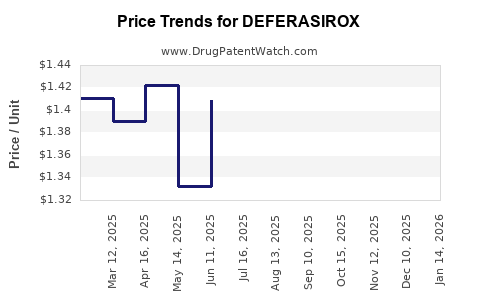
Generic competition moves deferasirox from specialty branded pricing toward contracted generic pricing. The size of the decline depends on the number of approved suppliers and whether the market has supply shortages.
Formulation substitution
A generic tablet may compete directly with the branded tablet, while a separate product may compete for patients who previously used Exjade dispersible tablets or Jadenu Sprinkle. The substitution pathway is affected by state substitution law and the FDA therapeutic-equivalence designation.
Payer steering
Payers can place generic deferasirox on preferred tiers and require prior authorization for Exjade or Jadenu. This makes retention dependent on clinical justification rather than brand recognition.
Channel concentration
Specialty pharmacies and hospital systems can shift large volumes between suppliers. A manufacturer with limited production capacity may lose share rapidly if it cannot maintain inventory.
What manufacturing and intellectual-property barriers remain?
Deferasirox manufacturing is less protected by the original composition patent than by execution requirements. Barriers include:
- Consistent control of impurities and polymorphic form.
- Stable manufacture of film-coated tablets and granules.
- Bioequivalence across dosage forms.
- Reliable supply of active pharmaceutical ingredient.
- Pediatric-friendly taste and administration characteristics.
- Compliance with FDA and other regulators’ current good manufacturing practice standards.
- Pharmacovigilance and laboratory-monitoring support.
These barriers can preserve modest margins for suppliers with reliable quality systems. They do not normally support the margins associated with an active composition-of-matter patent.
How does deferasirox compare with deferoxamine and deferiprone?
| Factor |
Deferasirox |
Deferoxamine |
Deferiprone |
| Route |
Oral |
Usually parenteral |
Oral |
| Administration burden |
Low to moderate |
High |
Low to moderate |
| Generic pressure |
High |
High in many markets |
Market-specific |
| Main commercial advantage |
Convenience and established use |
Long clinical experience |
Oral alternative |
| Key safety considerations |
Renal, hepatic, gastrointestinal |
Infusion-related and systemic risks |
Hematologic monitoring, including neutropenia risk |
| Revenue outlook |
Mature and genericized |
Mature |
Regional growth opportunity |
Deferasirox has the strongest commercial position where oral convenience drives adherence and clinicians are comfortable with renal and hepatic monitoring. Deferiprone can gain share where clinicians prioritize an alternative oral mechanism or where local guidelines support it. Deferoxamine remains relevant when clinical experience or patient-specific factors outweigh administration burden.
What is the outlook for deferasirox revenue?
The revenue outlook is stable to declining for branded products and competitive for generic manufacturers.
Originator outlook
Novartis-originated revenue has limited growth potential because:
- The active ingredient is mature.
- Core exclusivity has expired in major markets.
- Generic substitution is established.
- Product differentiation is primarily formulation-based.
- Novartis no longer treats the franchise as a major separately reported growth asset.
Generic outlook
Generic revenue can remain attractive when a supplier has:
- Limited competition in a particular country.
- Strong specialty-pharmacy access.
- Reliable API and finished-dose supply.
- Approved pediatric or alternative formulations.
- A temporary shortage advantage.
- Low manufacturing costs.
Generic pricing is likely to remain under pressure as additional suppliers enter. The strongest opportunities are regional, not global, and depend on procurement structure and regulatory status.
Geographic outlook
The most durable demand is likely in:
- North America, where chronic transfusion populations and specialty reimbursement support continued use.
- Europe, where national procurement and generic substitution determine pricing.
- The Middle East and North Africa, where thalassemia prevalence supports ongoing iron-chelation demand.
- South and Southeast Asia, where patient volume is substantial but pricing and access vary widely.
- Latin America, where public procurement and local manufacturing can determine market access.
Key Takeaways
- Deferasirox is a mature oral iron-chelation product with continuing clinical demand but limited branded growth.
- Exjade and Jadenu generated approximately $1 billion in annual peak sales before patent maturity and generic erosion.
- Jadenu improved administration and delayed some revenue loss but did not create durable ingredient-level exclusivity.
- U.S. generic entry followed the expiry of core deferasirox protection and product-specific patent challenges.
- The product is regulated as a small-molecule drug; biosimilar risk is not relevant.
- Generic competition, payer steering, and supply reliability now determine commercial performance.
- Residual value is concentrated in formulations, pediatric administration, manufacturing quality, and underpenetrated geographic markets.
- The financial profile is more attractive for efficient generic suppliers than for a branded originator.
FAQs
Is deferasirox still patent protected?
Broad compound-level protection has expired or reached the end of its practical commercial term in major markets. Some formulation or product-specific rights may have had later expiration dates, but they do not restore broad exclusivity for the active ingredient.
Is Jadenu interchangeable with Exjade?
Jadenu and Exjade contain deferasirox but use different dosage forms and dosing instructions. They should not be treated as automatically interchangeable on a milligram-for-milligram basis without reference to FDA labeling and prescriber direction.
Does deferasirox have biosimilar competition?
No. Deferasirox is a small-molecule drug. Competition proceeds through generic drug applications, not the FDA biosimilar pathway.
Why did Novartis develop Jadenu after Exjade?
Jadenu reduced administration burden by providing a film-coated tablet rather than a dispersible tablet requiring preparation in liquid. The reformulation also supported patient migration before generic competition intensified.
What is the main investment risk in generic deferasirox?
The principal risk is rapid price erosion caused by additional ANDA suppliers and payer substitution. Secondary risks include API shortages, manufacturing observations, product-specific patent disputes, and limited market size.
References
-
Novartis AG. (2014-2019). Annual reports. Basel, Switzerland: Author.
-
U.S. Food and Drug Administration. (2005). Exjade (deferasirox) prescribing information. Silver Spring, MD: Author.
-
U.S. Food and Drug Administration. (2015). Jadenu (deferasirox) prescribing information. Silver Spring, MD: Author.
-
U.S. Food and Drug Administration. (2023). Orange Book: Approved drug products with therapeutic equivalence evaluations. Silver Spring, MD: Author.
-
U.S. Patent and Trademark Office. (2002). U.S. Patent No. 6,465,022: Deferasirox and pharmaceutical compositions. Washington, DC: Author.
-
U.S. Patent and Trademark Office. (2014). U.S. Patent No. 8,895,079: Deferasirox formulations. Washington, DC: Author.