Last updated: September 7, 2026
Atovaquone is a mature small-molecule anti-infective with limited patent protection, broad generic availability, and continued clinical demand in Pneumocystis jirovecii pneumonia (PJP) and malaria markets. Its commercial value is concentrated in oral-suspension formulations, where manufacturing complexity, taste masking, particle-size control, and payer pricing support higher margins than the active pharmaceutical ingredient alone.
Standalone atovaquone revenue is not separately reported by major manufacturers. The market is fragmented across branded Mepron, generic atovaquone oral suspension, and the atovaquone-proguanil combination sold as Malarone and its generic equivalents.
What is atovaquone used for and how large is the addressable market?
Atovaquone is an antiprotozoal drug used primarily for:
- Treatment of mild-to-moderate PJP in patients who cannot tolerate trimethoprim-sulfamethoxazole.
- Prevention of PJP in selected immunocompromised patients.
- Treatment and prophylaxis of malaria when combined with proguanil.
The FDA-approved Mepron formulation is an oral suspension containing 750 mg of atovaquone per 5 mL. The labeled PJP treatment dose is 750 mg twice daily for 21 days. Absorption is substantially improved when the product is taken with food, particularly a high-fat meal. [1]
The economic market has three distinct segments:
| Segment |
Principal product |
Commercial characteristics |
| PJP treatment |
Mepron and generic atovaquone suspension |
Specialty-infectious-disease demand; high unit prices; low patient volume |
| PJP prophylaxis |
Atovaquone suspension and alternatives |
Chronic or recurrent use; competitive with dapsone and aerosolized pentamidine |
| Malaria treatment and prevention |
Malarone and generic atovaquone-proguanil tablets |
Larger prescription volume; travel and institutional demand; intense generic competition |
Atovaquone is not a mass-market antibiotic. Demand is clinically durable but narrow, with volumes linked to HIV, transplant, hematology-oncology, and other immunocompromised populations. The malaria market is more volume-oriented but highly price-sensitive.
When does atovaquone lose exclusivity?
Atovaquone’s original compound exclusivity has expired. The foundational U.S. compound patent, U.S. Patent No. 4,981,874, covered atovaquone and related naphthoquinone compounds and expired in the mid-2000s based on its 1986 priority date and statutory patent term. The principal oral-suspension formulation patent, U.S. Patent No. 5,134,127, also expired around 2010 under the pre-URAA patent-term framework. [2]
| Protection category |
Representative protection |
Status |
| Active compound |
U.S. Patent No. 4,981,874 |
Expired |
| Oral-suspension formulation |
U.S. Patent No. 5,134,127 |
Expired |
| FDA chemical exclusivity |
Original Mepron approval |
Expired |
| Pediatric exclusivity |
Any historical six-month extension |
Expired |
| Current formulation protection |
Later product-specific patents, if any |
No material blocking estate identified in the public record through 2024 |
The commercial consequence is clear: generic manufacturers can compete directly with Mepron, subject to FDA approval, pharmaceutical-equivalence requirements, manufacturing controls, and formulation performance.
What is the Orange Book status of Mepron and atovaquone?
Mepron was approved by the FDA under NDA 020591 as an atovaquone oral suspension. The product was initially associated with Burroughs Wellcome and later with GlaxoSmithKline. [1,3]
The Orange Book has historically listed patents associated with Mepron, but the key compound and formulation rights are expired. An Orange Book listing does not itself create continuing market exclusivity after the listed patent expires. Generic applicants can file ANDAs when all blocking patents have expired or when they submit an appropriate certification.
Atovaquone-proguanil products are separately regulated. Malarone is not an atovaquone-only product, and patents or exclusivity associated with the combination product should not be treated as protection for Mepron. The combination was approved for malaria treatment and prophylaxis under a separate NDA. [4]
How many patents cover atovaquone?
The active commercial patent estate is limited. Historical protection included compound patents, formulation patents, and patents relating to pharmaceutical compositions. The most important barriers were:
- The atovaquone molecule itself.
- Suspension formulations designed to overcome poor water solubility.
- Manufacturing controls for particle size, dispersion, and dose uniformity.
- The atovaquone-proguanil combination product.
The key distinction is between expired foundational patents and any later patents covering narrow formulation improvements. A competitor does not need to reproduce the branded manufacturing process if it can demonstrate an independently developed formulation that satisfies FDA quality and bioequivalence requirements.
What formulations are protected by atovaquone patents?
The principal technical challenge is not synthesis of atovaquone. It is delivery.
Atovaquone has very low aqueous solubility and variable absorption. Oral suspensions require control over:
- Particle-size distribution.
- Sedimentation and redispersibility.
- Dose uniformity.
- Viscosity.
- Palatability and taste masking.
- Chemical stability.
- Food-dependent exposure.
The historical formulation patents addressed pharmaceutical compositions that enabled atovaquone administration as an oral suspension. Those patents have expired. Their technical teachings remain commercially relevant because generic manufacturers must still solve the same formulation problems, even though the intellectual-property barrier is gone.
How strong is the current atovaquone patent estate?
The patent estate is weak from an exclusivity perspective and moderate from a manufacturing-execution perspective.
| Factor |
Assessment |
| Compound patent protection |
None remaining |
| Broad formulation exclusivity |
Expired |
| Generic substitution risk |
High |
| API manufacturing difficulty |
Moderate |
| Suspension-development difficulty |
Moderate to high |
| Biosimilar exposure |
None |
| Litigation-based delay risk |
Low based on publicly visible activity through 2024 |
| Pricing durability |
Limited for tablets; stronger for branded or constrained suspensions |
The surviving commercial moat is operational rather than legal. Manufacturers with validated suspension processes, reliable API supply, FDA inspection history, and payer access can compete effectively. New entrants face development and quality costs, but they do not face a strong blocking patent estate.
Which companies manufacture or market atovaquone?
The branded product is Mepron. GlaxoSmithKline has historically held the U.S. commercial position, although the product has had limited strategic importance relative to the company’s larger respiratory, vaccine, HIV, and oncology franchises.
Generic atovaquone oral suspension has been marketed by multiple FDA-approved manufacturers and label holders, including companies operating through abbreviated new drug applications and contract-manufacturing arrangements. Product availability can vary by distributor, wholesaler, and pharmacy channel.
The atovaquone-proguanil market includes generic manufacturers such as Teva, Glenmark, Lupin, Cipla, and other suppliers depending on jurisdiction and product presentation. The combination tablet market has a larger number of competitors than the atovaquone-suspension market.
What is the financial trajectory for atovaquone?
Atovaquone has a mature, low-growth financial profile.
No major manufacturer separately reports global atovaquone revenue. GlaxoSmithKline has not generally disclosed Mepron revenue as a standalone line item in recent annual reporting. Generic companies also typically combine atovaquone sales with broader infectious-disease or established-products portfolios. [5]
The financial trajectory has four phases:
Branded growth phase
Mepron benefited from demand for alternative PJP treatment in patients unable to use trimethoprim-sulfamethoxazole. Pricing was supported by the small patient population, specialist prescribing, and the absence of immediate generic substitution.
Patent-expiry phase
After compound and formulation patents expired, generic competition reduced the economic value of the product. The market shifted from patent-supported pricing to supply, contracting, and formulation availability.
Generic fragmentation phase
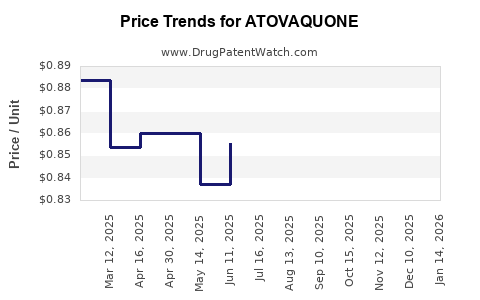
The market now has lower prices in channels with several suppliers. Pricing can remain elevated when only a small number of companies maintain commercial inventory or when a pharmacy cannot substitute across dosage forms.
Mature maintenance phase
Revenue is likely to remain stable to modestly declining in nominal terms, with periodic increases caused by price changes, supply disruptions, or changes in immunocompromised patient populations. Volume growth is limited because atovaquone is an alternative therapy rather than first-line treatment for most PJP patients.
An indicative commercial profile is:
| Metric |
Atovaquone market implication |
| Volume growth |
Low single digit or flat |
| Unit economics |
Higher for oral suspension than low-cost antimicrobial tablets |
| Brand share |
Narrow and vulnerable to substitution |
| Generic price pressure |
High |
| Reimbursement sensitivity |
High |
| Supply-chain sensitivity |
Moderate |
| Long-term revenue outlook |
Stable to declining without a new formulation or indication |
Public market-size estimates for “atovaquone” often combine Mepron, atovaquone-proguanil, hospital procurement, travel medicine, and multiple geographic markets. They should not be treated as audited product revenue.
Are there Paragraph IV challenges for atovaquone?
Paragraph IV litigation is not a major current market event for atovaquone. The core patents expired long ago, and generic atovaquone products have already entered the U.S. market.
The principal ANDA risk is therefore not delayed entry caused by a new patent challenge. It is ordinary generic competition, including:
- Additional ANDAs for oral suspension.
- Distributor switching.
- Contract-manufacturing changes.
- State substitution and payer formulary pressure.
- Short-term supply interruptions that alter market share.
A new Paragraph IV campaign would have limited commercial value unless it targeted a newly issued, narrowly drafted formulation or manufacturing patent. No such patent appears to create a material market-wide barrier through 2024.
What patent litigation affects atovaquone?
No major active U.S. patent dispute appears to be driving the atovaquone market through 2024. Historical disputes, if any, have less strategic importance than the expiration of the foundational patent estate and subsequent generic approvals.
For investors and licensing teams, the relevant legal risk is product-specific:
- A generic suspension could face patent claims directed to excipients or particle engineering.
- A branded reformulation could create a new patent estate.
- A combination product could have separate patents from atovaquone alone.
- A manufacturing patent may affect a particular process without blocking alternative production routes.
These distinctions matter because a formulation patent generally does not restore exclusivity to the active ingredient.
What FDA regulatory status applies to atovaquone?
Mepron is an FDA-approved oral suspension for PJP treatment. Generic atovaquone suspensions are approved through the ANDA pathway when they demonstrate pharmaceutical equivalence and bioequivalence to the reference product or satisfy applicable FDA requirements for the dosage form. [1,3]
Atovaquone-proguanil tablets are separate approved products. They should not be analyzed as interchangeable with atovaquone suspension because they have different active ingredients, indications, dosing, and bioavailability considerations.
The regulatory burden is highest for suspension products because FDA review must address physical stability, dose uniformity, microbial quality, dissolution or performance characteristics, and the clinical effect of food on exposure.
What generic launch scenarios exist for atovaquone?
The most likely market scenarios are:
| Scenario |
Commercial result |
| One or two reliable generic suppliers |
Moderate price erosion; branded product retains some channel presence |
| Four or more active generic suppliers |
Significant price compression and reduced brand relevance |
| Supply interruption at a major generic manufacturer |
Temporary price increases and pharmacy-level shortages |
| Branded reformulation |
Potential premium pricing if clinical convenience improves |
| New indication |
Limited upside unless supported by strong clinical adoption |
| Hospital or payer contracting shift |
Rapid movement toward the lowest-cost supplier |
The greatest opportunity is not a new patent on old atovaquone. It is a differentiated delivery system that improves food independence, taste, portability, dosing convenience, or administration in patients unable to swallow tablets.
How does atovaquone compare with competing PJP therapies?
| Therapy |
Main advantage |
Main limitation |
Commercial position |
| Trimethoprim-sulfamethoxazole |
Standard first-line efficacy and low cost |
Allergy, cytopenias, renal and electrolyte toxicity |
Dominant first-line option |
| Atovaquone |
Oral alternative; generally better tolerated than some alternatives |
High cost, poor absorption, food dependence |
Niche alternative |
| Dapsone |
Oral and inexpensive |
Hemolysis, methemoglobinemia, G6PD concerns |
Selective use |
| Aerosolized pentamidine |
Avoids systemic oral exposure |
Administration burden and lower convenience |
Institutional or alternative use |
| Clindamycin-primaquine |
Effective alternative in selected cases |
Drug interactions and tolerability concerns |
Rescue or specialist use |
Atovaquone’s clinical value is higher than its market size suggests because it fills a treatment gap for patients who cannot receive standard therapy. That value does not translate directly into durable pricing power after patent expiration.
Does atovaquone face biosimilar risk?
No. Atovaquone is a chemically synthesized small molecule, not a biologic. It is subject to generic competition through ANDAs rather than biosimilar applications under the Public Health Service Act.
The relevant risks are generic substitution, formulation competition, API supply, and FDA manufacturing compliance. Biosimilar interchangeability and biologic reference-product exclusivity do not apply.
What licensing deals involve atovaquone?
Atovaquone originated in the Burroughs Wellcome research and commercial organization and later became part of GlaxoSmithKline’s portfolio. No major current licensing transaction is publicly associated with atovaquone as a standalone growth asset.
Potential transaction value is more likely to arise from:
- Regional rights to Mepron or generic suspension.
- Contract manufacturing.
- Atovaquone-proguanil distribution.
- Pediatric or taste-masked formulations.
- Fixed-dose or combination anti-infective products.
A licensing deal centered solely on the unprotected atovaquone molecule would face weak exclusivity economics unless it included a differentiated formulation, regulatory advantage, or geographic supply position.
How does geographic coverage affect the atovaquone market?
The United States has the clearest branded-versus-generic structure because Mepron is an FDA reference product and generic approvals are publicly trackable. European and other markets may use different brand names, local generic suppliers, and national reimbursement rules.
Geographic commercial differences include:
- Variable availability of oral suspension.
- Different malaria-prescribing patterns.
- National tendering and hospital procurement.
- Local requirements for bioequivalence and pediatric formulations.
- Greater reliance on atovaquone-proguanil in travel-medicine markets.
- Different reimbursement for HIV and transplant indications.
The U.S. market is likely to remain the most commercially visible, while international revenue is distributed among local licensees, generic suppliers, and institutional channels.
Key Takeaways
- Atovaquone is a mature anti-infective with expired compound and core formulation patents.
- Mepron remains clinically relevant for PJP, but its commercial position is exposed to generic oral suspensions.
- Atovaquone-proguanil is a separate and more competitive market with broader generic participation.
- The molecule has no biosimilar risk because it is a small-molecule drug.
- The strongest remaining commercial barrier is formulation execution, not patent exclusivity.
- Standalone revenue is not publicly disclosed by major manufacturers.
- Financial performance is likely stable to declining, with temporary pricing volatility tied to supply and contracting.
- A differentiated suspension or delivery system would offer more strategic value than a conventional atovaquone product.
- No major active patent litigation or Paragraph IV campaign appears to be driving the market through 2024.
FAQs
Is atovaquone still under patent protection?
The foundational U.S. compound and oral-suspension patents have expired. New patents could cover narrow formulations or manufacturing methods, but they would not restore broad protection for atovaquone.
Is generic atovaquone as effective as Mepron?
FDA-approved generic products are required to meet applicable pharmaceutical-equivalence and bioequivalence standards. Clinical performance can still be affected by suspension handling, food intake, and product availability.
Why is atovaquone expensive despite being generic?
Atovaquone has poor water solubility and requires a stable, uniform, palatable suspension. Limited volume, manufacturing complexity, and intermittent supplier participation can support prices above those of simpler generic antibiotics.
Is atovaquone used to prevent malaria?
Atovaquone is used for malaria prevention in combination with proguanil. The relevant product is atovaquone-proguanil, not atovaquone monotherapy.
Could a new atovaquone formulation receive market exclusivity?
A new formulation could potentially obtain patent protection, FDA regulatory exclusivity in certain circumstances, or both. The commercial strength would depend on whether it provides a clinically meaningful advantage and whether competitors can design around the claims.
References
- U.S. Food and Drug Administration. (2023). Mepron (atovaquone) oral suspension prescribing information.
- United States Patent and Trademark Office. (1986, 1992). U.S. Patent No. 4,981,874 and U.S. Patent No. 5,134,127.
- U.S. Food and Drug Administration. (2024). Approved drug products with therapeutic equivalence evaluations: Orange Book.
- U.S. Food and Drug Administration. (2023). Malarone (atovaquone and proguanil hydrochloride) prescribing information.
- GSK plc. (2024). Annual report 2023.