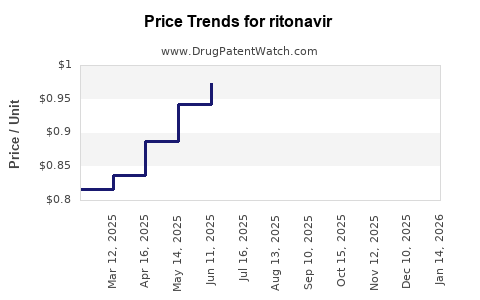
Last updated: August 7, 2026
Ritonavir is no longer primarily a standalone HIV medicine. Its commercial value shifted toward pharmacokinetic boosting, especially as the ritonavir component of Pfizer’s Paxlovid combination with nirmatrelvir. Standalone ritonavir has generic competition, limited pricing power, and undisclosed brand-level revenue. Paxlovid generated approximately $18.9 billion for Pfizer in 2022 before falling to about $1.49 billion in 2023 as COVID-19 demand moved from government stockpiling to commercial purchasing and treatment volumes declined.[1][2]
The key market issue is therefore not the intrinsic market for ritonavir tablets. It is the durability of Pfizer’s combination-product franchise, the remaining COVID-19 treatment market, and the extent to which generic or licensed nirmatrelvir/ritonavir products can enter lower-income countries.
What is ritonavir and how is it used commercially?
Ritonavir is an HIV-1 protease inhibitor developed by Abbott Laboratories, now AbbVie. The FDA approved Norvir in 1996 for HIV infection.[3] At antiviral doses, ritonavir inhibits HIV protease. At low doses, it inhibits CYP3A-mediated metabolism and increases plasma exposure to other drugs.
Its principal commercial uses are:
| Use |
Product or combination |
Commercial role |
| HIV treatment |
Norvir and generic ritonavir |
Antiretroviral component or pharmacokinetic booster |
| HIV combination therapy |
Darunavir/ritonavir and other protease-inhibitor regimens |
Improves exposure and dosing convenience |
| COVID-19 treatment |
Nirmatrelvir/ritonavir, marketed as Paxlovid |
Boosts nirmatrelvir exposure |
| Investigational combinations |
Various CYP3A-boosted therapies |
Limited or development-stage use |
Ritonavir’s value comes from its pharmacology, manufacturing availability, and regulatory familiarity. Its weaknesses are extensive generic competition, drug-drug interaction risks, and the absence of meaningful standalone exclusivity.
What is the FDA regulatory status of ritonavir and Paxlovid?
Norvir is an FDA-approved HIV product. Ritonavir is available in tablets, capsules, and oral-solution formulations, although specific presentations and suppliers vary by market.[3][4]
Paxlovid received FDA emergency use authorization in December 2021 and full FDA approval for adults at high risk of progression to severe COVID-19 in May 2023.[5] The approved regimen contains nirmatrelvir and ritonavir, with ritonavir administered solely as a pharmacokinetic enhancer.
The regulatory transition changed Pfizer’s commercial model:
- 2021-2023: government procurement and emergency distribution dominated.
- 2023 onward: commercial distribution became more important in the United States.
- Demand became concentrated in older and medically vulnerable patients.
- Prescribing depends on current treatment guidelines, circulating variants, diagnosis timing, and drug-interaction management.
- Ritonavir remains necessary in the Paxlovid regimen because nirmatrelvir is rapidly metabolized without CYP3A inhibition.
The FDA has not approved ritonavir as a COVID-19 treatment on a standalone basis. Its COVID-19 role is tied to the nirmatrelvir combination.
How large is the ritonavir market?
No reliable public source reports global ritonavir revenue as a separate market category. AbbVie does not disclose Norvir revenue as a standalone financial segment, and Pfizer reports Paxlovid revenue as a combination-product franchise rather than as ritonavir revenue.
The market has three economically distinct layers:
- Standalone generic ritonavir.
- Branded Norvir and HIV boosting use.
- Ritonavir embedded in Paxlovid revenue.
The first layer is mature and price-sensitive. The second is strategically relevant for HIV treatment but relatively small compared with major antiretroviral franchises. The third created the large but temporary revenue surge.
Paxlovid financial trajectory
| Year |
Pfizer Paxlovid revenue |
Primary market condition |
| 2021 |
Commercial contribution began late in year |
Initial authorization and government procurement |
| 2022 |
Approximately $18.9 billion |
Large government purchases and high COVID-19 treatment demand |
| 2023 |
Approximately $1.49 billion |
Inventory write-offs, declining demand, commercial transition |
| 2024 |
Not treated here as a separately verified ritonavir figure |
Ongoing commercial-market normalization |
Pfizer’s 2022 Paxlovid sales were among the largest single-product COVID-19 revenues in the pharmaceutical industry. The 2023 decline exceeded 90%, reflecting a collapse in emergency procurement rather than a loss of ritonavir’s pharmacological role.[1][2]
Ritonavir itself captured only a fraction of Paxlovid economics. Pfizer’s pricing, manufacturing, regulatory ownership, distribution agreements, and nirmatrelvir intellectual property supported the combination-product revenue. Ritonavir was the established generic component.
When does ritonavir lose exclusivity?
Ritonavir’s original compound and formulation exclusivity has expired in the United States. The historical U.S. ritonavir patent estate included patents such as U.S. Patent No. 5,541,206, associated with ritonavir and HIV protease inhibitor technology, and related formulation and process patents. Those rights expired years before the current Paxlovid market.[6]
| Protection category |
Current position |
| Original ritonavir compound patents |
Expired |
| Original Norvir formulation patents |
Expired or no longer commercially decisive |
| Generic ritonavir entry |
Established |
| Paxlovid combination protection |
Driven mainly by nirmatrelvir and combination patents |
| COVID-19 regulatory exclusivity |
Linked to Paxlovid approvals, not to ritonavir alone |
Ritonavir has no current standalone patent barrier capable of preventing ordinary generic competition in the United States. Any remaining commercial protection relates to product presentation, manufacturing know-how, regulatory approvals, or combination-product claims.
What patents protect Paxlovid and the ritonavir combination?
Paxlovid’s enforceable commercial position is not based on new exclusivity for ritonavir. It depends primarily on Pfizer’s rights covering nirmatrelvir, pharmaceutical compositions, combination use, and related manufacturing or formulation technology.
The relevant protection categories include:
- Nirmatrelvir compound and composition patents.
- Nirmatrelvir/ritonavir combination claims.
- Methods for treating COVID-19 with the combination.
- Solid-state, formulation, and dosage-form claims.
- Manufacturing processes for nirmatrelvir and related intermediates.
Pfizer identifies Paxlovid patents through FDA Orange Book and related regulatory records. Patent expiration dates vary by jurisdiction and by claim type. The most relevant U.S. protections extend materially beyond the expiration of the original ritonavir patents, with some claims reaching into the 2030s.[4][7]
The patent estate is stronger for Paxlovid than for standalone ritonavir because the commercial product combines an old booster with a newer antiviral. A generic company can source ritonavir, but it must address the separate patent and regulatory position for nirmatrelvir.
What is the Orange Book status of ritonavir and Paxlovid?
The FDA Orange Book lists approved drug products and patent information submitted by sponsors.[4] Norvir-related listings concern the ritonavir product. Paxlovid listings concern the approved nirmatrelvir/ritonavir combination.
Orange Book analysis should distinguish:
- Ritonavir patents that are expired.
- Paxlovid patents that cover nirmatrelvir or the combination.
- Pediatric exclusivity or other regulatory periods.
- Patent delisting or listing changes.
- Different strengths and dosage forms.
A ritonavir ANDA does not automatically authorize a generic Paxlovid product. A manufacturer must address the nirmatrelvir component, the fixed treatment regimen, bioequivalence or applicable pathway, manufacturing controls, and any listed patents.
Are there Paragraph IV challenges to ritonavir or Paxlovid?
Paragraph IV risk is materially greater for Paxlovid than for standalone ritonavir.
For generic ritonavir, the principal compound and formulation barriers have expired. ANDA applicants can rely on established generic pathways, subject to FDA requirements and any remaining listed patent claims.
For Paxlovid, a Paragraph IV filer would need to challenge patents covering nirmatrelvir, the combination, methods of use, or manufacturing. The commercial incentive is substantial when COVID-19 demand is high, but it weakens when annual sales are uncertain and treatment volumes are concentrated in high-risk patients.
A generic challenge could take several forms:
- A patent-certification challenge before full expiry.
- A licensed entry agreement.
- An authorized generic or contract-manufacturing arrangement.
- A post-expiry launch limited by manufacturing capacity.
- A regional launch through the Medicines Patent Pool licensing framework.
Publicly disclosed litigation and settlement terms should be reviewed patent by patent. No standalone ritonavir patent dispute is likely to restore meaningful brand exclusivity because the core rights are old and generic competition is established.
Which companies are challenging or competing with ritonavir products?
Competition differs by product category.
Standalone ritonavir competitors
Generic manufacturers compete in tablets, capsules, and oral solution. The competitive field includes ANDA holders and suppliers active in antiretroviral distribution. Product availability can vary because ritonavir manufacturing is technically demanding and demand is linked to other HIV medicines.
Paxlovid competitors
Paxlovid competes with:
- Merck’s Lagevrio, or molnupiravir.
- Remdesivir, marketed as Veklury by Gilead Sciences.
- Supportive care and outpatient risk management.
- Future oral antivirals and long-acting antiviral candidates.
Paxlovid has generally held the strongest outpatient efficacy position among widely used oral COVID-19 antivirals for high-risk patients, but its drug-interaction burden can affect prescribing. Molnupiravir has a simpler interaction profile but weaker clinical positioning. Remdesivir requires intravenous administration.
How strong is the ritonavir patent estate?
The standalone ritonavir patent estate is weak because the core patents are expired and generic products exist.
The broader Paxlovid estate is stronger but commercially exposed to demand erosion. Its principal strengths are:
- Newer nirmatrelvir patent rights.
- Combination-product integration.
- Pfizer’s manufacturing and regulatory infrastructure.
- Clinical-guideline support for high-risk patients.
- Licensing access in many lower-income markets.
Its weaknesses are:
- Reliance on COVID-19 incidence and treatment policy.
- Short treatment window after diagnosis.
- Significant CYP3A drug interactions.
- Generic ritonavir availability.
- Potential patent challenges to nirmatrelvir-related claims.
- Uncertain willingness of health systems to maintain large inventories.
The estate is commercially valuable but less predictable than a chronic-care product patent estate.
What licensing deals affect ritonavir and Paxlovid?
Pfizer entered a voluntary licensing agreement with the Medicines Patent Pool covering nirmatrelvir/ritonavir for supply in 95 low- and middle-income countries.[8] The agreement allows qualified manufacturers to produce and supply generic versions in covered territories after regulatory and manufacturing requirements are met.
This arrangement has three effects:
- It reduces patent-based barriers in covered markets.
- It expands access without eliminating Pfizer’s higher-income-market rights.
- It limits the value of direct generic entry in licensed territories because multiple manufacturers can compete under the license.
The agreement primarily concerns Paxlovid, not a new exclusivity grant for ritonavir. Ritonavir can be sourced as a generic component, but the licensed product still requires compliant nirmatrelvir manufacturing.
What manufacturing and intellectual-property barriers exist?
Ritonavir manufacturing is more mature than nirmatrelvir manufacturing, but quality control remains important. Key barriers include:
- Consistent active pharmaceutical ingredient production.
- Control of polymorphic and formulation characteristics.
- Stable tablet manufacture.
- High containment and analytical standards.
- Reliable sourcing of nirmatrelvir intermediates.
- Combination packaging and labeling.
- Management of ritonavir-mediated drug interactions.
- Regulatory validation across multiple jurisdictions.
For Paxlovid, nirmatrelvir is the more important manufacturing bottleneck. The combination product also requires strict dosing instructions because ritonavir changes exposure to co-administered drugs.
What generic launch scenarios exist for ritonavir and Paxlovid?
Standalone ritonavir
Generic entry is already established. Future competition will focus on:
- Price.
- Supply reliability.
- Dosage-form breadth.
- Hospital and public-sector tenders.
- Integration with HIV treatment regimens.
Paxlovid
Three scenarios are commercially relevant:
| Scenario |
Timing logic |
Market effect |
| Licensed regional supply |
Active in covered MPP countries |
Lower prices and multi-source competition |
| Patent-challenge entry |
Depends on litigation and settlements |
Could accelerate entry before patent expiry |
| Post-exclusivity generic launch |
Follows expiry of relevant nirmatrelvir patents |
Broadest price erosion |
An early generic launch would require a credible legal strategy and sufficient demand to justify development costs. A late launch may face weaker economics because COVID-19 treatment volumes could continue to decline.
How does ritonavir compare with competing COVID-19 antivirals?
| Product |
Company |
Route |
Main commercial advantage |
Main limitation |
| Paxlovid |
Pfizer |
Oral |
Strong outpatient efficacy and established use |
Drug interactions and declining demand |
| Lagevrio |
Merck |
Oral |
Simpler administration and fewer interaction concerns |
Weaker efficacy profile |
| Veklury |
Gilead |
Intravenous |
Hospital and outpatient use with established supply |
Infusion requirement |
Paxlovid’s ritonavir component is both an advantage and a constraint. CYP3A inhibition produces the required nirmatrelvir exposure, but it creates clinically significant interaction management. That limits use in some patients taking anticoagulants, antiarrhythmics, immunosuppressants, anticonvulsants, and other medicines.
What revenue exposure does ritonavir create for AbbVie and Pfizer?
Pfizer has the largest direct financial exposure through Paxlovid. Its revenue trajectory moved from emergency-scale sales to a smaller, commercially managed product.
AbbVie retains the Norvir brand and HIV-related commercial interests, but public disclosures do not isolate Norvir revenue sufficiently to support a standalone valuation. Ritonavir is more important strategically as a component of HIV regimens and as a widely recognized booster than as a major independent revenue source.
For investors and licensing teams, the economic conclusion is clear:
- Pfizer’s exposure is linked to Paxlovid demand and nirmatrelvir patent durability.
- AbbVie’s exposure is linked to mature HIV products and generic substitution.
- Generic manufacturers have a lower-risk opportunity in ritonavir than in Paxlovid.
- The largest upside or downside variable is COVID-19 treatment volume, not standalone ritonavir pricing.
Key Takeaways
- Ritonavir is an old, genericized HIV drug whose commercial value shifted toward pharmacokinetic boosting.
- Norvir has no meaningful current compound-patent exclusivity.
- Paxlovid generated about $18.9 billion in 2022 and about $1.49 billion in 2023 for Pfizer.[1][2]
- Paxlovid’s patent position depends mainly on nirmatrelvir and combination claims, not ritonavir.
- Generic ritonavir competition is established; generic Paxlovid entry requires separate patent and regulatory analysis.
- Pfizer’s Medicines Patent Pool agreement opens licensed supply in 95 low- and middle-income countries.[8]
- The main financial risk is continued COVID-19 demand erosion.
- The main legal risk is Paragraph IV or other challenges to nirmatrelvir-related patents.
- Ritonavir’s standalone market is mature, price-sensitive, and strategically important rather than high-growth.
FAQs About Ritonavir Market and Patent Outlook
Does ritonavir have patent protection in the United States?
The original ritonavir compound and principal formulation patents have expired. Current protection for products containing ritonavir generally comes from the partner drug, product-specific claims, regulatory status, or non-patent commercial factors.
Can a generic company manufacture ritonavir for HIV treatment?
Yes. Generic ritonavir products are available through FDA-approved abbreviated new drug application pathways, subject to product-specific approval and manufacturing requirements.
Can a generic ritonavir tablet be substituted for Paxlovid?
No. Paxlovid contains both nirmatrelvir and ritonavir. A ritonavir-only product does not provide the antiviral activity of nirmatrelvir and is not therapeutically equivalent to Paxlovid.
Will Paxlovid revenue recover to 2022 levels?
A return to 2022 revenue levels would require a major increase in COVID-19 treatment demand, large-scale government procurement, or a severe epidemiological change. The post-emergency market is structurally smaller and less predictable.
Is ritonavir a biosimilar opportunity?
No. Ritonavir is a chemically synthesized small molecule, not a biologic. The relevant pathway is generic-drug approval, not biosimilar approval.
References
- Pfizer Inc. (2023). 2022 annual report.
- Pfizer Inc. (2024). 2023 annual report.
- U.S. Food and Drug Administration. (1996). Norvir (ritonavir) approval information.
- U.S. Food and Drug Administration. (2024). Approved drug products with therapeutic equivalence evaluations, Orange Book.
- U.S. Food and Drug Administration. (2023). FDA approves first oral antiviral treatment for COVID-19 in adults.
- U.S. Patent and Trademark Office. (1996). U.S. Patent No. 5,541,206.
- Pfizer Inc. (2024). Paxlovid prescribing information and patent information.
- Medicines Patent Pool. (2022). Medicines Patent Pool and Pfizer sign agreement for COVID-19 oral treatment.