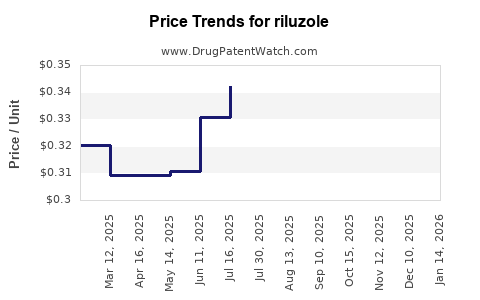
Last updated: August 10, 2026
Riluzole is a mature ALS therapy with declining value in standard tablet form and more durable pricing in differentiated oral formulations. The active ingredient has long faced generic competition, while oral suspension and oral-film products preserve narrower branded markets. Revenue growth is therefore driven by formulation switching, specialty distribution, and geographic expansion rather than by new indications.
What is riluzole and how is it used?
Riluzole is a glutamate-modulating drug approved primarily to treat amyotrophic lateral sclerosis, or ALS. The FDA approved Rilutek, the original riluzole product, in 1995. Riluzole does not reverse established motor-neuron loss, but clinical studies support a modest extension of survival or delayed need for tracheostomy in ALS patients.[1]
The main marketed forms are:
| Product |
Dosage form |
Original or current developer |
Commercial position |
| Rilutek |
50 mg tablet |
Rhône-Poulenc, later Sanofi |
Original branded product; exposed to generics |
| Generic riluzole |
50 mg tablet |
Multiple manufacturers |
Lowest-cost standard formulation |
| Tiglutik |
50 mg/10 mL oral suspension |
ITF Pharma |
Branded liquid formulation |
| Exservan |
50 mg oral film |
Aquestive Therapeutics |
Differentiated oral-film product |
Riluzole is also used off-label in several neurologic disorders, including spinal cord injury, mood disorders, and certain movement disorders. Those uses have not produced a comparably large commercial market because they lack broad regulatory approval and reimbursement support.
How large is the riluzole market?
The global riluzole market is a mature, fragmented specialty-pharmaceutical market. Public companies generally do not report riluzole revenue as a separate line item, so market-size estimates from commercial databases are not directly verifiable against audited filings.
The market has four economic segments:
- Generic riluzole tablets, which account for most treatment volume.
- Rilutek and other branded tablets, which retain limited use where prescriber familiarity or reimbursement supports them.
- Oral suspension, which addresses swallowing difficulty and feeding-tube administration.
- Oral film, which targets patients with dysphagia who need a non-tablet product.
The largest demand driver is ALS prevalence and diagnosis. The U.S. ALS population is commonly estimated at roughly 25,000 patients, with approximately 5,000 new diagnoses annually, although prevalence and incidence estimates differ by methodology.[2] Europe and Japan add substantial demand, but pricing and reimbursement differ sharply by country.
Riluzole demand is relatively stable because:
- ALS has no curative pharmacologic treatment.
- Treatment is often initiated soon after diagnosis.
- The drug is generally used chronically while tolerated.
- The patient population is small but medically concentrated.
- Generic entry has reduced price rather than eliminated demand.
The market lacks the growth profile of a launch-stage specialty drug. Volume growth is tied mainly to diagnosis rates, survival duration, and access to care.
What is the financial trajectory for riluzole?
Riluzole revenue has moved through three phases.
Phase one: branded tablet growth
Rilutek benefited from first-mover status after its 1995 FDA approval. Sanofi and predecessor companies monetized the product through a conventional specialty-pharmaceutical model: one principal indication, chronic use, and limited direct competition.
The original tablet franchise reached maturity before generic competition. Once generic riluzole became available, tablet pricing and branded market share declined. Rilutek is no longer the primary financial growth engine for the molecule.
Phase two: generic erosion
Generic riluzole tablets shifted the market from brand economics to volume economics. Multiple manufacturers can compete through abbreviated new drug applications, subject to FDA quality and bioequivalence requirements.[3]
The financial consequences are typical of mature small-molecule markets:
- Lower average selling prices.
- Reduced branded share.
- Greater pharmacy substitution.
- Higher sensitivity to wholesaler and payer contracting.
- Limited economic value in the expired active-ingredient patent.
Generic tablets remain commercially viable because manufacturing is relatively straightforward and ALS treatment is persistent. Margins are lower than branded margins, but recurring demand supports a stable base business for manufacturers with efficient supply chains.
Phase three: formulation-led pricing
The commercial value of riluzole has shifted toward delivery systems.
Tiglutik, approved in 2018, is a liquid suspension designed for patients who have difficulty swallowing tablets. Exservan, approved in 2022, is an oral film intended to dissolve in the mouth and avoid conventional swallowing.[4][5]
These products can command higher prices than generic tablets because they provide:
- Easier administration for patients with dysphagia.
- Potential compatibility with caregiver-assisted dosing.
- Differentiation in specialty-pharmacy channels.
- A basis for formulation-specific patent protection.
- Reduced direct substitutability with a standard tablet.
Their markets remain limited by the size of the ALS population and by payer pressure. Formulation products can preserve revenue per patient, but they do not create a large new patient population.
Which companies commercialize riluzole?
The commercial landscape includes originator, specialty-formulation, generic, and licensing participants.
Sanofi and Rilutek
Sanofi commercialized Rilutek in major markets after the original approval. The product’s economic importance declined after loss of exclusivity and generic substitution. Public company reporting does not generally provide a current standalone Rilutek revenue figure.
ITF Pharma and Tiglutik
ITF Pharma developed Tiglutik as a liquid formulation. Its commercial rationale is based on administration rather than a new mechanism or a new disease indication. The product competes with both generic tablets and other differentiated riluzole formulations.
Aquestive Therapeutics and Exservan
Aquestive developed Exservan using its oral-film technology. Aquestive has used licensing and commercialization arrangements for its products, including partnerships designed to provide market access, regulatory support, and specialty distribution. The financial value of Exservan depends on adoption among patients with swallowing difficulty and on the commercial terms of its licensing arrangements.
Generic manufacturers
Generic riluzole suppliers compete primarily on price, manufacturing reliability, wholesaler access, and regulatory compliance. The relevant competitive set changes over time as ANDA approvals, withdrawals, shortages, and supply agreements change.
What patents protect riluzole products?
The core riluzole compound is no longer the principal source of patent protection. The original composition-of-matter protection expired years ago, leaving formulation, dosage-form, manufacturing, and method-of-use claims as the principal potential barriers.
Core compound protection
Rilutek’s original compound patent protection expired before the current commercial period. This enabled generic tablets to enter the U.S. market and materially reduced the value of the original tablet franchise.
Formulation patents
Formulation patents may protect:
- A stable riluzole suspension.
- Particle-size or excipient combinations.
- A film-forming oral dosage system.
- Specific dissolution, dosing, or administration characteristics.
- Manufacturing processes that improve uniformity or stability.
These patents are narrower than a composition-of-matter patent. Their commercial strength depends on claim scope, infringement visibility, validity under obviousness standards, and whether a generic can design around the claimed formulation.
Method-of-use patents
Potential method-of-use claims may address:
- Administration to ALS patients with dysphagia.
- Use through enteral feeding systems.
- Specific dosing schedules.
- Use in defined patient subgroups.
Method-of-use protection is difficult to enforce when the same active ingredient is already available for the underlying disease. Commercial control depends heavily on prescribing, labeling, pharmacy substitution, and the availability of a legally valid carve-out.
What is the Orange Book status of riluzole?
The FDA Orange Book separates products by application and listed patents rather than treating riluzole as a single patent estate.[6]
The relevant regulatory categories are:
| Product type |
Orange Book and exclusivity profile |
| Rilutek tablets |
Original NDA product; core compound exclusivity expired |
| Generic tablets |
ANDA products relying on the reference product |
| Tiglutik suspension |
Separate NDA with formulation-specific regulatory and patent considerations |
| Exservan oral film |
Separate NDA with dosage-form-specific protection |
A generic tablet applicant can generally rely on an abbreviated pathway because the active ingredient and reference product are established. A generic suspension or oral film may require a more complicated analysis because formulation characteristics, inactive ingredients, dosage-form performance, and labeling differ from a conventional tablet.
Orange Book-listed patents can create Paragraph IV certification exposure. A Paragraph IV filer asserts that a listed patent is invalid, unenforceable, or not infringed. The first substantially complete Paragraph IV filing can receive 180-day generic exclusivity if statutory conditions are met.[7]
The commercial significance of a Paragraph IV challenge depends on the target:
- A challenge to an old tablet patent is less valuable if multiple generic tablets already compete.
- A challenge to a formulation patent can be more valuable if the branded product has meaningful premium pricing.
- A challenge to a method-of-use patent may produce a skinny-label launch rather than unrestricted substitution.
- A patent suit can trigger a 30-month stay of FDA approval under applicable Hatch-Waxman rules.
When does riluzole lose exclusivity?
Riluzole’s principal exclusivity loss occurred when the original compound and regulatory protections for the tablet product expired. The market now operates primarily under generic competition.
The practical exclusivity timeline is:
| Period |
Market event |
Financial effect |
| 1995 |
FDA approval of Rilutek |
Originator monopoly and branded pricing |
| Pre-generic period |
Rilutek tablet franchise matures |
Revenue stabilizes |
| Post-patent expiry |
Generic tablets enter |
Price and share erosion |
| 2018 |
Tiglutik approval |
New liquid-formulation segment |
| 2022 |
Exservan approval |
New oral-film segment |
| Current period |
Formulation competition |
Revenue shifts toward delivery-system differentiation |
The key point is that riluzole has lost molecule-level exclusivity but may retain product-level protection in newer dosage forms. Each formulation must be analyzed separately.
Are there Paragraph IV challenges or riluzole patent lawsuits?
Riluzole tablets have experienced the normal generic-entry process associated with an off-patent small molecule. The commercially important litigation risk now concerns differentiated formulations rather than the basic active ingredient.
Potential litigation issues include:
- Whether a generic suspension infringes formulation claims.
- Whether an oral film can avoid claims covering film composition or manufacturing.
- Whether a listed method-of-use patent supports a 30-month stay.
- Whether a generic can use a label carve-out.
- Whether formulation claims are obvious in view of riluzole tablets and other oral thin-film technologies.
No broad, molecule-level patent barrier currently prevents generic riluzole tablet competition. Formulation litigation, where it occurs, is more likely to produce a product-specific result than to restore exclusivity across the entire riluzole market.
Is there biosimilar risk for riluzole?
There is no biosimilar risk because riluzole is a chemically synthesized small molecule, not a biologic. The relevant competitive threats are:
- Conventional generic tablets.
- Generic oral liquids.
- Competing branded formulations.
- Compounded products in limited circumstances.
- Alternative ALS therapies.
The larger therapeutic competitive threat comes from drugs with different mechanisms or administration profiles, particularly edaravone products. FDA approved Radicava, an intravenous edaravone product, in 2017 and Radicava ORS in 2022.[8] Edaravone competes for ALS treatment budgets, prescriber attention, and specialty-pharmacy resources.
How does riluzole compare with edaravone?
| Factor |
Riluzole |
Edaravone |
| FDA ALS approval |
1995 |
2017 |
| Core market status |
Mature and genericized |
More recent branded franchise |
| Administration |
Tablet, suspension, oral film |
Intravenous infusion and oral suspension |
| Main commercial advantage |
Low cost and long clinical use |
Differentiated treatment positioning and newer brand |
| Generic exposure |
High for tablets |
Lower than riluzole, depending on product |
| Pricing power |
Concentrated in formulations |
Greater in branded products |
| Patient access issue |
Swallowing difficulty |
Infusion burden or oral administration |
Riluzole’s competitive defense is affordability and familiarity. Edaravone’s defense is a newer regulatory position and differentiated product presentation. Many patients may receive both drugs, so the products are not necessarily complete substitutes.
What generic launch risks exist for riluzole?
The highest generic risk is concentrated in standard tablets. A new entrant can compete through price if it secures FDA approval, reliable supply, and pharmacy-channel access.
The risk is lower, but not absent, for oral suspension and oral film products. Barriers include:
- More complex formulation development.
- Device or film-manufacturing know-how.
- Stability and dose-uniformity requirements.
- Potential formulation patents.
- Specialty-pharmacy contracting.
- Smaller addressable patient volume.
- Payer restrictions favoring lower-cost tablets.
A generic formulation launch could produce a sharp price decline if the entrant is therapeutically substitutable and obtains broad reimbursement. A carve-out or narrow label would reduce immediate substitution but would not eliminate long-term price pressure.
What manufacturing and intellectual-property barriers affect riluzole?
Riluzole’s active ingredient is not generally viewed as a high-barrier manufacturing product. The principal risks are commercial execution and formulation control.
For tablets, key risks include:
- Active pharmaceutical ingredient supply.
- Batch consistency.
- FDA manufacturing compliance.
- Low-margin economics.
- Competitive wholesaler pricing.
For oral suspensions and films, barriers are higher because the manufacturer must control:
- Content uniformity.
- Drug release and dissolution.
- Moisture sensitivity.
- Packaging integrity.
- Shelf life.
- Taste and patient acceptability.
- Process reproducibility at commercial scale.
These barriers can delay entry, but they do not provide permanent protection. A successful challenger can erode premium pricing once it demonstrates bioequivalence or otherwise satisfies the applicable FDA pathway.
What is the outlook for riluzole revenue?
The most likely financial trajectory is:
- Continued decline or stagnation for branded tablets.
- Stable, low-margin generic tablet volume.
- Selective growth for oral suspension and oral film products.
- Increased payer pressure on premium formulations.
- Limited impact from population growth because ALS remains a rare disease.
- Greater competitive pressure from edaravone and future ALS therapies.
Revenue upside depends on formulation adoption rather than a broad increase in riluzole prescribing. The strongest commercial position belongs to products that solve administration problems and maintain defensible reimbursement. The weakest position belongs to undifferentiated tablets competing solely on brand recognition.
Key Takeaways
- Riluzole is a mature ALS drug with expired core compound protection.
- Generic tablets control the volume market and limit branded tablet pricing.
- Tiglutik and Exservan shift commercial value toward liquid and oral-film delivery.
- Formulation patents, not the original riluzole patent, are the main current IP issue.
- Paragraph IV risk is most relevant to differentiated products with premium pricing.
- Riluzole has no biosimilar risk because it is a small molecule.
- Edaravone is the principal branded therapeutic competitor in ALS.
- Public filings do not provide a single audited global riluzole revenue figure.
- Long-term revenue is likely to be stable to declining overall, with formulation-specific pockets of growth.
FAQs
Can riluzole tablets still command branded pricing?
Only to a limited extent. Generic substitution and payer controls make sustained premium pricing difficult unless a product provides a distinct clinical or administration advantage.
Does an oral-film riluzole product have the same generic risk as a tablet?
No. An oral film may face separate formulation, manufacturing, bioequivalence, and patent issues. Its risk is lower initially but can increase once a technically capable competitor enters.
Is riluzole used for spinal muscular atrophy?
Riluzole is not broadly FDA-approved for spinal muscular atrophy. Its principal U.S. approved use is ALS.
Can a generic manufacturer launch riluzole without challenging every patent?
Potentially. A manufacturer may use Paragraph III certification, a Paragraph IV certification, or a section viii label carve-out depending on the patents listed and the intended product label.
Which riluzole product has the strongest commercial positioning?
The strongest positioning is generally associated with a formulation that addresses dysphagia while securing specialty-pharmacy access and reimbursement. Standard tablets have the weakest pricing protection because of generic competition.
References
- U.S. Food and Drug Administration. (1995). Rilutek (riluzole) prescribing information.
- Centers for Disease Control and Prevention. (2023). Prevalence of amyotrophic lateral sclerosis in the United States.
- U.S. Food and Drug Administration. (n.d.). Approved drug products with therapeutic equivalence evaluations: Orange Book.
- U.S. Food and Drug Administration. (2018). Tiglutik (riluzole) oral suspension approval information.
- U.S. Food and Drug Administration. (2022). Exservan (riluzole) oral film approval information.
- U.S. Food and Drug Administration. (n.d.). Orange Book: Approved drug products with therapeutic equivalence evaluations.
- U.S. Food and Drug Administration. (2023). Abbreviated new drug application submissions and Paragraph IV certifications.
- U.S. Food and Drug Administration. (2022). Radicava ORS (edaravone) prescribing information.