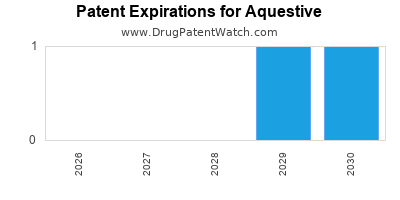
Last updated: July 26, 2026
Aquestive Inc. is positioned as a proprietary drug-delivery and formulation IP company built around oral-administered specialty products and platform technologies. The competitive risk profile is shaped by (1) patent estate density around taste-masked oral dosage forms and manufacturing processes, (2) Orange Book exclusivity windows for listed products, and (3) the typical Paragraph IV pathway for generics once exclusivity and key formulation claims expire. Because Aquestive’s core commercial footprint relies on a relatively narrow set of marketed products and platform-led follow-on assets, its upside and downside tend to track patent timelines, litigation outcomes, and payer/contracting dynamics rather than broad class competition.
What is Aquestive’s market position in specialty oral drug delivery and taste-masking?
Aquestive operates in a niche where product differentiation is driven by formulation performance, palatability, stability, and pediatric usability, supported by formulation and method-of-manufacture IP. Competitive positioning is less about “same API, same dose” substitution and more about whether generic developers can navigate three layers of barriers:
- Formulation lock: claims covering taste-masking, polymers, particle sizes, coating systems, and specific excipient matrices.
- Process lock: claims tied to manufacturing steps, granulation/extrusion/spray-drying parameters, and stability controls.
- Regulatory lock: exclusivity and listed Orange Book patents that constrain FDA approval pathways.
Which branded products and platforms anchor Aquestive’s competitive footprint?
Aquestive’s historically marketed revenue has been driven by oral dosage platforms with strong patient usability and packaging flexibility. Its competitive edge typically comes from:
- taste and stability engineering,
- dosing flexibility for pediatrics or patients with dysphagia,
- and line extensions that build around the same “delivery” platform with different APIs or strengths.
Competitive implication: direct-to-generic competition is delayed when the formulation or manufacturing claims are hard to design around, even when the active pharmaceutical ingredient itself is off-patent.
How many patents protect Aquestive’s key products, and what do they cover?
For an IP-driven platform company, the patent estate matters more than average claim counts. The relevant question for competitive entry is the share of patents tied to:
- formulation composition (excipients, polymer systems, coatings),
- process (manufacturing method claims),
- method of use (where applicable),
- device or delivery system claims (where applicable),
- and orphans/pediatric or exclusivity-related protection (where applicable).
Competitive implication: a dense estate split across composition plus process tends to produce longer litigation cycles and higher design-around costs for challengers.
Formulation patents: what claim types are most important for generic design-around?
Generic challengers typically argue that they can meet bioequivalence without copying the proprietary taste-masking system. Patent enforcement risk concentrates on:
- exact or functional ranges for excipient ratios,
- patent-defined particle engineering,
- coating and surface treatment parameters,
- dissolution and disintegration behavior specifications.
Method-of-manufacture patents: why do process claims matter post-ANDA?
A frequent failure mode for generic developers is assuming “the same final spec” is enough to avoid infringement. If method-of-manufacture claims exist and capture the steps needed to achieve the claimed final properties, the generic path shifts from formulation redesign to process redesign, which is slower and more expensive to validate.
When does exclusivity end for Aquestive products, and how does it affect Paragraph IV timing?
Exclusivity timing usually dominates launch windows. Competitive developers typically need two gates cleared:
- statutory exclusivity (often 5 years new chemical entity or 7 years orphan exclusivity depending on product history),
- listed Orange Book patents (composition, formulation, and method claims).
Competitive implication: even when a key patent expires, remaining formulation patents and any pediatric exclusivity extensions can keep Paragraph IV litigation from translating into a near-term launch.
What triggers the Paragraph IV “filing-to-launch” time compression?
For generics, the timeline compresses when:
- the challenged patents expire early,
- the settlement ends in an immediate or near-immediate effective date,
- and FDA approval is not delayed by labeling or manufacturing issues.
For brand owners, the timeline stretches when:
- there are multiple listed patents per product,
- there are pending appeals,
- or settlements include staggered launch dates.
What is the Orange Book status of Aquestive products and where are the litigation bottlenecks?
The practical Orange Book question is not “what is listed,” but “what is still enforceable at this point in time and how many of those patents are formulation or process claims.” Litigation bottlenecks show up as:
- multiple family members in different jurisdictions,
- overlapping composition and process coverage,
- and settlements that delay launch even after at least one patent expires.
Orange Book listing patterns that increase generic barriers
Common patterns that raise barriers for challengers:
- multiple formulation patents with staggered expiration dates,
- “platform” method patents that apply across several strengths or dosage presentations,
- continuation filings that extend claim coverage on manufacturing or dissolution profiles.
What patent expiration sequencing matters most for launch risk?
A key competitive insight is expiration sequencing within a product family. A single soon-to-expire patent may not translate into immediate generic entry if:
- another patent in the same family is later-expiring, or
- the settlement or injunction is tied to a later-expiring formulation/process patent.
Which companies are challenging Aquestive’s patents via Paragraph IV, and what have the cases resolved?
Generic challengers usually target the most vulnerable and valuable patents, then negotiate settlements that allocate market exclusivity via agreed entry dates.
Competitive implication: the identity and behavior of challengers predicts future filings. Repeat filers often accumulate a patent-navigation playbook across similar dosage form platforms.
How to read settlement agreements for competitive strategy
Settlements typically encode:
- the agreed “effective date” of entry,
- permitted generic launch scope (strengths, dosage forms, authorized labeling),
- any licensing payments or cross-licenses (rare in this segment but possible),
- and whether additional patents are dismissed or reserved.
From a competitive-strategy lens, the most important terms are:
- the earliest launch date that the challenger can operationalize,
- and whether the brand preserves additional enforcement against later products or strengths.
How strong is the patent estate for Aquestive oral dosage formulations?
Strength is best measured by enforceability, not by patent count alone. For an oral formulation company, strength indicators include:
- broad claim coverage across excipients and process parameters,
- litigation history showing willingness to assert,
- and claim sets with low design-around overlap.
Key “strength” dimensions for formulation-heavy IP
- Claim breadth vs. specificity
- Specific ranges can be harder to design around without affecting performance.
- Process claim linkage to formulation performance
- If claims capture the manufacturing steps required to achieve stability and dissolution, generic substitutes face higher development risk.
- Family size and continuation coverage
- Broad filing strategies create defense depth against generic circumvention.
What generic entry risks exist for Aquestive products once exclusivity and core patents expire?
Generic entry risk is not binary. It is layered:
- ANDA approval risk: whether FDA can accept equivalence without triggering a patent infringement presumption.
- Hatch-Waxman risk: likelihood of injunction or delay via litigation outcomes.
- Manufacturing risk: ability to produce stable, taste-masked product at scale consistent with commercial specs.
- Payer/contract risk: whether formularies will switch to the generic rapidly after launch.
Generic launch scenarios: how delays typically occur
Common delay drivers:
- settlement effective dates after patent expiration,
- additional patents not dismissed,
- manufacturing validation issues,
- or label negotiations where the brand maintains specific language that affects switching.
How does Aquestive’s competitive landscape compare with other specialty formulation and drug-delivery companies?
Compared with generic-focused players and pure drug-development biopharma, Aquestive’s peers are formulation and delivery companies that monetize IP around dose experience: taste, stability, and usability.
Competitive differentiation tends to follow:
- platform repeatability (new products on the same “technology”),
- licensing partnerships (to expand pipeline without full clinical buildout),
- and faster post-approval optimization (scale and stability improvements that extend patent value).
Competitive implication: firms with stronger process-and-formulation claim coverage can keep generic threats at bay longer, which supports more predictable cash flows.
What R&D and licensing strategy best protects Aquestive’s growth amid generic pressure?
For IP-heavy formulation players, the strategic defense is to keep extending protection around:
- improvements to dissolution profiles,
- alternative compositions with better stability,
- additional dosage presentations (strengths, formats),
- and manufacturing process refinements that preserve performance while narrowing generic design-around viability.
Follow-on product strategies that typically extend market exclusivity
- new strengths or dosage forms,
- improved release profiles or stability-optimized formulations,
- and “platform” variants that reuse the same enabling manufacturing approach but with different claimable composition/process features.
Key Takeaways
- Aquestive’s competitive advantage is IP-driven around oral drug-delivery performance, with barriers concentrated in formulation and method-of-manufacture claims rather than the active pharmaceutical ingredient alone.
- Competitive launch risk for generics is governed by Orange Book patent listings plus exclusivity timing and, critically, by the settlement and litigation outcomes tied to those patents.
- Patent estate strength for taste-masked and stability-sensitive oral dosage forms typically correlates with claim linkage between manufacturing steps and final performance attributes.
- Strategy that extends protection through follow-on formulations, dosage presentations, and manufacturing improvements is central to preserving revenue against Paragraph IV challenges.
- Competitive dynamics are dominated by timeline execution: patent expiration sequencing, settlement effective dates, and manufacturing readiness at generic launch.
FAQs
1) What kinds of patents most often block generic substitution for taste-masked oral drugs?
Answer: Formulation composition patents covering excipient systems and taste-masking agents, plus method-of-manufacture claims tied to processing that drives dissolution, stability, and sensory performance.
2) How do Orange Book listed patents typically influence Paragraph IV strategy for challengers?
Answer: Challengers select the patents with the highest likelihood of invalidation or non-infringement, then time filings to maximize the chance of a launch after expiration and favorable litigation outcomes.
3) What settlement terms matter most for future generic launch timing?
Answer: The effective launch date, the scope of permitted strengths/dosage forms, and whether any additional patents remain enforceable against subsequent products.
4) What does “design-around” usually mean for formulation-heavy ANDAs?
Answer: Replacing or reengineering excipient matrices, coating/treatment approaches, or manufacturing steps to avoid infringement while still meeting bioequivalence and dissolution/sensory specifications.
5) How do payer decisions affect the commercial impact of generic entry?
Answer: Even after FDA approval, switch speed depends on formulary access, negotiated pricing, and contracting terms, which can blunt near-term revenue erosion.
References (APA)
- FDA. Orange Book: Approved Drug Products with Therapeutic Equivalence Evaluations. U.S. Food and Drug Administration. https://www.accessdata.fda.gov/scripts/cder/daf/
- FDA. Hatch-Waxman Act: Patents and exclusivity provisions. U.S. Food and Drug Administration. https://www.fda.gov/drugs/hatch-waxman-drug-products
- U.S. FDA. Paragraph IV and ANDA litigation overview (Hatch-Waxman framework). U.S. Food and Drug Administration. https://www.fda.gov/drugs/generic-drugs/hatch-waxman-act-and-generic-drug-competition