Last updated: September 8, 2026
Nystatin is a mature, low-cost antifungal with broad generic availability and limited branded pharmaceutical value. Its market is driven by recurring treatment demand, primary-care prescribing, hospital formularies, dermatology and gynecology use, and over-the-counter or pharmacy-dispensed products in some countries. The original molecule has no meaningful remaining composition-of-matter exclusivity. Commercial competition centers on manufacturing cost, regulatory compliance, formulation quality, distribution, and retail access rather than patent barriers.
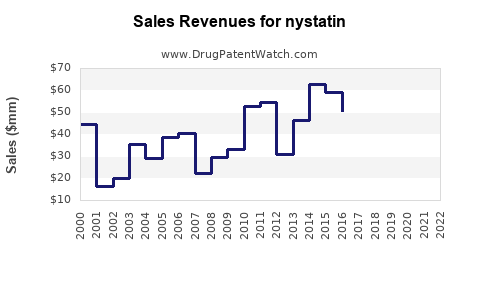
Public companies generally do not disclose standalone nystatin revenue. Financial estimates must therefore be treated as product-market estimates rather than audited manufacturer sales.
What is nystatin and how is it used?
Nystatin is a polyene antifungal antibiotic used primarily against Candida species. It binds to ergosterol in fungal cell membranes, increasing membrane permeability and causing fungal-cell death. Because systemic absorption from most oral and topical formulations is limited, nystatin is used mainly for localized infections.
| Product type |
Common indication |
Commercial characteristics |
| Oral suspension |
Oral candidiasis, including thrush |
Prescription and pharmacy-dispensed; frequently used in pediatrics |
| Oral tablets |
Intestinal candidiasis in selected markets |
Smaller segment than suspension and topical products |
| Cream, ointment, or powder |
Cutaneous candidiasis and intertrigo |
Highly genericized; competes with azole antifungals |
| Vaginal tablets or cream |
Vulvovaginal candidiasis |
Market share varies by country and treatment guidelines |
| Combination products |
Fungal infections with dermatologic symptoms |
May contain corticosteroids, antibacterials, or zinc oxide |
Nystatin is not generally used for invasive systemic fungal infections because it has poor systemic absorption and significant toxicity when administered systemically. Modern systemic antifungal treatment relies more heavily on azoles, echinocandins, and amphotericin B formulations.
The FDA-approved label for nystatin oral suspension identifies treatment of candidiasis in the oral cavity. Topical products are approved for superficial fungal infections, including cutaneous candidiasis [1][2].
How large is the nystatin market?
The global nystatin market is a small, fragmented generic market. Commercial research firms publish materially different estimates because they define the market differently. Some include only prescription products; others include hospital, retail, consumer-health, combination, and regional products.
A defensible commercial conclusion is that nystatin generates a low hundreds-of-millions-dollar global market at most, with substantial uncertainty around the inclusion of nonprescription and combination products. No reliable public source supports a single audited global revenue figure for the active ingredient.
Market structure by product
Topical formulations are generally the largest commercial segment by volume because they are inexpensive, easy to manufacture, and used across dermatology, primary care, and gynecology. Oral suspension remains strategically important because it is widely used for oral thrush, particularly in infants and immunocompromised patients.
Vaginal products are more exposed to competition from fluconazole, clotrimazole, miconazole, and other azoles. Nystatin may retain use where local prescribing practices, pregnancy considerations, resistance concerns, or formulary preferences support it.
Geographic dynamics
North America has a mature generic market with low unit pricing and multiple suppliers. Europe has substantial country-level variation because reimbursement, prescription status, and formulary placement differ by national health system. Latin America, Asia, and parts of the Middle East have broader use of topical and combination products, but regulatory enforcement and product-quality standards vary.
Demand is strongest where:
- Candida infections are common in primary care and pediatrics.
- Nystatin remains included in national treatment guidelines.
- Retail pharmacy access is high.
- Low-cost topical and oral antifungal therapy is favored.
- Local manufacturers can supply hospitals and pharmacies at low prices.
What is the financial trajectory for nystatin?
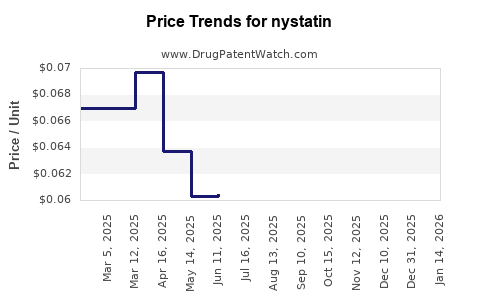
Nystatin revenue is likely stable to modestly declining in developed markets, with unit-price pressure offset partly by persistent volume. The product has no conventional branded-growth profile.
Financial drivers
The main revenue drivers are:
- Patient volume for oral thrush, diaper-associated candidiasis, cutaneous candidiasis, and vulvovaginal candidiasis.
- Product availability, especially for oral suspension.
- Pediatric prescribing and hospital supply contracts.
- Retail pharmacy and consumer-health distribution.
- Regional treatment guidelines.
- Manufacturing reliability and active pharmaceutical ingredient supply.
The main financial constraints are:
- Multiple generic competitors.
- Minimal differentiation among standard formulations.
- Low reimbursement prices.
- Substitution by topical azoles and fluconazole.
- Limited ability to raise prices without losing formulary or pharmacy share.
- Small average treatment values.
- Regulatory and quality-control costs that can be material relative to product revenue.
Manufacturer economics
Nystatin can remain commercially viable because the products are mature and manufacturing processes are established. Profitability depends on scale, procurement efficiency, capacity utilization, and portfolio economics. A manufacturer with an existing topical, oral-liquid, or hospital-product infrastructure can earn acceptable margins even when the individual product has a low selling price.
Standalone investment in a new nystatin product is less attractive unless it offers one of the following:
- A differentiated delivery system.
- Better taste or dosing convenience for pediatric oral suspension.
- A preservative-free or allergen-reduced formulation.
- Improved stability or packaging.
- A combination product with regulatory and commercial value.
- Access to a protected regional market.
- A supply agreement with hospitals or government buyers.
When did nystatin lose exclusivity?
Nystatin's original molecule is long out of patent protection. It was discovered in the early 1950s and entered commercial use decades ago. Any original composition-of-matter patent rights expired many years ago, and generic competition has existed for decades.
There is no current market exclusivity comparable to the exclusivity periods for recently approved small-molecule drugs. The FDA's standard five-year new chemical entity exclusivity is not relevant to the current nystatin market because nystatin is an established active ingredient with long-standing approvals.
| Exclusivity category |
Current commercial relevance |
| Original composition patent |
Expired |
| New chemical entity exclusivity |
Expired or not applicable to current products |
| Orphan-drug exclusivity |
Not a material market feature |
| Pediatric exclusivity |
No known market-defining current exclusivity |
| Formulation patents |
Potentially relevant to specific products, not the core molecule |
| Data exclusivity |
Not a meaningful barrier to ordinary generic nystatin |
What patents protect nystatin products?
The active ingredient itself is not protected by a live, commercially significant U.S. composition patent. Patent exposure, where it exists, is more likely to involve a particular formulation, delivery method, combination, packaging system, or manufacturing process.
Potentially relevant patent categories include:
- Stable oral suspensions.
- Taste-masked pediatric formulations.
- Mucoadhesive oral delivery systems.
- Controlled-release dosage forms.
- Vaginal delivery systems.
- Nystatin combinations with corticosteroids or antibacterials.
- Manufacturing or purification processes.
- Novel excipient systems.
These patents generally do not prevent competitors from selling conventional nystatin cream, ointment, powder, suspension, or tablet products. They may constrain a specific branded formulation if the formulation has technically meaningful differences and an enforceable patent.
How strong is the nystatin patent estate?
The core nystatin patent estate is weak because the molecule is old, generic competition is entrenched, and conventional dosage forms are readily replicated. Formulation patents can have moderate value when they cover a clinically meaningful improvement, but their commercial strength is limited by:
- Easy substitution with another nystatin formulation.
- The availability of non-infringing conventional products.
- Narrow claim scope.
- Difficulty proving meaningful commercial value.
- Low product prices and limited litigation budgets.
Patent protection is therefore unlikely to support premium pricing for ordinary nystatin products.
What is the FDA regulatory status of nystatin?
Nystatin is an FDA-approved antifungal active ingredient sold in multiple dosage forms. U.S. regulatory status differs by product and manufacturer. FDA approval does not mean that every formulation, strength, or combination product is interchangeable with every other product.
The principal FDA pathways include:
- Abbreviated New Drug Applications for generic products.
- New Drug Applications for certain branded or reformulated products.
- OTC pathways in markets or indications where the product satisfies applicable requirements.
- Drug-quality and manufacturing compliance obligations for all approved products.
The FDA's Drugs@FDA database and product labeling provide the authoritative record for individual approvals, indications, strengths, manufacturers, and regulatory histories [1]. DailyMed provides current labeling for many marketed prescription and nonprescription products [2].
What is the Orange Book status of nystatin?
Nystatin products may appear in FDA product databases, but the Orange Book does not create exclusivity for the active ingredient. The commercial significance of any Orange Book listing depends on the individual reference product, listed patents, dosage form, and whether an approved generic has a therapeutic-equivalence rating.
For ordinary nystatin products, the practical market position is one of established generic competition. Any Orange Book patent listing should be reviewed at the specific product level rather than inferred from the existence of nystatin as an active ingredient.
Are there Paragraph IV challenges for nystatin?
Paragraph IV litigation is unlikely to be a central current issue for standard nystatin products. A Paragraph IV certification is relevant when a generic applicant challenges a listed patent for a reference drug. Since ordinary nystatin products have long been genericized, the principal commercial contest is usually between approved suppliers rather than between an innovative reference company and first-wave generic challengers.
A Paragraph IV dispute could arise for a newly patented delivery system or reformulated nystatin product. That would concern the specific formulation, not the underlying nystatin molecule.
What litigation affects nystatin?
No major, market-defining U.S. patent litigation is generally associated with conventional nystatin cream, ointment, powder, oral suspension, or vaginal products. The more likely legal disputes involve:
- Manufacturing violations and product-quality failures.
- Labeling or advertising claims.
- Trademark and trade-dress rights.
- Pharmacy substitution and reimbursement.
- Contract disputes involving supply.
- Patent claims directed to a specialized formulation.
Because unit prices are low, expected damages from ordinary nystatin products are usually insufficient to justify extensive patent litigation unless a product has unusually large market share or is part of a broader portfolio dispute.
Which companies compete in the nystatin market?
Competition is fragmented across generic manufacturers, specialty pharmaceutical companies, contract manufacturers, and regional suppliers. Depending on product and country, market participants may include companies such as Taro Pharmaceutical Industries, ANI Pharmaceuticals, Padagis, Rising Pharma, Amneal Pharmaceuticals, and other generic or regional manufacturers. Brand ownership and supply relationships can change through acquisitions, licensing, divestitures, and private-label arrangements.
The relevant competitive advantage is usually operational:
| Competitive factor |
Impact |
| Reliable API sourcing |
Reduces shortages and production interruptions |
| Oral-liquid manufacturing |
Supports pediatric and hospital demand |
| Topical manufacturing scale |
Lowers cost per unit |
| Regulatory compliance |
Protects approval and supply continuity |
| Pharmacy distribution |
Determines prescription capture |
| Formulation quality |
Reduces recalls and substitution |
| Government tender access |
Supports high-volume, low-margin sales |
No single company has a durable monopoly over conventional nystatin products.
What generic entry risks exist?
Generic entry risk is already realized rather than prospective. Nystatin has been subject to generic competition for many years. The principal risk to an existing manufacturer is loss of market share, price erosion, supply interruption, or a competitor's regulatory approval for the same dosage form.
A new entrant could affect pricing if it has:
- Lower manufacturing costs.
- More reliable supply.
- Preferred wholesaler access.
- A larger product portfolio.
- A lower-cost active pharmaceutical ingredient source.
- A successful hospital-tender strategy.
A shortage can temporarily improve pricing or market share for remaining suppliers, but these effects are usually unstable once supply normalizes.
How does nystatin compare with competing antifungals?
| Drug |
Main use |
Competitive position |
| Nystatin |
Local Candida infections |
Low-cost, established, limited systemic absorption |
| Clotrimazole |
Topical and vaginal fungal infections |
Strong topical and gynecologic substitute |
| Miconazole |
Topical and vaginal infections |
Broad retail availability |
| Fluconazole |
Systemic and mucosal Candida infections |
More convenient systemic therapy; greater interaction and resistance considerations |
| Ketoconazole |
Selected topical uses |
Reduced systemic role because of safety concerns |
| Amphotericin B |
Serious systemic fungal infection |
Hospital product; not a direct substitute for ordinary topical nystatin |
Nystatin's commercial position is strongest where local therapy is sufficient, low price is important, and prescribers prefer a long-established antifungal. Its position is weaker where single-dose or short-course azole treatment is preferred.
What licensing deals and manufacturing barriers matter?
Large nystatin licensing transactions are uncommon because the molecule is generic and low-priced. Commercial arrangements are more likely to involve contract manufacturing, private-label supply, regional distribution, API procurement, or acquisition of established product portfolios.
Manufacturing remains a meaningful barrier despite the absence of molecule patents. Nystatin is produced by fermentation, followed by recovery, purification, standardization, and formulation. Quality variation can affect potency, stability, impurity profiles, and finished-product performance. Regulatory authorities may scrutinize microbial control, batch consistency, residual impurities, and manufacturing documentation.
The most important IP and supply barriers are therefore formulation-specific and operational rather than foundational patent barriers.
Key Takeaways
- Nystatin is a mature generic antifungal with no meaningful remaining core-molecule exclusivity.
- The market is fragmented, price-sensitive, and supported by recurring demand for oral, topical, and vaginal products.
- Public manufacturers generally do not report standalone nystatin revenue.
- Global market estimates vary because commercial reports use inconsistent product and geographic definitions.
- Topical products likely represent the largest volume segment, while oral suspension remains strategically important.
- Generic entry has already occurred; future risk centers on price erosion, supply reliability, and market-share shifts.
- Formulation patents may protect specific delivery systems, but they do not create broad protection for conventional nystatin.
- Nystatin competes mainly with clotrimazole, miconazole, and fluconazole.
- Manufacturing quality, API supply, hospital tenders, and distribution are more important than patent exclusivity.
- The financial trajectory is mature and volume-driven, with limited prospects for branded-style revenue growth.
FAQs
Is nystatin still commercially profitable?
Yes, but profitability depends on manufacturing scale, supply reliability, product mix, and distribution. Conventional products have low prices and limited pricing power.
Is nystatin an antibiotic or an antifungal?
Nystatin is a polyene antifungal antibiotic. It is used to treat Candida and other susceptible fungal infections, not bacterial infections.
Does nystatin have a biosimilar market?
No. Biosimilars apply to biologic products. Nystatin is a small-molecule, fermentation-derived antifungal marketed through conventional drug approval pathways.
Can a company obtain new patents on nystatin?
A company may obtain patents on a novel formulation, delivery system, combination, manufacturing process, or use if statutory patent requirements are satisfied. A new patent would not restore protection to the old molecule itself.
Why does nystatin remain in use despite newer antifungals?
Nystatin remains inexpensive, familiar to clinicians, effective for localized Candida infections, and useful when systemic exposure is undesirable. Its limitations are poor systemic absorption and competition from newer or more convenient antifungal therapies.
References
-
U.S. Food and Drug Administration. (2024). Drugs@FDA: FDA-approved drugs. https://www.accessdata.fda.gov/scripts/cder/daf/
-
National Library of Medicine. (2024). DailyMed: Current medication information. https://dailymed.nlm.nih.gov/dailymed/
-
U.S. Food and Drug Administration. (2024). Approved drug products with therapeutic equivalence evaluations. https://www.fda.gov/drugs/drug-approvals-and-databases/orange-book-data-files
-
U.S. Food and Drug Administration. (2024). Nystatin oral suspension prescribing information. Drugs@FDA and DailyMed labeling resources.
-
World Health Organization. (2023). WHO model list of essential medicines, 23rd list. https://www.who.int/publications/i/item/WHO-MHP-HPS-EML-2023.02