Levofloxacin - Generic Drug Details
✉ Email this page to a colleague
What are the generic drug sources for levofloxacin and what is the scope of freedom to operate?
Levofloxacin
is the generic ingredient in six branded drugs marketed by Janssen Pharms, Avet Lifesciences, Baxter Hlthcare Corp, Eugia Pharma, Gland, Hospira, Pharmobedient, Rising, Zydus Pharms, Fresenius Kabi Usa, Hikma Farmaceutica, Inforlife, Knack, Santen, Micro Labs Ltd India, Rubicon Research, Sciegen Pharms, Watson Labs Teva, Lannett Co Inc, Novitium Pharma, Apotex Inc, Aurobindo Pharma Ltd, Chartwell Molecular, Chartwell Rx, Dr Reddys Labs Inc, Glenmark Pharms Ltd, Hec Pharm, Hetero Labs Ltd V, Jubilant Generics, Lupin, Macleods Pharms Ltd, Natco Pharma, Orbion Pharms, Sandoz, Teva, Torrent Pharms, Watson Labs Inc, and Zydus Lifesciences, and is included in forty-eight NDAs. Additional information is available in the individual branded drug profile pages.Forty-three suppliers are listed for this compound. There are four tentative approvals for this compound.
Summary for levofloxacin
| US Patents: | 0 |
| Tradenames: | 6 |
| Applicants: | 38 |
| NDAs: | 48 |
| Finished Product Suppliers / Packagers: | 43 |
| Raw Ingredient (Bulk) Api Vendors: | 84 |
| Clinical Trials: | 318 |
| Patent Applications: | 5,397 |
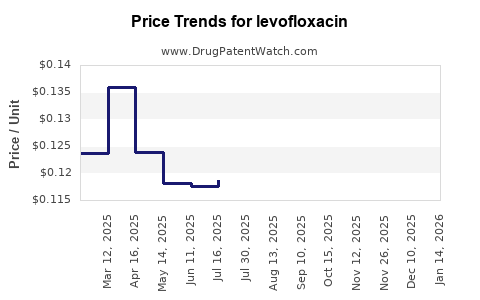
| Drug Prices: | Drug price trends for levofloxacin |
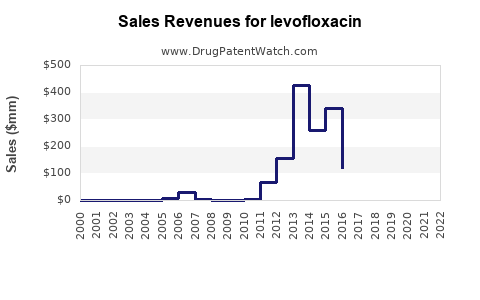
| Drug Sales Revenues: | Drug sales revenues for levofloxacin |
| What excipients (inactive ingredients) are in levofloxacin? | levofloxacin excipients list |
| DailyMed Link: | levofloxacin at DailyMed |
Recent Clinical Trials for levofloxacin
Identify potential brand extensions & 505(b)(2) entrants
| Sponsor | Phase |
|---|---|
| University of Virginia | PHASE3 |
| National Institute of Allergy and Infectious Diseases (NIAID) | PHASE3 |
| Gadjah Mada University | PHASE4 |
Generic filers with tentative approvals for LEVOFLOXACIN
| Applicant | Application No. | Strength | Dosage Form |
| ⤷ Start Trial | ⤷ Start Trial | 5MG/ML | INJECTABLE; INJECTION |
| ⤷ Start Trial | ⤷ Start Trial | 750MG | TABLET; ORAL |
| ⤷ Start Trial | ⤷ Start Trial | 500MG | TABLET; ORAL |
The 'tentative' approval signifies that the product meets all FDA standards for marketing, and, but for the patents / regulatory protections, it would approved.
Medical Subject Heading (MeSH) Categories for levofloxacin
Anatomical Therapeutic Chemical (ATC) Classes for levofloxacin
Paragraph IV (Patent) Challenges for LEVOFLOXACIN
| Tradename | Dosage | Ingredient | Strength | NDA | ANDAs Submitted | Submissiondate |
|---|---|---|---|---|---|---|
| LEVAQUIN | Oral Solution | levofloxacin | 25 mg/mL | 021721 | 1 | 2009-07-30 |
US Patents and Regulatory Information for levofloxacin
| Applicant | Tradename | Generic Name | Dosage | NDA | Approval Date | TE | Type | RLD | RS | Patent No. | Patent Expiration | Product | Substance | Delist Req. | Exclusivity Expiration |
|---|---|---|---|---|---|---|---|---|---|---|---|---|---|---|---|
| Chartwell Rx | LEVOFLOXACIN | levofloxacin | TABLET;ORAL | 090367-001 | Jun 20, 2011 | DISCN | No | No | ⤷ Start Trial | ⤷ Start Trial | ⤷ Start Trial | ||||
| Orbion Pharms | LEVOFLOXACIN | levofloxacin | TABLET;ORAL | 202200-001 | Jan 30, 2012 | AB | RX | No | No | ⤷ Start Trial | ⤷ Start Trial | ⤷ Start Trial | |||
| Hikma Farmaceutica | LEVOFLOXACIN IN DEXTROSE 5% IN PLASTIC CONTAINER | levofloxacin | INJECTABLE;INJECTION | 091375-002 | Sep 16, 2011 | AP | RX | No | No | ⤷ Start Trial | ⤷ Start Trial | ⤷ Start Trial | |||
| Zydus Lifesciences | LEVOFLOXACIN | levofloxacin | TABLET;ORAL | 077652-001 | Sep 7, 2012 | AB | RX | No | No | ⤷ Start Trial | ⤷ Start Trial | ⤷ Start Trial | |||
| Inforlife | LEVOFLOXACIN IN DEXTROSE 5% IN PLASTIC CONTAINER | levofloxacin | INJECTABLE;INJECTION | 090343-002 | Jul 7, 2011 | AP | RX | No | Yes | ⤷ Start Trial | ⤷ Start Trial | ⤷ Start Trial | |||
| >Applicant | >Tradename | >Generic Name | >Dosage | >NDA | >Approval Date | >TE | >Type | >RLD | >RS | >Patent No. | >Patent Expiration | >Product | >Substance | >Delist Req. | >Exclusivity Expiration |
Expired US Patents for levofloxacin
| Applicant | Tradename | Generic Name | Dosage | NDA | Approval Date | Patent No. | Patent Expiration |
|---|---|---|---|---|---|---|---|
| Janssen Pharms | LEVAQUIN | levofloxacin | INJECTABLE;INJECTION | 020635-001 | Dec 20, 1996 | ⤷ Start Trial | ⤷ Start Trial |
| Santen | QUIXIN | levofloxacin | SOLUTION/DROPS;OPHTHALMIC | 021199-001 | Aug 18, 2000 | ⤷ Start Trial | ⤷ Start Trial |
| Santen | QUIXIN | levofloxacin | SOLUTION/DROPS;OPHTHALMIC | 021199-001 | Aug 18, 2000 | ⤷ Start Trial | ⤷ Start Trial |
| Santen | QUIXIN | levofloxacin | SOLUTION/DROPS;OPHTHALMIC | 021199-001 | Aug 18, 2000 | ⤷ Start Trial | ⤷ Start Trial |
| Janssen Pharms | LEVAQUIN | levofloxacin | TABLET;ORAL | 020634-002 | Dec 20, 1996 | ⤷ Start Trial | ⤷ Start Trial |
| >Applicant | >Tradename | >Generic Name | >Dosage | >NDA | >Approval Date | >Patent No. | >Patent Expiration |
EU/EMA Drug Approvals for levofloxacin
| Company | Drugname | Inn | Product Number / Indication | Status | Generic | Biosimilar | Orphan | Marketing Authorisation | Marketing Refusal |
|---|---|---|---|---|---|---|---|---|---|
| Chiesi Farmaceutici S.p.A | Quinsair | levofloxacin | EMEA/H/C/002789Quinsair is indicated for the management of chronic pulmonary infections due to Pseudomonas aeruginosa in adult patients with cystic fibrosis.Consideration should be given to official guidance on the appropriate use of antibacterial agents. | Authorised | no | no | no | 2015-03-25 | |
| >Company | >Drugname | >Inn | >Product Number / Indication | >Status | >Generic | >Biosimilar | >Orphan | >Marketing Authorisation | >Marketing Refusal |
