Last updated: September 8, 2026
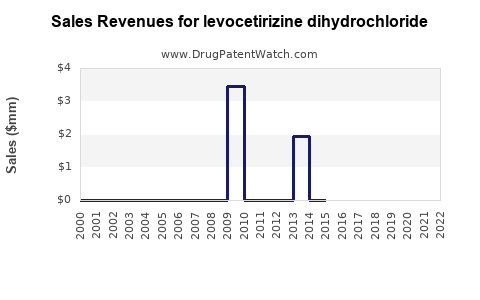
Levocetirizine dihydrochloride is a mature, largely generic antihistamine with stable underlying demand but limited pricing power. The U.S. brand, Xyzal, moved from prescription to over-the-counter status in 2017, accelerating generic and private-label competition. Public companies generally do not report levocetirizine revenue separately, so the financial trajectory is best assessed through product lifecycle, channel mix, pricing, competition, and regulatory exposure rather than a single audited market-revenue figure.
What is levocetirizine dihydrochloride and how is it used?
Levocetirizine is the active R-enantiomer of cetirizine, a second-generation H1 antihistamine. Levocetirizine dihydrochloride is used for:
- Seasonal allergic rhinitis
- Perennial allergic rhinitis
- Chronic idiopathic urticaria
- Allergy-related nasal and ocular symptoms
The principal marketed strengths are 5 mg tablets and oral solution. The product is administered once daily and competes with cetirizine, loratadine, desloratadine, and fexofenadine.
UCB developed levocetirizine and commercialized it under the Xyzal brand. The U.S. Food and Drug Administration approved Xyzal tablets in 2007 for prescription use. FDA later approved the product for nonprescription use, and Xyzal OTC entered the U.S. market in 2017. [1, 2]
What is the current market position of levocetirizine?
Levocetirizine occupies a mature position in the oral antihistamine market. Its commercial profile has four defining characteristics:
| Market factor |
Current effect |
| Product age |
Limits premium pricing and reduces brand differentiation |
| OTC availability |
Expands consumer access but increases retail competition |
| Generic supply |
Compresses average selling prices |
| Seasonal demand |
Creates recurring peaks during allergy seasons |
| Clinical familiarity |
Supports stable volume and physician recognition |
| Low formulation complexity |
Creates limited barriers to entry for standard tablets |
The product has a durable demand base because allergic rhinitis and urticaria are chronic or recurrent conditions. Demand is less dependent on new diagnosis than branded specialty medicines because patients can self-select therapy and switch among antihistamines.
Sales are concentrated in retail pharmacies, mass merchants, grocery chains, e-commerce channels, and private-label OTC programs. Prescription demand remains relevant in some markets outside the United States, but U.S. growth is primarily tied to consumer purchasing and retailer distribution.
How large is the levocetirizine market?
No authoritative public source provides a consolidated, audited global revenue figure for levocetirizine dihydrochloride across prescription, OTC, branded, generic, hospital, and private-label channels. Commercial market-research estimates vary materially because they use different geographic coverage, product definitions, and channel assumptions.
The more reliable conclusion is structural:
- The market is mature rather than discovery-driven.
- Unit demand is relatively stable.
- Revenue growth depends mainly on geographic expansion, retail placement, and formulation extensions.
- Average prices face long-term erosion from generic and private-label supply.
- Brand revenue is more exposed to substitution than total category demand.
The relevant financial distinction is between total category sales and originator sales. Total levocetirizine consumption can remain stable while the original branded product loses share and price.
What is the financial trajectory for levocetirizine?
Originator trajectory
The originator financial trajectory follows a conventional lifecycle:
| Period |
Commercial stage |
Financial effect |
| 2007-2010 |
U.S. prescription launch |
Higher price and brand-building investment |
| 2011-2016 |
Mature prescription product |
Increasing generic-entry and patent-expiry pressure |
| 2017 onward |
OTC conversion |
Wider consumer reach, lower exclusivity, greater retail competition |
| Current period |
Generic and private-label maturity |
Stable volume with low price growth and limited brand leverage |
The OTC switch increased the addressable consumer base but changed the economics. Prescription products can obtain higher unit prices through insurance reimbursement and physician prescribing. OTC products rely on shelf placement, advertising, retailer negotiations, promotional activity, and brand recognition.
For UCB and other brand-rights holders, levocetirizine is unlikely to be a major growth driver relative to newer specialty or biologic products. The principal financial value is lifecycle cash generation, international commercialization, and portfolio breadth rather than significant future pricing expansion.
Generic and private-label trajectory
Generic manufacturers typically compete on:
- Wholesale acquisition price
- Retailer supply reliability
- Tablet and solution availability
- Packaging and private-label capability
- Regulatory compliance
- International registration coverage
Because levocetirizine tablets are chemically stable and relatively simple to manufacture, manufacturing scale and distribution efficiency matter more than proprietary technology. Generic suppliers can experience volume growth while revenue per tablet declines.
Private-label products can capture substantial retail demand because consumers often view oral antihistamines as interchangeable. Retailers may prioritize store-brand products over branded Xyzal when the active ingredient, strength, and dosing schedule are comparable.
What patents protect levocetirizine dihydrochloride?
The principal patent protection for levocetirizine was associated with the active enantiomer, pharmaceutical compositions, and related manufacturing or formulation claims. The commercially important U.S. patent period has ended, and levocetirizine is now a generic and OTC product in the United States.
The original composition and product patents do not create a current broad barrier comparable to the patent estate for a recently launched small molecule. Any remaining patents must be evaluated individually by jurisdiction, dosage form, claim scope, and legal status.
Patent categories relevant to levocetirizine
| Patent category |
Commercial relevance today |
| Active-ingredient or enantiomer claims |
Historical originator protection; no longer a broad U.S. market barrier |
| Salt or crystalline-form claims |
May affect specific manufacturing routes or forms in selected jurisdictions |
| Tablet formulation claims |
Generally limited where equivalent generic products are already approved |
| Oral-solution claims |
Relevant to excipients, concentration, stability, or container systems |
| Method-of-use claims |
Potentially relevant outside the United States or for narrow indications |
| Manufacturing-process claims |
May affect a supplier’s process but usually do not block all alternative routes |
The main residual IP risk is not a broad monopoly over levocetirizine. It is the possibility of narrow, jurisdiction-specific claims covering a particular solid form, process, excipient system, or combination product.
When did levocetirizine lose exclusivity?
U.S. market exclusivity ended years before the current OTC maturity phase. Xyzal was approved as a prescription product in 2007, and levocetirizine subsequently became available from multiple generic suppliers. FDA approved the OTC switch in 2017, placing the brand into direct competition with generic and store-brand products in the consumer channel. [1, 2]
The important commercial event was not a single current patent expiry date. It was the transition from an originator-controlled prescription product to a widely substitutable OTC category.
What is the Orange Book status of levocetirizine?
Xyzal was approved under an FDA new drug application and was subject to the U.S. patent-listing framework applicable to approved prescription products. FDA’s Orange Book records approved products and relevant patent or exclusivity information for eligible applications. [3]
Current commercial analysis should distinguish:
- The historic prescription NDA
- Generic abbreviated new drug applications
- OTC monograph or OTC NDA status
- Patents that have expired
- Patents that are listed but no longer commercially blocking
- Product-specific formulation or labeling rights
The Orange Book is not a substitute for a live patent-register review. For a mature active ingredient, the practical question is whether an asserted patent can block an ANDA or OTC product, not whether a historical patent number appears in the regulatory record.
Which companies are challenging or competing with Xyzal?
Competition comes from both levocetirizine suppliers and substitute antihistamine brands.
Direct competitors
- Generic levocetirizine manufacturers
- Store-brand levocetirizine products
- International branded levocetirizine products
- Pharmacy and e-commerce private labels
Therapeutic substitutes
| Product |
Active ingredient |
Competitive position |
| Zyrtec and generics |
Cetirizine |
Closest pharmacologic substitute |
| Claritin and generics |
Loratadine |
Strong OTC brand and low-sedation positioning |
| Allegra and generics |
Fexofenadine |
Strong non-drowsy positioning |
| Clarinex and generics |
Desloratadine |
Prescription and OTC substitute in selected markets |
| Benadryl |
Diphenhydramine |
Older sedating antihistamine, often lower-priced |
Competition is determined less by patent status than by consumer recognition, price, sedation perceptions, retailer promotion, and availability.
What is the FDA regulatory status of levocetirizine?
Levocetirizine has an established FDA regulatory pathway for oral tablets and oral solution. Xyzal’s U.S. OTC approval expanded access beyond the prescription channel. FDA-approved labeling identifies allergic rhinitis and chronic urticaria as core uses. [1, 2]
Regulatory risk is relatively low for standard oral products because the active ingredient has a long clinical and manufacturing history. Risk remains for:
- Labeling errors
- Dose-related pediatric issues
- Product contamination
- Stability failures in oral solution
- Manufacturing deviations
- OTC advertising or labeling noncompliance
The OTC format also shifts risk toward consumer safety, readability, child-resistant packaging, and retail compliance.
What formulations are protected by levocetirizine patents?
The commercially relevant formulations include:
- 5 mg immediate-release tablets
- Oral solution
- Potential regional capsules, syrups, or combination products
Standard immediate-release tablets generally have low technical differentiation. Oral solutions can create more complex development requirements because manufacturers must demonstrate preservative effectiveness, chemical stability, microbial control, dose uniformity, and packaging compatibility.
Formulation patents can still matter when they claim a narrow excipient combination, improved stability profile, taste masking system, or delivery format. Such patents are unlikely to restore broad exclusivity for the active ingredient but can create targeted barriers for a particular product presentation.
What patent litigation affects levocetirizine?
Levocetirizine is not associated with a current litigation profile comparable to high-value branded drugs facing multiple Paragraph IV challenges. The major litigation risk was historically linked to generic entry and originator patent enforcement.
For current diligence, the more relevant questions are:
- Whether a supplier relies on a patented crystalline form
- Whether an ANDA certification challenged a listed patent
- Whether any settlement restricts launch timing
- Whether a foreign market maintains active formulation or process claims
- Whether a product is sold under a license or technology-transfer agreement
Publicly disclosed, material licensing deals tied specifically to levocetirizine are limited. UCB’s historic commercialization arrangements and later OTC commercialization relationships are more relevant than active exclusivity agreements. [4]
How strong is the levocetirizine patent estate?
The estate is weak as a broad blocking portfolio and potentially moderate for narrow technical claims.
| Dimension |
Assessment |
| Active-ingredient protection |
Expired or commercially exhausted in the main U.S. market |
| Formulation protection |
Narrow and product-specific |
| Process protection |
Potentially relevant to individual suppliers |
| Method-of-use protection |
Limited commercial leverage for established indications |
| Geographic coverage |
Varies significantly by country |
| Enforcement leverage |
Low against ordinary generic tablets |
| Lifecycle-extension potential |
Limited without a differentiated delivery system |
The strongest remaining barriers are operational rather than patent-based: regulatory approval, reliable supply, retailer qualification, quality systems, and cost-efficient manufacturing.
What generic launch risks exist?
Generic launch risk is low from a patent perspective but remains material operationally.
Key risks include:
- FDA manufacturing observations or warning letters.
- Inability to secure active pharmaceutical ingredient supply.
- Price competition that makes low-volume products uneconomic.
- Retailer delisting or failure to obtain shelf placement.
- Recalls involving contamination, packaging, or labeling.
- Foreign registration delays.
- Oral-solution stability or preservative failures.
The most likely launch model is a low-price tablet product sold through wholesalers, retail chains, e-commerce platforms, or private-label agreements. A new entrant is more likely to compete on cost and supply reliability than on clinical differentiation.
How does levocetirizine compare with cetirizine and loratadine?
| Factor |
Levocetirizine |
Cetirizine |
Loratadine |
| Drug class |
Second-generation H1 antihistamine |
Second-generation H1 antihistamine |
Second-generation H1 antihistamine |
| Core use |
Allergic rhinitis, urticaria |
Allergic rhinitis, urticaria |
Allergic rhinitis, urticaria |
| Originator brand |
Xyzal |
Zyrtec |
Claritin |
| Market maturity |
Mature |
Mature |
Mature |
| Generic pressure |
High |
High |
High |
| Differentiation |
Enantiomer-based positioning |
Broad consumer recognition |
Strong non-drowsy positioning |
| Pricing power |
Low |
Low |
Low to moderate for brand |
| Patent barrier |
Minimal in the U.S. |
Minimal in the U.S. |
Minimal in the U.S. |
Levocetirizine’s main commercial advantage is its established clinical positioning. Its principal weakness is the absence of durable exclusivity or a strong reason for consumers to pay a substantial premium over generic cetirizine or other antihistamines.
Key Takeaways
- Levocetirizine dihydrochloride is a mature, genericized antihistamine with stable demand and limited pricing power.
- Xyzal’s 2017 U.S. OTC switch expanded consumer access but increased exposure to private-label and generic competition.
- Public financial disclosures do not provide a reliable standalone global revenue figure for levocetirizine.
- The U.S. patent estate no longer creates a broad market-entry barrier for standard tablets.
- Oral solution and specialized formulation claims can create narrow technical barriers.
- Generic manufacturers compete primarily through cost, quality, supply reliability, and retailer access.
- Financial performance is likely to show stable or modestly growing unit demand alongside declining average prices.
- The main commercial risks are manufacturing, distribution, retail placement, and regulatory compliance rather than active-ingredient patent litigation.
FAQs
Is levocetirizine still under patent protection?
Broad U.S. patent protection for the active product has expired or lost practical blocking value. Narrow formulation, process, or foreign-jurisdiction claims must be assessed separately.
Is Xyzal still a prescription drug?
Xyzal is available OTC in the United States. Prescription and generic regulatory records may remain relevant because the product originated under an FDA prescription NDA.
Is levocetirizine more profitable than cetirizine?
There is no consistent public evidence showing higher standalone profitability. Both products face generic competition, and profitability depends mainly on brand, channel, retailer access, and manufacturing cost.
Can a company launch a new levocetirizine generic?
A company can generally pursue an approved generic or OTC pathway, subject to FDA requirements, applicable patents, manufacturing controls, labeling, and product-specific regulatory conditions.
Does levocetirizine have biosimilar risk?
No. Levocetirizine is a small-molecule drug, so it faces generic-drug competition rather than biosimilar competition.
References
- U.S. Food and Drug Administration. (2007). Xyzal (levocetirizine dihydrochloride) prescribing information.
- U.S. Food and Drug Administration. (2017). FDA approves OTC use of Xyzal allergy medicine.
- U.S. Food and Drug Administration. (2024). Approved drug products with therapeutic equivalence evaluations: Orange Book.
- UCB. (2017). Annual report 2017.