Last updated: July 22, 2026
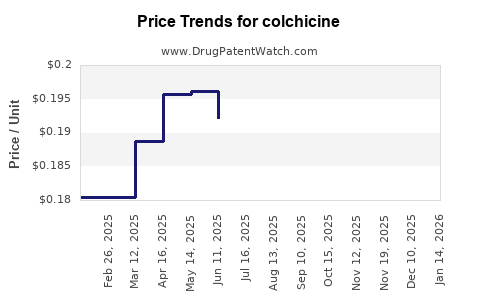
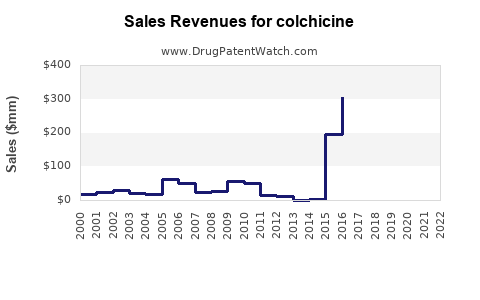
Colchicine has shifted from a low-price generics-and-biomarkers legacy product to a higher-revenue cardiovascular and anti-inflammatory franchise driven by new label indications (notably chronic coronary disease and post–cardiac surgery/percutaneous coronary intervention populations) and by branded premium pricing. The near-term revenue trajectory is shaped by (1) remaining branded exclusivity windows, (2) generic conversion intensity and payer pressure, and (3) evidence expansion that sustains utilization in cardiology and secondary prevention.
How is colchicine marketed in the US and what drives adoption across cardiovascular indications?
Colchicine is used as an anti-inflammatory with multiple clinical roles across cardiovascular disease, gout, and other inflammatory conditions. Market adoption depends less on new chemical entity launches than on indication mix, guideline uptake, and payer coverage policies tied to outcomes evidence.
What are the main US payer and formulary dynamics for colchicine?
- Cardiovascular secondary prevention: utilization is influenced by guideline language, cardiology prescribing patterns, and commercial coverage criteria that often require a qualifying cardiovascular diagnosis.
- Gout: formulary access is generally strong because colchicine is widely available in multiple generic forms. Growth is tied to adherence and dosing behavior rather than exclusivity.
- Commercial contracting: generic versions compress price quickly after launch; branded volume depends on negotiated rebates and restrictions versus low-cost generics.
Which dosing forms and strengths matter for commercial access?
- Oral tablets are the dominant commercial form for outpatient use.
- Low-dose cardiology regimens (typical once- or twice-daily patterns) support higher adherence and lower discontinuation, which can influence net sales versus gout-only use.
What is colchicine’s financial trajectory and how do price, volume, and mix drive revenue?
Colchicine’s revenue path tends to follow a classic “branded premium to generic-driven price compression” pattern, with the key swing factor being the share of sales attributable to newer cardiovascular indications.
How does the revenue split between branded and generic typically evolve?
- Early in indication expansion, branded products capture a disproportionate share because payers and prescribers establish treatment pathways before generic switching becomes entrenched.
- As generics gain formulary status and pharmacy channel stocking stabilizes, net price declines even if total patients persist.
What price-pressure vectors determine net sales?
- Generic entry timing: once multiples of dosage strengths and label-adjacent product lines enter, average realized price falls faster.
- Payer step edits: cardiovascular coverage often includes preferred-generic requirements after a period of branded exclusivity.
- Safety and drug-drug interaction management: higher physician engagement around renal function and interaction screening can slow switching, but does not stop it once outcomes are normalized.
When does colchicine lose exclusivity in major markets and what is the likely generic conversion timeline?
Colchicine’s exclusivity is jurisdiction- and product-specific. In practice, generic conversion risk is triggered by:
- Patent expiration for formulations or method-of-use claims (where applicable)
- Market exclusivity (where relevant) for specific approvals
- Paragraph IV certifications and settlement timing for branded-to-generic transitions
What patent-driven events typically control the calendar?
For each marketed product line (especially branded low-dose cardiovascular regimens), the calendar is usually determined by:
- Composition of matter or core active-ingredient claims (rare for colchicine itself due to historical availability)
- Formulation patents (low-dose, modified release, tablet composition)
- Method-of-use patents tied to cardiovascular populations
- Regulatory exclusivities linked to specific supplemental indications
What is the practical generic-entry profile for colchicine?
- Expect rapid price declines after first credible generic entry.
- After additional generic filings and multiple ANDA approvals, the market often shifts to highest-volume SKU consolidation, leaving a residual branded footprint only where contracting and access restrictions still favor it.
What patents protect colchicine in cardiovascular and anti-inflammatory use, and how strong is the patent estate?
Because colchicine is an old active ingredient, today’s IP landscape centers on indication-specific and formulation-specific protection rather than core drug substance exclusivity.
What types of patents are most likely to matter commercially?
- Method-of-use claims for treatment/secondary prevention in defined cardiovascular populations
- Dosage regimen patents that map to guideline dosing patterns
- Formulation and manufacturing patents that support specific strengths, excipients, or dissolution behavior
How does patent strength translate into litigation and launch timing?
- The strongest risk is not “any patent” but the last-to-expire claim set that can block FDA approval via section:
- Orphan-type restrictions are unlikely for colchicine.
- Method-of-use patents can block labeled generic substitution if the ANDA is not carve-out eligible.
- Patent landscapes typically produce staggered launch waves: first entry for carve-outs, then a second wave for broader label coverage after additional expirations.
What is the Orange Book status of colchicine and how many patents are listed per reference drug?
Orange Book status determines whether a generic filer must address each listed patent and whether a Paragraph IV challenge is feasible.
What Orange Book patterns matter for competitive strategy?
- Multiple patent listings with different expiration dates can create a “ladder” of generic launch opportunities.
- If method-of-use patents are listed, generics often pursue:
- Carve-out labeling to avoid infringing
- Paragraph IV litigation to invalidate or find non-infringement
How does the listing structure affect launch economics?
- Generics may accept lower margin on carve-outs if the market is small.
- Full-label coverage tends to drive higher volume and better realized prices, but requires stronger legal clearance.
Which Paragraph IV challenges and patent litigations affect colchicine generic entry?
Generic entry timing is often governed by district court outcomes and settlement terms, not just patent expiration.
What litigation milestones typically influence the market?
- Filing of Paragraph IV ANDA certifications
- Court decisions (infringement or invalidity)
- Settlement agreements that define “launch-at-risk” dates or entry carve-outs
- Stipulated dismissals when settlements end the dispute
What settlement structures are common in branded-to-generic colchicine transitions?
- Delay of launch until a specified date
- Label carve-out restrictions
- Agreement on patent non-infringement positions that later influence additional ANDAs
How does colchicine compare with other cardiovascular anti-inflammatory therapies on competition and payer behavior?
Colchicine competes in a therapeutic space that includes statins, antiplatelets, anti-inflammatory agents, and other secondary prevention regimens. The market question is less “therapeutic equivalence” than “added value and coverage.”
How does colchicine differentiate on clinical positioning?
- It has an anti-inflammatory mechanism used as an adjunct in cardiovascular disease pathways.
- Payers often evaluate it as a treatment add-on rather than a substitute for standard-of-care.
What does payer preference usually do to colchicine pricing?
- When colchicine is treated as a chronic adjunct, formulary placement is decisive.
- Once preferred generics are available, rebates and preferred-tier placement can shift quickly, reducing branded pricing power.
What formulations are protected for colchicine and what are the manufacturing/IP barriers for generic sponsors?
Commercial risk for generic entrants centers on whether the ANDA can:
- Use the same formulation and process claims without infringement
- Produce comparable dissolution and exposure profiles under current regulatory standards
- Avoid method-of-use claims via labeling carve-outs
What formulation elements often appear in the protected claim set?
- Tablet composition and excipient selection
- Dosage strength-specific manufacturing parameters
- Release and dissolution characteristics that support consistent exposure
How do manufacturing and bioequivalence requirements interact with patent risk?
- ANDA bioequivalence can be achieved even if patents exist, but the labeling and patent carve-outs determine whether the sponsor can launch with the commercially valuable indication coverage.
What biosimilar risk exists for colchicine and is there any biologic competition?
Colchicine is a small-molecule drug. Biosimilar risk is not applicable in the standard sense because there is no biologic reference product.
What other drug classes create substitute pressure?
- Anti-inflammatory regimens used for cardiovascular risk stratification
- Combination risk reduction using other pharmacologic pathways
- Over-the-counter and chronic anti-inflammatory use in gout and non-cardiovascular settings (less direct for cardiology label use)
How fast could colchicine volume grow or decline under different generic launch scenarios?
Revenue sensitivity for colchicine depends on whether volume is indication-driven enough to offset price compression.
Scenario pattern that usually determines net sales
- Branded share decline with generic entry: volume can remain stable, but net sales fall due to price compression.
- Indication expansion: can increase patient counts and preserve revenue even after generic entry, especially if clinical adoption is durable.
- Payer tightening: can slow utilization, making revenue more fragile.
What is the highest-leverage commercial variable?
- The proportion of total colchicine use attributed to higher-value cardiovascular indications where payers and prescribers follow outcome-based treatment patterns.
Key timeline events to monitor for colchicine’s next financial inflection
The market’s next inflection points typically include:
- Patent expiration for formulation or method-of-use claims that support cardiovascular label coverage
- ANDA filings with Paragraph IV challenges and associated litigation stays
- Court rulings or settlement-triggered entry dates
- Changes in labeling or evidence leading to expanded guideline-driven use
Key Takeaways
- Colchicine’s financial trajectory is driven by indication mix, with cardiovascular secondary prevention acting as the main sales-support lever against generic price pressure.
- The competitive battleground is patent- and labeling-driven, not active-ingredient novelty. Method-of-use and formulation claims determine whether generics launch with commercially meaningful label coverage.
- Net sales depend on whether patient growth in cardiovascular indications offsets rapid average selling price declines after generic conversion.
- The next major swings are tied to Orange Book patent ladders, Paragraph IV outcomes, and settlement calendars that govern generic entry timing.
FAQs
- Which colchicine strengths and dosing regimens are most likely to drive cardiology formulary uptake?
- How do method-of-use patent carve-outs change generic colchicine launch economics?
- What contracting and rebate structures keep branded colchicine on preferred tiers after generic entry?
- What are the key safety and drug-drug interaction constraints that affect colchicine prescribing continuity?
- How does colchicine’s pricing compare across outpatient pharmacy channels versus hospital outpatient purchases?
References
- U.S. Food and Drug Administration. Orange Book: Approved Drug Products with Therapeutic Equivalence Evaluations.
- U.S. Food and Drug Administration. Drugs@FDA.
- FDA. ANDA and 505(b)(2) guidance documents and related regulatory frameworks (as applicable).