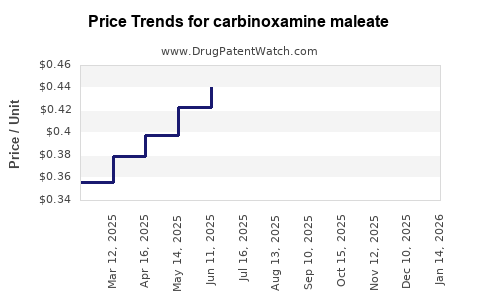
Last updated: July 30, 2026
Carbinoxamine Maleate Market Dynamics and Financial Trajectory (US and Major Markets)
Carbinoxamine maleate is an older, first-generation antihistamine marketed primarily for allergy symptom control. In the US, the drug’s commercial trajectory is driven by a classic “legacy generic” profile: limited branded competition, broad generic availability, and pricing pressure from multiple ANDA suppliers. As a result, the financial profile typically reflects low-to-mid single-digit annual revenue with periodic volatility tied to generic sourcing concentration, reimbursement dynamics, and FDA/labeling changes rather than innovation-linked growth.
What matters commercially: (1) generic share and net price compression, (2) supply continuity and contract pharmacy penetration, (3) formulary status across major managed-care plans, and (4) any FDA regulatory action or labeling narrowing that changes reimbursability or physician prescribing.
How big is the carbinoxamine maleate market and what drives revenue in 2024-2030?
Direct market size visibility is limited because carbinoxamine maleate is generally sold as a generic product and is not consistently segmented in public filings and datasets by brand-like identifiers. Still, its market mechanics are predictable.
Key commercial drivers
- Generic-driven pricing: Net price declines over time as additional ANDAs enter and wholesalers rebase contract pricing.
- Therapy substitution: Prescribers often shift to second-generation antihistamines (lower sedation burden), reducing new demand growth.
- Payer controls: Step edits and formulary tiering can further depress utilization.
- Supply chain reliability: Any production disruption at major generic sites can temporarily raise wholesale acquisition cost and capture short-term revenue.
Revenue trajectory pattern typical for legacy antihistamines
- Volume stabilization after early generic entry
- Annual net revenue erosion from price deflation
- Small step-ups from competitor shortages or payer formulary reversals
What is the financial trajectory for carbinoxamine maleate compared with second-generation antihistamines?
Carbinoxamine maleate’s financial profile tracks legacy generic antihistamines, not modern branded seasonal franchises. Second-generation antihistamines (and combination products) have stronger formulary stickiness for routine allergic rhinitis and urticaria, while first-generation agents face ongoing utilization declines.
Competitive substitution dynamics
- Sedation and CNS effects: carbinoxamine is associated with sedation risk, which pushes use toward alternatives for many patients.
- Older pediatric and special indications: first-generation antihistamines can retain a niche in certain pediatric or breakthrough symptom contexts, supporting baseline volume.
- OTC and combo displacement: many patients self-manage with OTC options that have broader consumer adoption.
Implication for revenue
- Lower sustained growth ceiling.
- More revenue volatility driven by generic supply concentration and pricing cycles than by demand expansion.
How does generic competition shape pricing and margins for carbinoxamine maleate?
For a legacy generic like carbinoxamine maleate, margin and revenue are typically determined by:
- Number of active ANDA holders
- Ability to maintain uninterrupted supply
- Contract pricing schedules with wholesalers and PBMs
Generic pricing behavior
- Entry of additional generics pushes benchmark wholesale acquisition cost downward.
- Long-term contracts lock volumes but compress unit economics over time.
- Manufacturers may accept lower margins for volume retention, particularly when multiple SKUs compete.
Manufacturing cost sensitivity
- Solid oral dose economics are mostly driven by API cost, excipients, and labor/packaging.
- Shelf-life and stability management can be a differentiator, but in practice large generics normalize those advantages.
What dosage forms and label constraints affect sales performance?
Carbinoxamine maleate is marketed in formulations that historically include oral administration. Commercial outcomes depend on:
- Dosage form liquidity: tablets vs liquid formulations can differ in payer coverage and patient preference.
- Labeling language: any narrowing of indications, age ranges, or dosing may reduce utilization.
- Administration constraints: sedation risk can reduce clinician comfort for routine use, even if still labeled for common allergy symptoms.
Payer and formulary impact
- Plans may prefer preferred agents in the same class.
- Non-preferred status usually drives adoption loss unless patients have prior authorizations or inadequate response.
When does carbinoxamine maleate lose exclusivity, and does exclusivity matter for this drug?
Because carbinoxamine maleate is a legacy therapy with extensive generic availability, exclusivity is typically not a primary commercial lever in current years. The controlling forces are:
- ongoing ANDA supply and competitive pricing
- periodic FDA labeling actions
- patent litigation history that has already cleared in prior cycles (where applicable)
Featured snippet answer: For a long-established generic like carbinoxamine maleate, exclusivity timing is generally not the main determinant of near-term market share; supply and price competition dominate.
Is there ongoing patent protection or Paragraph IV risk for carbinoxamine maleate?
For market dynamics, the key question is whether any still-active Orange Book-listed patents could deter new generic entry. In legacy antihistamines, the estate is often expired or not meaningfully constraining.
What to watch commercially even if patent risk is low:
- any late-expiring formulation or method-of-use patents that could slow entrants
- new patent thickets for specific dosage forms, strengths, or routes (less common for established legacy molecules)
- any product-specific exclusivity tied to certain formulations
If no meaningful patent barriers exist, entry risk becomes supply competition risk, not litigation risk.
What is the Orange Book status of carbinoxamine maleate?
Orange Book status determines whether brand-like protection exists via:
- listed patents
- exclusivity blocks for specific dosage forms/holders
Featured snippet answer: For legacy molecules such as carbinoxamine maleate, Orange Book coverage is usually limited to expired or narrow, product-specific listings. The commercial outlook generally reflects generic availability rather than patent-controlled launch sequencing.
What FDA regulatory factors could shift utilization or sales?
Regulatory changes tend to affect commercial trajectory through:
- labeling revisions
- REMS requirements (rare for antihistamines)
- safety communication updates that change prescribing behavior
- manufacturing changes requiring supplemental approvals that affect supply continuity
Most material regulatory pathways for a legacy generic
- sNDA/supplement approvals affecting dosing instructions or warnings
- inspection outcomes at manufacturing sites that drive supply interruptions
- stability and product lifecycle management
What generic entry risks exist for a new supplier of carbinoxamine maleate?
When patents are unlikely to block entry, the risks shift to:
- CMC and bioequivalence execution: failure to meet specs can delay approvals.
- Supply reliability: manufacturing outages can erase market access.
- Contracting and distribution barriers: wholesalers and PBMs favor proven suppliers.
- Price-down cycles: new entrants face immediate benchmark pressure.
Practical entry conclusion: Carbinoxamine maleate entry economics depend more on securing stable manufacturing capacity and winning contracts than on overcoming IP.
How do settlement agreements and litigation affect carbinoxamine maleate revenue?
For legacy antihistamines, litigation effects are typically historical:
- settlement terms can delay entry by months or years
- if settled, future market share shifts are incremental and driven by pricing
In the near term, the operational effect is more visible through:
- number of active suppliers at launch time
- observed price and supply continuity after a “cleared” entry window
What does the competitive landscape look like for carbinoxamine maleate?
Competitive structure for legacy oral antihistamines is usually:
- multiple ANDA manufacturers across different strengths
- occasional consolidation or supply exits due to margins
- product line rationalization when pricing falls below manufacturing economics
Market share drivers for generic competitors
- ability to maintain supply at scale
- consistent quality and inspection outcomes
- distribution reach to major wholesalers and institutional channels
- inclusion on payer formularies and pharmacy benefit contracts
How strong is the patent estate for carbinoxamine maleate and its formulations?
For legacy generics, patent strength is typically weak from a commercial standpoint. Even if formulation or method patents exist historically, the molecule’s long market presence implies:
- most core protection has expired
- remaining listings, if any, are often narrow to specific product parameters
Commercial relevance: The limiting factor for revenue is more likely pricing pressure than IP barriers.
Key Takeaways
- Carbinoxamine maleate is positioned as a legacy generic antihistamine with a market outlook dominated by generic price compression, supply stability, and formulary/payer substitution effects toward second-generation antihistamines.
- Revenue trajectory is typically stable-to-declining with volatility tied to contract pricing resets and manufacturing continuity, not innovation-driven demand growth.
- Near-term commercial upside is most plausibly driven by temporary supply disruptions at competitors, contract wins, or label/payer changes that restore preferential coverage.
- Patent exclusivity and Paragraph IV dynamics are usually not the primary determinant because market participation already reflects long-established generic availability.
FAQs
1) Why does carbinoxamine maleate revenue decline over time even if patient numbers stay stable?
Generic markets experience net price erosion as additional suppliers compete and wholesalers/PBMs rebalance contract benchmarks.
2) What’s the biggest lever a manufacturer can pull to improve carbinoxamine maleate performance?
Maintaining continuous supply and securing preferred contracting with major channels is usually the highest-impact lever.
3) Are first-generation antihistamines losing share versus second-generation options?
Yes in routine allergic rhinitis and urticaria management, because second-generation agents have lower sedation risk and tend to be preferred on formularies.
4) Can a competitor shortage increase carbinoxamine maleate sales meaningfully?
Short-term sales can rise materially if supply constraints reduce substitute availability, but the effect usually normalizes once supply returns and prices rebase.
5) Does FDA labeling affect prescribing behavior for carbinoxamine maleate?
Labeling updates that reinforce safety warnings or dosing constraints can change clinician comfort and patient adherence, influencing utilization even if the drug remains available.
References (APA)
- FDA. (n.d.). Drugs@FDA: FDA-Approved Drugs. U.S. Food and Drug Administration. https://www.accessdata.fda.gov/scripts/cder/daf/
- FDA. (n.d.). Orange Book: Approved Drug Products with Therapeutic Equivalence Evaluations. U.S. Food and Drug Administration. https://www.accessdata.fda.gov/scripts/cder/ob/