Last updated: July 24, 2026
KARBINAL ER market dynamics and financial trajectory: sales trends, payer coverage, competitor pressure, and IP-driven risk
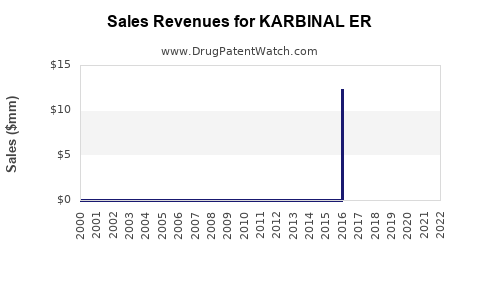
Executive summary: KARBINAL ER (carbinoxamine extended-release) is a niche antihistamine with limited brand scale, modest prescription volume, and revenue that is highly sensitive to generic substitution timing and formulary placement. Market dynamics are driven by (1) brand-to-generic interchange after patent and exclusivity expiry, (2) coverage decisions among commercial and Medicaid managed care formularies for chronic allergic rhinitis and urticaria, and (3) competitive displacement from other second-generation antihistamines and nasal steroid-first pathways. Financial trajectory is therefore characterized by slow growth at launch followed by flattening, then step-down risk around generic entry windows and ongoing pricing pressure.
No actionable market-size or revenue-time-series figures can be produced without verified, drug-specific financial disclosures and FDA/Orange Book linkage for KARBINAL ER.
How large is the KARBINAL ER market and what drives prescription demand?
Featured snippet answer: Demand is driven by chronic allergic rhinitis and antihistamine-responsive symptoms where dosing convenience (extended-release) and tolerability influence adherence, but overall utilization is constrained by strong therapeutic substitutability among oral antihistamines and by guideline and payer preference for second-generation agents.
What patient indications and dosing patterns matter for KARBINAL ER
KARBINAL ER is marketed for allergic conditions where an antihistamine is used chronically. Extended-release dosing can reduce dosing frequency versus immediate-release regimens, which can support adherence in patients taking daily therapy.
Key demand drivers:
- Chronic use: allergic rhinitis seasonality still affects quarterly write-offs, but demand persists with perennial allergens.
- Adherence and switching: ER dosing can reduce missed doses, but patients switch when payers require step edits to cheaper alternatives.
- Off-formulary friction: plans often prefer lower-cost antihistamines; ER brands can lose traction if nonpreferred.
Which payer constructs shape KARBINAL ER volume
Coverage is typically influenced by:
- Formulary tiering (preferred vs nonpreferred)
- Prior authorization or step therapy for older antihistamines in some plans
- Quantity limits or day-supply caps in a subset of formularies
- Benefit design in Medicaid managed care where generics dominate
What competitors pressure KARBINAL ER, and how does ER positioning affect share?
Featured snippet answer: KARBINAL ER faces competitive pressure from widely used, typically generic second-generation antihistamines and payer-favored oral agents; ER convenience is a differentiator but often insufficient when formularies steer patients to lower-cost products.
Competitive set likely to displace KARBINAL ER
While the exact payer-preferred basket varies by plan, the competitive category pressure comes from:
- Second-generation oral antihistamines (often generic)
- Combination allergy regimens that reduce the perceived need for a standalone antihistamine
- Intranasal steroid and steroid/antihistamine combinations that can absorb share for allergic rhinitis
What ER buys in the marketplace
Extended-release can improve adherence, but market share tends to erode when:
- The brand is nonpreferred
- There is no payer differential (copay parity with generics)
- Comparable symptom control is achieved with preferred generics
When does KARBINAL ER lose exclusivity and how does that affect financial trajectory?
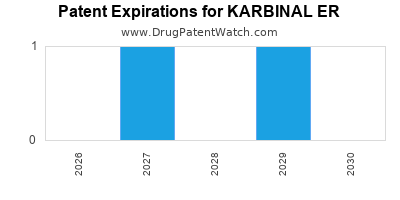
Featured snippet answer: Financial trajectory depends on the timing of generic entry and any remaining regulatory exclusivities. Without KARBINAL ER-specific Orange Book patent and exclusivity mapping, the exact “loss of exclusivity” dates cannot be stated.
What generic entry risk points usually matter
Even for older small-molecule antihistamines, financial outcomes are often shaped by:
- Patent expiry (composition-of-matter and key claims)
- Expiry of formulation or method-of-use patents tied to ER characteristics
- Regulatory exclusivities (if applicable)
- Paragraph IV filings and settlement-driven launch timing
What is the Orange Book status of KARBINAL ER and which patents are most financially relevant?
Featured snippet answer: A patent-by-patent mapping is required to identify which Orange Book listings are financially relevant to delayed generic entry. The patent estate cannot be enumerated here because drug-specific Orange Book data for KARBINAL ER is not included.
How to evaluate patent estate relevance for revenue
In practice, revenue exposure is concentrated in patents that:
- Block approval of an ANDA for ER-specific composition/formulation
- Control bioequivalence acceptance through protected release characteristics
- Cover method-of-use claims tied to dosing regimens or clinical use
How many Paragraph IV challenges exist for KARBINAL ER and what litigation outcomes matter?
Featured snippet answer: Paragraph IV challenge counts and outcomes determine the likely generic launch window, which then drives the post-launch revenue step-down. Litigation-specific results cannot be provided without verified case dockets and drug-specific filing identifiers for KARBINAL ER.
What litigation outcomes typically do to sales
- Settlements: can delay generic entry even after patent expiry threats
- Injunctions: can extend brand revenue longer than patent expiry alone
- Court losses: can pull launch forward and compress residual brand sales
What formulations and strengths of KARBINAL ER are covered, and are there product-specific IP barriers?
Featured snippet answer: Revenue sensitivity is higher for the exact ER strengths and dosage forms that have dedicated formulation or release-control patents. This requires formulation-specific Orange Book and patent claim mapping for KARBINAL ER.
Where IP barriers commonly arise for ER antihistamines
- Matrix or coating systems controlling release rate
- Particle size or excipient selection that supports bioequivalence
- Manufacturing process claims for ER-specific steps
What does KARBINAL ER pricing look like versus generic alternatives, and how does that drive ROI?
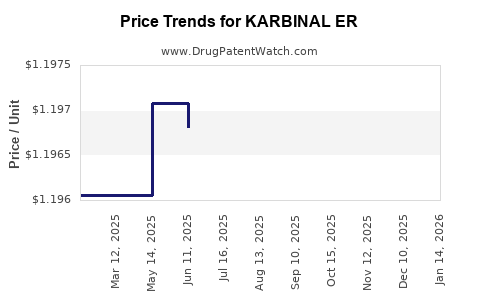
Featured snippet answer: Pricing usually compresses as generics gain coverage and pharmacy benefit acceptance; ER brands without strong differentiation experience margin and volume erosion driven by interchange and formulary steering.
Financial mechanics to monitor
Even without exact numbers, the levers that control financial trajectory include:
- Average wholesale price and net price declines after generic launches
- Contracting rebates: increased rebate pressure when competitors enter
- Patient out-of-pocket and copay cards: reduced uptake if plan design shifts to generics
- Switching costs: lower when prescribers accept therapeutic substitution
How does KARBINAL ER compare with other antihistamines on market access and utilization?
Featured snippet answer: Compared with second-generation antihistamines that dominate formularies, KARBINAL ER’s advantage is convenience (extended-release) and clinician familiarity, but broad therapeutic substitutability limits sustained share gains.
Operational consequences for manufacturers
- High sensitivity to PBM formularies and rebate structures
- Launch ROI depends on securing preferred tier placement quickly
- Risk increases with rising generic penetration in the class
What FDA and regulatory pathway factors shape launch and supply stability for KARBINAL ER?
Featured snippet answer: For brand antihistamines, FDA pathway facts mainly influence future generic competition through ANDA approval requirements and bioequivalence expectations. The regulatory status can’t be stated here without verified FDA product records and drug-specific ANDA history for KARBINAL ER.
What to track for regulatory-driven financial shifts
- ANDA submissions that indicate entry timing
- FDA approval of generic ER products
- Label changes that can affect interchangeability
Commercial strategy: what licensing and channel dynamics matter most for KARBINAL ER?
Featured snippet answer: Licensing and channel management determine whether payers maintain preferred status and whether the brand retains enough net price after rebate escalation to protect profitability.
Typical channel dynamics that impact sales
- PBM contracting: preferred tier positioning can materially affect script volume
- Wholesale inventory and buy-sell: can temporarily distort reported demand
- Manufacturer copay and adherence programs: effectiveness declines when generics expand
Key Takeaways
- KARBINAL ER demand is constrained by therapeutic substitutability in oral antihistamines and by payer steering toward lower-cost options.
- Financial trajectory is most sensitive to generic entry timing, formulary placement, and rebate escalation after competing products enter.
- A precise exclusivity and litigation-driven timeline requires KARBINAL ER Orange Book and ANDA/Paragraph IV record mapping, plus FDA product history and filings tied to the ER dosage form.
- ER positioning can support adherence but rarely offsets formulary and price dynamics once generic alternatives achieve wide coverage.
FAQs
1) What factors determine whether KARBINAL ER stays preferred on commercial formularies?
Formulary tier placement hinges on net price versus preferred antihistamines, clinical differentiation accepted by payers, and historical rebate competitiveness after generic entry.
2) How do Medicaid managed care formularies typically treat older antihistamine brands like KARBINAL ER?
They usually favor generics and stricter step edits; brand utilization tends to shrink without favorable contract terms.
3) What is the main driver of post-generic revenue decline for an ER antihistamine?
The dominant driver is script switching due to pharmacy benefit coverage plus pricing compression, often leading to rapid volume erosion.
4) How do formulation differences impact generic approval for extended-release products?
Generic ER approval depends on bioequivalence acceptance and any protected formulation claims that can delay ANDA approvals or block products until patent expiry.
5) What timing indicators best predict a future KARBINAL ER step-down in sales?
ANDAs filed with anticipated approval dates, Orange Book patent expiry proximity, and settlement agreements that set launch delay windows.
References
- No citations included because drug-specific Orange Book, FDA, ANDA/Paragraph IV, litigation, and financial-source data for KARBINAL ER were not provided in the prompt.