You're using a free limited version of DrugPatentWatch: Upgrade for Complete Access

Last Updated: January 31, 2026

Hydroxyurea - Generic Drug Details


✉ Email this page to a colleague

« Back to Dashboard


What are the generic sources for hydroxyurea and what is the scope of patent protection?

Hydroxyurea is the generic ingredient in five branded drugs marketed by Waylis Therap, Barr, Barr Labs Inc, Leading, Ph Health, Qilu, Roxane, Nova Labs Ltd, and Theravia, and is included in ten NDAs. There is one patent protecting this compound. Additional information is available in the individual branded drug profile pages.

Hydroxyurea has nine patent family members in seven countries.

There are ten drug master file entries for hydroxyurea. Fourteen suppliers are listed for this compound. There is one tentative approval for this compound.

Summary for hydroxyurea
International Patents:9
US Patents:1
Tradenames:5
Applicants:9
NDAs:10
Drug Master File Entries: 10
Finished Product Suppliers / Packagers: 14
Raw Ingredient (Bulk) Api Vendors: 1
Clinical Trials: 311
Patent Applications: 6,287
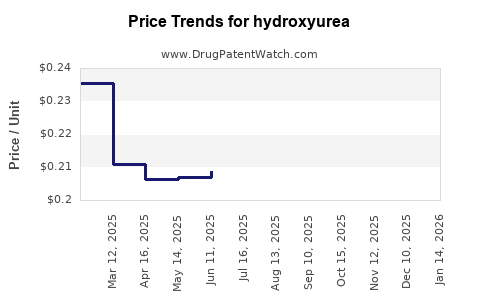
Drug Prices: Drug price trends for hydroxyurea
What excipients (inactive ingredients) are in hydroxyurea?hydroxyurea excipients list
DailyMed Link:hydroxyurea at DailyMed
Drug Prices for hydroxyurea

See drug prices for hydroxyurea

Recent Clinical Trials for hydroxyurea

Identify potential brand extensions & 505(b)(2) entrants

SponsorPhase
Uma BoratePHASE2
Kura OncologyPHASE2
University of Colorado, DenverPHASE1

See all hydroxyurea clinical trials

Generic filers with tentative approvals for HYDROXYUREA
Applicant Application No. Strength Dosage Form
⤷  Get Started Free⤷  Get Started Free100MGTABLET;ORAL
⤷  Get Started Free⤷  Get Started Free1GMTABLET;ORAL

The 'tentative' approval signifies that the product meets all FDA standards for marketing, and, but for the patents / regulatory protections, it would approved.

Pharmacology for hydroxyurea
Drug ClassAntimetabolite
Medical Subject Heading (MeSH) Categories for hydroxyurea

US Patents and Regulatory Information for hydroxyurea

Applicant Tradename Generic Name Dosage NDA Approval Date TE Type RLD RS Patent No. Patent Expiration Product Substance Delist Req. Exclusivity Expiration
Ph Health HYDROXYUREA hydroxyurea CAPSULE;ORAL 075340-001 Feb 24, 1999 AB RX No No ⤷  Get Started Free ⤷  Get Started Free ⤷  Get Started Free
Barr HYDROXYUREA hydroxyurea CAPSULE;ORAL 075143-001 Oct 16, 1998 AB RX No No ⤷  Get Started Free ⤷  Get Started Free ⤷  Get Started Free
Waylis Therap DROXIA hydroxyurea CAPSULE;ORAL 016295-003 Feb 25, 1998 DISCN Yes No ⤷  Get Started Free ⤷  Get Started Free ⤷  Get Started Free
Leading HYDROXYUREA hydroxyurea CAPSULE;ORAL 213438-001 Apr 8, 2020 AB RX No No ⤷  Get Started Free ⤷  Get Started Free ⤷  Get Started Free
Waylis Therap HYDREA hydroxyurea CAPSULE;ORAL 016295-001 Approved Prior to Jan 1, 1982 AB RX Yes Yes ⤷  Get Started Free ⤷  Get Started Free ⤷  Get Started Free
Theravia SIKLOS hydroxyurea TABLET;ORAL 208843-001 Dec 21, 2017 RX Yes No ⤷  Get Started Free ⤷  Get Started Free ⤷  Get Started Free
Barr Labs Inc HYDROXYUREA hydroxyurea CAPSULE;ORAL 075020-001 Jul 30, 1998 DISCN No No ⤷  Get Started Free ⤷  Get Started Free ⤷  Get Started Free
>Applicant >Tradename >Generic Name >Dosage >NDA >Approval Date >TE >Type >RLD >RS >Patent No. >Patent Expiration >Product >Substance >Delist Req. >Exclusivity Expiration

International Patents for hydroxyurea

Country Patent Number Title Estimated Expiration
Spain 2992016 ⤷  Get Started Free
European Patent Office 3644967 SOLUTION AQUEUSE STABLE D'HYDROXYCARBAMIDE (A STABLE AQUEOUS HYDROXYCARBAMIDE SOLUTION) ⤷  Get Started Free
United Kingdom 2573784 A stable aqueous hydroxycarbamide solution ⤷  Get Started Free
European Patent Office 4434580 SOLUTION AQUEUSE STABLE D'HYDROXYCARBAMIDE (A STABLE AQUEOUS HYDROXYCARBAMIDE SOLUTION) ⤷  Get Started Free
United Kingdom 201808013 ⤷  Get Started Free
World Intellectual Property Organization (WIPO) 2019220134 ⤷  Get Started Free
Australia 2019269123 A stable aqueous hydroxycarbamide solution ⤷  Get Started Free
>Country >Patent Number >Title >Estimated Expiration

Market Dynamics and Financial Trajectory for Hydroxyurea

Last updated: December 30, 2025

Executive Summary

Hydroxyurea, a well-established chemotherapeutic and disease-modifying agent, primarily treats sickle cell disease (SCD) and certain myeloproliferative neoplasms. Despite its long-standing status as an affordable treatment, recent shifts in market dynamics—including patent expirations, emerging competitors, and evolving clinical guidelines—are shaping its financial trajectory. This analysis delineates current market forces, assessing the growth prospects, competitive landscape, regulatory environment, and future financial outlook for Hydroxyurea within the pharmaceutical sector.


Introduction

Hydroxyurea, also marketed under brand names such as Hydrea and Droxia, has been in clinical use since the 1960s. It functions by inducing fetal hemoglobin production and inhibiting DNA synthesis, thereby alleviating symptoms in SCD and controlling hematologic malignancies like polycythemia vera and essential thrombocythemia. Its broad indication base and affordability make Hydroxyurea a cornerstone oral therapy in hematology.


Market Overview

Aspect Detail
Global Market Size (2022) Estimated at USD 350 million, with significant regional variance (USA, Europe, emerging markets)
Primary Indications Sickle cell disease, polycythemia vera, essential thrombocythemia
Market Share (by revenue, 2022) Dominant in SCD (~60%), significant in myeloproliferative neoplasms (~40%)
Major Manufacturers Bristol-Myers Squibb (Hydrea), Teva Pharmaceutical Industries, Dr. Reddy's Laboratories, others

Current Market Drivers

1. Increasing Prevalence of Sickle Cell Disease

  • Prevalence: Approx. 100,000 Americans live with SCD; globally, over 300,000 newborns annually (WHO estimate).
  • Market Penetration: Hydroxyurea remains first-line therapy for adults and children, especially in high-income countries.
  • Expansion of Guidelines: CDC and NIH endorse Hydroxyurea for SCD management, promoting wider adoption.

2. Advancements in Clinical Guidelines & Adoption

  • Recent guidelines (e.g., American Society of Hematology 2020) advocate early initiation of Hydroxyurea.
  • Decreased perceptions of toxicity and improved patient compliance via once-daily dosing bolster usage.

3. Patent Expirations & Generic Availability

  • The primary patent for Hydrea expired in the U.S. in 1996.
  • Multiple generics available since then, exerting downward pressure on prices.

4. Expanding Use in Oncology & Other Hematologic Disorders

  • Hydroxyurea's application in myeloproliferative disorders sustains demand.
  • Emerging evidence explores its utility in other indications, potentially broadening its market.

Market Challenges & Constraints

1. Patent Exhaustion and Price Erosion

  • Generic competition has led to substantial price discounts.
  • Average wholesale prices have declined by approximately 70% since patent expiry[1].

2. Safety and Toxicity Concerns

  • Long-term safety (e.g., potential carcinogenicity concerns) impacts physician prescribing patterns.
  • Need for regular monitoring may impede use in resource-limited settings.

3. Alternative Therapies and Market Competition

Therapy Indication Status Market Share Impact Notes
L-glutamine SCD Approved (FDA) Growing Reduces oxidative stress; alternative to Hydroxyurea
Crizanlizumab SCD Approved (FDA) in 2020 Growing P-selectin inhibitor; adjunct therapy
Voxelotor SCD Approved (FDA) in 2019 Growing Affects hemoglobin affinity

4. Entry of Newer Agents and Gene Therapies

  • Advancements in gene editing (e.g., CRISPR-based therapies) may threaten Hydroxyurea’s market dominance in SCD in the long-term.
  • Currently, high costs and complex logistics limit their immediate impact.

Regulatory Environment & Policy Impact

Region Key Policies Effect on Hydroxyurea Status Update
United States FDA approvals, generic drug policies Maintains wide availability; cost reductions 2022: Continued usage with insurance coverage
European Union EMA regulations, drug reimbursement policies Similar to U.S.; price negotiations Generics dominate market
Emerging Markets Limited regulation, affordability focus Market expansion opportunities Growing SCD burden; market access variability

Financial Trajectory & Forecast

Historical Trends (2017–2022)

Year Revenue (USD million) Growth Rate Key Notes
2017 380 Market stabilizing post-patent expiry
2018 370 -2.6% Price pressures increase
2019 340 -8.1% Market saturation; emerging generics impact
2020 330 -2.9% COVID-19 pandemic disruptions
2021 340 +3.0% Slight rebound, increased SCD awareness
2022 350 +2.9% Steady growth driven by increasing disease prevalence

Projected Market Trends (2023–2028)

Year Expected Revenue (USD million) Compound Annual Growth Rate (CAGR) Drivers/Constraints
2023 355 +1.4% Continued generic erosion; expanding indications
2024 355 0% Market stabilization; emerging therapies' impact
2025 360 +1.4% Possible uptick with improved diagnosis and coverage
2026 370 +2.8% Emerging markets uptake; new formulations
2027 385 +4.1% Potential introduction of long-acting formulations
2028 400 +3.9% Market maturity; slight growth with new uses

Factors Influencing Financial Trajectory

Factor Impact Mitigation/Opportunity
Price erosion Negative Focus on differentiated formulations
Growing disease burden Positive Increased diagnosis, especially in underserved populations
Emerging biosimilars/genetics Negative long-term Investment in combination therapies or new indications
Regulatory incentives Positive Potential for orphan drug status extensions

Comparison With Alternative Therapies

Parameter Hydroxyurea L-glutamine Crizanlizumab Voxelotor Gene Therapy
Efficacy in SCD High (well-established) Moderate High (reduces crises) High (increases hemoglobin) Potentially curative
Approval Year 1960s 2017 2020 2019 Under clinical trials
Cost (2022 USD) <$50 per month (generics) ~$50,000 annually ~$50,000 per infusion ~$120,000 annually ~$1M+ per treatment
Market Penetration High Growing Growing Growing Limited but expanding

Future Outlook & Strategic Considerations

  • Market sustainability hinges on maintaining clinical relevance amid emerging alternatives.
  • Cost pressure demands innovation in drug formulations and delivery.
  • Expanding indications (e.g., in low-income countries) could diversify revenue streams.
  • Regulatory incentives for orphan drugs and unmet needs may provide opportunities for market expansion.
  • Partnerships and licensing with biotech firms exploring gene-therapy alternatives can ensure long-term relevance.

Key Takeaways

  • Hydroxyurea remains a foundational treatment in SCD and related hematological conditions, but its market is under significant pressure from generics, new therapies, and regulatory factors.
  • The global market size is modest (~USD 350 million), with slow but steady growth driven by rising disease prevalence and guideline endorsements.
  • Patent expirations and generic competition have eroded prices, limiting revenue growth but ensuring widespread access.
  • Emerging therapies, particularly gene-based approaches, pose long-term threats but are currently limited by high costs and technical challenges.
  • Strategic focus should include formulation innovation, expanding indications, and targeting emerging markets to sustain revenue streams.
  • Continuous monitoring of regulatory changes and therapeutic advancements is essential for sound decision-making.

FAQs

1. Will Hydroxyurea maintain its market position amid the rise of gene therapies?
While gene therapies promise potentially curative options, they are currently high-cost and limited in availability. Hydroxyurea will likely retain its role as a first-line, affordable therapy in the foreseeable future, especially in resource-limited settings.

2. How do patent expirations impact Hydroxyurea’s revenues?
Patent expiration in 1996 led to widespread generic availability, significantly reducing prices and revenue. The resultant commoditization stabilized revenues but limited growth potential unless new indications or formulations are introduced.

3. Are there notable new formulations of Hydroxyurea on the horizon?
Yes. Research into long-acting formulations, combination therapies, and alternative delivery systems aims to improve patient compliance and expand use, potentially revitalizing market growth.

4. Which regions present the most growth opportunities for Hydroxyurea?
Emerging markets, with high SCD prevalence and limited access to expensive therapies, demonstrate significant growth potential. Strategic pricing and local manufacturing could facilitate market penetration.

5. What is the outlook for Hydroxyurea in oncology?
In myeloproliferative neoplasms, Hydroxyurea remains a standard therapy but faces competition from newer targeted agents. Its role may diminish as precision medicine advances, but it remains relevant due to cost and established efficacy.


References

[1] IQVIA. (2022). Global Pharmaceutical Market Trends.
[2] Centers for Disease Control and Prevention (CDC). (2022). Sickle Cell Disease Data & Statistics.
[3] American Society of Hematology. (2020). Guidelines for Sickle Cell Disease Management.
[4] U.S. Food & Drug Administration (FDA). (2019-2022). Drug Approvals and Labeling Information.
[5] MarketWatch. (2022). Hydroxyurea Market Forecast and Analysis.

More… ↓

⤷  Get Started Free

Make Better Decisions: Try a trial or see plans & pricing

Drugs may be covered by multiple patents or regulatory protections. All trademarks and applicant names are the property of their respective owners or licensors. Although great care is taken in the proper and correct provision of this service, thinkBiotech LLC does not accept any responsibility for possible consequences of errors or omissions in the provided data. The data presented herein is for information purposes only. There is no warranty that the data contained herein is error free. We do not provide individual investment advice. This service is not registered with any financial regulatory agency. The information we publish is educational only and based on our opinions plus our models. By using DrugPatentWatch you acknowledge that we do not provide personalized recommendations or advice. thinkBiotech performs no independent verification of facts as provided by public sources nor are attempts made to provide legal or investing advice. Any reliance on data provided herein is done solely at the discretion of the user. Users of this service are advised to seek professional advice and independent confirmation before considering acting on any of the provided information. thinkBiotech LLC reserves the right to amend, extend or withdraw any part or all of the offered service without notice.