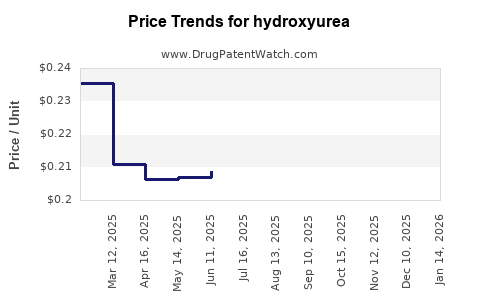
Last updated: September 8, 2026
Hydroxyurea is a mature, low-cost oral oncology and hematology drug with no meaningful remaining U.S. compound-patent barrier. Its commercial value is concentrated in sickle cell disease, where branded pediatric products such as Siklos compete with inexpensive generic capsules and tablets. Revenue growth is constrained by generic pricing, limited diagnosis and treatment access, and manufacturing shortages, while demand has a durable clinical base because hydroxyurea remains a standard disease-modifying therapy for many patients with sickle cell disease.
What is the current market position of hydroxyurea?
Hydroxyurea is an oral ribonucleotide reductase inhibitor marketed for several indications:
- Sickle cell anemia and recurrent vaso-occlusive pain
- Chronic myelogenous leukemia
- Locally advanced squamous cell carcinoma of the head and neck in combination with radiation
The sickle cell disease market is the main commercial growth opportunity. Cancer uses are clinically established but economically less differentiated because physicians can prescribe multiple cytotoxic therapies and generic hydroxyurea has been available for decades.
| Market factor |
Current position |
| Drug class |
Antimetabolite; ribonucleotide reductase inhibitor |
| Primary commercial use |
Sickle cell disease |
| U.S. dosage forms |
Capsules and tablets |
| U.S. regulatory status |
Multiple approved branded and generic products |
| Core patent status |
No meaningful active U.S. composition-of-matter protection |
| Biosimilar exposure |
Not applicable; hydroxyurea is a small molecule |
| Generic exposure |
High |
| Pricing profile |
Low for generic products; higher for differentiated branded formulations |
| Main demand driver |
Chronic treatment of sickle cell disease |
| Main commercial constraint |
Low reimbursement leverage and inconsistent patient access |
Hydroxyurea is recommended by the National Heart, Lung, and Blood Institute for adults and children with sickle cell disease, particularly patients with recurrent pain or other clinically significant complications (National Heart, Lung, and Blood Institute, 2014).
What FDA-approved hydroxyurea products are available?
The U.S. market includes legacy products and generic equivalents.
| Product |
Sponsor or manufacturer |
FDA status |
Principal labeled use |
| Hydrea |
Bristol-Myers Squibb legacy product |
Original NDA approval in 1967 |
CML and head and neck cancer |
| Droxia |
Bristol-Myers Squibb legacy product |
FDA-approved sickle cell product |
Sickle cell anemia |
| Siklos |
Addmedica |
FDA-approved tablet product |
Sickle cell anemia |
| Generic hydroxyurea capsules |
Multiple ANDA holders |
Approved generics |
Primarily equivalent labeled uses |
| Generic hydroxyurea tablets |
Selected manufacturers |
Approved generics |
Sickle cell disease and other labeled uses, depending on product |
Hydrea is associated with NDA 016295, Droxia with NDA 020972, and Siklos with NDA 208573 in FDA regulatory records. Siklos was approved as a scored tablet designed to support weight-based dosing, including pediatric treatment. The product is available in 100-mg and 1,000-mg strengths in the U.S. label, subject to product-specific regulatory details (U.S. Food and Drug Administration, 2017).
The availability of a tablet product matters commercially because pediatric sickle cell dosing often requires dose adjustment by body weight. Generic capsules remain competitive for adults and larger pediatric patients, but tablet flexibility can support premium pricing in pediatric and specialty-care channels.
When does hydroxyurea lose exclusivity?
Hydroxyurea lost practical market exclusivity decades ago. The original Hydrea approval dates to 1967, and generic hydroxyurea products have competed in the U.S. market for many years. No active composition-of-matter patent is generally understood to prevent generic competition.
The relevant commercial distinction is between the molecule and individual formulations:
| Exclusivity category |
Hydroxyurea position |
| Original compound patent |
Expired |
| Original Hydrea exclusivity |
Expired |
| Generic capsule entry |
Established |
| Generic tablet entry |
Established or available by product strength and manufacturer |
| Sickle cell method-of-use protection |
No broad, commercially blocking protection |
| Pediatric formulation protection |
Limited product-specific protection, if any, rather than molecule-wide exclusivity |
| Biosimilar exclusivity |
Not applicable |
Siklos may retain commercial differentiation from its tablet design, dose flexibility, pediatric positioning, and regulatory history. Those characteristics do not recreate composition-of-matter exclusivity. A competing manufacturer can challenge the commercial position through an equivalent or therapeutically substitutable hydroxyurea product.
What patents protect hydroxyurea products?
The commercially important hydroxyurea patent estate is weak relative to newer specialty drugs.
Core molecule and legacy products
Hydroxyurea is an old active pharmaceutical ingredient. The original patents associated with Hydrea and the molecule's early development are expired. Generic manufacturers therefore do not face a basic active-ingredient patent barrier in the United States.
Formulation patents
Potential formulation protection is more relevant for products such as Siklos than for standard hydroxyurea capsules. Relevant differentiators can include:
- Scored tablets
- Dose uniformity across tablet segments
- Pediatric dosing
- Tablet dissolution and stability
- Manufacturing processes
- Packaging and handling controls
These protections are narrower than a composition-of-matter patent. They may affect a particular product or manufacturing route without preventing generic hydroxyurea capsules from entering the market.
Method-of-use patents
Hydroxyurea's use in sickle cell disease is clinically established and broadly practiced. Method-of-use patents, where present, would need to cover a specific patient population, dosing regimen, treatment combination, or clinical outcome. Broad use of hydroxyurea for sickle cell anemia is unlikely to create a durable commercial barrier because the therapy has been used and studied for decades.
The FDA label for Siklos includes warnings concerning myelosuppression, carcinogenicity, embryo-fetal toxicity, and the need for blood-count monitoring. These labeling requirements affect product development and risk management but do not create market exclusivity (U.S. Food and Drug Administration, 2017).
What is the Orange Book status of hydroxyurea?
The Orange Book lists approved drug products and relevant patent and exclusivity information for eligible products. For hydroxyurea, the Orange Book's commercial significance is limited because generic products are already marketed and the original branded products are mature.
The key Orange Book conclusions are:
- Hydrea and Droxia are legacy products with expired historical exclusivity.
- Generic hydroxyurea products have established therapeutic competition.
- Siklos is differentiated primarily by its tablet formulation and pediatric dosing utility, not by a new chemical entity.
- Any remaining listed patents must be evaluated product by product because a formulation listing would not necessarily block generic capsules or alternative tablet products.
An Orange Book listing does not automatically establish that a patent will prevent market entry. Generic applicants can certify under Paragraph IV that listed patents are invalid, unenforceable, or not infringed. In the hydroxyurea market, the commercial impact of Paragraph IV activity is lower than in markets where a single active patent controls the entire product.
Which companies are challenging hydroxyurea exclusivity?
Generic competition is already the principal challenge to branded hydroxyurea products. The relevant competitors include manufacturers that supply generic capsules or tablets through retail pharmacies, specialty pharmacies, hospitals, and government purchasers.
Publicly reported hydroxyurea competition has generally been characterized by:
- ANDA-based generic entry
- Multiple suppliers rather than a single challenger
- Price competition in standard capsule products
- Specialty-product differentiation for pediatric dosing
- Periodic supply constraints rather than sustained patent litigation
There is no broad biosimilar threat because hydroxyurea is a small-molecule drug. The relevant regulatory pathway is the abbreviated new drug application, not the biosimilar pathway under the Public Health Service Act.
What is the FDA regulatory status of hydroxyurea?
Hydroxyurea has a long FDA regulatory history and is approved for both oncology and hematology uses. The product's regulatory risk is therefore lower than that of an investigational drug, but manufacturing and safety obligations remain significant.
Important regulatory features include:
- Chronic administration in sickle cell disease
- Required monitoring of blood counts
- Dose interruption or adjustment for myelosuppression
- Reproductive and embryo-fetal safety warnings
- Handling precautions for cytotoxic products
- Need for validated manufacturing controls and stability data
The FDA has also recognized the importance of pediatric sickle cell treatment. The approval of Siklos expanded commercially usable hydroxyurea dosing options for children and adolescents, supporting broader treatment adoption (U.S. Food and Drug Administration, 2017).
How strong is the hydroxyurea patent estate?
The patent estate is weak for the active ingredient and standard generic products, but moderate for narrow product attributes.
| Patent dimension |
Strength |
Commercial implication |
| Active ingredient |
Very weak |
Generic entry is established |
| Hydrea legacy product |
Expired |
No meaningful protection |
| Droxia legacy product |
Expired or commercially exhausted |
No broad barrier |
| Pediatric tablet formulation |
Narrow to moderate |
May support premium pricing |
| Manufacturing process |
Potentially narrow |
Can be designed around or challenged |
| Method of use |
Limited |
Broad sickle cell treatment is difficult to monopolize |
| Regulatory know-how |
Moderate operational value |
Supports quality and supply reliability |
| Brand recognition |
Low to moderate |
Less valuable than in differentiated chronic therapies |
Hydroxyurea's strongest defenses are operational rather than legal. Reliable manufacturing, pediatric dosing, distribution to sickle cell centers, and reimbursement execution can matter more than patent litigation.
What generic entry risks exist for branded hydroxyurea?
Generic entry risk is already realized. The market does not depend on a future first generic launch. Instead, commercial risk comes from additional suppliers, price compression, substitution within formularies, and loss of volume from branded products.
Generic capsule risk
Generic capsules are the main threat to Hydrea and Droxia. They are suitable for many adult patients and are generally prescribed at substantially lower cost than branded products.
Generic tablet risk
Tablet competition is more complex because pediatric treatment may require flexible dosing. A tablet with scoring, dose uniformity, and appropriate packaging can compete directly with Siklos if it satisfies FDA bioequivalence and product-quality requirements.
Substitution risk
Hydroxyurea can also face indirect competition from:
- Chronic transfusion programs
- Hematopoietic stem-cell transplantation for selected patients
- L-glutamine
- Voxelotor, although its U.S. commercial status changed after withdrawal
- Crizanlizumab
- Emerging gene therapies and curative approaches for eligible sickle cell patients
These therapies do not eliminate hydroxyurea's role. Their cost, eligibility requirements, administration burden, and access limitations keep hydroxyurea relevant as a first-line or foundational treatment.
What is the financial trajectory for hydroxyurea?
Hydroxyurea's financial trajectory is mature rather than growth-oriented. Public companies generally do not report hydroxyurea revenue as a separate line item, so a precise global market size or manufacturer-by-manufacturer revenue ranking cannot be established from public filings alone.
The financial profile has five features:
- Low unit economics for generic products. Competition has reduced price and gross margin potential in standard capsules.
- Stable chronic demand. Patients with sickle cell disease may use hydroxyurea for years, supporting recurring volume.
- Premium opportunity in pediatric formulations. Scored tablets and specialty distribution can command higher prices than standard generic capsules.
- Access-driven volume upside. Diagnosis, specialist availability, adherence, and monitoring determine treatment penetration.
- Supply-chain volatility. Older generic products may face shortages or limited manufacturer participation, creating intermittent pricing and availability effects.
The molecule is therefore more attractive as a dependable, low-cost volume product than as a high-growth branded asset. Revenue expansion depends on patient identification and treatment rates, not patent-protected pricing.
How does hydroxyurea compare with newer sickle cell drugs?
| Therapy |
Commercial position |
Cost and access profile |
Effect on hydroxyurea |
| Hydroxyurea |
Established oral standard |
Low-cost generic options |
Baseline therapy and price anchor |
| L-glutamine |
Adjunctive oral therapy |
Higher cost than generic hydroxyurea |
Limited substitution; often complementary |
| Crizanlizumab |
Specialty infusion therapy |
Higher administration and reimbursement burden |
Competes in selected patients |
| Gene therapies |
Potentially curative, highly specialized |
Very high upfront cost and limited eligibility |
Long-term strategic threat for selected patients |
| Transfusion therapy |
Established supportive treatment |
Resource-intensive |
Alternative for severe disease or specific complications |
Hydroxyurea's low cost makes it difficult for premium products to displace broadly. Newer therapies generally compete through differentiated outcomes or use in patients who cannot tolerate, do not respond to, or cannot adhere to hydroxyurea.
What patent litigation and settlement activity affects hydroxyurea?
Hydroxyurea has a lower litigation profile than newer specialty drugs because the core compound and major legacy products are long off patent. Paragraph IV litigation may arise around a specific branded tablet formulation or listed patent, but the commercial stakes are narrower than in markets where one patent controls a multibillion-dollar product.
No widely reported, market-defining settlement agreement is central to the current U.S. hydroxyurea market. The main competitive variables are generic supply, procurement contracts, formulation differentiation, and reimbursement rather than ongoing patent injunction risk.
What is the geographic coverage of hydroxyurea?
Hydroxyurea is marketed internationally, but access varies sharply by region. The United States, Europe, and other high-income markets have established regulatory and distribution channels. In lower-income countries with substantial sickle cell prevalence, availability can be constrained by:
- Limited diagnosis
- Weak laboratory-monitoring infrastructure
- Irregular medicine procurement
- Shortages of child-appropriate dosage forms
- Limited specialist care
- Concerns about adherence and toxicity monitoring
Global demand has substantial volume potential because sickle cell disease is concentrated in regions with large affected populations, including sub-Saharan Africa and parts of India. Commercial realization depends on public procurement and health-system capacity more than private-pay pricing.
Key Takeaways
- Hydroxyurea is a mature generic drug with no meaningful remaining U.S. composition-of-matter exclusivity.
- Sickle cell disease is the primary commercial growth market.
- Generic capsules create sustained price pressure on Hydrea and Droxia.
- Siklos retains differentiation through scored pediatric tablets and dosing flexibility, but its protection is narrower than molecule-level exclusivity.
- Biosimilar risk does not apply; ANDA-based generic competition is the relevant pathway.
- The financial trajectory is stable in volume but limited in price growth.
- Supply reliability, pediatric formulation capability, and access to sickle cell patients are stronger commercial defenses than patents.
- Emerging gene therapies and specialty treatments create selective long-term substitution risk, not an immediate broad replacement risk.
FAQs
Is hydroxyurea still profitable for pharmaceutical manufacturers?
Generic hydroxyurea can generate recurring volume, but standard capsules generally have limited pricing power. Profitability is more attractive where a manufacturer has efficient production, reliable supply, specialty distribution, or a differentiated pediatric formulation.
Does hydroxyurea have orphan-drug exclusivity for sickle cell disease?
Hydroxyurea's historical use and multiple approved products mean that any product-specific orphan exclusivity must be evaluated by product and indication. Orphan designation would not restore broad exclusivity for the active ingredient.
Can a generic manufacturer launch hydroxyurea without a Paragraph IV challenge?
Yes. A generic applicant can use other ANDA certification strategies where applicable, including certification that no relevant patent is listed or that the relevant patent has expired. Paragraph IV certification is not required for every generic launch.
Are hydroxyurea tablets commercially superior to capsules?
Tablets can be superior for pediatric weight-based dosing when they are scored and available in suitable strengths. Capsules remain commercially competitive because they are familiar, inexpensive, and widely distributed.
Will gene therapy eliminate the hydroxyurea market?
No. Gene therapies are expensive, available only to selected patients, and dependent on specialized treatment centers. Hydroxyurea is likely to remain important for patients who are ineligible for, cannot access, or do not choose gene therapy.
References
-
National Heart, Lung, and Blood Institute. (2014). Evidence-based management of sickle cell disease: Expert panel report, 2014. U.S. Department of Health and Human Services.
-
U.S. Food and Drug Administration. (2017). Siklos (hydroxyurea) tablets: Prescribing information. Addmedica.
-
U.S. Food and Drug Administration. (2024). Orange Book: Approved drug products with therapeutic equivalence evaluations. https://www.accessdata.fda.gov/scripts/cder/ob/
-
U.S. Food and Drug Administration. (2024). Drugs@FDA: FDA-approved drugs. https://www.accessdata.fda.gov/scripts/cder/daf/
-
U.S. Food and Drug Administration. (2024). Hydroxyurea products: Product labeling and safety information. https://www.fda.gov/drugs.