Last updated: July 30, 2026
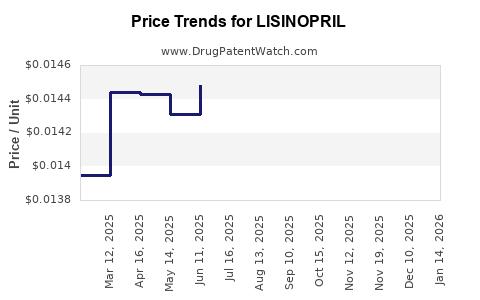
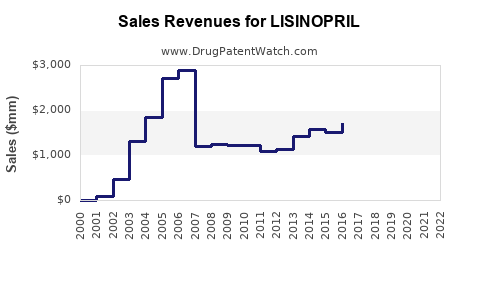
Executive summary: Lisinopril, the blockbuster ACE inhibitor, is fully generic in the US and faces structurally low pricing tied to mature generic competition, frequent label-driven substitution, and multi-source availability across strengths and dosage forms. Financial trajectory in major markets is characterized by shrinking unit revenue from price compression, stable to modest volume depending on managed-care formularies and country-specific reimbursement, and periodic market share shifts driven by NDC-level manufacturing capacity, shortages, and product quality. Near-term revenue growth is unlikely absent supply disruptions; medium-term value erosion persists as additional generic entrants consolidate supply and as remaining branded or NCE-like value from any originator-derived market position continues to disappear.
Is lisinopril still a branded drug, and what does its current status mean for revenue?
Short answer: In most developed markets, lisinopril revenue is dominated by generics across tablet strengths. Any residual originator-associated revenue is indirect through legacy product lines, line extensions, or supply arrangements, not through legal exclusivity in the typical “branded moat” sense.
What matters for market dynamics
- No meaningful US Hatch-Waxman exclusivity leverage: Lisinopril is an established small molecule with extensive generic coverage, so competitive pressure is steady rather than cyclical.
- High substitution intensity: ACE inhibitors are therapeutically substitutable within hypertension and heart failure care pathways, pushing dispensing toward lowest-cost or formulary-preferred products.
- Tendering and PBM contracting: Major payers use multi-source bids and NDC-level preferred lists, which accelerates price declines and shifts share to suppliers with favorable contract terms.
Where revenue stability can still come from
- Clinical persistence: Lisinopril remains an option in hypertension, post-MI regimens, and heart failure management. Patients often stay on therapy long-term, supporting baseline volume even as prices fall.
- Country-level procurement structures: In some jurisdictions, national formularies or wholesaler procurement patterns dampen rapid price drops, creating slower revenue decay than in the US.
How fast has lisinopril pricing fallen, and what drives future price erosion?
Short answer: Pricing declines follow the classic generic lifecycle: initial generics reduce price sharply, then successive entries compress further. For lisinopril, the competitive set is large and persistent, so “last-man-standing” pricing leverage rarely lasts.
Key drivers of price compression
- Multi-source availability across strengths
- Lisinopril is supplied in multiple tablet strengths (commonly 2.5 mg, 5 mg, 10 mg, 20 mg, and 30 mg in various markets). Each strength increases substitution friction for originator-like differentiation.
- Wholesale and PBM rebate mechanics
- Contract structures shift net prices lower over time. Even when list prices stabilize, net revenue continues to decline.
- Manufacturing scale and cost curve
- Over time, the effective cost per tablet falls for suppliers that keep plants running at scale, pulling achievable pricing down.
- Regulatory and quality-based capacity shifts
- Periodic supply constraints can temporarily lift prices, but this is typically short-lived and driven by availability rather than demand growth.
What patent estate protects lisinopril today, and how much is left to affect exclusivity?
Short answer: For lisinopril as an active ingredient, most relevant patents that could block generic entry are long expired or invalidated in practice. Market reality is that exclusivity is not a material determinant of generic access anymore.
Patent strategy implications for investors and litigators
- Focus shifts to life-cycle IP rather than API patents
- Remaining enforceable IP, if any, tends to live in:
- formulation-specific patents (e.g., particular release profiles)
- method-of-use patents that carve out distinct clinical regimens
- pediatric data or minor label modifications
- In practice, generic competition often neutralizes life-cycle IP
- Generic manufacturers can frequently use non-infringing formulations or pursue Paragraph IV via carve-outs where Orange Book listings do not cover the proposed product.
Why “patent strength” is less decisive for lisinopril
- The drug is old enough that the market has already absorbed entry risk across multiple waves of generic manufacturers.
- The financial trajectory is therefore primarily a function of contracting and supply, not patent durability.
What is the FDA regulatory status of lisinopril tablets, and how does this shape generic entry risk?
Short answer: Lisinopril is regulated as an approved generic product with numerous ANDAs for different strengths and manufacturers. Generic entry risk is low because entry has already occurred at scale.
Orange Book and ANDA dynamics (business impact)
- If an ANDA product is listed for a given NDC/strength, it signals availability of multiple supply chains and weakens any perceived “exclusive channel.”
- Where formulary and pharmacy substitution are permissive, the market typically moves quickly toward lowest-cost preferred products.
Litigation-based entry friction
- For an old molecule, litigation tends to be sporadic and product-specific. Its financial impact is usually limited to discrete manufacturers or supply channels rather than altering the full market trajectory.
How does the lisinopril market compare with other ACE inhibitors (enalapril, ramipril) in pricing and share dynamics?
Short answer: All ACE inhibitors face the same generic lifecycle forces, but their relative market behavior depends on:
- relative dosing convenience (tablet strengths and scoring)
- formulary placement and managed-care switching behavior
- supply and quality history that affects contract awards
Comparative market mechanics
- Switching is common: Providers and patients often switch across ACE inhibitors within class based on tolerance, supply, and payer preferences.
- Contracting determines share: Even where clinical preference exists, PBM and wholesaler contracts can override.
Typical outcome for mature ACE inhibitors
- Unit volume stays relatively stable across years.
- Net revenue trends downward as prices compress and the cheapest preferred suppliers gain incremental share.
What generic entry scenarios could still move lisinopril’s financials (even though it is fully generic)?
Short answer: Share and net revenue can move even without patent cliffs. The most realistic scenarios are supply-driven and contract-driven.
Scenario set with financial effects
- New manufacturing capacity enters at aggressive price
- Likely outcome: short-term net price decline and share shift to new entrant.
- Plant outages or quality issues constrain supply
- Likely outcome: temporary price increase, improved netback for constrained NDCs, but usually followed by normalization.
- PBM or government tender retendering
- Likely outcome: step-change shifts in net price and volume for preferred products.
- NDC-level discontinuations
- Likely outcome: volume redistribution to remaining strengths/manufacturers, potentially increasing revenue concentration and margin for survivors.
Does lisinopril have biosimilar or biologic-like competitive risk?
Short answer: No. Lisinopril is a small molecule; there is no biosimilar pathway. Competitive risk is driven by ANDA generics, supply chain changes, and contracting.
Which companies dominate lisinopril supply, and how does that affect commercial margins?
Short answer: The lisinopril supply chain is widely multi-source. Commercial outcomes are typically determined by:
- manufacturing scale and cost position
- ability to secure PBM and government contracts
- throughput reliability and compliance history
Margin structure realities in mature generics
- Net margins compress with intense competition.
- Margin dispersion exists by manufacturer depending on:
- manufacturing yield and batch failure rates
- distribution agreements and contract terms
- freight and input costs
- inventory management and shortage dynamics
What to track for margin direction
- NDC-level price indices and tender results (where available)
- FDA inspection outcomes for relevant plants
- reported shortages and field alerts that correlate with price dislocations
What are the main therapeutic and utilization trends that influence lisinopril volume?
Short answer: Volume depends on prevalence and prescribing patterns for hypertension and heart failure, plus adherence and persistence on ACE inhibitors.
Volume drivers
- Hypertension prevalence: Stable long-term demand from chronic disease burden.
- Care guidelines and tolerability: ACE inhibitor use is guided by renal function monitoring and tolerability; discontinuation rates affect annual volume but not demand direction.
- Heart failure regimen changes: Beta blockers, ARNI, SGLT2 inhibitors, and MRAs can shift relative ACE inhibitor use, but ACE inhibitors often remain components of therapy or switch options.
Volume headwinds
- ARBs and ARNI substitution: In specific patient segments, prescribers may favor alternative RAAS pathways.
- Switching due to side effects: Cough and angioedema risk can drive discontinuation, though this is not unique to lisinopril.
How does reimbursement in the US vs ex-US markets shape lisinopril revenue trajectory?
Short answer: In the US, PBM and competitive contracting accelerate net price erosion. In many ex-US markets, reimbursement mechanisms can slow price declines, but government procurement and national tenders still produce downward pressure.
US-specific factors
- competitive WAC-to-net spreads and frequent contract retendering
- utilization management in formularies (preferred ACE inhibitor lists)
- adoption by retail and mail order pharmacies tied to contract pricing
Ex-US factors
- state or national formularies
- tendering cycles and supplier qualifying requirements
- pharmacy margin rules and wholesaler discounts affecting final consumer price and demand elasticity
What key risks could reverse or disrupt lisinopril’s financial trajectory upward?
Short answer: Sustained upward revenue shifts are rare in a mature generic market; the plausible catalysts are supply constraints combined with tight contract coverage.
Upward risk list
- Longer-than-expected shortages: If capacity exits or persists off-market, prices can temporarily rise.
- Quality-driven scarcity: If high-quality suppliers lose capacity due to compliance actions, prices and allocation can shift.
- Contracting misalignment: If remaining suppliers secure preferred status with favorable net prices before others retender.
Downward risk list
- Aggressive pricing by new entrants
- Further consolidation of preferred NDCs
- Input cost declines leading to competitive price resets
- Formulary switches to alternative RAAS agents in some segments
Key Takeaways
- Lisinopril’s financial trajectory is dominated by generic multi-source competition, with net revenue erosion driven by contracting and price compression rather than patent events.
- Near-term growth is supply- and contract-dependent, not exclusivity-dependent. Revenue can fluctuate with shortages and tender outcomes.
- Patent strength is not the primary variable in market forecasting for lisinopril; the drug behaves like a fully matured small-molecule generic.
- Investors and business teams should focus monitoring on NDC-level pricing trends, supply/quality events, and PBM/government tender cycles to predict margin direction.
FAQs
1) What drives NDC-level price differences for lisinopril tablets?
Contract tiering, preferred supplier status, local availability, and manufacturer-specific tender terms.
2) How do supply shortages of lisinopril affect patient access and pharmacy buying behavior?
Shortages shift purchasing to in-stock suppliers, often leading to temporary price increases and allocation-based purchasing.
3) Does lisinopril have multiple dosage forms that change its market dynamics?
Yes, tablet strengths dominate; any differences in strengths available, labeling, and supplier coverage change share distribution.
4) Are there method-of-use or formulation patents that could block some generic lisinopril?
For an old molecule, blocking is generally limited to specific listed products or narrow label/formulation coverages rather than the entire active ingredient market.
5) How does lisinopril utilization compare with ARBs in payer formularies?
ACE inhibitor placement varies by payer; many formularies treat RAAS classes similarly, but net pricing and contract incentives often determine which agent is preferred.
References (APA)
- FDA. (n.d.). Drug shortages: FDA updates. U.S. Food and Drug Administration.
- FDA. (n.d.). Orange Book: Approved Drug Products with Therapeutic Equivalence Evaluations. U.S. Food and Drug Administration.
- IQVIA. (n.d.). Generic drug market and pricing analytics (industry reports).
- Carroll, J., & Hogue, C. (2018). ACE inhibitors in hypertension and heart failure: clinical and economic considerations (review literature).