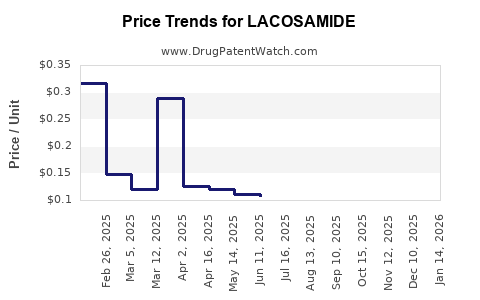
Last updated: August 9, 2026
Lacosamide, marketed by UCB as Vimpat, moved from a high-growth branded antiseizure medicine to a mature generic market after U.S. and European patent protection ended in 2022-2023. UCB’s Vimpat revenue reached approximately €1.4 billion before generic erosion, then declined as lacosamide tablets, oral solutions, and injectables entered the market. The product remains commercially relevant because of broad epilepsy use, hospital demand for intravenous treatment, and continued prescribing in patients stabilized on the branded product. Its long-term value is limited by the absence of biosimilar barriers, expired core patents, and intense generic competition.
What is lacosamide and how large is its market?
Lacosamide is a small-molecule antiseizure medicine used primarily for focal-onset seizures. Vimpat is available as film-coated tablets, oral solution, and intravenous injection. The FDA approved lacosamide in 2008 for adjunctive therapy in partial-onset seizures in patients aged 17 years and older. The U.S. label later expanded to include monotherapy and adjunctive therapy for adults and pediatric patients aged four years and older with focal-onset seizures. [1]
Lacosamide has a differentiated pharmacology within the sodium-channel class. It selectively enhances slow inactivation of voltage-gated sodium channels, distinguishing it mechanistically from conventional fast-inactivation sodium-channel agents such as carbamazepine, phenytoin, and lamotrigine.
The commercial market includes:
| Segment |
Main products |
Commercial status |
| Originator |
Vimpat |
Mature branded product with declining sales |
| Generic oral tablets |
Lacosamide tablets |
Broad generic competition |
| Generic oral solution |
Lacosamide oral solution |
Generic competition |
| Intravenous treatment |
Lacosamide injection |
Hospital and acute-care demand |
| Adjacent branded therapies |
Briviact, Xcopri, Fycompa, Valtoco |
Compete for epilepsy treatment budgets |
| Older generic therapies |
Levetiracetam, lamotrigine, valproate, carbamazepine |
Strong price competition |
Lacosamide competes most directly with levetiracetam and other focal-seizure treatments. Cenobamate, marketed as Xcopri by SK Biopharmaceuticals and Jazz Pharmaceuticals, is a newer branded competitor with stronger remaining patent protection but a narrower commercial history.
How did Vimpat revenue develop before generic entry?
Vimpat was one of UCB’s largest products before loss of exclusivity. Its growth reflected expanded labeling, increased use in focal epilepsy, adoption of oral and intravenous formulations, and conversion of patients from older sodium-channel therapies.
UCB reported Vimpat sales of approximately €1.4 billion in 2022, near the product’s pre-generic peak. Sales declined materially after generic entry. UCB’s annual reports identify Vimpat as a product affected by loss of exclusivity in the United States and other markets. [2][3]
Vimpat financial trajectory
| Period |
Approximate commercial position |
Primary driver |
| 2008-2014 |
Launch and label expansion |
FDA approval, adjunctive use, later monotherapy positioning |
| 2015-2019 |
High-growth branded product |
Broader adoption and international expansion |
| 2020-2021 |
Mature growth |
Continued epilepsy demand and hospital use |
| 2022 |
Approximately €1.4 billion in UCB sales |
Peak or near-peak branded revenue before broad generic erosion |
| 2023 onward |
Material decline |
Generic lacosamide tablets and other formulations |
| 2024 and later |
Mature residual franchise |
Brand retention, IV demand, international differences, and generic pricing |
Vimpat’s decline does not represent a complete disappearance of lacosamide revenue. UCB continues to receive sales from markets where generic penetration is slower, from patients remaining on branded treatment, and from clinical settings where injectable supply and contracting relationships matter. The revenue pool, however, shifts from originator economics toward volume-driven generic economics.
UCB has offset part of the Vimpat decline with newer medicines, particularly Bimzelx, Fintepla, Briviact, and continued Cimzia sales. This reduces UCB’s dependence on lacosamide, but the company’s historical earnings trajectory still includes a significant patent-cliff effect from Vimpat. [2][3]
When did lacosamide lose U.S. patent exclusivity?
The principal U.S. patent estate protecting Vimpat expired between late 2022 and early 2023, including applicable pediatric extensions. Generic products entered the market during 2022, producing rapid erosion of U.S. branded sales.
Key U.S. Vimpat patents
| Patent |
General subject matter |
Reported expiration position |
| U.S. Patent No. 6,048,899 |
Lacosamide compound and related chemical subject matter |
October 2022, including applicable extension considerations |
| U.S. Patent No. 7,951,400 |
Pharmaceutical composition and formulation-related protection |
March 2023, including applicable extension considerations |
The FDA Orange Book listed patents associated with Vimpat and lacosamide products. Orange Book listings supported patent litigation against abbreviated new drug application, or ANDA, applicants. [4]
The core compound patent did not create a long post-approval exclusivity period because lacosamide was discovered and developed years before its 2008 U.S. approval. The effective commercial life depended on patent term, regulatory exclusivity, pediatric extensions, and enforcement of later formulation claims.
What patents protect lacosamide formulations and methods of use?
Lacosamide’s patent protection was narrower than the protection surrounding many newer small-molecule products. The main commercial barriers consisted of compound claims and formulation or composition claims rather than a large portfolio of late-filed dosage, device, manufacturing, and method-of-use patents.
Formulation protection
U.S. Patent No. 7,951,400 became a major litigation asset for UCB. The patent addressed pharmaceutical compositions containing lacosamide and was asserted against generic applicants. Its commercial importance was greater than its remaining term because it covered the dosage forms most relevant to ANDA filings.
Formulation claims can delay generic launch when they are valid, infringed, and listed in the Orange Book. Their value declines sharply after expiration because ANDA applicants can launch substantially equivalent products without negotiating a commercial license.
Method-of-use protection
Lacosamide’s method-of-use protection covered treatment of seizure disorders, including partial-onset seizures. Method-of-use claims can create a basis for a section viii “skinny label” where the generic applicant removes patented indications from its labeling. Their practical value depends on whether the patented use is commercially important, whether physicians prescribe the generic for that use, and whether the brand can establish induced infringement.
For lacosamide, the principal market was already concentrated in indications exposed to generic substitution. Method-of-use patents therefore provided less durable protection than they might have provided for a drug with multiple distinct indications and limited off-label overlap.
Manufacturing and process protection
Manufacturing patents and proprietary know-how may affect cost, purity, crystallization, and supply reliability. They did not prevent broad generic entry into the U.S. lacosamide market. Generic manufacturers can use non-infringing processes or obtain active pharmaceutical ingredient from qualified suppliers.
The absence of a complex biologic manufacturing process materially reduces the originator’s ability to preserve premium pricing after patent expiry.
Which companies challenged Vimpat patents?
UCB faced ANDA challenges from multiple generic manufacturers. The litigation centered on whether generic lacosamide products would infringe the listed patents and whether the asserted claims were valid.
A significant Federal Circuit decision, UCB, Inc. v. Watson Laboratories, Inc., addressed U.S. Patent No. 7,951,400. The case illustrates the commercial strategy used by branded companies: assert formulation patents against generic applicants to obtain a 30-month stay and negotiate launch timing. [5]
The relevant competitive group included major generic companies such as:
- Teva Pharmaceuticals
- Amneal Pharmaceuticals
- Aurobindo
- Zydus
- Apotex
- Accord Healthcare
- Hikma and other suppliers in selected markets
The exact launch position varied by applicant, dosage form, strength, and settlement terms. Generic approvals expanded rapidly after the principal patent barriers expired.
What was the Paragraph IV risk for lacosamide?
Paragraph IV ANDA certifications created the principal U.S. litigation pathway for generic lacosamide. An applicant filing a Paragraph IV certification asserts that an Orange Book-listed patent is invalid, unenforceable, or not infringed.
The first qualifying Paragraph IV filing can trigger a 180-day exclusivity period for the first approved generic applicant, although shared first-filer outcomes and later statutory changes can affect the practical duration and market structure. Generic companies had a strong incentive to challenge the Vimpat formulation patent because early entry could produce substantial value before additional suppliers compressed prices.
Generic launch scenarios
| Scenario |
Commercial outcome |
| Single authorized or first generic entrant |
Limited initial price erosion and elevated generic margins |
| Several oral-tablet entrants |
Rapid volume substitution and steep brand decline |
| Broad multi-source competition |
Generic price compression and lower manufacturer margins |
| Continued IV demand |
Slower erosion in hospitals and acute-care channels |
| Settlement-based entry |
Controlled launch before or at patent expiry, subject to agreement terms |
The ultimate risk was high because the core patent estate had finite remaining term and the product was a conventional small molecule. Once multiple ANDA-approved products became available, substitution pressure increased sharply.
What is the FDA regulatory status of lacosamide?
The FDA has approved lacosamide in multiple dosage forms:
| Dosage form |
Regulatory role |
| Tablets |
Chronic outpatient treatment |
| Oral solution |
Pediatric and swallowing-constrained patients |
| Injection |
Short-term replacement for oral therapy and hospital use |
The FDA-approved generic pathway is an ANDA demonstrating pharmaceutical equivalence and bioequivalence to the reference listed drug. Generic lacosamide does not require the clinical development program required for an innovator product.
The drug is not a biologic. Biosimilar regulation is therefore not relevant. The competitive threat is conventional generic substitution rather than biosimilar interchangeability.
FDA approval of generic lacosamide products created a scalable entry pathway across strengths and dosage forms. Generic competition is strongest in oral tablets because production is comparatively simple and pharmacy substitution is straightforward. Intravenous products have more operational barriers, including sterile manufacturing, hospital contracting, inventory management, and supply continuity.
How strong is the lacosamide patent estate?
The lacosamide patent estate was strong enough to support litigation and delay some generic products, but it was not strong enough to preserve a long-term monopoly after 2022.
Patent-strength assessment
| Factor |
Assessment |
Commercial implication |
| Core compound patent |
Expired |
No continuing composition-of-matter barrier |
| Formulation patents |
Historically important, now expired or near-expired |
Limited current leverage |
| Method-of-use patents |
Narrower practical value |
Vulnerable to label carve-outs and market overlap |
| Manufacturing patents |
Limited market-blocking effect |
Suppliers can design around claims |
| Regulatory exclusivity |
Completed |
No current orphan or new chemical entity protection |
| Biologic complexity |
Not applicable |
Generic replication is comparatively accessible |
| Litigation history |
Active before expiry |
Delayed but did not prevent eventual entry |
The strongest protection was the combination of core chemical and formulation patents during the pre-expiry period. The current estate has limited ability to support premium pricing or exclude generic suppliers.
What litigation and settlement issues affect lacosamide?
The principal litigation period occurred before generic entry and involved UCB’s enforcement of listed patents against ANDA applicants. The central legal issues were validity, infringement, and the scope of formulation claims.
Settlements in pharmaceutical patent cases can establish agreed generic launch dates, licensing rights, authorized-generic arrangements, or other commercial terms. The business impact depends on whether the agreement permits entry before the listed patent expiration date and whether it limits the number of generic suppliers.
For lacosamide, the commercially decisive event was the transition from patent-protected sales to broad generic availability. Litigation did not create a durable second patent cliff after the primary 2022-2023 expiry period.
How does lacosamide compare with competing antiseizure drugs?
| Drug |
Manufacturer or originator |
Patent position |
Competitive profile |
| Lacosamide |
UCB |
Core and formulation protection expired |
Mature generic market |
| Levetiracetam |
UCB originator, widely generic |
Expired |
Low-cost, high-volume competitor |
| Brivaracetam |
UCB |
Later-stage branded protection |
Mechanistically related, premium branded option |
| Cenobamate |
SK Biopharmaceuticals/Jazz |
Substantial remaining protection |
Strong branded competitor for refractory epilepsy |
| Perampanel |
Eisai |
Mature and largely genericized |
Adjunctive treatment with established use |
| Lamotrigine |
GlaxoSmithKline originator, generic |
Expired |
Broad use and strong price competition |
| Valproate |
Multiple manufacturers |
Expired |
Broad-spectrum efficacy but safety limitations |
Lacosamide’s advantages include predictable dosing, multiple dosage forms, intravenous availability, and established physician familiarity. Its disadvantages include generic price erosion and competition from lower-cost levetiracetam and lamotrigine.
Brivaracetam provides UCB with a related epilepsy franchise, but it does not fully replace Vimpat revenue. Cenobamate has greater potential to capture refractory-epilepsy treatment share, although its indication, safety monitoring, and pricing differ from lacosamide.
What generic entry risks exist for lacosamide investors?
The generic entry risk is high and structurally persistent.
Key risks include:
- Rapid oral substitution. Pharmacy substitution can redirect patients from Vimpat to generic lacosamide without a new clinical decision.
- Price compression. Each additional ANDA-approved supplier tends to reduce average selling prices.
- Brand retention costs. UCB may need contracting, patient-support, or channel programs to retain branded volume.
- Hospital tender pressure. Injectable lacosamide may face lower prices through institutional procurement.
- Limited patent fallback. Expired compound and formulation protection leaves few exclusionary tools.
- Therapeutic substitution. Prescribers can choose levetiracetam, brivaracetam, cenobamate, or other antiseizure medicines.
- International timing differences. Patent expiry and reimbursement rules vary by jurisdiction, producing uneven erosion.
The residual opportunity is concentrated in supply reliability, intravenous products, branded patient retention, and markets where generic penetration is slower.
What licensing deals support lacosamide commercialization?
UCB obtained lacosamide through its acquisition of Schwarz Pharma in 2006. The transaction expanded UCB’s neurology portfolio and provided control of the Vimpat development and commercialization program. [6]
There is no comparable current licensing transaction that materially changes the post-expiry economics of lacosamide. The product’s commercial value now depends primarily on UCB’s existing brand, generic manufacturers’ supply strategies, and local market access.
What is the geographic coverage of lacosamide patents?
Lacosamide patent protection was pursued across major pharmaceutical markets, including the United States, Europe, and other territories where UCB commercialized Vimpat. Expiration timing varied by jurisdiction because of national patent grants, supplementary protection certificates, pediatric extensions, and local regulatory rules.
The United States was the most important single patent and revenue market. European erosion also followed loss of exclusivity, but substitution rates differ by country because generic prescribing, reimbursement, and reference-pricing systems vary.
Markets with centralized procurement tend to experience faster price erosion after generic entry. Markets with stronger brand loyalty, physician prescribing controls, or slower reimbursement changes may retain branded sales for longer.
Key Takeaways
- Lacosamide is a mature small-molecule antiseizure medicine marketed originally as Vimpat by UCB.
- UCB Vimpat sales reached approximately €1.4 billion around 2022 before broad generic erosion.
- Key U.S. patents included U.S. Patent Nos. 6,048,899 and 7,951,400.
- Core and formulation patent protection ended in the 2022-2023 period.
- Paragraph IV litigation delayed or shaped generic entry but did not create durable post-expiry protection.
- Generic risk is highest for oral tablets and lower, but still material, for sterile injectable products.
- Biosimilar risk does not apply because lacosamide is a conventional small molecule.
- UCB’s financial exposure has declined as newer products offset the Vimpat patent cliff.
- Lacosamide retains clinical value, but its commercial economics are now driven by generic volume, supply reliability, and residual branded demand.
FAQs About Lacosamide Patent and Market Economics
Does Vimpat still have market exclusivity?
Vimpat no longer has broad U.S. market exclusivity based on its principal compound and formulation patents. UCB may retain branded sales, but generic lacosamide products compete directly.
Can a generic manufacturer launch intravenous lacosamide?
Yes. Generic injection products can enter after obtaining FDA approval and addressing sterile manufacturing, bioequivalence, and facility requirements. Hospital contracting and supply reliability affect commercial success.
Is lacosamide protected by an orphan-drug exclusivity period?
Lacosamide’s commercial protection was primarily patent-based and did not depend on a current orphan-drug exclusivity barrier that would prevent generic entry across its principal indications.
Why can Vimpat maintain sales after generic lacosamide launches?
Some patients remain on the branded product because of physician preference, perceived consistency, payer arrangements, or clinical stability. Brand persistence is usually strongest in selected channels rather than across the entire market.
Which UCB product is most likely to replace Vimpat revenue?
UCB’s newer growth products, particularly Bimzelx and Fintepla, are more important to corporate revenue replacement than Briviact alone. Briviact remains strategically relevant in neurology but has a smaller commercial base than Vimpat had before generic entry.
References
- U.S. Food and Drug Administration. (2023). Vimpat (lacosamide) prescribing information. FDA.
- UCB. (2023). Annual report 2022. UCB S.A.
- UCB. (2024). Annual report 2023. UCB S.A.
- U.S. Food and Drug Administration. (2024). Approved drug products with therapeutic equivalence evaluations: Orange Book. FDA.
- UCB, Inc. v. Watson Laboratories, Inc., 927 F.3d 1271 (Fed. Cir. 2019).
- UCB. (2006). UCB completes acquisition of Schwarz Pharma. UCB S.A.