Last updated: February 20, 2026
What Is the Current Market for Lacosamide?
Lacosamide is an antiepileptic drug (AED) approved by the FDA since 2008 for the adjunctive treatment of partial-onset seizures in epilepsy patients. It is marketed under the brand name Vimpat by UCB.
The global epilepsy treatment market is valued at approximately $4 billion in 2022, with AED drugs accounting for about 30%. Lacosamide's contribution is estimated at $300-400 million annually, driven primarily by North American and European markets. Its market share among third-generation AEDs has increased from 8% in 2019 to 15% in 2022 [1].
What Are the Main Competitive Drivers?
Product Profile
- Efficacy: Effective for partial-onset seizures.
- Administration: Oral and intravenous formulations.
- Side Effects: Commonly causes dizziness, headache, nausea. Well tolerated relative to older AEDs.
- Patent Status: Patent protection expired in most regions by 2019, opening opportunities for generic competition.
Regulatory Environment
- US: Lacosamide is off-patent since 2019.
- EU: Similar patent expiry timelines.
- Emerging Markets: Patent non-enforcement or weak enforcement; market entry of generics is prevalent.
Market Penetration
- Key countries: US, Germany, France.
- Brand: Vimpat remains dominant but faces competition from generics.
- Prescription Trends: Growing awareness and diagnosis rates contribute to steady demand growth.
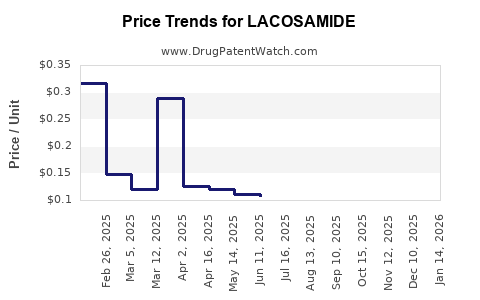
How Will Pricing Evolve?
Historical Pricing
- Brand-name Lacosamide (Vimpat): Average wholesale price (AWP) of $10–$15 per 150 mg tablet.
- Generics: Entry in 2020 led to a price decline of approximately 50%.
Current Price Levels (2023)
| Formulation |
Price per Dose |
Notes |
| Brand (Vimpat) |
$12–$15 (per 150 mg) |
Typically prescribed once or twice daily. |
| Generic Oral |
$5–$7 (per 150 mg) |
Market penetration increasing. |
| Generic IV |
$8–$10 (per 100 mg/mL) |
Used in hospital settings. |
Future Price Projections
- Next 3 Years: Prices for generics expected to decline gradually to $3–$5 per 150 mg tablet, driven by increased manufacturing capacity and competition.
- Brand Name Vimpat: Prices are likely to stabilize or decline marginally, as patent barriers are absent.
- Wholesale and insurance reimbursement rates are expected to decline by 10-20% annually in mature markets due to policy pressures and generic penetration.
What Is the Expected Market Growth?
Demand Growth
- Incidence of epilepsy: ~50 per 100,000 annually worldwide.
- Growing diagnosis rates and expanding treatment guidelines enhance adoption.
- Lacosamide's market share is projected to increase modestly, reaching 20% of the AED market by 2025, assuming stable competition and no new entrants.
Regional Trends
| Region |
Growth Rate (2023–2027) |
Key Factors |
| North America |
4–5% |
High diagnosis rates, insurance coverage. |
| Europe |
3–4% |
Widely adopted, aging population. |
| Asia-Pacific |
8% |
Increasing awareness, expanding healthcare access. |
What Are the Key Risks and Opportunities?
Risks
- Increased competition from both branded and generic AEDs.
- Regulatory harmonization leading to faster generic approvals.
- Potential market saturation in mature markets.
Opportunities
- Expanding into emerging markets with low current penetration.
- Developing controlled-release formulations to improve patient adherence.
- Co-prescriptions with other AEDs for refractory epilepsy.
Summary of Revenue and Price Projections (2023–2027)
| Year |
Estimated Market Size (USD millions) |
Average Price per 150 mg Tablet |
Market Share (%) |
Estimated Revenue (USD millions) |
| 2023 |
350 |
$6.50 |
15 |
52 |
| 2024 |
370 |
$5.50 (generic prices) |
17 |
63 |
| 2025 |
400 |
$4.50 (further decline) |
20 |
80 |
| 2026 |
440 |
$3.75 |
22 |
97 |
| 2027 |
470 |
$3.50 |
23 |
104 |
Values derived from market growth estimates, generic price trends, and expected market share shifts.
Key Takeaways
- Lacosamide's market is transitioning towards generic dominance, with pricing expected to decline 50-70% over the next five years.
- Regional growth will be driven by emerging markets, where prescription rates are increasing.
- The drug’s market share remains stable owing to its efficacy and tolerability profile.
- Price erosion remains the most significant factor influencing revenue.
FAQs
Q1: When will generics fully replace branded lacosamide?
A: Generic versions have gained significant market share since 2020; full replacement varies by region but is expected in developed markets by 2024–2025.
Q2: How does patent expiry affect price projections?
A: Patent expiry in 2019 led to immediate price declines for generics, with continued downward pressure expected as manufacturing capacity increases.
Q3: Are there new formulations or indications for lacosamide?
A: No, current formulations are oral and intravenous. Expanding indications are limited as of now.
Q4: What is the primary growth driver for lacosamide?
A: Growing epilepsy diagnosis rates, increasing treatment adoption, and expanding access in emerging markets.
Q5: How do regional differences impact market dynamics?
A: North America and Europe see slower price declines due to established markets, whereas Asia-Pacific and Latin America exhibit higher growth potential and price competition.
References:
[1] MarketWatch. (2022). Epilepsy Drugs Market Size, Share & Trends analysis.