Share This Page
FOLIC ACID - Generic Drug Details
✉ Email this page to a colleague
What are the generic drug sources for folic acid and what is the scope of patent protection?
Folic acid
is the generic ingredient in four branded drugs marketed by Ben Venue, Fresenius Kabi Usa, Xgen Pharms, Wyeth Pharms Inc, Solubiomix, Aiping Pharm Inc, Amneal Pharm, Barr, Cadila Pharms Ltd, Chartwell Molecular, Contract Pharmacal, Everylife, Halsey, Hikma Pharms, Impax Labs, Ivax Sub Teva Pharms, Jubilant Cadista, Lannett, Leading, Lilly, Mk Labs, Nexgen Pharma Inc, Nuvo Pharms Inc, Ph Health, Pharmeral, Pioneer Pharms, Purepac Pharm, Rising, Sandoz, Sun Pharm Industries, Tablicaps, UDL, Usl Pharma, Valeant Pharm Intl, Vangard, Vintage Pharms, Watson Labs, Whiteworth Town Plsn, and Mission Pharma, and is included in forty-one NDAs. Additional information is available in the individual branded drug profile pages.Thirty-one suppliers are listed for this compound.
Summary for FOLIC ACID
| US Patents: | 0 |
| Tradenames: | 4 |
| Applicants: | 39 |
| NDAs: | 41 |
| Finished Product Suppliers / Packagers: | 31 |
| Raw Ingredient (Bulk) Api Vendors: | 1 |
| Patent Applications: | 7,936 |
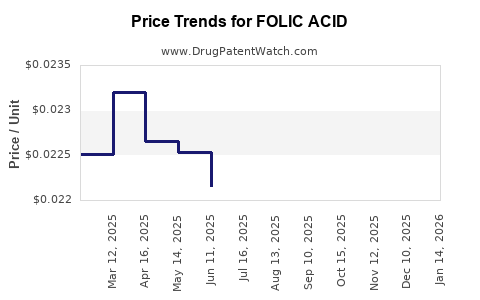
| Drug Prices: | Drug price trends for FOLIC ACID |
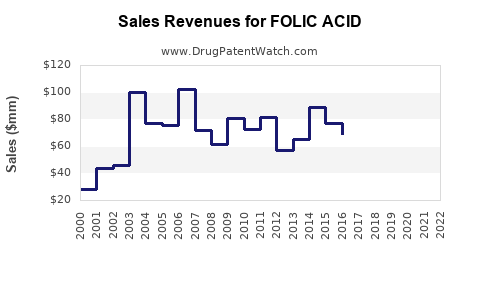
| Drug Sales Revenues: | Drug sales revenues for FOLIC ACID |
| What excipients (inactive ingredients) are in FOLIC ACID? | FOLIC ACID excipients list |
| DailyMed Link: | FOLIC ACID at DailyMed |
Medical Subject Heading (MeSH) Categories for FOLIC ACID
Anatomical Therapeutic Chemical (ATC) Classes for FOLIC ACID
US Patents and Regulatory Information for FOLIC ACID
| Applicant | Tradename | Generic Name | Dosage | NDA | Approval Date | TE | Type | RLD | RS | Patent No. | Patent Expiration | Product | Substance | Delist Req. | Exclusivity Expiration |
|---|---|---|---|---|---|---|---|---|---|---|---|---|---|---|---|
| Vintage Pharms | FOLIC ACID | folic acid | TABLET;ORAL | 086296-001 | Approved Prior to Jan 1, 1982 | DISCN | No | No | ⤷ Start Trial | ⤷ Start Trial | ⤷ Start Trial | ||||
| Chartwell Molecular | FOLIC ACID | folic acid | TABLET;ORAL | 090035-001 | Jun 9, 2009 | AA | RX | No | No | ⤷ Start Trial | ⤷ Start Trial | ⤷ Start Trial | |||
| Tablicaps | FOLIC ACID | folic acid | TABLET;ORAL | 083133-002 | Approved Prior to Jan 1, 1982 | DISCN | No | No | ⤷ Start Trial | ⤷ Start Trial | ⤷ Start Trial | ||||
| Usl Pharma | FOLIC ACID | folic acid | TABLET;ORAL | 087828-001 | May 13, 1982 | DISCN | No | No | ⤷ Start Trial | ⤷ Start Trial | ⤷ Start Trial | ||||
| Valeant Pharm Intl | FOLIC ACID | folic acid | TABLET;ORAL | 080903-001 | Approved Prior to Jan 1, 1982 | DISCN | No | No | ⤷ Start Trial | ⤷ Start Trial | ⤷ Start Trial | ||||
| >Applicant | >Tradename | >Generic Name | >Dosage | >NDA | >Approval Date | >TE | >Type | >RLD | >RS | >Patent No. | >Patent Expiration | >Product | >Substance | >Delist Req. | >Exclusivity Expiration |
Folic Acid Market Dynamics, Patent Status, FDA Regulation, and Financial Trajectory
Folic acid is a mature, low-cost vitamin B9 product with stable global demand and limited patent protection. Its commercial value comes from high-volume nutrition markets, prenatal supplementation, food fortification, generic prescription products, and pharmaceutical manufacturing inputs rather than branded-drug pricing. No single company reports consolidated global folic acid revenue, and the market is fragmented across pharmaceutical manufacturers, dietary-supplement companies, food producers, and chemical suppliers.
What is the current market position of folic acid?
Folic acid occupies two overlapping markets:
- Pharmaceutical folic acid, supplied as prescription tablets, oral solutions, injections, and compounded products.
- Nutritional folate, supplied through dietary supplements, prenatal vitamins, fortified foods, and food-grade premixes.
The active ingredient is folic acid, a synthetic form of vitamin B9. The body converts folic acid into biologically active folate forms involved in DNA synthesis, red blood cell production, and fetal neural-tube development.
The pharmaceutical market is mature. Demand is relatively defensive because folic acid is used in pregnancy care, nutritional deficiency treatment, hematology, and food-fortification programs. Unit growth is constrained by low prices and broad availability, while value growth depends on population growth, prenatal-care uptake, fortification policy, and premium supplement positioning.
The largest commercial demand pools are:
| Demand segment | Primary use | Market characteristic |
|---|---|---|
| Prenatal supplements | Neural-tube-defect prevention | Recurring, recommendation-driven demand |
| General multivitamins | Nutritional supplementation | Highly competitive and brand fragmented |
| Fortified foods | Public-health programs | Large-volume, low-margin procurement |
| Generic prescription products | Folate-deficiency treatment | Price-sensitive and commoditized |
| Pharmaceutical manufacturing | Formulation and premix input | B2B, specification-driven |
| Agricultural and animal nutrition | Feed and veterinary applications | Separate demand pool from human medicine |
The U.S. Food and Drug Administration requires enriched grain products to contain folic acid under the U.S. fortification program. The Centers for Disease Control and Prevention recommends that women capable of becoming pregnant consume 400 micrograms of folic acid daily to reduce the risk of neural-tube defects (CDC, 2024).
How large is the folic acid market?
There is no standardized, audited market figure for folic acid alone. Commercial market reports often combine folic acid with folate, vitamin B9, prenatal vitamins, nutraceuticals, or broader vitamin markets. Those categories are not interchangeable and produce materially different revenue estimates.
The most reliable market conclusion is structural rather than a single revenue figure:
- Prescription folic acid revenue is small relative to branded specialty pharmaceuticals.
- Supplement and prenatal products generate most consumer-facing value.
- Food fortification generates substantial volume but low unit pricing.
- Ingredient manufacturing is concentrated and exposed to raw-material, energy, compliance, and export-cost changes.
- Premium products increasingly use methylfolate or other reduced folate forms, creating a value segment separate from commodity folic acid.
Standalone revenue disclosure is limited because major supplement companies report folic acid within broader vitamin, mineral, supplement, or consumer-health categories. Ingredient manufacturers also tend to report folic acid within larger nutrition or pharmaceutical-ingredient divisions.
What is the financial trajectory for folic acid?
Folic acid has a stable-volume, low-price financial profile. Revenue growth is more likely to come from mix, geographic expansion, premium formulations, and supplement distribution than from price increases in generic tablets.
Base-market trajectory
The core trajectory has four characteristics:
- Stable demand: Prenatal supplementation and mandatory food fortification support recurring consumption.
- Low price elasticity at the ingredient level: Folic acid is inexpensive per dose, so demand is less sensitive to modest price changes than demand for discretionary branded therapies.
- Persistent margin pressure: Multiple generic and ingredient suppliers limit pricing power.
- Limited innovation premium: Conventional folic acid is chemically established, and most basic formulations do not support meaningful exclusivity.
Revenue drivers
| Driver | Effect on revenue | Effect on margin |
|---|---|---|
| Higher prenatal supplement use | Positive | Neutral to positive |
| Expansion of food fortification | Positive volume | Low margin |
| Generic price competition | Negative value effect | Negative |
| Premium prenatal branding | Positive value effect | Positive |
| Methylfolate substitution | Can divert demand | May raise category value |
| Regulatory changes | Variable by market | Can raise compliance cost |
| Ingredient supply concentration | Can lift prices temporarily | Increases volatility |
| E-commerce supplement sales | Expands access | Raises marketing competition |
The most attractive commercial segment is not bulk folic acid itself. It is differentiated delivery, prenatal positioning, physician-recommended supplementation, combination products, and branded formulations that use clinical claims permitted by applicable regulation.
What patents protect folic acid products?
Conventional folic acid has no meaningful active-ingredient patent estate. The compound has been known and used for decades, and any original composition-of-matter protection expired long ago.
Patent protection by product type
| Product type | Current patent position |
|---|---|
| Conventional folic acid API | No enforceable original composition patent |
| Standard folic acid tablets | Generally unprotected by commercially significant patents |
| Folic acid injection | Product-specific formulation patents may exist in isolated cases, but no broad basic-ingredient estate |
| Prenatal combinations | Possible formulation, dosage, or method claims, usually product-specific |
| Methylfolate products | Separate ingredient and formulation analysis required |
| Controlled-release folate | Potential formulation claims, subject to claim scope and expiration |
| Manufacturing processes | Possible process patents, normally narrow and supplier-specific |
| Food-fortification premixes | Contract, quality, process, or formulation know-how can matter more than patents |
Patent risk therefore shifts from the molecule to the delivery system, combination product, manufacturing process, and branded trade dress.
When does folic acid lose exclusivity?
Folic acid lost meaningful pharmaceutical exclusivity decades ago. There is no relevant upcoming basic-drug patent cliff comparable to the loss of exclusivity for a modern branded therapy.
The practical exclusivity position is:
- Active ingredient: long expired.
- Standard oral dosage forms: generic and commercially available.
- Food use: broadly established and not dependent on a single supplier.
- Prenatal products: brand-level differentiation may remain, but it is not molecule exclusivity.
- Specialized formulations: protection depends on individual patents, regulatory exclusivity, and commercial enforceability.
Patent expiry dates are relevant only for specific formulation or process patents. A single universal expiration date for “folic acid” would be misleading because the product category includes multiple formulations, combinations, and jurisdictions.
What is the FDA regulatory status of folic acid?
Folic acid is regulated in the United States as both an approved pharmaceutical ingredient and a dietary-supplement ingredient, depending on the product’s composition, claims, dosage form, and intended use.
Pharmaceutical regulation
Prescription folic acid products are generally marketed through abbreviated new drug applications or older approved applications. Common strengths include 1 mg and 5 mg tablets. Products are used for folate deficiency and related hematologic conditions.
FDA-approved labeling identifies folic acid for treatment of megaloblastic anemias caused by folate deficiency. Folic acid is not a substitute for vitamin B12 when B12 deficiency is present because it can correct anemia while neurologic injury progresses.
Dietary supplements
Dietary supplements containing folic acid are regulated under the Dietary Supplement Health and Education Act. Manufacturers are responsible for product safety, truthful labeling, and compliance with good manufacturing practices. Supplements cannot make disease-treatment claims without entering the drug regulatory framework.
Fortified foods
The FDA established requirements for folic acid fortification of enriched grain products. This policy materially expanded population exposure and created a durable institutional demand base for food-grade folic acid (FDA, 2024).
What is the Orange Book status of folic acid?
The FDA Orange Book is relevant to approved prescription drug products, but it does not create exclusivity for the folic acid molecule. Generic manufacturers may rely on abbreviated approval pathways where the reference product and applicable regulatory requirements support an ANDA.
For standard folic acid tablets, the commercial environment is characterized by:
- Multiple generic suppliers.
- Limited or absent blocking patents.
- Low barriers to therapeutic substitution.
- Price competition among manufacturers and distributors.
- Greater importance of manufacturing compliance and supply reliability than patent ownership.
Orange Book analysis must be performed at the product and strength level. A broad statement that “folic acid has no Orange Book patents” would not capture potential product-specific listings for a particular formulation or combination.
Are there Paragraph IV challenges involving folic acid?
Paragraph IV litigation is not a major feature of the conventional folic acid market. The molecule is generic, inexpensive, and widely available. The expected economic return from challenging a blocking patent is generally too low to support extensive litigation unless a specific high-value formulation or combination product has unusually strong sales.
Potential Paragraph IV activity would more likely involve:
- A branded prenatal combination.
- A controlled-release folate product.
- A combination containing folic acid and another therapeutic ingredient.
- A device-enabled delivery system.
- A formulation with a narrow patent claim and concentrated revenue.
For conventional 1 mg or 5 mg folic acid tablets, generic-entry risk is already embedded in the market structure.
What formulation patents protect folic acid products?
Formulation patents can cover:
- Extended-release delivery.
- Taste-masked oral solutions.
- Stability improvements.
- Solubility or dissolution control.
- Combination prenatal tablets.
- Layered or multiparticulate dosage forms.
- Folic acid with iron, vitamin B12, vitamin D, or other nutrients.
- Premixes designed for industrial food processing.
- Specific excipient ratios or manufacturing conditions.
These patents are commercially relevant only if the claims are narrow enough to avoid routine design-around and the product has enough revenue to support enforcement. For low-cost folic acid tablets, process patents and formulation patents rarely create durable market exclusivity.
What patent litigation affects folic acid?
No major, broadly consequential patent litigation currently defines the conventional folic acid market. Litigation exposure is more likely to arise in adjacent categories:
- Prenatal vitamins.
- Methylfolate and reduced-folate products.
- Combination therapies.
- Nutritional products making disease-related claims.
- Supplier disputes involving manufacturing processes or specifications.
- Trademark and advertising disputes involving “active folate” or “natural folate” positioning.
The absence of major litigation reflects the economics of the product. Low revenue per unit and extensive generic supply reduce the incentive to pursue molecule-level enforcement.
Is biosimilar risk relevant to folic acid?
No. Folic acid is a small-molecule vitamin, not a biologic. Biosimilar approval pathways do not apply.
The relevant competitive risks are generic substitution, ingredient competition, private-label supplements, methylfolate substitution, and food-fortification procurement pricing.
Which companies compete in the folic acid market?
Competition exists across several layers rather than through one branded pharmaceutical market.
Ingredient suppliers
Ingredient producers compete on:
- Pharmaceutical-grade and food-grade specifications.
- Certificate-of-analysis reliability.
- Regulatory documentation.
- Batch consistency.
- Supply continuity.
- Cost and geographic availability.
- Good manufacturing practice compliance.
China and India have major roles in global pharmaceutical-ingredient and vitamin supply chains, while Western companies remain active in branded supplements, specialty nutrition, premixes, and distribution.
Finished-dose manufacturers
Generic drug companies compete in prescription tablets and other dosage forms. Consumer-health companies compete in prenatal vitamins, multivitamins, and specialty nutrition products. Retailers and contract manufacturers also supply private-label products.
The strongest commercial position usually belongs to companies that combine:
- Established regulatory files.
- Reliable API sourcing.
- National or international distribution.
- Prenatal or clinical brand recognition.
- Contract manufacturing scale.
- Quality and recall-management capabilities.
What manufacturing and intellectual-property barriers exist?
Patent barriers are low, but manufacturing barriers remain practical and regulatory.
Key barriers include:
- API qualification and supplier validation.
- Stability data.
- Microbiological and contaminant controls.
- Batch-to-batch potency consistency.
- GMP compliance.
- Documentation for global registrations.
- Food-fortification premix compatibility.
- Supply-chain resilience.
- Registration in markets with different food and medicine classifications.
For a new entrant, the primary risk is not freedom to operate. It is achieving acceptable cost, quality, regulatory compliance, and distribution scale.
How does folic acid compare with methylfolate?
Folic acid is cheaper, more standardized, and widely used in fortification. Methylfolate is marketed as a biologically active folate form and often commands higher prices in supplements.
| Attribute | Folic acid | Methylfolate |
|---|---|---|
| Cost | Low | Higher |
| Fortification use | Extensive | Limited |
| Generic pharmaceutical availability | Broad | Narrower |
| Patent exposure | Minimal for basic ingredient | More product-specific claims possible |
| Consumer positioning | Established, familiar | Premium or differentiated |
| Clinical recommendation base | Strong for neural-tube prevention | Product- and population-specific |
| Margin potential | Low to moderate | Higher, subject to competition |
The commercial threat to folic acid is not a complete replacement. It is gradual value migration in premium prenatal and nutraceutical products.
What generic launch scenarios exist for folic acid?
The conventional generic-launch scenario is already mature:
- Multiple manufacturers maintain market access.
- Retail and wholesale prices remain low.
- Supply interruptions can create temporary price increases.
- New entrants compete through procurement, manufacturing efficiency, or distribution.
- A branded formulation can delay substitution only through product differentiation, regulatory positioning, or enforceable formulation claims.
A new conventional folic acid tablet would face low patent risk but high commercial commoditization risk. A differentiated prenatal combination or delivery system could support better margins, but it would also face greater regulatory, clinical, and marketing costs.
What is the investment outlook for folic acid?
Folic acid is unlikely to produce blockbuster pharmaceutical economics. Its investment profile is more suitable for companies with scale, vertical integration, established supplement brands, food-fortification contracts, or low-cost API production.
The strongest financial opportunities are likely to arise from:
- High-volume government or food-industry contracts.
- Prenatal and women’s-health brands.
- Premium folate combinations.
- Reliable pharmaceutical-grade API supply.
- Geographic markets expanding food fortification.
- Contract manufacturing and private-label distribution.
The principal risks are commodity pricing, supplier concentration, quality failures, regulatory noncompliance, product recalls, and substitution by premium folate forms.
Key Takeaways
- Folic acid is a mature vitamin B9 product with no meaningful basic-molecule patent protection.
- The market is fragmented across pharmaceuticals, supplements, prenatal vitamins, fortified foods, and ingredient supply.
- Prescription folic acid is generic, low priced, and exposed to continuing price competition.
- Consumer and prenatal products generate more commercial value than standard prescription tablets.
- Food fortification creates stable, high-volume demand but generally low margins.
- Paragraph IV litigation and biosimilar risk are not material for conventional folic acid.
- Formulation, combination, manufacturing-process, and branding rights are more relevant than active-ingredient patents.
- Premium methylfolate products create competitive pressure in higher-margin supplement segments.
- Financial upside depends on scale, distribution, product differentiation, and supply reliability rather than exclusivity.
- No single consolidated public revenue figure accurately represents the global folic acid market.
FAQs
Does folic acid have an active composition-of-matter patent?
No. The original compound is long out of patent protection. Any current rights would relate to a specific formulation, combination, manufacturing process, or branded product.
Is folic acid an over-the-counter drug or a dietary supplement?
It can be either, depending on the product. Prescription-strength products are regulated as drugs, while many low-dose products are sold as dietary supplements under DSHEA.
Can a company obtain FDA exclusivity for a new folic acid product?
Potentially, but exclusivity would depend on the product’s regulatory pathway and innovation. A conventional folic acid tablet would not ordinarily support meaningful new exclusivity based only on the known active ingredient.
Why do prenatal vitamins use folic acid if methylfolate products are available?
Folic acid has extensive clinical and public-health support, low cost, standardized manufacturing, and established use in neural-tube-defect prevention. Methylfolate is used mainly for product differentiation and premium positioning.
What is the main commercial risk in launching a new folic acid product?
The main risk is commoditization. Patent freedom to operate is generally straightforward, but low prices, entrenched suppliers, retailer bargaining power, and limited product differentiation can prevent attractive returns.
References
Centers for Disease Control and Prevention. (2024). Folic acid and neural tube defects prevention. https://www.cdc.gov/folic-acid/
National Institutes of Health, Office of Dietary Supplements. (2024). Folate fact sheet for health professionals. https://ods.od.nih.gov/factsheets/Folate-HealthProfessional/
U.S. Food and Drug Administration. (2024). Folic acid fortification. https://www.fda.gov/
U.S. Food and Drug Administration. (2024). Approved drug products with therapeutic equivalence evaluations, Orange Book. https://www.fda.gov/drugs/drug-approvals-and-databases/approved-drug-products-therapeutic-equivalence-evaluations-orange-book
U.S. Food and Drug Administration. (2024). Dietary supplements. https://www.fda.gov/food/dietary-supplements-controls-and-regulations-dietary-supplements
More… ↓
