Last updated: September 7, 2026
Eszopiclone is a mature, largely generic insomnia medicine whose commercial value shifted from branded pricing to high-volume, low-margin prescription demand. The branded product, Lunesta, was developed by Sepracor and acquired by Eisai with Sepracor in 2010. U.S. generic entry began in 2014, sharply reducing branded revenue and transferring market share to Teva, Sandoz, Mylan, Dr. Reddy's Laboratories, and other manufacturers. The product remains FDA-approved and clinically relevant, but its financial profile is constrained by generic pricing, Schedule IV controls, safety-label changes, and competition from zolpidem, zaleplon, suvorexant, lemborexant, daridorexant, and non-drug insomnia therapy.
What is eszopiclone and how is it used?
Eszopiclone is the S-enantiomer of zopiclone and belongs to the cyclopyrrolone class of hypnotic agents. It is approved for the treatment of insomnia, including difficulty falling asleep and difficulty maintaining sleep. Lunesta received FDA approval on December 15, 2004, under NDA 021476. The product was initially approved in 2-mg and 3-mg tablets, with a 1-mg strength added later to address next-day impairment concerns.
Eszopiclone is administered orally and is generally taken immediately before bedtime. The FDA labeling identifies 1 mg as the recommended starting dose for adults, with a maximum recommended dose of 3 mg. Older adults and patients with hepatic impairment generally require lower dosing because clearance is reduced.
Eszopiclone is a Schedule IV controlled substance in the United States. Its controlled-substance status creates prescribing and dispensing requirements but does not provide meaningful market exclusivity. The drug competes in a crowded insomnia market where formulary managers and prescribers often favor inexpensive generic zolpidem.
When did eszopiclone lose brand exclusivity?
Lunesta lost its commercial exclusivity in the United States when generic eszopiclone products entered the market in 2014. The market transition occurred through abbreviated new drug applications, patent litigation, and settlement arrangements involving the branded manufacturer and generic applicants.
Eszopiclone exclusivity timeline
| Milestone |
Date |
Commercial significance |
| FDA approval of Lunesta |
December 15, 2004 |
Established eszopiclone as a branded insomnia product |
| New chemical entity exclusivity |
Through December 2009 |
Blocked abbreviated applications based on the new chemical entity exclusivity period |
| Core patent litigation |
Approximately 2010-2014 |
Delayed or structured generic entry |
| First U.S. generic approvals and launches |
2014 |
Initiated rapid price and share erosion |
| FDA-required dose-label changes |
2014 |
Lowered recommended starting dose because of next-day impairment |
| FDA boxed warning for complex sleep behaviors |
2019 |
Increased safety scrutiny across the sedative-hypnotic class |
| Current market status |
2024 |
Mature generic market with no meaningful branded exclusivity |
The core historical U.S. patent associated with Lunesta is U.S. Patent No. 6,319,926, assigned to Sepracor. The patent covered eszopiclone and related pharmaceutical compositions. The Orange Book listing and related patent litigation were central to the timing of generic approval. By 2024, the principal patent barriers had expired or ceased to prevent ordinary generic competition.
What patents protect eszopiclone?
The main patent protection for eszopiclone was composition-of-matter protection rather than a durable formulation platform.
| Patent or protection |
Holder |
Subject matter |
Current commercial relevance |
| U.S. Patent No. 6,319,926 |
Sepracor |
Eszopiclone and related cyclopyrrolone compounds |
Historical core protection; no longer blocks routine U.S. generic entry |
| FDA NCE exclusivity |
Sepracor |
Regulatory exclusivity for the new chemical entity |
Expired in 2009 |
| Orange Book-listed patents |
Sepracor and successor entities |
Patent claims tied to the approved product |
Historically relevant to Paragraph IV litigation |
| Generic product patents |
Various generic applicants |
Manufacturing, formulation, or packaging claims |
Generally limited commercial impact for immediate-release tablets |
Eszopiclone did not develop the type of extensive patent thicket associated with complex biologics, long-acting injectables, inhaled products, or modified-release products. The commercial product is a conventional immediate-release oral tablet. That dosage form limits the number of technically meaningful follow-on patent positions.
What was the Paragraph IV litigation around Lunesta?
Generic applicants challenged the relevant Lunesta patents through Paragraph IV certifications under the Hatch-Waxman Act. The challenges alleged that the patents were invalid, unenforceable, or would not be infringed by the proposed generic products.
Sepracor litigated against multiple generic manufacturers, including Teva, Mylan, Ranbaxy, and Dr. Reddy's Laboratories. The litigation created a period in which generic companies could prepare products while the branded company sought to preserve market protection. Settlements and court proceedings ultimately permitted generic entry before the branded product had exhausted every possible commercial protection.
The practical result was earlier generic availability without a prolonged second-generation patent estate. Once multiple approved suppliers entered, the market rapidly moved toward commodity economics.
What is the Orange Book status of eszopiclone?
The Orange Book historically listed Lunesta as an approved drug with associated patents and exclusivity information. The active branded exclusivity period has ended, and generic eszopiclone products are approved through ANDA pathways.
The current regulatory issues are therefore product-specific rather than exclusivity-driven:
- FDA approval of multiple generic immediate-release tablets.
- Bioequivalence to the reference-listed drug.
- Controlled-substance compliance.
- Labeling consistent with next-day impairment and complex sleep behavior warnings.
- Manufacturing compliance under current good manufacturing practices.
- Supply continuity and drug-shortage monitoring.
The Orange Book no longer provides the branded product with a meaningful barrier to generic substitution. A manufacturer seeking to enter the U.S. market would generally face regulatory, manufacturing, and commercial hurdles rather than an active primary patent barrier.
How did generic entry change the eszopiclone market?
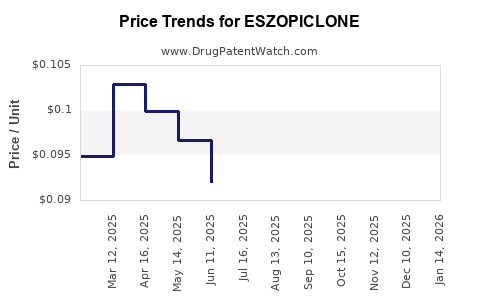
Generic entry changed eszopiclone from a premium branded therapy into a price-sensitive prescription product. Before 2014, Lunesta benefited from branded reimbursement, physician familiarity, direct-to-consumer advertising, and the ability to position itself as a longer-duration alternative to zolpidem. After generic launch, pharmacy benefit managers and health plans gained leverage to substitute lower-cost products.
The principal market effects were:
- Rapid decline in branded prescriptions.
- Lower average selling prices.
- Increased share for generic manufacturers.
- Reduced promotional spending.
- Greater dependence on supply reliability and contract pricing.
- Lower barriers for additional generic suppliers.
Generic insomnia drugs are particularly exposed to price competition because the clinical category has several substitutable therapies. Zolpidem remains the dominant low-cost comparator in many formularies. Eszopiclone retains demand among patients who require sleep-maintenance efficacy or who do not respond adequately to zolpidem, but that differentiation is rarely sufficient to support branded pricing.
What is the financial trajectory for Lunesta and eszopiclone?
The financial trajectory has three stages.
Branded growth before generic entry
Lunesta generated meaningful revenue for Sepracor and later Eisai during the period when the company controlled the U.S. brand. The product benefited from approval for both sleep initiation and sleep maintenance, a large insomnia patient population, and extensive promotion.
Sepracor made Lunesta its leading commercial asset. The company used television advertising and physician promotion to build awareness, including the well-known “butterfly” campaign. That strategy supported branded demand but also created a large cost base that became difficult to sustain after generic entry.
Acquisition and erosion phase
Eisai acquired Sepracor in 2010 for approximately $2.6 billion. The transaction gave Eisai access to Lunesta and other specialty products, but the asset carried a finite patent life and substantial exposure to generic substitution.
By the time of the acquisition, investors understood that Lunesta would face material loss of exclusivity. Eisai's financial exposure therefore depended on how quickly generic entry occurred, the structure of litigation settlements, and whether newer products could replace the declining revenue stream.
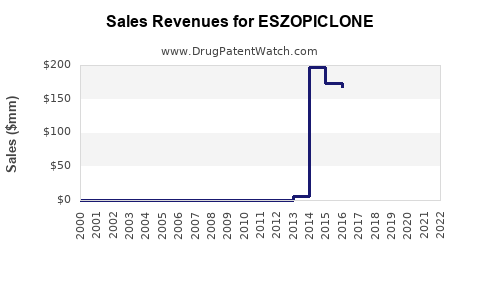
The product's revenue trajectory weakened as the U.S. market approached generic entry. Generic availability in 2014 converted much of the remaining brand value into residual prescription demand, licensing income, and low-volume branded sales.
Mature generic phase
After 2014, eszopiclone revenue became fragmented across manufacturers. Public financial reporting generally does not provide a single audited global revenue figure for the active ingredient because manufacturers report products within broader generic portfolios. The market is therefore better assessed through prescription volume, average generic pricing, supplier count, and brand share.
The economic profile is now characterized by:
| Financial driver |
Effect on eszopiclone |
| Generic substitution |
Reduces brand price and share |
| Multiple ANDA holders |
Increases price competition |
| Established tablet manufacturing |
Limits technical differentiation |
| Controlled-substance handling |
Adds compliance costs |
| Low-cost active pharmaceutical ingredient supply |
Supports low prices |
| Formulary preference for zolpidem |
Limits share expansion |
| Safety warnings |
Constrain high-dose and long-term use |
| Chronic insomnia prevalence |
Supports baseline volume |
Lunesta no longer represents a major growth asset for Eisai. The financial value of eszopiclone is concentrated in generic manufacturing efficiency rather than intellectual property.
What formulation patents protect eszopiclone?
The approved product is an immediate-release oral tablet, which is relatively easy to reproduce through a standard ANDA pathway. No major commercial formulation platform has emerged around eszopiclone comparable to extended-release delivery, transdermal delivery, depot injection, or abuse-deterrent technology.
Potential formulation claims may cover:
- Tablet composition.
- Excipients.
- Particle size.
- Crystalline form.
- Manufacturing process.
- Stability profile.
- Packaging.
These claims can protect individual products or manufacturing processes, but they do not recreate the broad market exclusivity of a composition-of-matter patent. Their value is usually limited by design-around options and the availability of alternative suppliers.
What regulatory risks affect eszopiclone sales?
The FDA has taken several actions that affect the commercial positioning of eszopiclone.
In 2014, the FDA required lower recommended starting doses for Lunesta after data showed that blood levels could remain elevated the following morning, impairing activities such as driving. The agency recommended a 1-mg starting dose and retained a 3-mg maximum dose for appropriate patients.
In 2019, the FDA required boxed warnings for eszopiclone, zaleplon, and zolpidem concerning complex sleep behaviors. These events include sleepwalking, sleep driving, and other activities performed while not fully awake. The warning applies even at recommended doses and can affect prescribing decisions.
The regulatory impact is mainly demand-related. The warnings do not remove eszopiclone from the market, but they discourage use in patients at higher risk and strengthen competition from non-sedating or newer insomnia treatments.
How does eszopiclone compare with competing insomnia drugs?
| Drug |
Class |
Patent and exclusivity position |
Commercial position |
| Eszopiclone |
Cyclopyrrolone hypnotic |
Generic |
Low-cost option; sleep initiation and maintenance |
| Zolpidem |
Imidazopyridine hypnotic |
Generic |
Major formulary and prescription competitor |
| Zaleplon |
Pyrazolopyrimidine hypnotic |
Generic |
Shorter-acting option |
| Suvorexant |
Orexin receptor antagonist |
Branded and patent-protected for much of the period |
Premium alternative for sleep maintenance |
| Lemborexant |
Orexin receptor antagonist |
Branded, with active patent positions |
Competes on sleep onset and maintenance |
| Daridorexant |
Orexin receptor antagonist |
Branded, with active patent positions |
Premium newer entrant |
| Ramelteon |
Melatonin receptor agonist |
Generic |
Non-controlled alternative |
| Doxepin |
Tricyclic antidepressant at low dose |
Generic |
Low-dose sleep-maintenance option |
The key competitive divide is between inexpensive generic hypnotics and newer branded dual orexin receptor antagonists. Orexin products can command higher prices, but they face reimbursement restrictions and their own eventual loss-of-exclusivity risk. Eszopiclone remains commercially relevant because it is inexpensive, familiar, and available through broad pharmacy networks.
What generic entry risks exist for eszopiclone manufacturers?
The principal risks are commercial rather than patent-based.
Price compression
Each additional ANDA holder can reduce average selling prices. Retail and institutional buyers may switch suppliers based on small price differences, especially where products are therapeutically interchangeable.
Supply-chain exposure
Generic manufacturers depend on reliable supplies of eszopiclone API, compliant tablet production, and stable packaging operations. A manufacturing interruption can create temporary pricing opportunities, but it also exposes companies to FDA scrutiny and contract loss.
Controlled-substance compliance
Schedule IV status imposes requirements relating to inventory, records, distribution, diversion controls, and DEA compliance. These obligations increase operating costs relative to non-controlled oral medicines.
Limited differentiation
The immediate-release tablet has limited room for meaningful clinical differentiation. Manufacturers typically compete on price, supply reliability, customer service, and regulatory execution.
Label and safety compliance
Manufacturers must maintain labeling consistent with FDA warnings. Failure to update labels, manage adverse-event reporting, or control promotional claims can lead to enforcement and product liability exposure.
How strong is the eszopiclone patent estate?
The current patent estate is weak as a barrier to U.S. generic entry. The historical estate provided meaningful protection for the branded product, but it did not evolve into a broad portfolio of active formulation, method-of-use, device, or manufacturing patents.
Its commercial strength can be summarized as follows:
| Dimension |
Assessment |
| Composition-of-matter protection |
Historically strong, now expired |
| NCE exclusivity |
Expired |
| Formulation protection |
Limited |
| Method-of-use protection |
Limited commercial impact |
| Manufacturing barriers |
Moderate for compliant production, low from an IP perspective |
| Biosimilar risk |
Not applicable |
| Generic entry risk |
High and already realized |
| Geographic protection |
Country-specific and largely expired in major generic markets |
| Litigation leverage |
Historical, not a current U.S. market barrier |
Eszopiclone is a small-molecule drug, so biosimilar regulation does not apply. The relevant competitive threat is generic substitution through ANDA or equivalent international pathways.
What is the outlook for eszopiclone revenue?
Eszopiclone revenue should remain stable to declining in value terms, with prescription volume more resilient than price. The product has a persistent clinical role, but no obvious mechanism for a return to branded growth.
The most likely financial pattern is:
- Continued generic volume in the United States.
- Further unit-price erosion as suppliers compete.
- Stable demand among patients who respond to eszopiclone or prefer it to zolpidem.
- Periodic pricing increases only during supply disruptions.
- Limited value from additional formulation patents.
- Continued migration of some patients toward orexin antagonists or behavioral therapy.
- Residual international sales where generic penetration or reimbursement differs.
For manufacturers, eszopiclone is a portfolio product rather than a strategic growth platform. Its value depends on manufacturing scale, procurement discipline, regulatory reliability, and distribution access.
Key Takeaways
- Eszopiclone is the generic successor to Eisai's Lunesta franchise.
- FDA approval occurred in 2004; U.S. generic entry began in 2014.
- U.S. Patent No. 6,319,926 was the principal historical patent associated with the product.
- The active U.S. patent barrier is no longer a meaningful constraint on generic entry.
- Lunesta's revenue declined materially after generic substitution and is no longer a major growth asset.
- The product remains a Schedule IV insomnia medicine with established demand.
- FDA dose changes in 2014 and boxed warnings in 2019 affected prescribing and risk perception.
- Zolpidem is the main low-cost generic competitor; suvorexant, lemborexant, and daridorexant compete as branded alternatives.
- Biosimilar risk does not apply because eszopiclone is a small-molecule drug.
- Future value is driven by generic manufacturing economics, supply reliability, and prescription volume rather than patent exclusivity.
FAQs about eszopiclone market and patent economics
Is Lunesta still patent-protected?
No meaningful U.S. patent protection prevents ordinary generic competition. The historical Sepracor patent estate supported the branded product before generic entry, but generic eszopiclone is now broadly available.
Does eszopiclone have a biosimilar competitor?
No. Eszopiclone is a chemically synthesized small molecule. Competitors enter through generic drug applications rather than biosimilar applications.
Which companies manufacture generic eszopiclone?
Generic eszopiclone has been marketed by companies including Teva, Sandoz, Mylan or Viatris, Dr. Reddy's Laboratories, and other FDA-approved ANDA holders. Supplier participation can change over time because generic manufacturers enter, exit, or suspend products.
Can a new company still launch eszopiclone in the United States?
Yes, subject to FDA approval, bioequivalence, manufacturing compliance, controlled-substance requirements, and commercial viability. The primary challenge is price competition, not an active composition-of-matter patent.
Will orexin drugs replace eszopiclone?
They will take some share in patients seeking alternatives to traditional hypnotics, but they are unlikely to eliminate eszopiclone. Generic pricing, physician familiarity, and established demand support continued use of eszopiclone.
References
-
Eisai Co., Ltd. (2010). Eisai completes acquisition of Sepracor Inc. Eisai.
-
Eisai Co., Ltd. (2014). Annual report and financial results materials. Eisai.
-
U.S. Food and Drug Administration. (2004). Lunesta approval letter and prescribing information, NDA 021476. FDA.
-
U.S. Food and Drug Administration. (2014). FDA drug safety communication: FDA approves new label changes and dosing for sleep drug Lunesta. FDA.
-
U.S. Food and Drug Administration. (2019). FDA adds boxed warning for risk of serious injuries caused by sleepwalking with certain prescription insomnia medicines. FDA.
-
U.S. Food and Drug Administration. (2024). Approved drug products with therapeutic equivalence evaluations: Orange Book. FDA.
-
United States Patent and Trademark Office. (2001). U.S. Patent No. 6,319,926: Cyclopyrrolone derivatives. USPTO.
-
U.S. Drug Enforcement Administration. (2024). Controlled substance schedules. DEA.