Drug Sales Trends for ESZOPICLONE
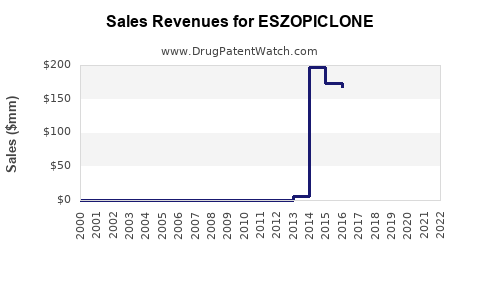
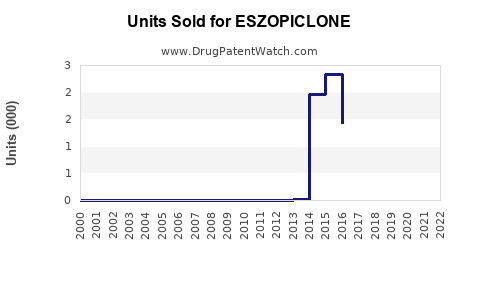
Annual Sales Revenues and Units Sold for ESZOPICLONE
| Drug Name | Revenues (USD) | Units | Year |
|---|---|---|---|
| ESZOPICLONE | ⤷ Start Trial | ⤷ Start Trial | 2022 |
| ESZOPICLONE | ⤷ Start Trial | ⤷ Start Trial | 2021 |
| ESZOPICLONE | ⤷ Start Trial | ⤷ Start Trial | 2020 |
| ESZOPICLONE | ⤷ Start Trial | ⤷ Start Trial | 2019 |
| ESZOPICLONE | ⤷ Start Trial | ⤷ Start Trial | 2018 |
| >Drug Name | >Revenues (USD) | >Units | >Year |
# Eszopiclone Market Analysis, Sales Forecast, Patent Expiration, and Generic Competition
Eszopiclone is a mature, low-growth insomnia drug market dominated by generic manufacturers. The branded product Lunesta no longer controls pricing, and the core U.S. exclusivity period has ended. Global manufacturer revenue for eszopiclone is estimated at approximately $170 million to $230 million in 2024, with a base-case forecast of $185 million in 2030. The forecast implies annual growth of about 1% to 2%, driven by prescription volume, aging populations, and continued use of pharmacologic insomnia treatment.
The principal risks are generic price erosion, substitution by zolpidem and newer agents such as lemborexant and daridorexant, controlled-substance restrictions, and limited differentiation among generic products. Eszopiclone has no biosimilar exposure because it is a chemically synthesized small molecule.
What is the current market status of eszopiclone?
Eszopiclone is the active ingredient in Lunesta, an oral cyclopyrrolone hypnotic approved by the U.S. Food and Drug Administration in 2004 for insomnia. The product is available primarily as 1 mg, 2 mg, and 3 mg tablets. It is a Schedule IV controlled substance in the United States because of abuse, dependence, and misuse risks.[1]
The market has shifted through three commercial phases:
| Period | Market structure | Commercial characteristics |
|---|---|---|
| 2004-2013 | Branded Lunesta | Patent-protected pricing and direct-to-consumer promotion |
| 2014-2018 | Initial generic entry | Rapid erosion of branded volume and price |
| 2019-2030 | Mature generic market | Low prices, multiple suppliers, contract and retail concentration |
Lunesta was developed and commercialized by Sepracor, later acquired by Dainippon Sumitomo Pharma. The U.S. commercial organization became Sunovion Pharmaceuticals. The branded product generated substantial revenue before generic entry, but current U.S. eszopiclone sales are primarily generic manufacturer revenue rather than originator revenue.[2]
How large is the eszopiclone market?
Publicly available sources do not provide a single audited global revenue figure for generic eszopiclone. Market research estimates vary widely because some reports measure retail sales, some measure manufacturer revenue, and others combine eszopiclone with the broader insomnia-drug market.
A practical commercial estimate is:
| Metric | 2024 estimate | 2030 base case |
|---|---|---|
| Global manufacturer revenue | $170 million-$230 million | $185 million |
| Global retail-equivalent value | $300 million-$500 million | $320 million-$540 million |
| U.S. share of manufacturer revenue | 45%-60% | 40%-55% |
| U.S. prescription volume | Approximately 5 million-7 million prescriptions | Approximately 5 million-7.5 million |
| Six-year revenue CAGR | N/A | Approximately 1.5% |
The range reflects differences in net pricing, channel mix, international availability, and whether hospital and institutional purchases are included.
The United States remains the largest commercially relevant market because of its prescription volume, extensive generic distribution, and established use of eszopiclone in primary care and psychiatry. Japan, Canada, selected European markets, Australia, and parts of Latin America contribute smaller revenue pools. Market access differs materially by country because eszopiclone may be unavailable, restricted, or commercially replaced by zopiclone, zolpidem, or local hypnotics.
What are the eszopiclone sales projections through 2030?
The base case assumes stable prescription volume, continued generic price compression, modest growth in older-adult use, and limited expansion into new indications.
Base-case forecast
| Year | Estimated global manufacturer revenue | Annual growth |
|---|---|---|
| 2024 | $185 million | N/A |
| 2025 | $187 million | 1.1% |
| 2026 | $190 million | 1.6% |
| 2027 | $193 million | 1.6% |
| 2028 | $196 million | 1.6% |
| 2029 | $199 million | 1.5% |
| 2030 | $202 million | 1.5% |
A more conservative model produces declining revenue because generic price reductions exceed prescription growth. An upside case assumes higher treatment rates for chronic insomnia, stable reimbursement, and reduced prescribing of benzodiazepines.
| Scenario | 2024 revenue | 2030 revenue | 2024-2030 CAGR |
|---|---|---|---|
| Downside | $185 million | $145 million | -3.9% |
| Base case | $185 million | $202 million | 1.5% |
| Upside | $185 million | $260 million | 5.8% |
The base case is more likely than the upside case because eszopiclone has limited product differentiation. Revenue growth depends mainly on volume rather than price or new clinical claims.
What drives demand for eszopiclone?
Demand is supported by the prevalence of insomnia, aging populations, primary-care prescribing, and the low cost of generic tablets. Eszopiclone is used for sleep-onset and sleep-maintenance insomnia, which gives it a broader positioning than products focused mainly on sleep initiation.
The main demand drivers are:
- Chronic insomnia and short-term sleep disturbance.
- Older patients with persistent sleep-maintenance problems.
- Clinician familiarity with the product since its 2004 launch.
- Generic affordability.
- Availability in multiple tablet strengths.
- Continued use when patients do not respond adequately to zolpidem.
Demand is constrained by next-day impairment, unpleasant taste, abuse concerns, controlled-substance monitoring, and clinical preference for cognitive behavioral therapy for insomnia. The American Academy of Sleep Medicine recommends behavioral therapy as a principal treatment approach and evaluates pharmacologic options based on specific insomnia symptoms and patient characteristics.[3]
Eszopiclone also faces competition from dual orexin receptor antagonists. Suvorexant, lemborexant, and daridorexant target sleep-wake regulation rather than gamma-aminobutyric acid signaling. These products have stronger branded pricing but remain more expensive and may face reimbursement restrictions.
How does eszopiclone compare with competing insomnia drugs?
| Drug | Commercial status | Main competitive advantage | Main risk to eszopiclone |
|---|---|---|---|
| Eszopiclone | Generic and branded | Low price; sleep-maintenance efficacy | Generic price erosion and taste-related tolerability |
| Zolpidem | Predominantly generic | Large prescriber base and low cost | Direct substitute in most formularies |
| Zaleplon | Generic | Short duration and sleep-onset use | Narrower clinical positioning |
| Suvorexant | Branded/generic transition varies by market | Orexin mechanism and sleep-maintenance positioning | Higher cost |
| Lemborexant | Branded | Efficacy for sleep onset and maintenance | Reimbursement and price |
| Daridorexant | Branded | Newer orexin mechanism and daytime-function claims | Limited access and premium pricing |
| Ramelteon | Branded/generic in some markets | Non-controlled melatonin-receptor mechanism | Lower use and limited commercial scale |
Zolpidem is the strongest volume competitor. Orexin antagonists are the strongest premium-price competitors. Eszopiclone remains competitive where payers prioritize low acquisition cost and clinicians require a treatment with established evidence for both sleep initiation and maintenance.
When did eszopiclone lose exclusivity?
The branded Lunesta product lost effective market exclusivity when FDA-approved generic eszopiclone products entered the U.S. market in 2014. The launch followed patent litigation and Paragraph IV activity involving generic applicants. The exact commercial impact varied by manufacturer and dosage strength, but generic substitution rapidly reduced branded pricing power.
The core composition-of-matter and product protection associated with Lunesta is no longer a material barrier to ordinary generic tablet entry. The Orange Book historically listed patents covering the branded product, but those protections have expired or no longer prevent routine generic competition.[4]
What is the Orange Book status of Lunesta?
Lunesta remains an FDA-approved reference product, but its commercial patent position is mature. The FDA Orange Book is the controlling source for listed patents, regulatory exclusivity, and approved therapeutic-equivalence information. Current competitive analysis should distinguish between:
- Expired composition or product patents.
- Expired method-of-use patents.
- Patents that were listed historically but no longer block approval.
- Any remaining regulatory exclusivity, which is not expected to be commercially significant for the original product.
No active exclusivity period comparable to a new chemical entity exclusivity period protects the original eszopiclone product.
Which companies manufacture or challenge eszopiclone?
The market has historically included large generic manufacturers such as Teva, Mylan, Sandoz, Dr. Reddy’s Laboratories, Aurobindo, and smaller U.S. abbreviated new drug application holders. Participation varies by dosage strength, country, manufacturing status, and current supply contracts.
The competitive landscape has four tiers:
- Large U.S. generic suppliers with national pharmacy and wholesaler contracts.
- Mid-sized manufacturers competing through tenders and discount programs.
- Contract manufacturers supplying private-label or regional distributors.
- Authorized or branded-generic suppliers retaining limited price premiums.
The largest commercial advantage is manufacturing scale. Tablet production is technically conventional, and no unusual delivery device or complex biologic process creates a major barrier. Manufacturers with approved facilities, stable active pharmaceutical ingredient supply, and controlled-substance compliance systems are best positioned to retain volume.
What Paragraph IV challenges and litigation affected eszopiclone?
Generic eszopiclone applicants used the Abbreviated New Drug Application pathway and challenged listed Lunesta patents through Paragraph IV certifications. Those challenges produced patent litigation before generic launch, as required when an applicant asserts that listed patents are invalid, unenforceable, or not infringed.
The principal commercial result was generic entry in 2014. Once multiple suppliers entered, the market moved from patent litigation risk to price and supply-chain competition. Any historical settlement terms should be evaluated for launch timing, authorized-generic rights, and restrictions on generic commercialization. Public litigation records and FDA approval records are more reliable than secondary market summaries for determining the actual launch sequence.[4,5]
There is no current litigation framework comparable to an active branded product facing a first generic challenge. The material legal risk has shifted to product liability, controlled-substance compliance, manufacturing inspections, and possible antitrust claims involving supply or contracting practices.
What formulations are protected by eszopiclone patents?
Eszopiclone is generally sold as an immediate-release oral tablet. The original commercial formulation does not require a complex drug-delivery system. Potentially protectable features include:
- Tablet composition.
- Excipients and taste-masking systems.
- Dissolution characteristics.
- Manufacturing processes.
- Packaging and stability improvements.
- Specific dosing regimens or patient populations.
These features have limited commercial value unless they produce a meaningful clinical or regulatory advantage. A formulation patent could support a niche product, but it would not necessarily prevent approval or substitution of ordinary immediate-release generic tablets.
No established long-acting eszopiclone platform has materially changed the market. The absence of a differentiated delivery system limits the ability of a sponsor to rebuild branded pricing.
Does eszopiclone face biosimilar risk?
No. Eszopiclone is a small-molecule drug, so the relevant competitors are generic products approved under ANDA procedures, not biosimilars approved under the Public Health Service Act.
The main regulatory requirements are pharmaceutical equivalence, bioequivalence, manufacturing compliance, labeling consistency, and controlled-substance obligations. Generic applicants do not need to repeat the full clinical efficacy program conducted for the reference product if they meet FDA equivalence standards.[5]
What FDA regulatory issues affect eszopiclone sales?
FDA labeling includes warnings concerning complex sleep behaviors, next-day impairment, central nervous system depression, alcohol and other sedatives, and abnormal thinking or behavior. The FDA reduced the recommended starting dose for some patients after evaluating next-morning impairment associated with hypnotic products.[1,6]
These regulatory factors affect commercial demand in several ways:
- Lower starting doses can reduce average milligrams per prescription.
- Prescribers may avoid use in older adults or patients at fall risk.
- Controlled-substance monitoring can reduce refill frequency.
- Product warnings can shift demand toward non-controlled or orexin-based alternatives.
- Generic labels must remain consistent with FDA requirements.
The drug remains commercially viable because the safety concerns are managed through labeling, prescribing controls, and patient selection rather than through market withdrawal.
How strong is the eszopiclone patent estate?
The patent estate is weak for broad market protection and moderate for narrow formulation or manufacturing claims.
| Patent category | Current commercial strength |
|---|---|
| Core active-ingredient protection | Low; historical protection has expired |
| Original tablet formulation | Low to moderate, depending on claim scope and expiration |
| Method-of-use claims | Low for ordinary insomnia treatment |
| New formulation claims | Moderate if clinically differentiated |
| Manufacturing claims | Moderate for specific processes, but limited against ordinary suppliers |
| Regulatory exclusivity | Low or none for the mature reference product |
The estate does not support a credible strategy based on blocking standard generic eszopiclone tablets. A new entrant would need to compete through manufacturing cost, supply reliability, a new delivery system, a combination product, or a clinically meaningful insomnia indication.
What licensing deals affect eszopiclone?
The relevant historical transaction was Dainippon Sumitomo Pharma’s acquisition of Sepracor, which brought Lunesta and other products into the Sunovion portfolio.[2] That transaction consolidated ownership and commercialization rather than creating a current licensing barrier.
There is no widely recognized active licensing arrangement that materially restricts generic eszopiclone supply. Generic distribution is typically governed by commercial supply contracts, wholesaler agreements, private-label arrangements, and authorized-generic structures rather than by a single market-wide license.
What generic launch scenarios exist for eszopiclone?
Continued multi-source generic competition
This is the base case. Multiple manufacturers maintain ANDAs, prices remain low, and revenue tracks prescription volume. Gross margins remain positive for efficient suppliers but are vulnerable to wholesaler and payer pressure.
Supplier consolidation
If manufacturers exit because of low prices or compliance costs, remaining suppliers could regain pricing power. This scenario is more likely after a manufacturing disruption or active pharmaceutical ingredient shortage than through patent enforcement.
Branded reformulation
A sponsor could attempt to commercialize a reformulated product with improved taste, modified release, or a new delivery system. The probability of material success is low without clinical evidence, payer support, and a patent position that prevents rapid substitution.
Increased competition from orexin antagonists
Broader reimbursement for lemborexant or daridorexant could reduce eszopiclone volume in patients concerned about dependence, next-day impairment, or GABAergic effects. Premium pricing limits the speed of this substitution.
What revenue exposure does eszopiclone create for manufacturers?
For diversified generic companies, eszopiclone is unlikely to be a material portfolio driver. A single product typically represents a small share of total revenue. The product can still be commercially useful because it has established demand, conventional manufacturing, and recurring refill volume.
Revenue exposure is greatest for:
- Small companies with a limited CNS portfolio.
- Contract manufacturers dependent on a few U.S. retail products.
- Suppliers with high-cost facilities or single-source API exposure.
- Distributors holding inventory during price declines.
The key financial variables are net selling price, prescription count, market share, dosage-strength mix, chargebacks, returns, and manufacturing utilization. Unit growth without price stability may not translate into revenue growth.
What geographic markets offer the strongest opportunity?
The United States offers the largest generic opportunity but also the most intense price competition. Canada and Australia provide smaller markets with established regulatory pathways. Europe is fragmented by national reimbursement systems and may favor zopiclone or zolpidem depending on country. Japan has its own prescribing patterns and regulatory requirements.
International expansion is constrained by:
- Country-specific registration.
- Controlled-substance classification.
- Local reference-product requirements.
- Reimbursement pricing.
- Existing use of zopiclone or other hypnotics.
- Local manufacturing and pharmacovigilance obligations.
A manufacturer pursuing international growth should prioritize markets where eszopiclone is approved, generic competition is limited, and sleep-maintenance insomnia is clinically recognized as a treatment segment.
Key Takeaways
- Eszopiclone is a mature generic insomnia market with limited pricing power.
- Estimated global manufacturer revenue is approximately $170 million to $230 million in 2024.
- Base-case revenue is projected to reach about $202 million by 2030, representing approximately 1.5% annual growth.
- U.S. generic entry began in 2014 after Paragraph IV litigation involving Lunesta patents.
- The core patent estate no longer blocks ordinary generic tablets.
- Zolpidem is the principal volume competitor; orexin antagonists are the main premium-priced alternatives.
- Eszopiclone has no biosimilar risk because it is a small molecule.
- Manufacturing scale, API security, regulatory compliance, and contracting are more important than patent exclusion.
- A reformulated or modified-release product could create a niche opportunity, but ordinary generic tablets offer limited strategic upside.
- The downside case is driven by price erosion and substitution; the upside case requires prescription growth or differentiated formulation technology.
FAQs About Eszopiclone Market Economics
Is eszopiclone still profitable for generic manufacturers?
Yes, but profitability depends on manufacturing efficiency, supply reliability, and contract terms. Large manufacturers can operate profitably at low prices, while smaller suppliers face greater margin pressure.
Is Lunesta still commercially relevant?
Lunesta remains the reference product for regulatory purposes, but generic eszopiclone controls most U.S. volume. The brand has limited ability to command a substantial premium without a differentiated formulation or service offering.
Can a new company obtain market exclusivity for eszopiclone?
A new company could seek patents for a novel formulation, delivery system, manufacturing process, or treatment method. It would not obtain new chemical entity exclusivity for the existing eszopiclone molecule.
Which insomnia drug is the largest threat to eszopiclone?
Generic zolpidem is the largest volume threat because of its low price and broad prescribing base. Lemborexant and daridorexant pose greater long-term threats in premium segments if reimbursement expands.
What would most improve eszopiclone sales?
The most credible growth opportunities are expansion into underpenetrated international markets, improved adherence through tolerability enhancements, and a differentiated formulation supported by clinical and payer evidence.
References
-
U.S. Food and Drug Administration. (2023). Lunesta (eszopiclone) prescribing information. FDA.
-
Dainippon Sumitomo Pharma Co., Ltd. (2010). Annual report and corporate transaction materials relating to the acquisition of Sepracor Inc. Dainippon Sumitomo Pharma.
-
Sateia, M. J., Buysse, D. J., Krystal, A. D., Neubauer, D. N., & Heald, J. L. (2017). Clinical practice guideline for the pharmacologic treatment of chronic insomnia in adults. Journal of Clinical Sleep Medicine, 13(2), 307-349.
-
U.S. Food and Drug Administration. (2024). Approved drug products with therapeutic equivalence evaluations: Orange Book. FDA.
-
U.S. Food and Drug Administration. (2024). Generic drug facts and abbreviated new drug application guidance. FDA.
-
U.S. Food and Drug Administration. (2019). FDA adds boxed warning for risk of serious injuries caused by sleepwalking with certain prescription insomnia medicines. FDA.
More… ↓
