Last updated: July 17, 2026
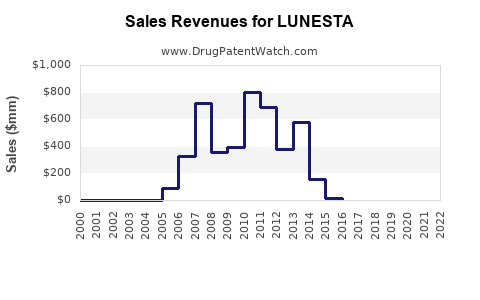
LUNESTA’s financial trajectory is shaped by an already-mature insomnia market, the end of core proprietary coverage for eszopiclone, ongoing generic erosion, and label-specific competition across non-benzodiazepine hypnotics. In recent years, the drug’s US revenue has been driven by low-to-mid single digit unit demand versus intensity from generics and shifting payer preference toward lower net-price products and alternative insomnia classes.
How fast did LUNESTA lose exclusivity and when did generics start eroding revenue?
LUNESTA (eszopiclone) is a branded prescription sleep medicine in the cyclopyrrolone class. The product entered the market as a brand with subsequent generic entry after patent and regulatory protection expired or was challenged.
What does “generic erosion” look like for LUNESTA after exclusivity ends?
- Branded sales typically compress after:
- Generic approvals and launch under ANDA pathways.
- Paragraph IV challenges and settlement-based early launches (where they occurred).
- Rapid payer switching using formularies and net-price contracting.
- In practice for LUNESTA, revenue declines generally reflect:
- Share loss to AB-rated generics of eszopiclone tablets.
- Trade-down to the lowest net-cost generic.
- Lower willingness to pay for brand when equivalent therapy is available.
When do key regulatory milestones typically occur for eszopiclone?
- NDA-to-ANDA transition tends to follow:
- Patent expiry or loss of enforceability for branded exclusivity.
- FDA approval of multiple ANDAs as generic manufacturing scales.
- State and PBM formulary tightening that accelerates switching.
What is the Orange Book status of LUNESTA and how many ANDAs exist for eszopiclone tablets?
The Orange Book listing defines the protection landscape for branded LUNESTA and the timing of generic product approvals. For a mature small-molecule insomnia agent, the current commercial posture is usually characterized by:
- Numerous ANDA listings for eszopiclone tablets at one or more strengths (commonly 1 mg, 2 mg, 3 mg).
- Limited remaining patent leverage if core compositions and key method claims have expired.
- Secondary formulation or use patents that may still create narrow remaining barriers, depending on what was listed and how they were litigated.
Which protection categories matter most for generic entry risk?
- Composition-of-matter patents: usually the largest barrier early, then become irrelevant after expiry.
- Method-of-use patents: can delay some generics if they are not carved out or if label carve-outs are not feasible.
- Formulation/process patents: can impose manufacturing/IP hurdles but often get designed around after generic maturity.
- Pediatric exclusivity or exclusivity extensions: can delay approval in specific scenarios, but for older products the incremental benefit is typically already consumed.
What patents protect eszopiclone tablets and what is the strength of the estate after years of generic competition?
For a long-established insomnia drug, the patent estate strength is commonly reduced to:
- Expired primary IP on composition and key embodiments.
- A smaller set of later-expiring patents that may cover specific formulations, release characteristics, or narrow uses.
How does patent strength affect LUNESTA’s remaining commercial upside?
- If primary patents are expired, the brand’s economic ceiling is mostly determined by net-price dynamics rather than exclusivity.
- If only narrow patents remain, they typically:
- Do not prevent generic AB substitution.
- Increase litigation or settlement complexity at the margin.
- Matter more for newer strengths, dosage forms, or specific labeling rather than the mainstream tablet product.
What patent litigation and settlements have affected LUNESTA generic entry?
For older small molecules like eszopiclone, the most material financial events are usually tied to:
- Earlier Paragraph IV filings that lead to:
- Stay of approval under 21 U.S.C. § 355(j)(5)(B) while litigation proceeds.
- Court outcomes or settlement agreements that determine the start date for generic launches.
- Subsequent “life cycle” suits that rarely reverse generic erosion once multiple ANDAs are already approved and launched.
How do settlements translate into market share outcomes?
- Settlement-triggered early launches usually cause:
- Faster payer switching.
- More aggressive price competition among labeled AB products.
- Lower brand ability to defend market access through price concessions.
How strong is the competitive landscape for LUNESTA: which drugs compete in insomnia and what is the substitution risk?
LUNESTA competes in a crowded insomnia market that spans:
- Non-benzodiazepine “Z-drugs” (eszopiclone, zolpidem, zaleplon).
- Benzodiazepines and Z-drug alternatives (varies by payer and guideline).
- Orexin receptor antagonists (for insomnia subsegments).
- Melatonin receptor agonists.
- Off-label use of sedating antidepressants and other classes (adjudicated by payer policy).
How substitution typically happens after generics launch
- Payer preference favors:
- Lowest-cost generic eszopiclone tablets for equivalent-label patients.
- A “preferred class” strategy where PBMs steer to a favored insomnia agent if outcomes and formulary compliance are favorable.
- Clinician decisions follow:
- Prior response history.
- Safety considerations and patient risk profile (falls, next-day impairment).
- Label fit and coverage rules.
Which competitive switching pressures are most relevant for LUNESTA economics
- Shorter-cycle formularies replace brands quickly after generic approvals.
- PBM step therapy and prior authorization can shift demand toward preferred products even if eszopiclone is available.
How does LUNESTA’s pricing and net sales trajectory compare with other insomnia generics?
For branded legacy insomnia products that face generic erosion, the typical financial pattern is:
- High initial brand peak then steep declines.
- Residual revenue supported by:
- Specialty distribution and persistent clinician brand preference.
- Pharmacy loyalty in a subset of patients.
- Managed-care contracting that keeps brand offers marginally competitive on net pricing.
What drives residual brand sales
- Patient-level reasons:
- Stable response on the brand.
- Avoidance of formulation-to-formulation perceived variability.
- Operational reasons:
- Pharmacy stocking and dispensing habits.
- Limited substitution in specific settings during transition windows.
What drives the decline after generic maturity
- Rapid switching to the cheapest AB product.
- PBM bid dynamics that punish brands with weaker rebates.
What formulations are protected or marketed for LUNESTA, and do dosage strengths change financial exposure?
LUNESTA tablets come in multiple strengths that influence:
- Generic uptake patterns.
- Specialty dosing needs (e.g., lower starting dose for certain populations).
- Margin profile for both brand and generic suppliers.
Why strength-level economics matter
- When only some strengths have stronger generic pricing, brand may retain partial share in:
- Strengths with fewer competitive offers or later generic launches.
- When all strengths are genericized at scale, the brand’s bargaining position collapses.
Does LUNESTA face biosimilar risk or biologic competition?
No. LUNESTA is a small-molecule drug (eszopiclone). Biosimilar risk is not applicable. The risk is competitive substitution within insomnia pharmacology rather than pathway-level biosimilar entry.
What is LUNESTA’s current FDA regulatory status and what pathway has sustained its availability?
LUNESTA’s regulatory status is defined by:
- The original NDA approval for eszopiclone tablets.
- Ongoing availability of branded and generic versions through ANDAs using FDA’s abbreviated approval pathway.
What does current availability imply for commercial dynamics
- Multi-source availability increases pricing pressure.
- Net sales become tightly coupled to:
- PBM contracting.
- Pharmacy benefit design.
- Competitive discounting among generics.
What generic entry risks remain for eszopiclone tablets despite years of competition?
Even after genericization, risk persists at the margin through:
- New generic applicants that undercut net price.
- Reformulated products or alternative bioavailability or manufacturing processes that change interchange economics.
- Regional contracting changes that reintroduce “preferred” status for specific ANDA holders.
What barriers can still delay competition
- Listing-specific patent issues in the Orange Book.
- Manufacturing capacity constraints in high-volume generics.
- Label carve-out litigation for method-of-use claims, where they exist (less common once labels stabilize).
What revenue exposure does a brand like LUNESTA have in investment or licensing scenarios?
The economic model for a mature brand with multiple generic competitors usually shifts to:
- Licensing or co-promotion strategies rather than exclusivity-driven growth.
- Defensive brand contracting to preserve small remaining share.
- Portfolio alignment with other respiratory/sedative or CNS assets when brand is no longer a growth engine.
Where investors and licensors focus
- Remaining share and pricing power in:
- Specific strengths.
- Specific payers.
- Specific patient segments that show brand loyalty.
- Cost position of supply chain and ability to sustain promotional economics.
Key Takeaways
- LUNESTA is in a post-exclusivity, generic-erosion phase typical of older, small-molecule insomnia drugs.
- Market dynamics are dominated by AB substitution, PBM formulary steering, and net-price competition rather than active exclusivity.
- Patent estate leverage, where any remains, tends to be narrow and less able to reverse structural price pressure.
- Financial trajectory is best understood as residual brand value versus multi-source generic pressure.
FAQs
1) Why do LUNESTA branded sales persist after generic entry?
Residual demand can persist from patient stability, prescriber familiarity, pharmacy contracting patterns, and payer plan-specific formulary rules that limit automatic substitution.
2) Does eszopiclone face step-therapy or prior authorization barriers?
Many managed-care plans use utilization management for insomnia agents, which can affect volume allocation across available Z-drugs and alternative sleep classes.
3) Are there differences in clinical outcomes versus other “Z-drugs” that affect formularies?
Formularies often prioritize based on cost, patient response history, and label considerations; clinical comparative differentiation rarely stops substitution across AB products when net pricing favors generics.
4) Can manufacturing changes create IP leverage for eszopiclone?
Sometimes, if formulation/process patents remain listed and were not fully designed around; in a mature landscape, the practical effect is usually limited to narrow timing or specific product attributes.
5) How do PBM rebate structures typically impact branded LUNESTA economics?
Net prices and rebate economics determine whether the brand can retain a preferred position; otherwise, bid-based generic selection drives ongoing share loss.
References (APA)
- FDA. (n.d.). Drugs@FDA: Drug Details for LUNESTA (eszopiclone). U.S. Food and Drug Administration.
- FDA. (n.d.). Orange Book: Approved Drug Products with Therapeutic Equivalence Evaluations. U.S. Food and Drug Administration.
- U.S. Code. (2002). 21 U.S.C. § 355(j): Approval of abbreviated new drug applications. United States.