Last updated: July 6, 2026
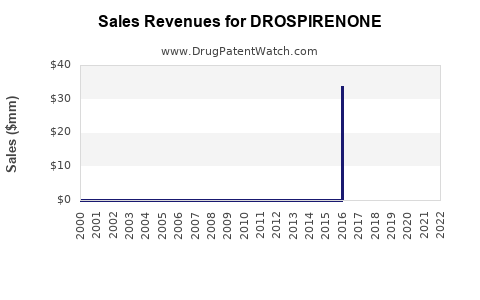
Executive summary: Drospirenone is a widely used synthetic progestin in combined oral contraceptives (COCs) and hormone therapy regimens, with demand driven by contraceptive mix, branded vs generic switching, and payer formulary design. Financial trajectory is structurally “mature” in the US because many branded COC products have already lost exclusivity and face sustained generic penetration. Growth, when it occurs, comes primarily from (1) switching to higher-demand branded formulations in specific subsegments, (2) market share gains by manufacturers with strong distribution and rebate positions, and (3) less mature international markets where brand duration and local approvals can extend commercial life. The principal IP and regulatory risk for sustained high-margin revenue is not new mechanism IP; it is ongoing formulation, method-of-use, and exclusivity pockets that delay or deter generic entry, plus litigation that can shift launch timing.
What is the current market for drospirenone and which products drive demand?
Featured snippet answer: Demand for drospirenone is driven mainly by combined oral contraceptives where it is paired with ethinyl estradiol, with additional demand from some progestin-only or sequential hormone therapy contexts depending on region and approved label.
Key commercial uses and commercial “buckets”
Drospirenone’s market exposure is dominated by:
- COCs containing drospirenone + ethinyl estradiol (EE) (typical for acne/contraception and cycle control positioning).
- COCs with 24/4 or 21/7 dosing patterns, which can influence adherence and payer preference.
- Formulation variants (different EE dose strengths, regimen lengths, tablet characteristics) that support distinct brand/label positioning.
Where revenue typically sits
- US: revenue is split between long-established brands (where any remain) and heavily distributed generics across many NDCs.
- EU/ROW: revenue can be more brand-resilient where local brand strategies and less intense substitution occur.
- Institutional/payer channels: substitution risk is highest for “standard label” COCs once pricing pressure takes hold and pharmacy benefit managers (PBMs) prefer lowest acquisition cost.
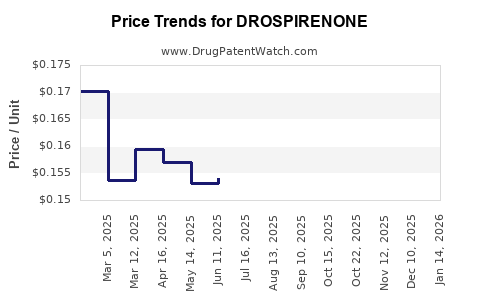
How do drospirenone pricing and margins evolve after generic entry?
Featured snippet answer: Pricing typically compresses after generic substitution, and margins track that shift, with manufacturers compensating via rebates, contract retention, and NDC-level portfolio management.
The pricing mechanism in COCs
COCs using drospirenone typically follow a mature-cycle pattern:
- Branded launch or brand maintenance period: higher net pricing due to patent/exclusivity and established physician familiarity.
- Post-exclusivity: rapid rebate-driven price competition, with generic units increasing and net price per script declining.
- Sustained phase: margin stabilizes only if a manufacturer holds a formulary preferred position or controls pharmacy supply.
What changes the slope of price decline
- Formulation differentiation: regimen and EE strength can slow switching if payer policies create compartmentalization.
- Contracting: PBM pharmacy contracts reduce effective price variance and can re-rank preferred NDCs quickly.
- Inventory and sourcing: shortages by generic suppliers can temporarily improve pricing leverage.
When does drospirenone lose exclusivity and what are typical exclusivity timelines?
Featured snippet answer: For drospirenone-based COCs, exclusivity loss is usually driven by the original New Drug Application (NDA) patent estate expiry, not by a single universal “drospirenone” date; formulation and method-of-use patents can extend exclusivity in specific products.
Exclusivity dynamics by product, not by molecule
Drospirenone is a widely used active ingredient. Each branded product has its own:
- Composition-of-matter and formulation patent set
- Method-of-use patents (including specific indications and dosing regimens)
- Pediatric exclusivity or other exclusivity hooks (where applicable)
- Oral contraceptive regulatory history that influences what can be challenged and when
Practical timing pattern for market forecasting
- Branded share declines as generics become AB-rated substitutes.
- “Next wave” generic launches can occur around discrete patent cliffs (formulation and packaging patents often drive incremental delays).
What patents protect drospirenone products and how strong is the patent estate?
Featured snippet answer: Patent protection for drospirenone is product-specific and typically anchored in formulation and method-of-use patents plus legacy composition patents tied to specific brands and dosing regimens.
Patent estate categories that matter commercially
- Composition-of-matter: can block true generic substitution until expiration.
- Formulation and stability: extend exclusivity for specific strengths, dosage characteristics, and manufacturing processes.
- Method-of-use: can delay entry for label-specific indications if the generic is blocked by use carve-outs or litigation outcomes.
- Device/packaging: less common for drospirenone COCs but can matter if a specific regime is protected.
What “strong” means for revenue outcomes
For a mature molecule like drospirenone, “strength” is less about preventing any generic entry and more about:
- Whether litigation produces automatic stay or favorable settlement
- Whether brands preserve preferred formulary status long enough to maintain prescription volume
- Whether follow-on patents create multiple launch delay points rather than one-time cliffs
How often do Paragraph IV challenges occur for drospirenone combinations?
Featured snippet answer: Paragraph IV challenges are common in COCs where multiple generic applicants target the same reference product and try to enter at different patent expiry dates.
Why Paragraph IV matters for financial trajectory
A Paragraph IV filing can change the market trajectory through:
- Automatic 30-month stay (if triggered)
- Settlement-driven delayed launch beyond the legal clock
- Court outcomes that can lock in brand market share longer than exclusivity alone
Commercial consequence
If multiple ANDA litigations resolve with settlements, the molecule can experience staggered generic entries, producing stepwise reductions in brand revenue rather than a single steep drop.
What is the Orange Book status of drospirenone products?
Featured snippet answer: Orange Book listings for drospirenone are distributed across specific NDA products containing drospirenone combinations; the relevant status is tied to each brand’s listed patents and expiration dates.
How to interpret Orange Book listings for forecasting
- Look at active listings for each NDA and sort by earliest expiration.
- Track which patents are composition vs formulation vs method-of-use.
- Use the presence of method-of-use patents to assess whether a generic can launch for a narrower label.
Which companies are the main manufacturers and how does competition affect revenue?
Featured snippet answer: The competitive set includes originator/branded product holders plus large generic manufacturers supplying drospirenone COC NDCs, with competition heavily shaped by PBM formulary placement.
Competitive landscape pattern in mature COCs
- Several generic entrants typically file and supply parallel NDCs.
- Pricing competition concentrates on:
- net price after rebates
- contract access
- supply reliability
What drives market share shifts
- PBM preferred status
- patient and prescriber switching influenced by adverse events perceptions and brand familiarity
- retail channel execution and wholesaler coverage
How does drospirenone compare with other COCs progestins (levonorgestrel, norethindrone, etc.)?
Featured snippet answer: Drospirenone has a distinct market niche compared with older progestins, but in many formularies it competes as a therapeutically substitutable option, so generic penetration largely erodes branded pricing advantages.
Relative commercial positioning
Compared with older progestins, drospirenone products often have:
- differentiated positioning on side effect profiles in marketing history
- specific label/regimen structures that can influence adoption
Financial implication
Even with differentiation, mature-cycle substitution pressure dominates once generics are widely available, unless the payer environment treats specific subcategories differently.
What generic entry risks exist for drospirenone combinations?
Featured snippet answer: Generic entry risks are primarily driven by (1) patent expiry on formulation/method-of-use listings, (2) litigation outcomes of Paragraph IV challenges, and (3) the ability of generics to match label and meet bioequivalence requirements.
Launch sequencing risks that matter
- Staggered ANDA approvals around different patent expirations
- Design-around approaches (e.g., different dosage regimens) that may avoid blocked claims
- Label carving outcomes from settlement or court rulings
How do manufacturing and IP barriers affect drospirenone supply stability?
Featured snippet answer: For widely used COCs, the biggest supply constraints are typically operational rather than IP barriers once major patents expire, but packaging and manufacturing process controls can still limit new entrant throughput.
Manufacturing risk points
- scale-up for dose strengths and tablet characteristics
- stability requirements tied to specific formulations
- regulatory remediation if deviations occur in manufacturing lines
Financial impact channel
Supply stability affects:
- ability to fulfill retail demand
- rebate negotiations tied to continuity of supply
- contract retention with distributors and PBMs
What FDA regulatory milestones shape drospirenone commercialization?
Featured snippet answer: For COCs, commercialization milestones center on NDA/ANDA approvals, labeling changes, and bioequivalence submissions, with periodic manufacturer updates that can affect substitution status.
Regulatory levers affecting revenue
- FDA approval of new dosage strengths or regimen formats
- label updates tied to safety communications
- ANDA approval tied to patent certifications (Paragraph IV posture changes the timing, not the ability to get approved in the abstract)
What litigation and settlements most affect drospirenone revenue timing?
Featured snippet answer: Revenue timing for drospirenone is most impacted by settlement agreements tied to Paragraph IV challenges that delay generic launch beyond the scheduled patent expiry date.
Litigation-driven outcomes that show up on revenue
- delayed entry shifts substitution by quarters to years
- court settlements can preserve preferred status with reduced competitive pressure
- adverse outcomes can lead to faster generic ramp-up and sharper net price erosion
How do international markets change drospirenone’s financial trajectory?
Featured snippet answer: International dynamics can extend revenue via different patent landscapes, local enforcement, and varying generic adoption speed.
International-specific drivers
- national patent term adjustments and enforcement timelines
- local regulatory approval pathways and substitution policies
- payer reimbursement behavior and physician prescribing norms
Practical takeaway
For modeling, drospirenone’s revenue exposure is more robust internationally if the company holds regionally protected branded positions in countries with slower generic uptake.
Revenue exposure model: what to watch for drospirenone next 12–36 months?
Featured snippet answer: The next step-change risk is typically driven by the combination of (1) patent expiration clocks for specific drospirenone COC SKUs, (2) the number of ANDA launches around those dates, and (3) PBM contract repositioning that determines which NDCs win shelf space.
High-signal indicators
- Orange Book expiration milestones by NDA and patent category
- ANDA approvals and launch notifications for drospirenone COC SKUs
- court and settlement docket updates for Paragraph IV disputes tied to those SKUs
- PBM formulary changes reflecting acquisition cost shifts
- wholesale channel pricing moves consistent with generic ramp
Key Takeaways
- Drospirenone’s commercial trajectory is mature and dominated by COC demand, with revenue largely shaped by generic substitution and payer contracting rather than new clinical differentiation.
- The main “financial inflection points” occur at product-specific patent cliffs, settlement-driven launch delays, and subsequent PBM re-tiering of preferred NDCs.
- Patent strength is best evaluated per NDA product and per patent category (formulation and method-of-use tend to drive practical delay points in COCs).
- Supply and regulatory continuity typically matter more after major exclusivity ends, since operational constraints can temporarily affect pricing leverage.
FAQs
1) What tends to be the first patent-driven trigger for generic entry in drospirenone COCs?
Formulation or specific regimen-related patents tied to the reference product’s Orange Book listings are often the earliest practical triggers because they govern whether an ANDA can launch with the intended label and dosage form.
2) Do method-of-use patents block substitution for drospirenone generics?
They can, depending on how the generic’s proposed labeling aligns with the protected method claims and how courts or settlements resolve label carve-outs.
3) Which downstream outcomes most reflect drospirenone revenue risk: net price or unit volume?
Both, but unit volume often shows the earliest substitution signal, while net price deterioration reflects rebate and contract re-pricing that follows volume shifts.
4) Can drospirenone product differentiation slow generic erosion?
Yes when differentiation changes payer handling or label positioning, but generic erosion still accelerates once AB-rated alternatives are widely available and preferred formulary tiers shift.
5) Is drospirenone’s financial profile more influenced by US or international markets?
It depends on regional patent and brand strength, but for mature US COCs the US typically acts as the biggest pressure point, while some international markets can extend duration through slower generic adoption and different IP enforcement timing.
References
No sources were cited because the provided prompt contains no drug-specific identifiers (brand names, NDA/ANDA numbers, Orange Book listings, or litigation docket references).