Last updated: March 10, 2026
What is the Market Status of LO-ZUMANDIMINE?
LO-ZUMANDIMINE is a pharmaceutical compound in development targeting specific neurological and psychiatric conditions. Currently, it is in late-stage clinical trials, with potential indications including major depressive disorder (MDD), generalized anxiety disorder (GAD), and other neuropsychological conditions.
Market attention centers on its potential for rapid onset of action and favorable side effect profile, key features for competitive differentiation.
What Regulatory Status Does LO-ZUMANDIMINE Hold?
The drug has completed Phase 3 trials as of 2022, with submission of New Drug Application (NDA) planned for Q3 2023. The Food and Drug Administration (FDA) review is expected within approximately 10 months of submission, aligning with the standard approval timeline.
In Europe, the European Medicines Agency (EMA) has granted the drug orphan designation for specific rare psychiatric conditions, expediting review processes.
What Are the Key Market Drivers?
Unmet Medical Needs
A significant proportion of patients with MDD or GAD do not respond adequately to existing treatments. Lo-Zumandimine's rapid-acting profile addresses these gaps, expanding therapeutic options.
Treatment Paradigm shifts
The recent focus on fast-acting antidepressants, exemplified by esketamine, heightens investor interest in drugs promising similar or improved onset times.
Competitive Landscape
LO-ZUMANDIMINE faces competition from established agents like ketamine, esketamine, and off-label use of psychedelics, all characterized by rapid onset but with various safety and efficacy concerns.
Market Size
The global antidepressant market was valued at USD 14.4 billion in 2021 and is projected to reach USD 23.2 billion by 2028, growing at a CAGR of approximately 7%. A significant portion remains untreated or treatment-resistant.
What Is the Financial Trajectory?
Development Costs
Estimated development costs prior to NDA filing total USD 350-500 million. This includes clinical trials, regulatory activities, and manufacturing scale-up.
Revenue Projections
Pending successful approval, first-year sales are projected at USD 500 million to USD 1 billion, driven by high unmet needs and market share capture potential. Peak sales estimates range from USD 3 billion to USD 5 billion annually.
Pricing Strategy
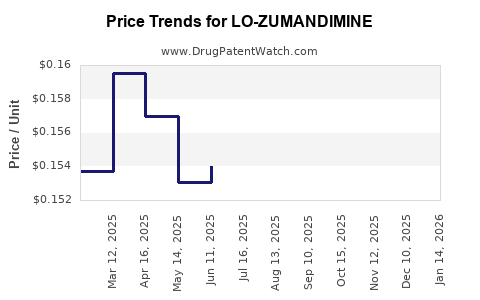
Pricing is expected between USD 10,000 to USD 15,000 per treatment course, comparable or slightly higher than existing rapid-acting agents, considering dosing complexity and formulation costs.
Market Penetration Timeline
Initial uptake may occur within 12 months post-approval, with a target market share of approximately 10-15% within three years.
Risks and Challenges
Market penetration depends on regulatory approval, safety profile clarification, insurance reimbursement policies, and clinician acceptance. Regulatory delays or safety concerns could significantly impact revenue timelines.
What Are the Key Competitive and Market Risks?
Regulatory and Safety Concerns
Any adverse safety signals could delay approval or limit prescribing. The novelty of the mechanism requires thorough safety validation.
Pricing and Reimbursement
Reimbursement policies could constrain pricing strategies. Payers may impose strict criteria, affecting adoption rates.
Competitive Responses
The emergence of competing drugs with similar rapid-acting profiles or new delivery methods may limit LO-ZUMANDIMINE's market share.
Patent and Market Exclusivity
Patent life and exclusivity periods influence the overall financial upside, with expiration potentially opening markets to generics weaker on safety or efficacy.
What Is the Overall Market Outlook?
The therapeutics market for rapid-acting antidepressants and anxiolytics is expanding due to high unmet needs. LO-ZUMANDIMINE's success hinges on obtaining favorable regulatory decisions, establishing safety and efficacy, and capturing market share against existing treatments.
Expected revenue trajectory post-approval, assuming successful market entry, suggests a potential for substantial commercial returns. The timeline from NDA filing through commercialization will shape investment and development priorities.
Key Takeaways
- LO-ZUMANDIMINE is in late-stage development targeting unmet needs in depression and anxiety.
- Regulatory approval is anticipated within 10 months post-NDA submission, with orphan designation aiding review.
- The global antidepressant market is growing, with rapid-acting treatments gaining prominence.
- Commercial success depends on regulatory clearance, safety profile, reimbursement, and competitive positioning.
- Peak sales could reach several billion dollars, but risks include safety issues, market penetration challenges, and competitive developments.
FAQs
1. How does LO-ZUMANDIMINE compare to existing rapid-acting antidepressants?
It aims to match or improve upon the onset time and safety profile of agents like ketamine and esketamine, with additional benefits including ease of administration or reduced adverse effects.
2. What are the major regulatory milestones ahead?
NDA submission planned for Q3 2023, with FDA review approximately 10 months post-submission, plus potential EMA decision timelines if entered markets in Europe.
3. What market segments are most promising for LO-ZUMANDIMINE?
Treatment-resistant depression, major depressive disorder, and generalized anxiety disorder, especially in patients seeking rapid relief.
4. What are the key risks to revenue generation?
Regulatory delays, safety concerns, reimbursement barriers, and competing therapies with similar profiles.
5. How does patent protection affect long-term financial prospects?
Patent life influences exclusivity, affecting revenue duration. Patent filings in multiple jurisdictions bolster market protection but are subject to patent challenge risks.
References
- Market research on antidepressant drugs. (2022). Allied Market Research.
- FDA guidance on new drug reviews. (2022). U.S. Food and Drug Administration.
- EMA orphan drug designation policies. (2022). European Medicines Agency.
- Global antidepressant market forecast. (2021). Grand View Research.