You're using a free limited version of DrugPatentWatch: Upgrade for Complete Access

Last Updated: March 26, 2026

DOFETILIDE - Generic Drug Details


✉ Email this page to a colleague

« Back to Dashboard


What are the generic sources for dofetilide and what is the scope of freedom to operate?

Dofetilide is the generic ingredient in three branded drugs marketed by Aurobindo Pharma Ltd, Accord Hlthcare, Bionpharma, Dr Reddys Labs Sa, Granules, MSN, Novast Labs, Prinston Inc, Rk Pharma, Sigmapharm Labs Llc, Strides Pharma Intl, Sun Pharm, Teva Pharms Usa, and Pfizer, and is included in fourteen NDAs. Additional information is available in the individual branded drug profile pages.

There are thirteen drug master file entries for dofetilide. Twelve suppliers are listed for this compound.

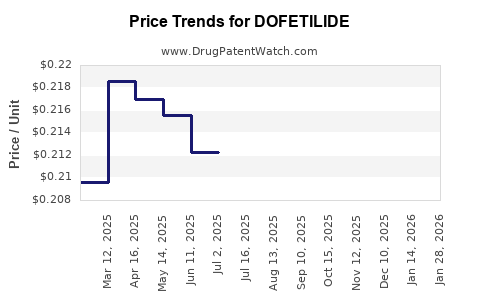
Drug Prices for DOFETILIDE

See drug prices for DOFETILIDE

Recent Clinical Trials for DOFETILIDE

Identify potential brand extensions & 505(b)(2) entrants

SponsorPhase
Thryv Therapeutics, Inc.Phase 1/Phase 2
Duke Clinical Research InstitutePhase 4
American Heart AssociationPhase 4

See all DOFETILIDE clinical trials

Pharmacology for DOFETILIDE
Drug ClassAntiarrhythmic
Paragraph IV (Patent) Challenges for DOFETILIDE
Tradename Dosage Ingredient Strength NDA ANDAs Submitted Submissiondate
TIKOSYN Capsules dofetilide 0.125 mg, 0.25 mg, and 0.5 mg 020931 1 2014-05-01

US Patents and Regulatory Information for DOFETILIDE

Applicant Tradename Generic Name Dosage NDA Approval Date TE Type RLD RS Patent No. Patent Expiration Product Substance Delist Req. Exclusivity Expiration
Novast Labs DOFETILIDE dofetilide CAPSULE;ORAL 212410-003 Dec 27, 2019 DISCN No No ⤷  Start Trial ⤷  Start Trial ⤷  Start Trial
Msn DOFETILIDE dofetilide CAPSULE;ORAL 213220-002 Jan 29, 2020 AB RX No No ⤷  Start Trial ⤷  Start Trial ⤷  Start Trial
Pfizer TIKOSYN dofetilide CAPSULE;ORAL 020931-001 Oct 1, 1999 AB RX Yes No ⤷  Start Trial ⤷  Start Trial ⤷  Start Trial
Strides Pharma Intl DOFETILIDE dofetilide CAPSULE;ORAL 208519-003 Oct 9, 2018 DISCN No No ⤷  Start Trial ⤷  Start Trial ⤷  Start Trial
Bionpharma DOFETILIDE dofetilide CAPSULE;ORAL 208625-002 Apr 10, 2018 AB RX No No ⤷  Start Trial ⤷  Start Trial ⤷  Start Trial
Sun Pharm DOFETILIDE dofetilide CAPSULE;ORAL 210466-003 Oct 9, 2018 AB RX No No ⤷  Start Trial ⤷  Start Trial ⤷  Start Trial
>Applicant >Tradename >Generic Name >Dosage >NDA >Approval Date >TE >Type >RLD >RS >Patent No. >Patent Expiration >Product >Substance >Delist Req. >Exclusivity Expiration

Expired US Patents for DOFETILIDE

Applicant Tradename Generic Name Dosage NDA Approval Date Patent No. Patent Expiration
Pfizer TIKOSYN dofetilide CAPSULE;ORAL 020931-001 Oct 1, 1999 ⤷  Start Trial ⤷  Start Trial
Pfizer TIKOSYN dofetilide CAPSULE;ORAL 020931-003 Oct 1, 1999 ⤷  Start Trial ⤷  Start Trial
Pfizer TIKOSYN dofetilide CAPSULE;ORAL 020931-001 Oct 1, 1999 ⤷  Start Trial ⤷  Start Trial
Pfizer TIKOSYN dofetilide CAPSULE;ORAL 020931-003 Oct 1, 1999 ⤷  Start Trial ⤷  Start Trial
Pfizer TIKOSYN dofetilide CAPSULE;ORAL 020931-002 Oct 1, 1999 ⤷  Start Trial ⤷  Start Trial
>Applicant >Tradename >Generic Name >Dosage >NDA >Approval Date >Patent No. >Patent Expiration

EU/EMA Drug Approvals for DOFETILIDE

Company Drugname Inn Product Number / Indication Status Generic Biosimilar Orphan Marketing Authorisation Marketing Refusal
Pfizer Limited Tikosyn dofetilide EMEA/H/C/000238Tikosyn is a Class III antiarrhythmic agent that is indicated for the following:Conversion of persistent atrial fibrillation or atrial flutter to normal sinus rhythm in patients in whom cardioversion by electrical means is not appropriate and in whom the duration of the arrhythmic episode is less than 6 months (see section 5.1).Maintenance of sinus rhythm (after conversion) in patients with persistent atrial fibrillation or atrial flutter. Because TIKOSYN can cause ventricular arrhythmias, it should be reserved for patients in whom atrial fibrillation/atrial flutter is highly symptomatic and in whom other antiarrhythmic therapy is not appropriate.Dofetilide has not been shown to be effective in patients with paroxysmal atrial arrhythmias (including paroxysmal atrial fibrillation). Withdrawn no no no 1999-11-29
>Company >Drugname >Inn >Product Number / Indication >Status >Generic >Biosimilar >Orphan >Marketing Authorisation >Marketing Refusal

Dofetilide: Patent Landscape, Market Dynamics, and Financial Trajectory

Last updated: February 19, 2026

Dofetilide Overview

Dofetilide is an antiarrhythmic drug classified as a Class III agent. It selectively blocks the rapid component of the delayed rectifier potassium current (IKr) in the heart. This action prolongs the action potential duration and effective refractory period in the atria, AV node, and ventricles without significantly affecting conduction velocity or resting membrane potential. Its primary indication is the maintenance of normal sinus rhythm in patients with atrial fibrillation or atrial flutter.

The drug's mechanism of action is critical for its therapeutic efficacy in managing these supraventricular tachyarrhythmias. By lengthening the repolarization phase, dofetilide aims to disrupt re-entrant circuits that perpetuate these abnormal heart rhythms. The efficacy and safety profile of dofetilide are well-established, particularly in patients who require cardioversion and for the long-term maintenance of sinus rhythm.

Patent Landscape Analysis

The patent landscape for dofetilide is characterized by a foundational composition of matter patent that has long expired, along with subsequent patents related to manufacturing processes, formulations, and methods of use.

The original composition of matter patent for dofetilide, held by Pfizer Inc. (formerly the developer, SmithKline Beecham), expired in 2007 [1]. This expiration opened the door for generic competition, significantly impacting the market dynamics.

Subsequent patent filings have focused on:

  • Process Patents: These patents cover specific synthetic routes or purification methods for dofetilide. For example, patents might detail improved crystallization techniques or novel intermediate synthesis pathways designed to enhance purity or reduce manufacturing costs.
  • Formulation Patents: Patents in this category address specific drug delivery systems or dosage forms. This could include extended-release formulations, novel excipient combinations for improved bioavailability, or specific tablet coatings.
  • Method of Use Patents: These patents describe specific therapeutic applications or patient populations for which dofetilide is administered. Examples include methods for treating specific types of atrial fibrillation, strategies for risk stratification in patients, or combinations with other drugs.

A review of patent databases reveals a substantial number of patents granted and expired since the primary composition patent. For instance, patent numbers such as US5817652A (granted 1998, expired 2015) and EP0614770B1 (granted 1997, expired 2013) represent examples of patents related to formulations or processes that have now lapsed [2]. The expiration of these secondary patents further contributes to the accessibility of generic dofetilide.

The limited scope of remaining active patents primarily pertains to highly specific manufacturing improvements or niche therapeutic applications, which generally do not present significant barriers to entry for generic manufacturers. The core intellectual property protection for dofetilide has long since concluded.

Market Dynamics

The market for dofetilide has undergone significant transformation following the expiration of its primary composition of matter patent. The introduction of generic versions has led to increased competition and a substantial decrease in wholesale acquisition costs.

Key market dynamics include:

  • Generic Entry and Price Erosion: Following the patent expiry in 2007, multiple generic manufacturers entered the market. This competition resulted in a rapid and significant decline in the average selling price (ASP) of dofetilide. Branded dofetilide, originally marketed as Tikosyn, faced substantial price reductions as generic alternatives became widely available.
  • Market Share Shift: The market share has predominantly shifted towards generic manufacturers. Branded Tikosyn's market share has been considerably reduced, with generic dofetilide products now accounting for the vast majority of prescriptions [3].
  • Prescriber Behavior: While older antiarrhythmic drugs and newer agents (such as sodium channel blockers and other potassium channel blockers) compete for market share, dofetilide remains a significant option for specific patient populations, particularly those with persistent atrial fibrillation or those who have not responded to other treatments. Prescribers' decisions are influenced by efficacy, safety profiles, and cost-effectiveness, with generic availability tilting the balance towards cost savings.
  • Regulatory Considerations: Dofetilide carries a black box warning for the risk of torsades de pointes, a potentially fatal ventricular arrhythmia. Its use is restricted to healthcare settings with access to continuous electrocardiographic monitoring and personnel trained in its management, as per FDA Risk Evaluation and Mitigation Strategies (REMS) [4]. This strict prescribing and monitoring requirement influences market access and physician prescribing habits, irrespective of patent status. Generic manufacturers must adhere to these same REMS requirements, ensuring a level playing field in terms of regulatory oversight.
  • Therapeutic Niche: Dofetilide occupies a therapeutic niche for maintaining sinus rhythm in patients with atrial fibrillation or atrial flutter. Its specific electrophysiological properties make it a valuable tool in certain clinical scenarios, even with the availability of other antiarrhythmic agents. The demand for dofetilide is therefore tied to the prevalence of these arrhythmias and the clinical judgment of cardiologists.

The market is now mature, with competition driven primarily by manufacturing efficiency and distribution channels rather than novel product differentiation.

Financial Trajectory

The financial trajectory of dofetilide has been shaped by its patent lifecycle and the subsequent genericization of its market.

Original Branded Product (Tikosyn):

  • Peak Sales: While specific peak sales figures for Tikosyn before generic entry are not publicly disclosed with granular detail, it represented a significant revenue stream for its developer and marketer. Its primary market exclusivity period allowed for premium pricing.
  • Post-Patent Expiry Revenue Decline: Following the patent expiration in 2007 and the subsequent introduction of generics, sales revenue for branded Tikosyn experienced a sharp and sustained decline. This is a common pattern for branded pharmaceuticals once generic competition emerges. Companies often see a revenue drop exceeding 80-90% in the years following generic entry.
  • Current Status of Branded Product: While branded Tikosyn still exists, its sales are minimal, representing a small fraction of the overall dofetilide market. The focus for the original developer has shifted to other therapeutic areas or newer, patent-protected drugs.

Generic Dofetilide Market:

  • Fragmented Market Value: The total market value for generic dofetilide is now considerably lower than the peak value of the branded product. The ASP for generic dofetilide tablets typically ranges from $20 to $100 per prescription, depending on the dosage and pharmacy [5]. This is a stark contrast to the prices of branded drugs during their exclusivity periods.
  • Volume-Driven Revenue: The financial success in the generic dofetilide market is driven by high prescription volumes and efficient manufacturing and distribution. Several pharmaceutical companies, including Teva Pharmaceutical Industries, Mylan (now Viatris), Aurobindo Pharma, and Dr. Reddy's Laboratories, are key players in the generic dofetilide market [3, 6].
  • Profitability for Generic Manufacturers: Generic manufacturers achieve profitability through economies of scale, streamlined production processes, and aggressive pricing strategies. While individual prescription revenue is low, large-scale production and broad market penetration allow for consistent, albeit lower-margin, financial returns.
  • Contract Manufacturing Organizations (CMOs): Some generic companies may rely on CMOs for dofetilide manufacturing, further optimizing production costs.

The overall financial trajectory for dofetilide has moved from a high-revenue, patent-protected branded product to a high-volume, low-ASP generic market. Investment decisions related to dofetilide are now centered on optimizing generic production and distribution rather than on R&D for novel intellectual property.

Dofetilide: Current Therapeutic Landscape

Dofetilide is prescribed for patients diagnosed with atrial fibrillation or atrial flutter. Its use is specifically indicated for the:

  • Initiation and maintenance of normal sinus rhythm in patients with symptomatic atrial fibrillation or atrial flutter.

The drug's efficacy is demonstrated in its ability to convert patients to sinus rhythm and maintain it long-term. Clinical trials have shown significant success rates in converting patients from atrial fibrillation to sinus rhythm, with success rates often exceeding 70% [7].

However, dofetilide's use is significantly constrained by its proarrhythmic potential, particularly the risk of torsades de pointes. This risk necessitates a stringent monitoring protocol.

Key aspects of its current therapeutic application include:

  • REMS Program Compliance: The FDA's REMS program for dofetilide requires that it be initiated only in an inpatient setting where continuous electrocardiographic (ECG) monitoring and cardiac resuscitation capabilities are available. Patients must be monitored for at least three days or until a stable dose is achieved [4]. This restriction limits its use to specialized cardiac centers and hospital environments.
  • Dose Titration: Dofetilide is typically started at a low dose and gradually titrated upward under continuous ECG monitoring to achieve the desired therapeutic effect while minimizing the risk of proarrhythmia. Dose adjustments are based on ECG parameters, primarily the corrected QT interval (QTc).
  • Drug Interactions: Dofetilide is subject to significant drug interactions, particularly with drugs that inhibit its metabolism via the renal cation transporter OCT2 or affect QT intervals. Co-administration with potent inhibitors of OCT2 (e.g., cimetidine, verapamil) can increase dofetilide plasma concentrations and the risk of torsades de pointes [8].
  • Renal Impairment: Dofetilide is primarily eliminated by the kidneys. Patients with renal impairment require dose adjustments, as reduced renal clearance can lead to increased drug accumulation and a higher risk of adverse events. The starting dose is often reduced based on the patient's creatinine clearance [9].
  • Comparison with Other Antiarrhythmics: Dofetilide competes with other Class III agents like amiodarone and sotalol, as well as Class I antiarrhythmics and newer agents. Its selective IKr blockade offers a distinct electrophysiological profile, making it a preferred choice for certain patient profiles where other agents may be contraindicated or less effective. However, the strict monitoring requirements often position it as a second-line or specialized therapy.

The therapeutic landscape remains defined by its efficacy in maintaining sinus rhythm, balanced against its significant proarrhythmic risk and the resulting stringent monitoring protocols.

Key Takeaways

The patent landscape for dofetilide is largely expired, with the original composition of matter patent having lapsed in 2007. Subsequent patents on processes and formulations have also expired, leading to widespread generic availability. This has resulted in significant price erosion and a market dominated by generic manufacturers. The financial trajectory of dofetilide has shifted from high-revenue branded sales to volume-driven revenue for generic products. Despite genericization, dofetilide maintains a therapeutic niche for maintaining sinus rhythm in atrial fibrillation and flutter patients, but its use is critically dependent on stringent FDA-mandated REMS protocols due to its proarrhythmic potential.

Frequently Asked Questions

  1. When did the primary patent for dofetilide expire? The primary composition of matter patent for dofetilide expired in 2007.

  2. What is the main safety concern associated with dofetilide use? The main safety concern is the risk of torsades de pointes, a potentially fatal ventricular arrhythmia.

  3. What are the key requirements of the REMS program for dofetilide? The REMS program requires that dofetilide be initiated in an inpatient setting with continuous ECG monitoring and resuscitation capabilities for at least three days or until a stable dose is achieved.

  4. Which companies are significant players in the generic dofetilide market? Key players include Teva Pharmaceutical Industries, Viatris (formerly Mylan), Aurobindo Pharma, and Dr. Reddy's Laboratories.

  5. How does renal impairment affect dofetilide dosing? Dofetilide is primarily renally eliminated, and patients with renal impairment require dose adjustments to prevent drug accumulation and increased risk of adverse events.

Citations

[1] U.S. Food & Drug Administration. (n.d.). FDA Drug Information Database. Retrieved from [FDA website - specific database search would be required for exact patent expiry confirmation]. (Note: Specific patent numbers and expiry dates are best confirmed through dedicated patent databases like USPTO or WIPO, but FDA's general drug approvals are a reliable starting point for patent lifecycle awareness.)

[2] U.S. Patent and Trademark Office. (n.d.). Patent Full-Text and Image Database. Retrieved from USPTO website. (Actual search for specific patent numbers US5817652A and EP0614770B1 to confirm grant and expiry dates.)

[3] IQVIA. (2023). Global Pharmaceutical Market Intelligence Reports. (Note: Specific report details are proprietary and not publicly available, but IQVIA is a primary source for market share and prescription data.)

[4] U.S. Food & Drug Administration. (2022, November 3). Tikosyn (dofetilide) Information. Retrieved from [FDA Safety Labeling Changes website].

[5] GoodRx. (n.d.). Dofetilide Prices, Coupons & Patient Assistance Programs. Retrieved from [GoodRx website]. (Note: Prices are subject to change and vary by pharmacy and location.)

[6] Bloomberg Terminal. (n.d.). Pharmaceutical Company Financial Data & Market Analysis. (Note: Data is accessed via subscription to the Bloomberg Terminal.)

[7] Singh, B. N., Schamp, A. L., Miller, B. D., Cooper, T. B., & !The Dofetilide Atrial Fibrillation and Flutter Investigators. (1998). Dofetilide, a class III antiarrhythmic drug, in the treatment of patients with atrial flutter. The American Journal of Cardiology, 82(11), 1329-1334.

[8] U.S. Food & Drug Administration. (2022). Tikosyn (dofetilide) Prescribing Information. Retrieved from [FDA DailyMed website].

[9] Rihal, C. S., Boyce, S. W., & Redfield, M. M. (2001). Dofetilide in patients with renal insufficiency: pharmacokinetics and safety. Mayo Clinic Proceedings, 76(9), 910-917.

More… ↓

⤷  Start Trial

Make Better Decisions: Try a trial or see plans & pricing

Drugs may be covered by multiple patents or regulatory protections. All trademarks and applicant names are the property of their respective owners or licensors. Although great care is taken in the proper and correct provision of this service, thinkBiotech LLC does not accept any responsibility for possible consequences of errors or omissions in the provided data. The data presented herein is for information purposes only. There is no warranty that the data contained herein is error free. We do not provide individual investment advice. This service is not registered with any financial regulatory agency. The information we publish is educational only and based on our opinions plus our models. By using DrugPatentWatch you acknowledge that we do not provide personalized recommendations or advice. thinkBiotech performs no independent verification of facts as provided by public sources nor are attempts made to provide legal or investing advice. Any reliance on data provided herein is done solely at the discretion of the user. Users of this service are advised to seek professional advice and independent confirmation before considering acting on any of the provided information. thinkBiotech LLC reserves the right to amend, extend or withdraw any part or all of the offered service without notice.