Last updated: September 2, 2026
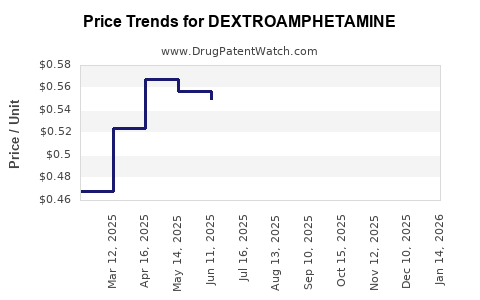
Dextroamphetamine is a mature, heavily genericized central nervous system stimulant used primarily for attention-deficit/hyperactivity disorder (ADHD) and narcolepsy. Its direct patent estate is largely expired, FDA exclusivity is not a material barrier, and generic competition keeps prices low. Market value is supported by persistent ADHD demand, recurring prescriptions, and shortages affecting competing stimulants, but constrained by controlled-substance quotas, substitution among stimulant products, payer pressure, and limited commercial differentiation.
The largest commercial opportunity is not basic dextroamphetamine itself. It is in differentiated delivery systems, abuse-deterrent formulations, extended-release products, and branded products that can command premiums over immediate-release generic tablets.
What is dextroamphetamine and how is it used?
Dextroamphetamine is the dextrorotatory isomer of amphetamine. It increases central nervous system concentrations of dopamine and norepinephrine and is classified by the Drug Enforcement Administration as a Schedule II controlled substance.
U.S. FDA-approved uses include:
| Product category |
Typical use |
Regulatory status |
| Dextroamphetamine sulfate tablets |
ADHD and narcolepsy |
FDA-approved prescription drug |
| Dextroamphetamine sulfate extended-release capsules |
ADHD and narcolepsy |
FDA-approved prescription drug |
| Dextroamphetamine oral solution |
ADHD and narcolepsy, depending on product labeling |
FDA-approved prescription drug |
| Lisdexamfetamine |
ADHD and binge-eating disorder; prodrug converted to dextroamphetamine |
Separate active ingredient and regulatory category |
| Mixed amphetamine salts |
ADHD and narcolepsy |
Competing amphetamine product, not equivalent to pure dextroamphetamine |
Dextroamphetamine differs from amphetamine mixed salts, marketed historically as Adderall, because the latter contains both dextroamphetamine and levoamphetamine salts. Lisdexamfetamine, marketed as Vyvanse, is a prodrug that is converted in the body to dextroamphetamine.
These distinctions affect prescribing, substitution, patent analysis, and revenue attribution. Sales of Vyvanse and generic lisdexamfetamine should not be counted as direct dextroamphetamine sales, although they compete for the same ADHD treatment population.
What is the U.S. regulatory status of dextroamphetamine?
Dextroamphetamine is an FDA-approved small-molecule drug with abbreviated new drug application, or ANDA, competition. Generic manufacturers generally demonstrate bioequivalence to an approved reference product rather than repeat the full clinical development program required for a new drug.
FDA regulatory characteristics include:
- Schedule II controlled-substance classification.
- Prescription-only distribution.
- No approved over-the-counter version.
- Generic tablet, capsule, and solution products.
- Manufacturing and distribution subject to DEA production quotas and controlled-substance security rules.
- Product-specific labeling and dosage-form requirements.
- Substitution governed by state pharmacy law and product-equivalence determinations.
The regulatory pathway is commercially favorable to generic manufacturers because the underlying active ingredient is well characterized and clinical efficacy is established. The main barriers are manufacturing controls, supply reliability, controlled-substance quota allocation, and compliance costs.
FDA-approved products have included Dexedrine, Zenzedi, and multiple generic dextroamphetamine sulfate products. Brand availability has changed over time as companies have discontinued, transferred, or repriced products.
What patents protect dextroamphetamine?
The core composition-of-matter patents for dextroamphetamine are expired. The active ingredient has been used clinically for decades, and no current patent should be expected to provide meaningful exclusivity over the basic molecule.
| Patent category |
Current commercial relevance |
| Dextroamphetamine composition patents |
Expired |
| Basic ADHD and narcolepsy use patents |
Expired or commercially immaterial |
| Immediate-release tablet patents |
Generally expired |
| Extended-release formulation patents |
Potentially relevant only for specific branded products |
| Abuse-deterrent formulation patents |
Relevant where a protected product exists, but not to ordinary generic tablets |
| Manufacturing-process patents |
May exist but generally do not block standard ANDA entry unless tied to a required process |
| Device or delivery-system patents |
Relevant only to specific dosage forms or delivery platforms |
The FDA Orange Book remains the principal source for listed patents and regulatory exclusivity associated with approved drug products. For mature dextroamphetamine products, the key commercial conclusion is that ordinary immediate-release formulations do not have a durable Orange Book patent barrier comparable to newer branded ADHD products.[1]
Patent analysis must separate dextroamphetamine from lisdexamfetamine. Vyvanse's patent estate protected a prodrug, not dextroamphetamine itself. The principal U.S. lisdexamfetamine composition patent, U.S. Patent No. 7,105,486, reached the end of its protection period in 2023 after pediatric exclusivity considerations. Generic lisdexamfetamine approvals began in 2023, increasing price pressure across the broader amphetamine stimulant market.[2]
When did dextroamphetamine lose exclusivity?
Dextroamphetamine lost meaningful market exclusivity decades ago. The current market is therefore governed by generic competition rather than a pending loss-of-exclusivity event.
Key timing points are:
| Event |
Timing |
| Original dextroamphetamine products |
Historical products with long-expired exclusivity |
| Generic dextroamphetamine entry |
Established for many years |
| Current basic-molecule exclusivity |
None of practical commercial significance |
| Vyvanse composition patent expiry |
2023, subject to applicable pediatric exclusivity |
| Generic lisdexamfetamine market entry |
2023 |
| Future dextroamphetamine risk event |
Product-specific formulation or manufacturing patent expiry, where applicable |
There is no single dextroamphetamine patent cliff comparable to the 2023 Vyvanse event. The market has already passed the principal loss-of-exclusivity phase for the molecule.
What is the Orange Book status of dextroamphetamine?
The Orange Book status depends on the specific reference product and dosage form rather than the active ingredient generally. An Orange Book listing for a branded extended-release capsule does not automatically protect immediate-release tablets or unrelated generic products.
For commercial diligence, the relevant questions are:
- Which reference listed drug is being challenged?
- Does the product have any unexpired listed patent?
- Does the patent claim the active ingredient, formulation, dosage form, or method of use?
- Is the patent eligible for a Paragraph IV certification?
- Does the generic applicant seek approval for all labeled indications or only a subset?
Older immediate-release dextroamphetamine products generally present little Orange Book patent risk to ANDA applicants. Any remaining patent exposure is more likely to arise from a specific extended-release formulation, coating system, capsule technology, or abuse-deterrent design.
Are there Paragraph IV challenges involving dextroamphetamine?
Paragraph IV challenges are most important when a branded product has unexpired Orange Book patents. Because basic dextroamphetamine products are mature and genericized, Paragraph IV litigation is not the principal market driver for ordinary tablets.
A Paragraph IV strategy could still arise for:
- A newly approved extended-release dextroamphetamine product.
- A branded oral solution with a proprietary formulation.
- A product using a novel release-controlling matrix.
- An abuse-deterrent or tamper-resistant formulation.
- A combination product involving dextroamphetamine and another active ingredient.
For generic manufacturers, a Paragraph IV filing could create a 180-day first-filer opportunity if statutory requirements are met. That opportunity is product-specific and should not be inferred from the existence of dextroamphetamine generics generally.[3]
How strong is the dextroamphetamine patent estate?
The core dextroamphetamine patent estate is weak from an originator-protection perspective. The commercial strength profile is:
| Asset |
Patent strength |
Commercial assessment |
| Basic molecule |
Very low |
Long expired |
| Immediate-release tablets |
Very low |
Broad generic competition |
| Standard capsules |
Low |
Limited differentiation |
| Extended-release delivery |
Moderate if product-specific |
Can delay substitution |
| Abuse-deterrent technology |
Moderate to high if clinically and commercially relevant |
Depends on enforceable claims and payer acceptance |
| Manufacturing know-how |
Moderate operational value |
Can support supply reliability but may not block entry |
| Brand, prescriber familiarity, and distribution |
Moderate |
Non-patent commercial advantages |
| Controlled-substance quota access |
Moderate |
Operational barrier, not exclusivity |
A branded company can still build a defensible business around a dextroamphetamine product, but the defense is more likely to come from formulation engineering, supply execution, market access, and brand positioning than from the molecule patent.
What formulations are protected by dextroamphetamine patents?
The most commercially relevant formulation opportunities involve pharmacokinetic differentiation. These include:
Extended-release products
Extended-release formulations can reduce dosing frequency and smooth peak plasma concentrations. Protection may cover:
- Multiparticulate bead systems.
- Polymer-based release matrices.
- Coated pellets.
- Delayed-release capsules.
- Drug-release profiles.
- Specific ratios of immediate-release and extended-release components.
The commercial value depends on whether the formulation produces a clinically meaningful benefit and whether payers reimburse it at a premium.
Oral solutions
Liquid dextroamphetamine products can target pediatric patients and individuals unable to swallow tablets. Potential protection may involve:
- Taste masking.
- Stability.
- Preservative systems.
- Concentration and dosing accuracy.
- Packaging and dispensing devices.
Oral solutions generally face less formulation complexity than extended-release systems but may compete on convenience and pediatric usability.
Abuse-deterrent formulations
Abuse-deterrent systems may use physical or chemical barriers to resist crushing, extraction, or rapid release. The business case depends on FDA labeling, evidence of abuse-deterrent performance, payer coverage, and prescriber adoption. A formulation patent alone does not guarantee a commercial premium.
What generic entry risks exist for dextroamphetamine?
Generic entry risk is high for ordinary dextroamphetamine products and lower for differentiated formulations.
| Product type |
Generic entry risk |
Main reason |
| Immediate-release tablets |
High |
Mature ingredient and established ANDA pathway |
| Standard capsules |
High |
Limited product differentiation |
| Oral solution |
Medium to high |
Formulation and supply requirements |
| Extended-release capsules |
Medium |
Bioequivalence and release-profile complexity |
| Abuse-deterrent product |
Medium |
Formulation and clinical-performance barriers |
| Novel combination product |
Low to medium |
Product-specific patents and regulatory requirements |
Generic manufacturers may still encounter practical barriers. Dextroamphetamine is a controlled substance, so an approved ANDA does not guarantee commercial supply. Companies need DEA quota capacity, qualified active pharmaceutical ingredient suppliers, secure manufacturing, validated testing, and reliable distribution.
Which companies compete in the dextroamphetamine market?
The competitive landscape is fragmented. Participants have included:
- Generic manufacturers such as Teva, Sandoz, Mallinckrodt, Amneal, Rhodes Pharmaceuticals, Hikma, and other FDA-approved suppliers, depending on product and period.
- Branded or specialty manufacturers marketing products such as Zenzedi or other dextroamphetamine formulations.
- Large stimulant manufacturers selling competing products, including mixed amphetamine salts and lisdexamfetamine.
- Contract manufacturers and active pharmaceutical ingredient suppliers with controlled-substance capabilities.
The relevant competition is broader than pure dextroamphetamine. Prescribers can choose among:
- Dextroamphetamine.
- Mixed amphetamine salts.
- Lisdexamfetamine.
- Methylphenidate products.
- Atomoxetine.
- Guanfacine extended release.
- Clonidine extended release.
- Nonstimulant ADHD medicines.
This substitutability limits pricing power. A supply disruption in one stimulant can shift prescriptions to another product, but patients may not respond identically across formulations.
What is driving dextroamphetamine market growth?
Demand is supported by several structural factors:
- Continued diagnosis and treatment of ADHD across pediatric and adult populations.
- Long-term prescription use among patients who respond to stimulant therapy.
- Increased treatment attention in adult ADHD.
- Shortages of competing stimulant products, which can redirect demand.
- Use in narcolepsy, although narcolepsy is a smaller market than ADHD.
- Availability of multiple dosage forms and strengths.
Demand is constrained by:
- Controlled-substance prescribing limits.
- Telehealth prescribing restrictions and evolving federal rules.
- State-level prescription and refill requirements.
- Stimulant safety concerns.
- Payer preference for low-cost generics.
- Substitution with methylphenidate or nonstimulants.
- Manufacturing interruptions and quota limitations.
FDA and DEA actions during the stimulant shortage period highlighted the importance of production planning and supply-chain coordination. Shortages have affected various amphetamine and methylphenidate products, with availability differing by manufacturer, strength, and dosage form.[4][5]
What is the financial trajectory for dextroamphetamine?
Dextroamphetamine does not generally appear as a separately reported revenue line in public company filings. Financial analysis therefore requires a product-level approach based on prescription volume, net price, market share, dosage form, and manufacturer disclosure.
The financial trajectory has four phases:
| Phase |
Financial characteristics |
| Originator phase |
Higher prices and stronger brand control |
| Generic transition |
Rapid price erosion and market-share fragmentation |
| Mature generic phase |
Low unit prices, high volume, modest margins |
| Differentiated formulation phase |
Potential premium pricing if protected and clinically distinct |
For standard immediate-release dextroamphetamine, revenue growth is likely to come from volume rather than price. Generic manufacturers compete on:
- Contract access.
- Wholesale availability.
- Retail pharmacy fill rates.
- Shortage-period supply.
- Manufacturing cost.
- Product breadth across strengths and dosage forms.
A company with a reliable supply position can capture disproportionate volume during shortages, but shortage-related gains may be temporary. New production capacity can restore competition and reduce prices.
Branded extended-release products have a better revenue profile because they can retain higher net prices. Their risks include payer step edits, required generic substitution, rebate pressure, and competing branded stimulant products. The 2023 generic entry of lisdexamfetamine increased the number of lower-cost amphetamine treatment options and weakened the long-term pricing environment for premium stimulant products.[2]
How does dextroamphetamine compare with Vyvanse and Adderall?
| Attribute |
Dextroamphetamine |
Vyvanse/lisdexamfetamine |
Adderall/mixed amphetamine salts |
| Active ingredient |
Dextroamphetamine |
Prodrug converted to dextroamphetamine |
Dextroamphetamine and levoamphetamine salts |
| Core patent status |
Expired |
Core U.S. protection ended in 2023 |
Mature and genericized |
| Generic availability |
Established |
Expanded materially after 2023 |
Established |
| Typical differentiation |
Immediate or extended release |
Prodrug pharmacology and branded history |
Mixed-isomer profile and dosage options |
| Pricing power |
Low for generics |
Historically higher, now under pressure |
Low for generics |
| Supply risk |
Controlled-substance and quota exposure |
Controlled-substance and quota exposure |
Significant shortage and quota exposure |
| Biosimilar risk |
None |
None |
None |
Dextroamphetamine has the weakest direct patent position but can benefit when competing stimulants are unavailable. Vyvanse historically carried stronger commercial protection because of its prodrug and brand positioning. Adderall has broad physician familiarity but also faces generic substitution and supply volatility.
What patent litigation and settlements affect dextroamphetamine?
There is no major current patent litigation trend centered on the expired dextroamphetamine molecule comparable to litigation surrounding newer branded pharmaceuticals. Litigation risk is more likely to arise around:
- A new extended-release formulation.
- A proprietary delivery system.
- Patent-listed combination products.
- Manufacturing-process disputes.
- Trade secrets involving controlled-substance production.
- Regulatory exclusivity for a newly approved product.
Settlement agreements are therefore product-specific. A settlement involving lisdexamfetamine or mixed amphetamine salts should not be treated as a settlement involving dextroamphetamine unless the agreement expressly covers the same active ingredient and dosage form.
What manufacturing and intellectual-property barriers remain?
Manufacturing barriers are more important than basic patent barriers. A supplier must manage:
- DEA quotas for active pharmaceutical ingredient and finished dosage production.
- Secure handling and inventory controls.
- Controlled-substance recordkeeping.
- Qualified suppliers for dextroamphetamine sulfate.
- Batch-release testing.
- Stability and dissolution requirements.
- Bioequivalence across strengths and dosage forms.
- Retail and wholesale distribution constraints.
Geographic coverage is also uneven. U.S. generic approval does not establish approval in the European Union, Canada, Japan, or other markets. Each jurisdiction applies its own controlled-substance rules, patent term calculations, data exclusivity provisions, and marketing authorization requirements.
In the United States, a mature ANDA market supports broad distribution, but supply interruptions can create regional shortages. In Europe, dextroamphetamine use and market access vary substantially by country, and methylphenidate and lisdexamfetamine often have stronger commercial positions.
What is the outlook for generic launch scenarios?
The most likely scenarios are:
Scenario 1: Continued commoditization
Immediate-release dextroamphetamine remains a low-price generic product. Manufacturers compete mainly on supply reliability and pharmacy access. This is the base case.
Scenario 2: Shortage-driven volume gains
A manufacturer gains share when competitors experience quota, API, or manufacturing problems. Revenue rises through volume, but margins may normalize after supply returns.
Scenario 3: Premium extended-release product
A company launches a protected extended-release or abuse-deterrent product. Commercial success depends on clinical differentiation, payer coverage, and the ability to resist generic substitution.
Scenario 4: Substitution pressure from generic lisdexamfetamine
Lower-cost lisdexamfetamine increases competition for amphetamine-class prescriptions. This can reduce branded stimulant pricing and limit growth in premium formulations.
Key Takeaways
- Dextroamphetamine is a mature Schedule II stimulant with long-expired core patents.
- Generic entry risk is high for immediate-release tablets and standard capsules.
- The FDA Orange Book is relevant at the product and dosage-form level, not merely at the active-ingredient level.
- There is no biosimilar risk because dextroamphetamine is a small molecule, not a biologic.
- Financial growth depends more on prescription volume, supply reliability, and differentiated formulations than on molecule-level exclusivity.
- Extended-release, liquid, abuse-deterrent, and combination products offer the strongest potential for patent-supported margins.
- DEA quotas and controlled-substance manufacturing requirements are more important barriers than basic dextroamphetamine patents.
- Generic lisdexamfetamine entry after the Vyvanse patent expiry has increased competitive pressure across the amphetamine stimulant market.
- Public companies generally do not disclose dextroamphetamine revenue separately, limiting standalone market-size precision.
- The core market outlook is stable volume with low pricing power and episodic shortage-related volatility.
FAQs About Dextroamphetamine Market and Patent Risk
Is dextroamphetamine still patent protected?
The core dextroamphetamine molecule is not protected by meaningful unexpired composition patents in the United States. Specific extended-release or proprietary formulations may have separate patents.
Is dextroamphetamine the same as Adderall?
No. Adderall contains mixed amphetamine salts, including dextroamphetamine and levoamphetamine components. Dextroamphetamine products contain the dextrorotatory amphetamine isomer, usually as dextroamphetamine sulfate.
Is Vyvanse a dextroamphetamine product?
Vyvanse contains lisdexamfetamine, a prodrug converted to dextroamphetamine in the body. It is not chemically identical to dextroamphetamine and has its own regulatory and patent history.
Can a generic dextroamphetamine manufacturer obtain exclusivity?
A generic applicant may obtain limited regulatory benefits, such as 180-day exclusivity, if it is an eligible first Paragraph IV filer for a product with relevant listed patents. Ordinary mature dextroamphetamine products generally do not offer a significant remaining exclusivity opportunity.
What is the largest commercial risk for dextroamphetamine manufacturers?
The largest risks are price erosion, controlled-substance quota limits, API shortages, manufacturing interruptions, and substitution by other ADHD therapies. Patent expiry is not the principal current risk because the molecule is already genericized.
References
-
U.S. Food and Drug Administration. (2023). Approved drug products with therapeutic equivalence evaluations: Orange Book. https://www.accessdata.fda.gov/scripts/cder/ob/
-
U.S. Patent and Trademark Office. (2006). U.S. Patent No. 7,105,486: L-lysine-d-amphetamine. https://patents.google.com/patent/US7105486
-
U.S. Food and Drug Administration. (2024). Abbreviated new drug application approvals and 180-day exclusivity. https://www.fda.gov/drugs/abbreviated-new-drug-application-anda
-
U.S. Food and Drug Administration. (2024). Drug shortages: Current and resolved drug shortages. https://www.accessdata.fda.gov/scripts/drugshortages/
-
Drug Enforcement Administration. (2023). Established aggregate production quotas for schedule I and II controlled substances. Federal Register. https://www.federalregister.gov/
-
U.S. Food and Drug Administration. (2023). Dextroamphetamine sulfate prescribing information. https://www.accessdata.fda.gov/drugsatfda
-
U.S. Food and Drug Administration. (2023). Lisdexamfetamine dimesylate prescribing information. https://www.accessdata.fda.gov/drugsatfda