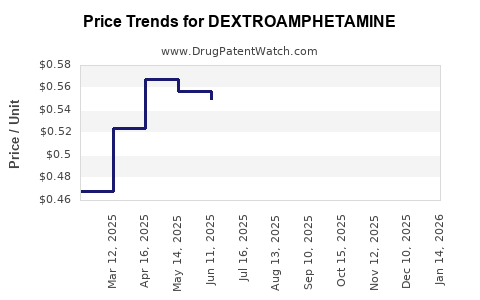
Last updated: February 20, 2026
Dextroamphetamine remains a widely prescribed central nervous system stimulant primarily used for attention-deficit hyperactivity disorder (ADHD) and narcolepsy. This analysis evaluates the current market landscape, competitive environment, pricing trends, and future price projections.
Market Size and Growth Dynamics
Dextroamphetamine is classified as a Schedule II controlled substance under the U.S. Controlled Substances Act. The market value for prescription stimulants, including dextroamphetamine, reached approximately $3.2 billion in 2022 in the U.S., representing a compound annual growth rate (CAGR) of 4.2% since 2017[1].
Key Drivers:
- Rising ADHD diagnosis rates, especially in children and young adults.
- Increased awareness and acceptance of stimulant therapies.
- Growing prevalence of narcolepsy.
- Expansion into adult treatment markets.
Competitive Landscape
Market players include:
- Eli Lilly (Adderall, Vyvanse)
- Teva Pharmaceuticals (Dextroamphetamine IR, generic formulations)
- Mallinckrodt (generic dextroamphetamine products)
- Shire (now part of Takeda; Vyvanse as a major branded option)
- Emerging generic manufacturers
Generics account for over 70% of prescriptions as patent protections for branded medications decline[2].
Pricing Trends Analysis
Historical Price Data
The average wholesale price (AWP) of branded dextroamphetamine has declined notably over the past decade due to generic entry.
| Year |
Average Wholesale Price (per 10 mg tablet) |
Notes |
| 2012 |
$4.50 |
Primarily branded medication |
| 2017 |
$3.20 |
Initial generic entries |
| 2022 |
$1.20 |
Dominance of generics reduces prices |
Pricing Factors
- Generic Competition: Drives prices downward.
- Manufacturing Costs: Marginally decrease with scale and technological efficiencies.
- Regulatory Environment: Stringent abuse-deterrent formulations (ADFs) impact formulation costs but influence pricing only marginally.
- Supply Chain Dynamics: Shortages or disruptions can temporarily inflate prices but are typically transient.
Future Price Projections
Given current market conditions, projections suggest the following trends:
- Short-term (next 1-2 years): Prices for dextroamphetamine will stabilize or slightly decline, averaging around $1.00–$1.50 per 10 mg tablet.
- Medium-term (3-5 years): Price reduction may slow as patent protections for some formulations expire, and new generics enter. Expect prices near $1.00 per 10 mg tablet.
- Long-term (5+ years): Prices could approach $0.80–$1.00, assuming continued generic competition and manufacturing efficiencies.
Factors Influencing Future Pricing
- Regulatory restrictions on abuse-deterring formulations.
- Emergence of biosimilars or alternative formulations that could replace traditional tablets.
- Policy changes around prescription monitoring and controlled substance regulation.
- Market demand shifts, including potential new indications.
Additional Market Considerations
- Pricing disparity: Brand-name dextroamphetamine prescriptions can cost significantly more—up to 4x—compared to generics.
- Reimbursement policies: Insurance coverage favors generics, reducing the market share and prices of branded versions.
- Potential restrictions: Increased regulatory oversight could impact supply and production costs.
Key Takeaways
- The dextroamphetamine market grew modestly pre-pandemic, driven by rising behavioral disorder diagnoses.
- The market is highly competitive with generics dominating over 70% of usage.
- Prices have declined steeply over the last decade due to generic entry, with a continued downward trend expected.
- Price stability is anticipated in the short term, with gradual declines projected over the medium term.
- Market dynamics will be influenced by regulatory policies, supply chain issues, and potential new formulations.
FAQs
1. How does the patent status affect dextroamphetamine prices?
Most dextroamphetamine formulations are off-patent, leading to widespread generic competition, which suppresses prices.
2. Are there significant brand-name vs. generic price differences?
Yes. Branded products like Dexedrine or proprietary formulations can cost 3-4 times more than generic versions.
3. What regulatory changes could impact pricing?
Enhanced abuse-deterrent formulations may increase manufacturing costs; stricter prescribing limits could reduce volume.
4. Is there potential for new formulations to disrupt the market?
Yes. Long-acting formulations or non-stimulant alternatives could influence demand and pricing.
5. How does the surge in telehealth affect market prices?
Increased telehealth prescriptions may expand access but generally shift demand toward lower-cost generics, maintaining downward price pressure.
References
[1] IQVIA. (2023). Pharmaceutical Market Data.
[2] U.S. Food & Drug Administration. (2022). Generic Drug Approvals and Trends.
[3] Market Research Future. (2022). Global ADHD Treatment Market Analysis.
[4] SSR Health. (2023). Prescription Drug Price Trends.
[5] FDA. (2021). Abuse-Deterrent Opioid Formulations and Market Impact.