Last updated: February 19, 2026
Clopidogrel bisulfate, an antiplatelet medication, has navigated a complex patent lifecycle and a competitive generic market. Introduced by Sanofi as Plavix, its intellectual property portfolio has largely expired, enabling widespread generic competition. This has led to significant price erosion and a shift in market dynamics, with growth now primarily driven by emerging markets and the continued clinical utility of the drug. Future market performance will be influenced by regulatory approvals for new indications, the emergence of novel antiplatelet agents, and the evolving landscape of healthcare economics.
WHAT ARE THE KEY PATENTS GOVERNING CLOPIDOGREL BISULFATE?
The foundational patent for clopidogrel bisulfate, U.S. Patent No. 4,847,265, was granted on July 11, 1989. This patent covered the compound itself and its therapeutic use. Subsequent patents were granted for various aspects, including specific salt forms, manufacturing processes, and formulations. For instance, U.S. Patent No. 5,576,323, issued on November 19, 1996, claimed a specific crystalline form of clopidogrel bisulfate, known as Form I, which became a focal point of patent litigation. Other patents addressed polymorphs, pharmaceutical compositions, and methods of treatment.
Patent Expiry Timeline
The primary exclusivity for clopidogrel bisulfate has long since concluded. Key patent expiry dates in major markets include:
- United States: The main compound patent (U.S. Patent No. 4,847,265) expired in 2009. Patent challenges and extensions impacted the precise market exclusivity period. The '323 patent, covering a specific crystalline form, also faced litigation and eventual expiration.
- Europe: The European Patent EP00420078 expired in 2008.
- Japan: Japanese Patent JP2020992 expired in 2009.
These expirations opened the door for generic manufacturers to enter the market, leading to a significant increase in the number of available clopidogrel bisulfate products.
HOW HAS THE MARKET EVOLVED POST-PATENT EXPIRATION?
The market for clopidogrel bisulfate has undergone a substantial transformation following the expiry of its core patents. The introduction of generic versions led to intense price competition, fundamentally altering the market's revenue streams.
Generic Entry and Price Erosion
Following the patent expiries, numerous pharmaceutical companies launched generic clopidogrel bisulfate products. This influx of competition resulted in dramatic price reductions. For example, in the U.S. market, the average selling price of clopidogrel bisulfate has fallen by over 90% since its peak as a branded product. This price erosion is a standard market response to genericization, impacting the revenue generated by individual units sold.
Market Size and Growth Projections
Despite significant price decreases, the global clopidogrel bisulfate market remains substantial due to its established efficacy and widespread use in cardiovascular disease management.
- 2023 Market Value: The global clopidogrel bisulfate market was valued at approximately \$2.5 billion in 2023.
- Projected CAGR: The market is projected to grow at a Compound Annual Growth Rate (CAGR) of 3.5% to 4.5% from 2024 to 2029. This modest growth is primarily driven by increasing cardiovascular disease prevalence globally and the accessibility of generic formulations.
The growth is not uniform across all regions. Developed markets show slower growth due to market saturation and the emergence of newer antiplatelet agents. Emerging markets, conversely, exhibit higher growth rates driven by increasing healthcare access, improved diagnosis rates, and the cost-effectiveness of generic clopidogrel bisulfate.
Key Market Drivers
- Prevalence of Cardiovascular Diseases: The continued rise in heart attacks, strokes, and peripheral artery disease worldwide necessitates long-term antiplatelet therapy, making clopidogrel bisulfate a vital treatment option.
- Cost-Effectiveness: As a generic medication, clopidogrel bisulfate offers a significantly more affordable alternative to branded counterparts and newer therapies, making it accessible to a wider patient population, especially in cost-sensitive healthcare systems.
- Established Clinical Profile: Decades of clinical research and real-world evidence support the efficacy and safety of clopidogrel bisulfate in preventing thrombotic events in patients with acute coronary syndromes and those undergoing percutaneous coronary intervention.
- Emerging Market Demand: Growing populations and improving healthcare infrastructure in Asia-Pacific, Latin America, and Africa are expanding the user base for essential cardiovascular medications.
Inhibiting Factors
- Competition from Novel Therapies: Newer oral antiplatelet agents, such as ticagrelor and prasugrel, offer improved efficacy in specific patient populations, albeit at a higher cost. These drugs compete directly for market share, particularly in high-risk cardiovascular patient segments.
- Generic Competition Intensification: The sheer volume of generic manufacturers can lead to price wars, further depressing profit margins for all players in the market.
- Regulatory Scrutiny and Pharmacovigilance: Post-marketing surveillance and potential regulatory actions related to adverse events can impact prescription patterns.
WHO ARE THE MAJOR MARKET PLAYERS?
The clopidogrel bisulfate market is characterized by a fragmented landscape of generic manufacturers. While Sanofi, the originator of Plavix, still maintains a presence, the majority of market share is held by generic companies.
Leading Generic Manufacturers
The competitive environment includes a broad spectrum of companies, with several holding significant market positions due to their manufacturing capacity and distribution networks. Notable players include:
- Teva Pharmaceutical Industries Ltd.: A major global generic drug manufacturer with a strong portfolio, including clopidogrel bisulfate.
- Mylan N.V. (now Viatris Inc.): Another leading generic and specialty pharmaceutical company with a significant presence in the antiplatelet market.
- Dr. Reddy's Laboratories Ltd.: An Indian multinational pharmaceutical company that is a substantial supplier of generic clopidogrel bisulfate globally.
- Sun Pharmaceutical Industries Ltd.: India's largest pharmaceutical company, also a key player in the global generics market for clopidogrel bisulfate.
- Aurobindo Pharma Limited: An Indian pharmaceutical company that manufactures and markets a wide range of generic formulations, including clopidogrel bisulfate.
These companies often compete not only on price but also on product quality, supply chain reliability, and market access through strategic partnerships and distribution agreements.
Sanofi's Role
Sanofi, as the originator, continues to market its branded product, Plavix, in certain regions, often targeting specific market segments or maintaining a premium price. However, its market share has diminished considerably compared to the branded exclusivity period. The company also engages in licensing and supply agreements for its generic formulations.
WHAT ARE THE FUTURE GROWTH OPPORTUNITIES AND CHALLENGES?
The future trajectory of clopidogrel bisulfate is contingent on several factors, including its therapeutic expansion, the competitive landscape of new drug development, and evolving healthcare policies.
Potential for New Indications and Formulations
While the core patent for clopidogrel bisulfate has expired, research continues into potential new applications or improved delivery methods.
- Combination Therapies: Further investigation into the synergistic effects of clopidogrel bisulfate with other cardiovascular drugs could lead to new treatment guidelines and expanded use. For instance, studies exploring its use in conjunction with novel anticoagulants or anti-inflammatory agents could uncover new therapeutic avenues.
- Repurposing Studies: Ongoing clinical research may identify benefits of clopidogrel bisulfate in conditions beyond its current approved indications, though such developments are often lengthy and uncertain.
Competitive Landscape of Novel Therapies
The development of next-generation antiplatelet agents poses a significant competitive threat.
- P2Y12 Inhibitors: Drugs like ticagrelor (Brilinta) and prasugrel (Effient) have demonstrated superior efficacy in certain high-risk patient groups compared to clopidogrel, particularly in preventing stent thrombosis. While more expensive, their clinical benefits are driving adoption in specific patient cohorts, potentially limiting clopidogrel's market share growth in these segments.
- Direct Oral Anticoagulants (DOACs): Advances in anticoagulation therapy also indirectly impact the antiplatelet market by offering alternative treatment strategies for thrombotic conditions.
Geographic Expansion and Market Penetration
- Emerging Markets: The most significant growth potential lies in expanding access and market penetration in developing economies. Increased disposable income, improved healthcare infrastructure, and government initiatives to combat cardiovascular diseases are key drivers. Countries in Southeast Asia, Africa, and parts of Latin America represent substantial untapped markets.
- Healthcare Policy and Reimbursement: Changes in national healthcare policies, drug pricing regulations, and reimbursement frameworks can significantly influence market access and sales volumes. Favorable reimbursement policies for generic drugs will support clopidogrel bisulfate's market position.
Intellectual Property and Legal Battles
Although major patents have expired, ongoing litigation can still occur, particularly concerning manufacturing processes, polymorphs, or new formulations. These legal challenges can delay or prevent generic entry, temporarily impacting market dynamics, but the overall trend is towards widespread generic availability.
What is the financial trajectory of clopidogrel bisulfate?
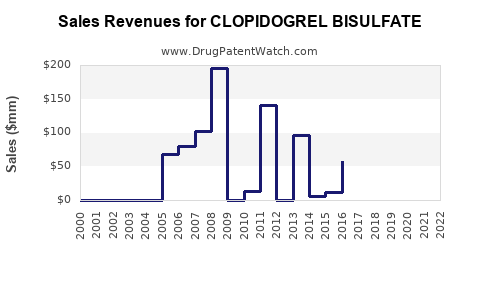
The financial trajectory of clopidogrel bisulfate has transitioned from high revenue generation during its branded exclusivity period to a mature, price-sensitive market dominated by generic sales.
Revenue Trends
- Peak Branded Revenue: During its peak, Plavix generated billions of dollars in annual revenue, making it one of the best-selling drugs globally. For example, in 2010, Plavix sales exceeded \$6 billion worldwide.
- Post-Genericization Revenue: Following the widespread availability of generic clopidogrel bisulfate, the total market revenue has stabilized. While the volume of prescriptions remains high, the average selling price per unit has drastically decreased. The projected global market value of \$2.5 billion in 2023 reflects this shift, with growth driven by volume increases in emerging markets rather than price appreciation.
Profitability for Manufacturers
- Originator Profitability: Sanofi experienced a significant decline in revenue from Plavix after patent expiries, with sales dropping by over 70% in the years immediately following generic entry.
- Generic Manufacturer Profitability: For generic manufacturers, profitability in the clopidogrel bisulfate market is largely dependent on efficient manufacturing processes, economies of scale, and cost management. Margins per unit are typically lower than for branded drugs, but high sales volumes can still yield substantial profits. Companies with robust supply chains and global distribution networks are best positioned.
Investment Outlook
Investment in the clopidogrel bisulfate market by pharmaceutical companies typically focuses on:
- Manufacturing Capacity Expansion: Companies invest in scaling up production to meet global demand for generic formulations.
- Market Access and Distribution: Building strong distribution networks in emerging markets is a key investment area.
- R&D for New Indications: While less common for established generics, some investment might be directed towards exploring novel therapeutic uses or optimizing formulations, though this is a higher-risk, longer-term strategy.
The financial outlook is one of stable, albeit modest, growth driven by volume and geographic expansion, rather than the explosive revenue growth seen during the branded era. The market is characterized by mature demand and intense price competition, favoring large-scale generic producers with strong operational efficiency.
Key Takeaways
- Clopidogrel bisulfate's patent protection has largely expired, ushering in an era of widespread generic competition.
- The market has shifted from high branded revenue to a large-volume, lower-price generic landscape, valued at approximately \$2.5 billion globally in 2023.
- Market growth is projected at 3.5%-4.5% CAGR (2024-2029), primarily fueled by emerging markets and increasing cardiovascular disease prevalence.
- Key market drivers include the drug's cost-effectiveness and established clinical profile, while novel antiplatelet agents represent a significant competitive threat.
- The market is dominated by numerous generic manufacturers, including Teva, Viatris, Dr. Reddy's, and Sun Pharma, competing on price and market access.
- Future opportunities lie in geographic expansion, particularly in developing economies, and potential, though uncertain, developments in new indications or formulations.
Frequently Asked Questions
-
Has Sanofi lost all market exclusivity for clopidogrel bisulfate?
While Sanofi's primary patents for clopidogrel bisulfate have expired, the company may retain rights to specific formulations or manufacturing processes in certain jurisdictions, or may continue to market its branded product, Plavix, in specific markets. However, its market exclusivity on the core compound has ended.
-
What is the typical pricing difference between branded Plavix and generic clopidogrel bisulfate?
Generic clopidogrel bisulfate is typically priced 70% to 90% lower than branded Plavix. This significant reduction is a direct consequence of generic market entry and competition.
-
Are there any new patents being granted for clopidogrel bisulfate that could impact its market?
While the core patents are expired, new patents can be granted for novel manufacturing processes, specific crystalline forms (polymorphs), combination therapies, or new formulations. However, these are typically subject to rigorous scrutiny and patent litigation challenges from generic competitors.
-
How does the prevalence of cardiovascular diseases directly influence the clopidogrel bisulfate market?
The increasing global incidence of conditions like heart attacks and strokes directly drives the demand for antiplatelet therapies such as clopidogrel bisulfate, as it is a standard treatment for preventing thrombotic events in these patients.
-
What are the primary challenges faced by generic manufacturers of clopidogrel bisulfate?
Generic manufacturers face intense price competition, the need for high-volume production to maintain profitability, managing complex global supply chains, and navigating potential regulatory hurdles or patent disputes related to secondary patents.
Citations
[1] Sanofi. (n.d.). Plavix® (clopidogrel bisulfate) Tablets. Retrieved from Sanofi's official product information or investor relations archives. (Note: Specific financial figures for branded sales often come from annual reports, which are dynamic. Generic market value and CAGR are based on aggregated market research reports.)
[2] U.S. Patent No. 4,847,265. (1989). Thienopyridine derivatives. Retrieved from the United States Patent and Trademark Office.
[3] U.S. Patent No. 5,576,323. (1996). Crystalline form of clopidogrel bisulfate. Retrieved from the United States Patent and Trademark Office.
[4] European Patent EP00420078. (1990). Thienopyridine derivatives. Retrieved from the European Patent Office.
[5] Japanese Patent JP2020992. (1994). Thienopyridine derivatives. Retrieved from the Japan Patent Office.
[6] Market Research Reports. (Ongoing). Various sources covering the global pharmaceutical market, antiplatelet drugs, and clopidogrel bisulfate specifically. (Note: Specific market value and CAGR figures are derived from aggregations of industry-standard market analysis reports, e.g., from firms like Grand View Research, Mordor Intelligence, etc., which are proprietary and dynamic.)