Last updated: September 26, 2026
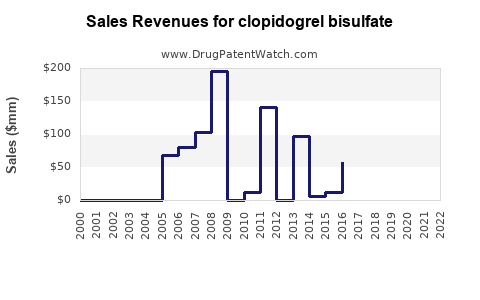
Clopidogrel bisulfate is a mature, high-volume antiplatelet drug with limited patent protection and intense generic competition. The branded product, Plavix, generated several billion dollars in annual global sales before U.S. exclusivity ended in 2012. Since then, market value has shifted from brand pricing to low-cost, high-volume generic supply.
Demand remains durable because clopidogrel is widely used for secondary prevention of myocardial infarction and ischemic stroke, treatment after coronary stenting, and peripheral arterial disease. Financial growth is constrained by generic pricing, therapeutic substitution by ticagrelor and prasugrel in selected acute coronary syndrome patients, and broad payer pressure.
What is the current market position of clopidogrel bisulfate?
Clopidogrel bisulfate is the bisulfate salt of clopidogrel, an oral P2Y12 platelet inhibitor. It is marketed primarily as immediate-release tablets in 75 mg and 300 mg strengths.
| Market factor |
Current position |
| Drug class |
P2Y12 platelet inhibitor |
| Main reference brand |
Plavix |
| Original developers |
Sanofi and Bristol-Myers Squibb |
| U.S. regulatory status |
Approved small-molecule prescription drug |
| Dosage forms |
Immediate-release tablets |
| Common strengths |
75 mg and 300 mg |
| Patent position |
Core U.S. exclusivity expired in 2012 |
| Biosimilar exposure |
None; clopidogrel is a small molecule |
| Generic competition |
Extensive |
| Primary commercial model |
High-volume, low-price generic supply |
| Main alternatives |
Aspirin, prasugrel, ticagrelor, cangrelor |
Clopidogrel remains commercially relevant because it is inexpensive, familiar to prescribers, available in most health systems, and suitable for long-term treatment. The drug is also used when ticagrelor or prasugrel is unsuitable because of bleeding risk, contraindications, tolerability, cost, or formulary restrictions.
How large was the Plavix market before generic entry?
Plavix was one of the largest pharmaceutical products globally before patent expiry. Combined sales reported by Sanofi and Bristol-Myers Squibb reached several billion dollars annually, with estimates for peak worldwide revenue commonly exceeding $6 billion and some industry sources placing peak sales near $9 billion.
The revenue was split between the two commercial partners under their global alliance. Sanofi had a major commercial role outside the United States, while Bristol-Myers Squibb led U.S. commercialization. Company reporting confirms that Plavix was a material contributor to both companies' revenue before generic erosion (Bristol-Myers Squibb, 2012; Sanofi, 2012).
Revenue trajectory
| Period |
Commercial phase |
Financial effect |
| 1997-2005 |
Global brand expansion |
Rapid sales growth driven by cardiovascular adoption |
| 2006-2011 |
Mature brand franchise |
Multi-billion-dollar annual revenue |
| 2012 |
U.S. generic entry |
Abrupt volume migration and price erosion |
| 2013-2015 |
Global generic expansion |
Brand revenue contracted sharply |
| 2016-present |
Mature generic market |
Stable demand with low unit pricing |
The principal financial event was not demand destruction. It was the conversion of branded revenue into generic revenue. Prescription volume remained substantial, but the revenue pool available to the originators collapsed after generic substitution.
When did clopidogrel lose patent exclusivity?
The principal U.S. clopidogrel patent estate expired in 2012. Generic entry followed the end of the core patent and associated regulatory protections. FDA-approved generic products entered the U.S. market in 2012, including products from major generic manufacturers.
The key U.S. patent was associated with the clopidogrel compound and its use in platelet aggregation inhibition. The relevant patent history included U.S. Patent No. 5,288,726, which covered the active compound and formed the primary basis of the Plavix exclusivity position.
| Exclusivity item |
Timing |
| U.S. Plavix approval |
1997 |
| Core U.S. patent expiry |
2012 |
| U.S. generic approvals |
2012 |
| Pediatric exclusivity |
Applied to the relevant regulatory period and affected launch timing |
| Current U.S. patent status |
No meaningful blocking core patent protection |
The exact commercial launch date varied by manufacturer and market. Patent expiry did not produce a single universal global event because patent terms, supplementary protection certificates, settlements, and regulatory approvals differed by country.
What patents protect clopidogrel bisulfate today?
The original composition-of-matter and active-compound patent protection has expired in the United States. Any remaining patents in individual jurisdictions are unlikely to create a broad commercial barrier for standard clopidogrel bisulfate tablets.
Core patent categories
| Patent category |
Commercial status |
| Active compound |
Expired in major markets |
| Clopidogrel bisulfate salt |
No meaningful broad U.S. exclusivity remaining |
| Standard 75 mg tablets |
Generic competition established |
| Standard 300 mg tablets |
Generic competition established |
| Method of treating cardiovascular disease |
Generally expired or commercially weak |
| Formulation patents |
Limited relevance for conventional immediate-release tablets |
| Manufacturing patents |
May protect specific processes but rarely block all generic supply |
| Pediatric indication |
Historical regulatory exclusivity; no current commercial barrier |
The remaining intellectual-property value is primarily defensive or process-specific. A manufacturer may hold patents covering a particular crystallization method, impurity-control process, particle-size distribution, or manufacturing route. Such patents normally do not prevent competitors from using alternative processes.
What is the Orange Book status of clopidogrel bisulfate?
The FDA Orange Book identifies approved reference products, therapeutic equivalents, patents, and exclusivity information for approved drug products. Plavix has long-standing generic competition, and multiple clopidogrel bisulfate tablet products have been rated therapeutically equivalent to the applicable reference-listed drug products.
The relevant commercial implication is that pharmacies and payers can substitute approved generic tablets without requiring a new clinical efficacy program. Generic applicants generally rely on the abbreviated new drug application pathway and demonstrate pharmaceutical equivalence, bioequivalence, and compliance with current manufacturing requirements (FDA, n.d.-a).
Because clopidogrel is a small molecule, it is not subject to the biosimilar pathway under the Public Health Service Act. Generic applicants use the Federal Food, Drug, and Cosmetic Act's abbreviated pathway rather than an abbreviated biologics license application.
Which companies compete in the clopidogrel generic market?
The U.S. generic market has included large multinational manufacturers and contract suppliers. Depending on the period and dosage strength, suppliers have included Teva, Mylan, Dr. Reddy's Laboratories, Lupin, Apotex, Zydus, Torrent, and other FDA-approved manufacturers.
The competitive structure has several layers:
- API suppliers produce clopidogrel or clopidogrel bisulfate.
- Finished-dose manufacturers compress, coat, package, and distribute tablets.
- Wholesalers and pharmacy benefit managers influence net pricing.
- Retail, hospital, mail-order, and government channels determine volume allocation.
Supplier concentration can vary by dosage strength and contracting cycle. The market is generally competitive, but temporary shortages can occur when manufacturers face inspection findings, raw-material disruptions, quality failures, or capacity constraints.
How strong is the current patent estate for clopidogrel?
The patent estate is weak for conventional clopidogrel bisulfate tablets. Patent strength is high only in historical terms, because the original compound patent created a substantial barrier before 2012.
| Patent-strength factor |
Assessment |
| Core composition patent |
Expired |
| Regulatory exclusivity |
Expired |
| Standard tablet formulation |
Weak |
| Method-of-use protection |
Weak or expired |
| Process patents |
Potentially useful but narrow |
| Litigation leverage |
Limited |
| Generic design-around risk |
Low for basic tablets |
| Barrier to new suppliers |
Regulatory and manufacturing, not patent-based |
The principal barriers now involve FDA approval, bioequivalence, quality systems, API sourcing, scale economics, and distribution contracts. Patent litigation is not the central market-control mechanism.
What Paragraph IV challenges affected clopidogrel?
Generic applicants historically used Paragraph IV certifications to challenge the validity, enforceability, or infringement of listed Plavix patents. The most prominent disputes involved Apotex and other generic manufacturers seeking early entry.
Bristol-Myers Squibb and Sanofi litigated against Apotex after Apotex filed an abbreviated new drug application containing a Paragraph IV certification. The dispute produced settlement activity and regulatory scrutiny, including review by the Federal Trade Commission. The matter became part of the broader policy debate over brand-generic settlements and potential pay-for-delay arrangements (Federal Trade Commission, 2006).
The key business effect was that generic challengers established leverage before expiration. Even where a settlement delayed commercial launch, the underlying patent position ultimately ended with generic entry in 2012.
What litigation and settlement agreements affected Plavix?
The principal litigation risk centered on:
- Validity and infringement of the core clopidogrel patent.
- Timing of generic entry.
- Settlement terms between Sanofi, Bristol-Myers Squibb, and generic applicants.
- Regulatory treatment of authorized and independent generic supply.
The Apotex litigation was the most commercially significant U.S. dispute. The settlement structure was scrutinized because agreements that restrict generic entry can preserve brand revenue beyond the date an independent generic might otherwise launch.
After the core patent expired, litigation ceased to be a meaningful mechanism for maintaining Plavix pricing. Any later disputes generally concerned product quality, labeling, manufacturing, supply contracts, or narrower process rights rather than control of the active pharmaceutical ingredient.
How does clopidogrel compare with ticagrelor and prasugrel?
Clopidogrel has the broadest cost advantage and the longest market history. Ticagrelor and prasugrel have stronger positions in selected acute coronary syndrome and percutaneous coronary intervention settings but are more expensive and have different safety and dosing profiles.
| Attribute |
Clopidogrel |
Prasugrel |
Ticagrelor |
| Mechanism |
P2Y12 inhibitor |
P2Y12 inhibitor |
P2Y12 inhibitor |
| Administration |
Once daily after loading |
Once daily after loading |
Twice daily |
| Generic availability |
Extensive |
Increasing or established in many markets |
Generic entry varies by market |
| Onset and platelet inhibition |
More variable |
More rapid and consistent |
Rapid and reversible |
| Key commercial advantage |
Low price and familiarity |
Potency in selected PCI patients |
Potency and clinical differentiation |
| Main limitation |
CYP2C19 activation and variable response |
Bleeding risk and restrictions |
Cost, dyspnea, twice-daily dosing |
| Long-term maintenance role |
Very strong |
More selective |
Selective, depending on indication |
Clinical guidelines continue to position clopidogrel as an important option, particularly for patients who cannot take aspirin, require long-term antiplatelet therapy, or face cost and tolerability constraints. Ticagrelor and prasugrel compete more directly in acute coronary syndrome rather than eliminating clopidogrel across all indications (American College of Cardiology/American Heart Association, 2016).
What is the financial trajectory for generic clopidogrel?
The financial trajectory has three phases:
Brand phase
Before 2012, Plavix generated high-margin revenue supported by patent exclusivity, global brand recognition, and broad cardiovascular use.
Patent-cliff phase
Following U.S. generic entry, branded revenue fell rapidly as pharmacies substituted generic tablets. The originators lost pricing power, while generic manufacturers competed for formulary access and wholesaler volume.
Mature generic phase
The current market is characterized by:
- High prescription volume.
- Low average selling prices.
- Thin margins for commoditized suppliers.
- Periodic price increases during shortages.
- Greater value in manufacturing scale and supply reliability.
- Limited opportunity for premium pricing without a differentiated formulation or distribution channel.
Generic manufacturers can still produce attractive returns when they have low-cost API access, efficient tableting operations, reliable regulatory compliance, and large purchasing contracts. The economic profile is less favorable for small entrants that lack scale or must purchase API at spot-market prices.
What manufacturing and intellectual-property barriers remain?
Clopidogrel manufacturing is technically manageable but requires control of stereochemistry, impurity profile, salt formation, and batch consistency. The active pharmaceutical ingredient contains a chiral center, and the desired stereoisomer must be controlled during synthesis and purification.
Key manufacturing risks include:
- Chiral purity and stereochemical control.
- Control of related substances and degradation products.
- Consistent bisulfate salt formation.
- Tablet dissolution and bioequivalence.
- API supply concentration.
- Compliance with current good manufacturing practices.
- Stability across global distribution conditions.
These issues can create temporary supply barriers but do not restore the historical patent moat. A competitor with a compliant alternative process can generally enter after receiving FDA approval.
What generic launch scenarios exist for clopidogrel?
The standard generic launch scenario has already occurred in the United States and other major markets. Current commercial scenarios are more limited:
| Scenario |
Probability profile |
Financial effect |
| Additional low-cost generic entrant |
Common |
Further price pressure |
| Supplier exit after margin compression |
Possible |
Temporary share shifts or shortage risk |
| API disruption |
Possible |
Short-term price increases |
| Premium reformulation |
Limited |
Potential niche pricing if clinically differentiated |
| New indication |
Limited |
Regulatory value without strong patent protection |
| Hospital-contract consolidation |
Ongoing |
Higher volume for selected suppliers |
| Branded re-entry |
Unlikely |
Weak economics against established generics |
A premium clopidogrel product would need a meaningful advantage, such as improved adherence, reduced interaction risk, a novel delivery system, or a clinically validated formulation. Standard tablets have little pricing power.
What is the geographic coverage of clopidogrel patents and generics?
Generic clopidogrel is available across North America, Europe, Asia, Latin America, and many emerging markets. Patent expiry timing was not identical in every jurisdiction, and some countries had different supplementary protection certificates, pediatric extensions, or local litigation outcomes.
The commercial pattern is consistent across most regions:
- Early brand leadership during patent protection.
- Rapid generic entry after local expiry.
- Price compression.
- Continued volume supported by cardiovascular disease prevalence.
- Greater supplier fragmentation in less regulated markets.
- More concentrated procurement in national health systems.
Emerging markets can retain branded or local-brand pricing premiums longer than the United States, but local tender systems often compress prices once multiple suppliers qualify.
What FDA regulatory status applies to clopidogrel bisulfate?
The FDA has approved clopidogrel bisulfate for reducing atherothrombotic events in patients with recent myocardial infarction, recent ischemic stroke, established peripheral arterial disease, and acute coronary syndrome settings. Approved labeling includes use with aspirin in specified acute coronary syndrome populations.
FDA-approved generics must meet requirements for:
- Pharmaceutical equivalence.
- Bioequivalence.
- Manufacturing quality.
- Labeling consistency.
- Postmarket safety obligations.
The principal regulatory risk is no longer clinical approval. It is manufacturing compliance, product-quality surveillance, and supply continuity.
What revenue exposure remains for Sanofi and Bristol-Myers Squibb?
Direct Plavix revenue exposure for Sanofi and Bristol-Myers Squibb is now negligible compared with the pre-expiry period. The patent cliff removed the product's ability to generate originator-level margins.
The larger strategic effect was historical:
- Plavix funded significant portions of both companies' cardiovascular franchises.
- The loss of exclusivity increased the importance of pipeline replacement.
- Generic entry reduced earnings concentration in a single mature product.
- Litigation and settlement decisions materially affected the final years of brand revenue.
Current value resides primarily with generic manufacturers, API producers, wholesalers, and healthcare systems rather than the original brand owners.
Key Takeaways
- Clopidogrel bisulfate is a mature, globally established generic antiplatelet drug.
- Plavix lost its principal U.S. exclusivity in 2012.
- Peak branded sales reached several billion dollars annually.
- Generic substitution caused a sharp revenue decline for Sanofi and Bristol-Myers Squibb.
- The current market is volume-driven and price-sensitive.
- No biosimilar pathway applies because clopidogrel is a small molecule.
- Standard tablet formulations have weak remaining patent protection.
- Manufacturing quality, API access, and distribution contracts are more important than patents.
- Ticagrelor and prasugrel compete in selected acute coronary syndrome and PCI settings, but neither has displaced clopidogrel across the full market.
- Future value is concentrated in efficient generic supply, not branded pricing power.
FAQs
Is clopidogrel bisulfate still profitable for generic manufacturers?
Yes, but profitability depends on manufacturing scale, API costs, quality compliance, and contract access. Margins are materially lower than the branded Plavix period.
Does clopidogrel have a biosimilar competitor?
No. Clopidogrel is a chemically synthesized small molecule, so competitors are approved as generic drugs rather than biosimilars.
Can a company launch a new patented clopidogrel formulation?
A company could seek patents for a genuinely novel formulation, delivery system, or manufacturing process. A conventional 75 mg or 300 mg immediate-release tablet would face limited patentability and weak commercial differentiation.
Is clopidogrel resistant to generic substitution?
No. FDA-rated therapeutically equivalent products can generally be substituted through pharmacy and payer channels, subject to local law and prescriber restrictions.
What is the largest commercial risk in the clopidogrel supply chain?
The largest current risk is supply disruption caused by API shortages, manufacturing deficiencies, regulatory actions, or supplier concentration. Patent litigation is no longer the primary risk.
References
-
American College of Cardiology/American Heart Association. (2016). 2016 ACC/AHA guideline focused update on duration of dual antiplatelet therapy in patients with coronary artery disease. Circulation, 134(10), e123-e155.
-
Bristol-Myers Squibb. (2012). 2011 annual report. Bristol-Myers Squibb Company.
-
Federal Trade Commission. (2006). Federal Trade Commission charges Bristol-Myers Squibb with anticompetitive conduct involving Plavix. Federal Trade Commission.
-
U.S. Food and Drug Administration. (n.d.-a). Approved drug products with therapeutic equivalence evaluations: Orange Book. U.S. Department of Health and Human Services.
-
U.S. Food and Drug Administration. (n.d.-b). Drugs@FDA: FDA-approved drugs. U.S. Department of Health and Human Services.
-
Sanofi. (2012). 2011 annual report. Sanofi.