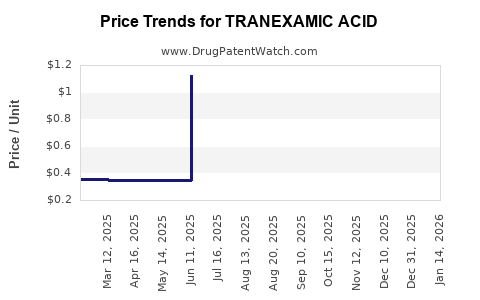
Last updated: August 10, 2026
Tranexamic acid is a mature, low-cost antifibrinolytic with broad use in trauma, surgery, postpartum hemorrhage, heavy menstrual bleeding, dentistry, and selected dermatology applications. Its core composition-of-matter protection expired decades ago. Commercial value now depends on manufacturing scale, injectable supply reliability, hospital contracts, regulatory registrations, formulation differentiation, and clinical adoption rather than exclusivity.
The market has durable demand but limited pricing power. Volume growth is strongest in trauma systems, obstetric care, orthopedic surgery, cardiac surgery, and hospital protocols. Generic competition keeps revenue concentrated among high-volume manufacturers and distributors. No biosimilar pathway applies because tranexamic acid is a small-molecule drug.
What is tranexamic acid used for, and what drives demand?
Tranexamic acid inhibits plasminogen activation and reduces fibrin breakdown. It is supplied mainly as an injectable solution and oral tablets.
The principal demand drivers are:
- Trauma and emergency medicine
- Postpartum hemorrhage
- Orthopedic and cardiac surgery
- Dental procedures in patients with bleeding disorders
- Heavy menstrual bleeding
- Epistaxis and other off-label bleeding indications
- Topical and cosmetic applications, including melasma products
Large randomized studies have expanded clinical adoption. The CRASH-2 trial supported early use in trauma, while the WOMAN trial supported use in postpartum hemorrhage. The HALT-IT trial did not support routine use in gastrointestinal bleeding, which has limited expansion in that indication [1-3].
The strongest commercial demand is for low-priced injectable products purchased through hospitals, government tenders, wholesalers, and group purchasing organizations. Oral tablets have a more differentiated reimbursement profile because the FDA-approved U.S. indication for Lysteda is heavy menstrual bleeding [4].
How large is the tranexamic acid market?
Public market estimates vary because analysts define the market differently. Some count only branded and generic pharmaceutical sales. Others include active pharmaceutical ingredient sales, hospital injectables, cosmetics, compounded products, and nonprescription channels.
The commercial market is best understood as a fragmented global pharmaceutical market rather than a concentrated branded-drug market. Key characteristics include:
| Market characteristic |
Commercial effect |
| Core molecule is generic |
Low pricing power |
| Injectable use dominates hospital demand |
Volume depends on procedure and emergency-care activity |
| Multiple suppliers |
Frequent tender competition |
| Oral heavy-menstrual-bleeding product has narrower positioning |
Higher potential price per treatment course |
| Global regulatory approvals are widespread |
Geographic expansion is feasible |
| API and sterile-fill capacity matter |
Supply interruptions can create temporary pricing opportunities |
| No biosimilar pathway |
Competition comes from generics, not biosimilars |
Public filings generally do not report tranexamic acid revenue as a standalone line item. Pfizer reports broad pharmaceutical revenues rather than a separately disclosed Cyklokapron revenue figure, and generic manufacturers typically combine the product with broader portfolios. As a result, product-level revenue exposure must be inferred from product listings, procurement awards, regulatory databases, and company portfolio disclosures.
When did tranexamic acid lose exclusivity?
The original tranexamic acid molecule and early pharmaceutical uses are long out of patent protection in major markets. The United States has had generic injectable and oral competition for years.
The principal exclusivity milestones are:
| Product or protection |
Market position |
Current commercial effect |
| Original tranexamic acid composition |
Expired |
No protection for the active molecule |
| Cyklokapron injection |
Legacy branded product |
Competes with generic injection |
| Lysteda tablets |
FDA-approved oral product |
Historical regulatory and formulation exclusivity has expired or no longer prevents broad generic competition |
| Later formulation patents |
Product-specific and time-limited |
May affect individual products but do not protect the molecule |
| Regulatory exclusivity |
Historical |
No current exclusivity supports a monopoly position |
Lysteda was approved by the FDA in November 2009 for the treatment of cyclic heavy menstrual bleeding [4]. Its commercial protection was materially weaker than that of a newly launched chemical entity because tranexamic acid itself was already an established generic compound.
What patents protect tranexamic acid products?
The core active ingredient is not protected by a live composition-of-matter patent in the United States or other major pharmaceutical markets. Remaining patent questions concern specific formulations, dosing regimens, delivery technologies, or manufacturing processes.
Formulation patents
The most commercially relevant historical formulation work involved oral tranexamic acid tablets designed for heavy menstrual bleeding. Formulation claims may address:
- Tablet strength and excipient composition
- Modified-release or controlled-release delivery
- Tablet dissolution characteristics
- Stability and packaging
- Manufacturing processes
- Specific dosing schedules
These rights are narrower than a molecule patent. Generic manufacturers can often avoid them by using different excipients, release profiles, tablet processes, or approved labeling strategies.
Method-of-use patents
Potential method-of-use claims have covered treatment of specific bleeding conditions, including menstrual bleeding, surgery-related bleeding, trauma, and other clinical settings. Their practical value is limited when:
- The indication is already established in medical practice
- Physicians can prescribe the product for off-label uses
- Generic applicants use a section viii labeling carve-out
- The same active ingredient is approved for multiple indications
Manufacturing and process rights
Manufacturing patents may cover crystallization, purification, salt handling, particle size, or sterile injectable production. These rights can create operational barriers for a particular supplier but generally do not block the market. Tranexamic acid is chemically established, and alternative manufacturing routes are available.
What is the Orange Book status of tranexamic acid?
The FDA Orange Book lists approved drug products and, where applicable, patent and exclusivity information [5]. The relevant U.S. products include:
| Product |
Dosage form |
FDA regulatory route |
Commercial position |
| Cyklokapron |
Intravenous injection |
NDA |
Legacy branded injectable |
| Lysteda |
Oral tablets |
NDA |
Branded oral product for heavy menstrual bleeding |
| Generic tranexamic acid |
Injection and tablets |
ANDA and other approved pathways |
Main source of market competition |
Orange Book status is product-specific. A patent listed against Lysteda does not create a patent barrier for every tranexamic acid product, and patents associated with one dosage form do not automatically cover injectable products.
Generic applicants may use:
- Paragraph IV certification to challenge listed patents
- Paragraph III certification where a patent remains valid but will be respected until expiration
- Section viii statements to omit patented uses from labeling
- Standard Paragraph I or II certifications where no relevant patent is listed or the patent has expired
Because generic products have reached the market, the molecule is commercially open. Any remaining Orange Book issue is likely to concern a particular brand, formulation, or use rather than the active ingredient as a whole.
Which companies compete in the tranexamic acid market?
Competition spans branded originators, multinational generic manufacturers, regional pharmaceutical companies, API suppliers, and hospital-injection specialists.
Branded and originator-linked products
Pfizer markets Cyklokapron in certain markets as an injectable tranexamic acid product. Ferring Pharmaceuticals is associated with Lysteda in the United States through the product’s development and commercialization history. These products retain brand recognition but face generic substitution and tender pressure.
Generic manufacturers
The competitive field includes large generic and hospital-product manufacturers such as:
- Fresenius Kabi
- Hikma Pharmaceuticals
- Teva Pharmaceuticals
- Viatris
- Sandoz
- Amneal Pharmaceuticals
- Regional manufacturers in India, China, Latin America, Southeast Asia, and Europe
The exact active supplier list varies by country, dosage form, registration status, and procurement contract. The injectable segment has a higher barrier to entry than tablets because sterile manufacturing, quality systems, inspection history, and reliable fill-finish capacity are required.
API suppliers
API production is concentrated in established chemical manufacturing regions, particularly China and India. API suppliers compete on:
- Certificate-of-analysis consistency
- Impurity control
- Regulatory documentation
- Batch scale
- Delivery reliability
- Support for drug-master-file submissions
API competition limits finished-dose pricing but can create supply concentration risk if manufacturing is disrupted.
How strong is the patent estate for tranexamic acid?
The patent estate is weak at the molecule level and moderate only for selected formulations or uses.
| Patent category |
Strength |
Commercial impact |
| Composition of matter |
Very low |
Expired |
| Standard oral tablets |
Low |
Generic substitution is established |
| Injectable formulation |
Low to moderate |
Sterile manufacturing is a larger barrier than patent protection |
| Modified-release delivery |
Moderate for a specific product |
Could support differentiation if clinically and commercially relevant |
| Method of use |
Low to moderate |
Carve-outs and off-label prescribing reduce practical exclusivity |
| Manufacturing process |
Moderate for a particular route |
Usually does not prevent alternative processes |
| Brand and regulatory know-how |
Moderate |
Supports procurement and physician familiarity but not monopoly pricing |
The main competitive moat is operational. A supplier with validated sterile capacity, broad hospital registrations, dependable inventory, and strong tender execution can outperform a company with no meaningful patent advantage.
What patent litigation and Paragraph IV risks affect tranexamic acid?
Tranexamic acid has historically generated less patent litigation than newer specialty drugs because the active ingredient is old, inexpensive, and widely available. Litigation risk is concentrated around branded oral formulations and listed use patents rather than the injectable molecule.
A Paragraph IV challenge could affect:
- Lysteda-listed formulation claims
- Patents covering a specific tablet technology
- Patented indications or dosing schedules
- Later-added product improvements
The economic value of a Paragraph IV challenge is constrained by low average selling prices and the availability of multiple noninfringing routes. A generic applicant may obtain market access without challenging every historical patent by using a section viii carve-out or by targeting an unprotected dosage form.
There is no biosimilar litigation risk. Tranexamic acid is a chemically synthesized small molecule and is regulated through generic-drug pathways rather than the biologics license application and biosimilar framework.
What is the FDA regulatory status of tranexamic acid?
The FDA has approved tranexamic acid in more than one product and dosage form. Cyklokapron injection is approved for selected bleeding-related uses, including use in patients with hemophilia undergoing tooth extraction. Lysteda tablets are approved for cyclic heavy menstrual bleeding [4].
Clinical use is broader than FDA-labeled use. Hospitals use tranexamic acid in trauma, obstetrics, orthopedic surgery, cardiac surgery, and other settings based on clinical evidence, guidelines, and institutional protocols.
Regulatory considerations include:
- Renal dose adjustment because the drug is primarily renally eliminated
- Thromboembolic risk assessment
- Seizure risk at high doses or in selected clinical settings
- Product-specific labeling differences
- Sterility and particulate controls for injection
- Bioequivalence requirements for oral generic products
Regulatory expansion is more likely to occur through guideline adoption and hospital protocols than through new molecule innovation.
How does tranexamic acid compare with competing antifibrinolytics?
Aprotinin is a historical comparator with a more complex safety and regulatory history. Aminocaproic acid remains an alternative antifibrinolytic in some markets. Tranexamic acid has generally benefited from stronger clinical evidence, lower cost, simpler logistics, and broad availability.
| Product |
Main role |
Cost position |
Competitive status |
| Tranexamic acid |
Broad antifibrinolytic use |
Low |
Market leader in many protocols |
| Aminocaproic acid |
Alternative antifibrinolytic |
Low |
Smaller commercial position |
| Aprotinin |
Selected surgical use in certain markets |
Higher and restricted |
Limited availability |
| Desmopressin |
Hemostatic alternative for selected disorders |
Higher |
Different mechanism and indication |
| Blood products and factor concentrates |
Replacement therapy |
High |
Used when clinically required, not direct substitutes in every case |
Tranexamic acid’s principal competitive advantage is not patent protection. It is the combination of clinical familiarity, low price, simple dosing, and broad availability.
What is the financial trajectory for tranexamic acid?
The financial trajectory is a mature-generic profile:
- Early commercialization generated value through branded positioning and regulatory approvals.
- Generic entry reduced price and shifted value toward volume.
- Expansion into trauma, obstetrics, and surgery increased unit demand.
- Hospital procurement and tendering compressed margins.
- Future growth depends on procedure volume, clinical adoption, geographic expansion, and supply reliability.
Revenue growth is likely to be volume-led rather than price-led. The main scenarios are:
| Scenario |
Market outcome |
Financial effect |
| Base case |
Stable hospital demand and gradual guideline adoption |
Low single-digit value growth, with stronger volume growth |
| Upside case |
Broader trauma, postpartum hemorrhage, and surgical protocol use |
Higher unit volumes and improved manufacturing utilization |
| Downside case |
Tender price erosion, supplier oversupply, or clinical restrictions |
Revenue decline despite stable or rising volumes |
| Supply-disruption case |
Sterile injectable shortage or API interruption |
Temporary price increases and share shifts |
| Differentiation case |
Extended-release, topical, or specialty formulations |
Higher margins in narrow segments |
Revenue exposure by business model
For a branded innovator, tranexamic acid is unlikely to be a major growth driver unless the company owns a differentiated formulation or a protected delivery system. For generic manufacturers, the product is more valuable as part of a hospital portfolio. It can improve contract competitiveness when bundled with anesthetics, antibiotics, fluids, and other injectable products.
For API producers, the product offers recurring demand but limited pricing leverage. The most attractive customers are manufacturers with multinational registrations and long-term hospital contracts.
For investors, the principal financial indicators are:
- Injectable capacity utilization
- Number of registered markets
- Hospital and government tender wins
- Average selling price by geography
- Gross margin after sterile-fill costs
- FDA warning letters or manufacturing observations
- API supplier concentration
- Product availability and back-order history
- Share of sales from oral versus injectable products
What manufacturing and intellectual-property barriers exist?
Manufacturing barriers exceed intellectual-property barriers.
Injectable products
Sterile injection production requires validated aseptic processing, environmental monitoring, container-closure integrity, extractables and leachables controls, and regulatory inspection readiness. These requirements reduce the number of credible suppliers compared with oral tablets.
Oral tablets
Tablet production is easier to scale and has more generic competitors. Commercial differentiation can come from:
- Lower-cost production
- Improved packaging
- Extended-release delivery
- Patient-friendly dosing
- Regional regulatory approvals
- Contract manufacturing relationships
Geographic coverage
Tranexamic acid is broadly used across North America, Europe, Asia-Pacific, Latin America, the Middle East, and Africa. Market access depends on national registrations, local pharmacopoeial requirements, procurement rules, import controls, and reimbursement status.
Emerging markets can produce higher unit growth, but prices are often lower and receivables, tender delays, and regulatory requirements increase execution risk.
What generic entry risks exist for tranexamic acid?
Generic entry is already established, so the relevant risk is continued price and share erosion rather than a future first generic launch.
The highest risks for branded products are:
- Automatic or pharmacy-level generic substitution
- Hospital formulary replacement
- Government tender repricing
- Multiple ANDA approvals
- Section viii labeling strategies
- Parallel procurement from lower-cost regions
- Distributor inventory substitution
The principal risk for generic manufacturers is different: excessive competition can reduce margins below the level required to support reliable sterile production. This can produce intermittent shortages, especially for injectable products, followed by rapid supplier substitution.
Key Takeaways
- Tranexamic acid is a mature generic drug with no meaningful composition-of-matter exclusivity.
- The U.S. branded products are Cyklokapron injection and Lysteda tablets.
- Lysteda’s historical regulatory and formulation protection does not create a broad market monopoly.
- The FDA Orange Book remains relevant for product-specific patents, but generic competition is established.
- No biosimilar pathway applies.
- Injectable manufacturing, regulatory compliance, and supply reliability are stronger barriers than patents.
- Demand is supported by trauma, postpartum hemorrhage, surgery, dental care, and heavy menstrual bleeding.
- Financial growth is expected to be volume-led, while price erosion limits revenue expansion.
- Branded revenue exposure is limited; generic manufacturers benefit mainly through portfolio scale and hospital contracts.
- The most attractive opportunities are reliable sterile injectables, specialty formulations, and geographic expansion in underpenetrated markets.
FAQs
Is tranexamic acid still under patent?
The core tranexamic acid molecule is no longer under meaningful patent protection in major markets. Specific formulations, manufacturing methods, or methods of use may have had separate patents, but these do not protect the entire market.
Does tranexamic acid have generic competition in the United States?
Yes. Generic tranexamic acid is available in oral and injectable forms, subject to product-specific FDA approvals, labeling, and supply status.
Is Lysteda protected by an active patent?
Lysteda has been subject to historical formulation and product-specific patent protection. Any current barrier must be assessed against the FDA Orange Book listing for the relevant product and patent.
Can hospitals substitute generic tranexamic acid for Cyklokapron?
Hospitals may use an FDA-approved generic product when it meets applicable quality, labeling, procurement, and formulary requirements. Substitution depends on dosage form, concentration, supplier approval, and institutional policy.
Is tranexamic acid an attractive pharmaceutical licensing asset?
The unprotected molecule is generally a weak standalone licensing asset. Commercial value is stronger for differentiated extended-release tablets, specialty delivery systems, proprietary manufacturing, hospital distribution, or products with registrations in difficult-to-enter markets.
References
-
CRASH-2 Collaborators. (2010). Effects of tranexamic acid on death, vascular occlusive events, and blood transfusion in trauma patients with significant haemorrhage. The Lancet, 376(9734), 23-32.
-
WOMAN Trial Collaborators. (2017). Effect of early tranexamic acid administration on mortality, hysterectomy, and other morbidities in women with postpartum haemorrhage. The Lancet, 389(10084), 2105-2116.
-
HALT-IT Trial Collaborators. (2020). Effects of a high-dose short-term infusion of tranexamic acid on death and thromboembolic events in patients with acute gastrointestinal bleeding. The Lancet, 395(10241), 1927-1936.
-
U.S. Food and Drug Administration. (2009). Lysteda: Tranexamic acid tablets prescribing information. FDA.
-
U.S. Food and Drug Administration. (n.d.). Approved drug products with therapeutic equivalence evaluations, Orange Book. FDA.