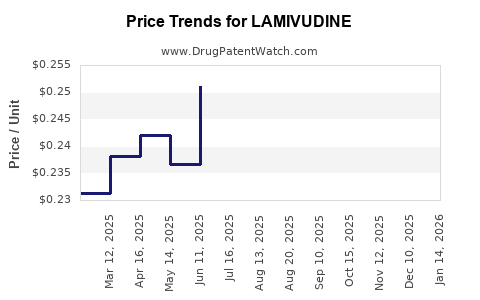
Last updated: November 11, 2026
Lamivudine is a mature, low-cost nucleoside reverse transcriptase inhibitor used for HIV-1 and chronic hepatitis B. Its standalone patent estate has expired in major markets, generic competition is extensive, and standalone brand revenue has largely disappeared. Commercial value remains in public-sector HIV and hepatitis B procurement, fixed-dose combinations, and emerging-market supply rather than in premium pricing or exclusivity.
What is lamivudine used for and who markets it?
Lamivudine, also known as 3TC, is a cytidine analogue that inhibits reverse transcriptase in HIV and the viral DNA polymerase of hepatitis B virus.
The principal historical brands are:
| Product |
Active ingredient |
Indication |
Historical sponsor or marketer |
| Epivir |
Lamivudine |
HIV-1 infection |
GlaxoSmithKline, later ViiV Healthcare |
| Epivir-HBV |
Lamivudine |
Chronic hepatitis B |
GlaxoSmithKline |
| Combivir |
Lamivudine/zidovudine |
HIV-1 infection |
GlaxoSmithKline |
| Trizivir |
Abacavir/lamivudine/zidovudine |
HIV-1 infection |
GlaxoSmithKline |
| Epzicom/Kivexa |
Abacavir/lamivudine |
HIV-1 infection |
GlaxoSmithKline, later ViiV Healthcare |
| Generic lamivudine |
Lamivudine |
HIV and hepatitis B |
Multiple manufacturers |
The FDA approved Epivir for HIV-1 infection in 1995 and Epivir-HBV for chronic hepatitis B in 1998.[1,2] Lamivudine is also included in national HIV treatment programs and World Health Organization-recommended antiretroviral regimens, although newer regimens commonly place dolutegravir, tenofovir, or other agents at the center of therapy.[3]
When did lamivudine lose market exclusivity?
Lamivudine lost effective commercial exclusivity after expiration of its core U.S. composition-of-matter patent and the entry of generic manufacturers. The relevant patent estate is now historical rather than a current barrier to generic entry.
Lamivudine exclusivity timeline
| Event |
Approximate date |
Commercial effect |
| Lamivudine introduced in HIV treatment |
1995 |
Brand market established |
| Epivir-HBV approved |
1998 |
Second major indication added |
| Original composition patent reaches end of term |
Around 2009-2010 |
Generic entry becomes commercially viable |
| Generic lamivudine expands |
2010s |
Standalone brand pricing collapses |
| Current market |
2020s |
Low-cost generic and combination-driven demand |
U.S. regulatory exclusivity has long expired. Lamivudine is a small-molecule drug, so biosimilar regulation does not apply. Competition occurs through abbreviated new drug applications, not through the biosimilar pathway.
What patents protect lamivudine?
The central historical U.S. patent was U.S. Patent No. 5,047,407, covering lamivudine-related nucleoside compounds and pharmaceutical applications. The patent was associated with the original development and commercialization of lamivudine and expired after the statutory patent term, including applicable adjustments.
Current commercial protection is not based on the original lamivudine molecule. Any remaining patent relevance generally concerns:
- Specific fixed-dose combinations
- Particular formulations or dosage forms
- Crystalline, salt, or process claims
- Combination use with other antiretrovirals
- Pediatric or modified-release presentations in selected jurisdictions
- Local patents in countries with different filing and term histories
The original active ingredient is widely available from generic suppliers. A manufacturer seeking to enter with plain lamivudine generally faces manufacturing, regulatory, quality, and procurement hurdles rather than a fundamental U.S. composition patent.
Are there formulation patents for lamivudine?
Formulation and combination patents can remain relevant even when the molecule itself is off patent. The commercial significance varies by product.
For standalone immediate-release lamivudine tablets and oral solution, generic competition is well established. Combination products may have had separate patent positions involving:
- Lamivudine plus zidovudine
- Abacavir plus lamivudine
- Three-drug HIV regimens
- Lamivudine plus newer agents such as dolutegravir
These patents generally protect a product combination or treatment architecture, not the lamivudine molecule alone. Their value depends on whether physicians, treatment guidelines, procurement agencies, and formularies continue to demand the specific combination.
What is the FDA and Orange Book status of lamivudine?
Lamivudine has full FDA approval for HIV-1 and chronic hepatitis B uses through branded and generic products. The FDA Orange Book historically listed patents for brand products and combination products, but the original lamivudine composition protection is no longer an active exclusivity barrier.
Regulatory status
| Regulatory issue |
Status |
| FDA approval |
Yes |
| New chemical entity exclusivity |
Expired |
| Standalone U.S. composition patent |
Expired |
| Generic availability |
Extensive |
| Biosimilar pathway |
Not applicable |
| Paragraph IV risk |
Primarily historical |
| Current standalone brand moat |
Weak |
| Combination-product patent relevance |
Product-specific |
Paragraph IV litigation was most relevant when generic applicants first challenged the remaining listed patents. In the current market, a new standalone lamivudine applicant is more likely to rely on established generic precedent and product-specific regulatory pathways than to face a high-value innovator patent dispute.
Which companies compete in the lamivudine market?
Competition is fragmented and divided between branded combination products, generic finished-dose suppliers, and active pharmaceutical ingredient manufacturers.
Relevant market participants have included:
- ViiV Healthcare
- GlaxoSmithKline
- Cipla
- Mylan, now part of Viatris
- Teva
- Aurobindo Pharma
- Hetero
- Matrix Laboratories
- Sun Pharmaceutical Industries
- Lupin
- Zhejiang Huahai Pharmaceutical and other API producers
- Regional suppliers serving Global Fund and government tenders
The competitive structure differs by geography. In the United States and Western Europe, lamivudine is mainly a generic or embedded combination ingredient. In low- and middle-income countries, procurement competition is often determined by tender price, WHO prequalification, manufacturing scale, supply reliability, and access to donor-funded purchasing programs.
How does lamivudine compare with competing HIV and hepatitis B drugs?
Lamivudine has low cost and strong clinical familiarity, but its position is weaker when treatment guidelines prioritize higher genetic barriers to resistance or more potent hepatitis B suppression.
| Drug or class |
Relative position versus lamivudine |
Commercial effect |
| Tenofovir disoproxil fumarate |
Stronger role in many hepatitis B and HIV regimens |
Limits lamivudine monotherapy use |
| Tenofovir alafenamide |
Lower renal and bone exposure in appropriate patients |
Supports premium branded and combination products |
| Dolutegravir |
High-barrier HIV anchor drug |
Shifts lamivudine into two-drug or triple combinations |
| Zidovudine |
Older and more toxicity-limited |
Lamivudine/zidovudine remains a low-cost legacy option |
| Emtricitabine |
Pharmacologically similar NRTI |
Competes in HIV combinations, especially with tenofovir |
| Entecavir |
Hepatitis B antiviral |
Competes in HBV, particularly where resistance history matters |
Lamivudine remains clinically valuable in combination therapy. Its main weakness is the low genetic barrier to resistance when used as monotherapy or in inadequately suppressive regimens. In hepatitis B, resistance can develop after prolonged exposure, reducing its role as a preferred first-line monotherapy option in many guidelines.[3,4]
What is the financial trajectory for lamivudine?
Lamivudine followed the standard financial trajectory of a successful small-molecule antiviral:
- Premium branded launch in the 1990s.
- Expansion through additional indications and fixed-dose combinations.
- Loss of exclusivity around the end of the 2000s.
- Sharp price erosion after generic entry.
- Transition from an innovator revenue asset to a high-volume, low-margin generic ingredient.
- Continued embedded value in combination products and public-health procurement.
GlaxoSmithKline and ViiV Healthcare have not generally reported lamivudine as a standalone revenue line in public financial statements. Reported product revenue has typically been aggregated by brand or franchise, making it difficult to isolate the contribution of lamivudine from products such as Combivir, Trizivir, Epzicom, Kivexa, and later HIV combinations.[5,6]
Revenue exposure by business model
| Business model |
Lamivudine economics |
| Standalone innovator brand |
Minimal current pricing power |
| U.S. generic tablets |
Low unit price, fragmented competition |
| Global tender supply |
High volume, low margin |
| API production |
Scale and cost efficiency are decisive |
| Fixed-dose combinations |
Greater commercial resilience |
| Pediatric formulations |
Public-health relevance and tender demand |
| Novel branded combination |
Value depends on the partner drug and product patent |
The largest remaining economic opportunity is not a return to premium standalone pricing. It is reliable, low-cost supply at scale and participation in combination products with stronger clinical or patent positioning.
What licensing deals affect lamivudine?
Lamivudine commercialization was shaped by licensing and corporate transactions involving the original developers and the later HIV-focused ViiV structure. GSK and Pfizer formed ViiV Healthcare in 2009 to consolidate HIV assets, with Shionogi later participating as a shareholder.[6]
Generic access has also been supported by voluntary licensing, technology transfer, and public-health procurement arrangements, although the terms vary by country and product. The most important commercial licensing issues today concern combination regimens and newer antiretroviral products, not standalone lamivudine.
For low-income and lower-middle-income markets, licensing can affect:
- Whether local manufacturers may produce a product
- Which countries are included
- Whether a product qualifies for donor procurement
- The timing of generic availability
- Royalty and supply obligations
- Regulatory filing rights
What patent litigation and settlement risks affect lamivudine?
Current litigation risk for standalone lamivudine is low because the basic molecule is long off patent and generic supply is established. Historical litigation risk was concentrated around:
- ANDA challenges to branded HIV products
- Combination-product patents
- Dosage and formulation claims
- Orange Book-listed patents associated with branded products
- Generic launch timing under Paragraph IV certification
Settlement agreements involving older antiretroviral products may have included licenses, delayed entry dates, or territory-specific provisions. Those agreements are generally less commercially important today than patent settlements involving newer HIV combinations and long-acting delivery systems.
The main legal risk now shifts from molecule patents to supply-chain and contract issues, including quality compliance, manufacturing interruptions, procurement exclusions, and trademark restrictions.
What generic launch scenarios exist for lamivudine?
United States
Generic entry is already established. A new entrant would compete on:
- ANDA approval status
- Wholesale acquisition cost and contract discounts
- FDA manufacturing compliance
- Product availability
- Pharmacy benefit manager access
- Ability to supply oral solution and pediatric forms
Europe
European markets are largely genericized, with national reimbursement systems and tender procurement controlling price. Reference pricing and substitution policies can compress margins quickly.
Emerging markets
The highest-volume opportunity is often in HIV treatment programs supported by governments, the Global Fund, PEPFAR, and other procurement channels. Success depends on WHO prequalification, local registration, tender eligibility, and supply continuity.
Combination products
Combination products may create more defensible commercial niches, but a manufacturer must analyze each active ingredient and each relevant patent family separately. Lamivudine itself does not provide meaningful exclusivity to the combination.
How strong is the lamivudine patent estate?
The standalone lamivudine patent estate is weak for present-day commercial purposes.
| Patent factor |
Assessment |
| Composition-of-matter protection |
Expired |
| Regulatory exclusivity |
Expired |
| Generic availability |
Broad |
| Standalone litigation exposure |
Low |
| Formulation protection |
Product- and jurisdiction-specific |
| Combination protection |
Potentially relevant, but dependent on other actives |
| Manufacturing barriers |
Moderate for compliant large-scale supply |
| Pricing power |
Low |
| Clinical demand |
Durable but increasingly genericized |
The strongest barriers are operational rather than legal. These include API quality, regulatory inspection outcomes, validated manufacturing, pediatric formulation capability, and procurement performance.
What revenue exposure remains for manufacturers?
For originator companies, direct lamivudine revenue exposure is limited. The drug can still contribute indirectly through established HIV franchises, but declining use of legacy combinations reduces its strategic importance.
For generic manufacturers, exposure is different:
- Demand is recurring because HIV and hepatitis B treatment is chronic.
- Volume is relatively predictable.
- Price competition is severe.
- Public tenders can create large but low-margin contracts.
- Regulatory or supply failures can remove a supplier from a market.
- Combination products can improve average selling price.
Lamivudine is therefore a defensive volume product rather than a growth asset. Its demand base is more stable than its price base.
Key Takeaways
- Lamivudine is an established generic antiviral used in HIV and hepatitis B.
- The original U.S. molecule patent and regulatory exclusivity have expired.
- Standalone lamivudine has little remaining patent-based pricing power.
- Generic competition is extensive across the United States, Europe, and emerging markets.
- Commercial value persists through chronic treatment demand, public procurement, pediatric products, and fixed-dose combinations.
- Combination-product patents can remain relevant, but they do not restore exclusivity to lamivudine itself.
- Biosimilar risk is irrelevant because lamivudine is a small molecule.
- Financial reporting from GSK and ViiV generally does not isolate lamivudine revenue.
- The main current barriers are manufacturing quality, regulatory compliance, tender access, and supply reliability.
- Long-term value is likely to remain stable in volume and compressed in price.
FAQs About Lamivudine Patents, Pricing, and Market Competition
Is lamivudine still under patent?
No. The original molecule-level patent protection has expired in major markets. Product-specific combination or formulation patents must be analyzed separately.
Can a generic company launch lamivudine without a Paragraph IV challenge?
Yes. Because the core exclusivity period has expired, a generic applicant can generally pursue the applicable abbreviated regulatory pathway without relying on a current molecule-level Paragraph IV challenge.
Is lamivudine included in modern HIV treatment?
Yes. It remains part of several HIV combinations, including regimens with dolutegravir and other antiretrovirals. Its use is determined by treatment guidelines, resistance history, tolerability, and product availability.
Why has lamivudine revenue declined despite continued demand?
Generic entry reduced prices, while public procurement and reimbursement systems increased purchasing leverage. Demand remains durable, but revenue per tablet is much lower than during the branded period.
Does lamivudine have a future in hepatitis B treatment?
Yes, but its role is more limited than in the early treatment era because resistance concerns and newer agents have changed first-line treatment preferences. It remains available where cost, prior treatment history, or local guidelines support its use.
References
- U.S. Food and Drug Administration. (1995). Epivir (lamivudine) prescribing information.
- U.S. Food and Drug Administration. (1998). Epivir-HBV (lamivudine) prescribing information.
- World Health Organization. (2024). Consolidated guidelines on HIV prevention, testing, treatment, service delivery and monitoring: Recommendations for a public health approach.
- World Health Organization. (2024). Guidelines for the prevention, diagnosis, care and treatment for people with chronic hepatitis B infection.
- GlaxoSmithKline plc. (2009-2014). Annual reports and financial statements.
- ViiV Healthcare. (2023-2024). Annual and corporate reports.