You're using a free limited version of DrugPatentWatch: Upgrade for Complete Access

Last Updated: December 28, 2025

TALTZ Drug Profile


✉ Email this page to a colleague

« Back to Dashboard


Summary for Tradename: TALTZ
High Confidence Patents:30
Applicants:1
BLAs:1
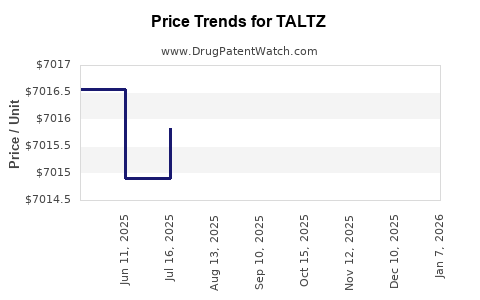
Drug Prices: Drug price information for TALTZ
Pharmacology for TALTZ
Mechanism of ActionInterleukin-17A Antagonists
Established Pharmacologic ClassInterleukin-17A Antagonist
Note on Biologic Patents

Matching patents to biologic drugs is far more complicated than for small-molecule drugs.

DrugPatentWatch employs three methods to identify biologic patents:

  1. Brand-side disclosures in response to biosimilar applications
  2. These patents were identified from disclosures by the brand-side company, in response to a potential biosimilar seeking to launch. They have a high certainty of blocking biosimilar entry. The expiration dates listed are not estimates — they're expiration dates as indicated by the brand-side company.

  3. DrugPatentWatch analysis and company disclosures
  4. These patents were identified from searching various sources, including drug labels and other general disclosures from the brand-side company. This list may exclude some of the patents which block biosimilar launch, and some of these patents listed may not actually block biosimilar launch. The expiration dates listed for these patents are estimates, based on the grant date of the patent.

  5. Patents from broad patent text search
  6. For completeness, these patents were identified by searching the patent literature for mentions of the branded or ingredient name of the drug. Some of these patents protect the original drug, whereas others may protect follow-on inventions or even inventions casually mentioning the drug. The expiration dates listed for these patents are estimates, based on the grant date of the patent.

1) High Certainty: US Patents for TALTZ Derived from Brand-Side Litigation

No patents found based on brand-side litigation

2) High Certainty: US Patents for TALTZ Derived from DrugPatentWatch Analysis and Company Disclosures

These patents were obtained from company disclosures
Applicant Tradename Biologic Ingredient Dosage Form BLA Patent No. Estimated Patent Expiration Source
Eli Lilly And Company TALTZ ixekizumab Injection 125521 10,065,011 2035-05-20 DrugPatentWatch analysis and company disclosures
Eli Lilly And Company TALTZ ixekizumab Injection 125521 10,258,679 2035-04-14 DrugPatentWatch analysis and company disclosures
Eli Lilly And Company TALTZ ixekizumab Injection 125521 10,266,597 2037-07-24 DrugPatentWatch analysis and company disclosures
Eli Lilly And Company TALTZ ixekizumab Injection 125521 10,519,241 2036-08-01 DrugPatentWatch analysis and company disclosures
Eli Lilly And Company TALTZ ixekizumab Injection 125521 10,549,021 2034-10-01 DrugPatentWatch analysis and company disclosures
Eli Lilly And Company TALTZ ixekizumab Injection 125521 10,729,731 2039-10-21 DrugPatentWatch analysis and company disclosures
Eli Lilly And Company TALTZ ixekizumab Injection 125521 10,737,000 2037-10-23 DrugPatentWatch analysis and company disclosures
>Applicant >Tradename >Biologic Ingredient >Dosage Form >BLA >Patent No. >Estimated Patent Expiration >Source

3) Low Certainty: US Patents for TALTZ Derived from Patent Text Search

These patents were obtained by searching patent claims

International Patents for TALTZ

Country Patent Number Estimated Expiration
Taiwan 202214556 ⤷  Get Started Free
Japan 6271346 ⤷  Get Started Free
Taiwan I796283 ⤷  Get Started Free
Japan 2023522249 ⤷  Get Started Free
Australia 2021282390 ⤷  Get Started Free
Australia 2015314744 ⤷  Get Started Free
World Intellectual Property Organization (WIPO) 2010080836 ⤷  Get Started Free
>Country >Patent Number >Estimated Expiration

Supplementary Protection Certificates for TALTZ

Supplementary Protection Certificate SPC Country SPC Expiration SPC Description
C20160030 00205 Estonia ⤷  Get Started Free PRODUCT NAME: IKSEKIZUMAB;REG NO/DATE: EU/1/15/1085 28.04.2016
38/2016 Austria ⤷  Get Started Free PRODUCT NAME: IXEKIZUMAB; REGISTRATION NO/DATE: EU/1/15/1085 (MITTEILUNG) 20160428
300829 Netherlands ⤷  Get Started Free PRODUCT NAME: IXEKIZUMAB; REGISTRATION NO/DATE: EU/1/15/1085 20160428
559 Finland ⤷  Get Started Free
93189 Luxembourg ⤷  Get Started Free PRODUCT NAME: IXEKIZUMAB ET SES DERIVES PHARMACEUTIQUEMENT ACCEPTABLES (TALTZ); FIRST REGISTRATION DATE: 20160428
16C0036 France ⤷  Get Started Free PRODUCT NAME: IXEKIZUMAB; REGISTRATION NO/DATE: EU/1/15/1085 20160428
C 2016 030 Romania ⤷  Get Started Free PRODUCT NAME: IXEKIZUMAB; NATIONAL AUTHORISATION NUMBER: EU/1/15/1085; DATE OF NATIONAL AUTHORISATION: 20160425; NUMBER OF FIRST AUTHORISATION IN EUROPEAN ECONOMIC AREA (EEA): EU/1/15/1085; DATE OF FIRST AUTHORISATION IN EEA: 20160425
>Supplementary Protection Certificate >SPC Country >SPC Expiration >SPC Description

Market Dynamics and Financial Trajectory for TALTZ (ixekizumab)

Last updated: November 20, 2025

Introduction

TALTZ (ixekizumab), a monoclonal antibody developed by Eli Lilly and Co., is an innovative biologic therap y approved for the treatment of immune-mediated conditions such as plaque psoriasis, psoriatic arthritis, and moderate-to-severe ankylosing spondylitis. Since its FDA approval in 2016, TALTZ has experienced significant market penetration, driven by evolving epidemiology, expanding indications, and competitive dynamics within the biologics space. This report delves into the market drivers, competitive landscape, revenue forecasts, and strategic factors influencing the financial trajectory of TALTZ.

Market Landscape and Epidemiological Drivers

Growing Prevalence of Targeted Indications

The global burden of psoriasis and psoriatic arthritis (PsA) is substantial, with estimates indicating approximately 125 million people affected worldwide by psoriasis alone [1]. The increasing recognition of these conditions' systemic and comorbid nature has accelerated diagnosis rates, enabling targeted biologic therapies like TALTZ to capture larger patient segments.

For psoriasis, the standard of care has shifted decisively towards biologics, especially for moderate-to-severe cases, due to superior efficacy and safety profiles compared to traditional systemic agents [2]. The expanding indication landscape further broadens TALTZ’s market potential; recent approvals for psoriatic arthritis and ankylosing spondylitis have reinforced its position within the IL-17 inhibitor class.

Medical Advances and Treatment Paradigms

Recent shifts toward personalization and early intervention in autoimmune diseases underpin the increased adoption of biologics such as TALTZ. The drug’s mechanism—IL-17A inhibition—targets pivotal inflammatory pathways, leading to high rates of skin clearance and disease control [3].

Moreover, the COVID-19 pandemic has highlighted the critical need for effective, targeted biologics, reinforcing the preference for agents with well-characterized safety profiles, such as TALTZ. Still, the pandemic has temporarily constrained healthcare utilization, but long-term impacts favor sustained biologics market growth.

Competitive Dynamics

Market Position and Differentiators

TALTZ faces competition primarily from other IL-17 inhibitors, including Cosentyx (secukinumab) by Novartis and Siliq (brodalumab) by AstraZeneca, as well as from biologics targeting alternative pathways such as Humira (adalimumab) and Stelara (ustekinumab). Its differentiators include rapid onset of action and high psoriasis clearance rates [4].

Eli Lilly employs strategic marketing, differentiated dosing regimens, and expanded indications to bolster TALTZ’s market share. Clinical data showcasing superior efficacy and favorable safety profiles continue to bolster TALTZ’s competitive edge.

Pricing, Reimbursement, and Access

Pricing strategies and reimbursement policies significantly influence TALTZ's access and adoption. Historically, biologics like TALTZ adopt premium pricing reflective of innovation, but payer negotiations, formularies, and biosimilar pressures affect revenue realization. Lilly’s engagement with healthcare payers for value-based agreements enhances market penetration.

Biosimilar and Patent Landscape

While biosimilars threaten traditional biologics, patent protections for TALTZ remain robust until 2029 [5], providing a window of exclusivity. Nonetheless, impending biosimilar entrants for competing IL-17 inhibitors could exert pricing pressure and impact market share in the latter half of the decade.

Financial Trajectory and Revenue Projections

Historical Performance and Current Revenue

Since its launch, TALTZ has demonstrated robust growth. In 2021, Lilly’s immunology segment, driven partly by TALTZ and other biologics, posted revenues exceeding $7 billion. TALTZ contributed a significant portion, reflecting increasing prescriptions and expanding indications.

Forecasting Future Revenues

Projections indicate that TALTZ’s global sales could reach approximately $4–6 billion annually by 2027, assuming steady uptake, expanding indications, and optimized market access. Several factors underpin this forecast:

  • Market Penetration: Continued uptake in existing indications, with expansion into psoriatic arthritis and ankylosing spondylitis markets.
  • Pipeline Expansion: Potential approvals for other immune-mediated diseases could elevate revenues further.
  • Geographic Expansion: Greater access in emerging markets, where biologics adoption is gaining momentum, supports growth.
  • Pricing Dynamics: Sustained premium pricing, coupled with value-based agreements, bolsters revenue—although biosimilar threat and policy changes could temper growth.

Revenue Risks and Challenges

Key risks include patent expirations, biosimilar competition, reimbursement hurdles, and late-stage safety data concerns. Additionally, the emergence of oral or small-molecule alternatives could alter treatment paradigms.

Strategic Factors Influencing Market Trajectory

Clinical and Regulatory Milestones

Achieving new indications and expedited approvals in unmet needs regions will be vital. Demonstrating long-term safety and real-world effectiveness will sustain demand.

Investment in Market Expansion

Strategic investments in sales force expansion, patient support programs, and partnerships with payers will enhance market access, especially in regions with nascent biologics markets.

Innovation and Pipeline Development

Innovative formulations, dosing regimens, and combination therapies could distinguish TALTZ from competitors, driving long-term revenue stability.

Conclusion

TALTZ is positioned at a favorable crossroads of a growing immunology therapeutics market characterized by high unmet medical needs and rapid innovation. Its mature market presence, coupled with expansion into new indications and geographical territories, indicates a promising financial trajectory. However, competitive pressures, patent expiries, and evolving payer landscapes necessitate continuous strategic adaptation.

Key Takeaways

  • The global prevalence of psoriasis and psoriatic arthritis underpins TALTZ’s long-term growth prospects.
  • Capitalizing on expanding indications and geographic markets will drive revenue growth toward an estimated $4–6 billion annually by 2027.
  • Competitive differentiation, pricing strategies, and payer negotiations are critical to maintaining market share amid biosimilar threats.
  • Innovation, clinical data, and pipeline expansion will influence TALTZ’s future market dominance and revenue trajectory.
  • Strategic adaptability in response to regulatory, competitive, and market dynamics remains essential for sustained financial success.

FAQs

1. What distinguishes TALTZ from other IL-17 inhibitors?
TALTZ offers rapid onset of action, high skin clearance rates, and flexible dosing schedules, which differentiate it from competitors like Cosentyx and Siliq. Its safety profile and expanding indications also contribute to its competitive position.

2. How will biosimilar entry impact TALTZ’s market share?
While biosimilars for IL-17 inhibitors are anticipated post-2029 patent expiry, current protections support TALTZ’s market dominance for the near- to medium-term. Biosimilar competition may lead to pricing pressure once approved, influencing revenue.

3. What are the key risks to TALTZ’s financial trajectory?
Patent expiries, biosimilar competition, payer reimbursement challenges, and safety or efficacy concerns pose significant risks to sustained revenue growth.

4. Which emerging indications could expand TALTZ’s marketability?
Potential approvals for additional autoimmune conditions, such as hidradenitis suppurativa or other inflammatory diseases, could further diversify its patient base and revenue streams.

5. How has COVID-19 influenced TALTZ’s market dynamics?
Pandemic-related healthcare disruptions temporarily reduced biologics prescriptions, but the long-term impact favors biologics like TALTZ due to their targeted treatment advantages and safety profiles.


Sources:

[1] World Health Organization. “Global psoriasis prevalence estimates.” 2020.

[2] Lebwohl, M. et al. “Guidelines of care for the management of psoriasis with biologics,” J Am Acad Dermatol. 2019.

[3] Blauvelt, A. et al. “Efficacy and Safety of Ixekizumab in Psoriasis,” N Engl J Med. 2017.

[4] Senthilnathan, P. et al. “Comparative efficacy of IL-17 inhibitors,” Expert Opin Pharmacother. 2020.

[5] U.S. Patent and Trademark Office. “Patent status for TALTZ,” 2022.

More… ↓

⤷  Get Started Free

Make Better Decisions: Try a trial or see plans & pricing

Drugs may be covered by multiple patents or regulatory protections. All trademarks and applicant names are the property of their respective owners or licensors. Although great care is taken in the proper and correct provision of this service, thinkBiotech LLC does not accept any responsibility for possible consequences of errors or omissions in the provided data. The data presented herein is for information purposes only. There is no warranty that the data contained herein is error free. We do not provide individual investment advice. This service is not registered with any financial regulatory agency. The information we publish is educational only and based on our opinions plus our models. By using DrugPatentWatch you acknowledge that we do not provide personalized recommendations or advice. thinkBiotech performs no independent verification of facts as provided by public sources nor are attempts made to provide legal or investing advice. Any reliance on data provided herein is done solely at the discretion of the user. Users of this service are advised to seek professional advice and independent confirmation before considering acting on any of the provided information. thinkBiotech LLC reserves the right to amend, extend or withdraw any part or all of the offered service without notice.