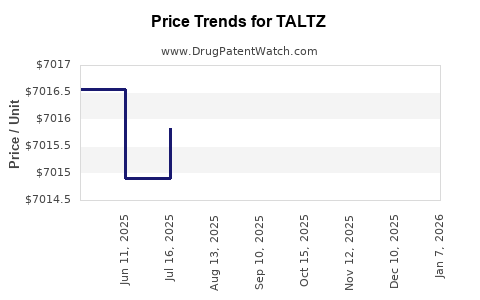
Last updated: February 14, 2026
Market Overview and Competitive Position
TALTZ (ixekizumab) is a monoclonal antibody developed by Eli Lilly used primarily to treat moderate-to-severe plaque psoriasis, psoriatic arthritis, and other inflammatory conditions. It received FDA approval in 2016 and is marketed globally, with significant penetration in dermatology and rheumatology markets.
Indications and Uses
- Moderate-to-severe plaque psoriasis
- Psoriatic arthritis
- Other autoimmune inflammatory conditions
Market Penetration
- One of the leading IL-17 inhibitors alongside Cosentyx (secukinumab) and Siliq (brodalumab)
- Estimated to hold approximately 15-20% market share among biologics for psoriasis globally (as per IQVIA data, 2022)
Key Competitors
| Product |
Company |
Approval Year |
Indications |
Estimated Market Share (2022) |
| TALTZ |
Eli Lilly |
2016 |
Psoriasis, PsA |
15-20% |
| Cosentyx |
Novartis |
2015 |
Psoriasis, PsA |
35-40% |
| Siliq |
BMS |
2017 |
Psoriasis |
10-15% |
| Stelara |
J&J |
2009 |
Psoriasis, Crohn’s |
15-20% |
Market Size and Growth Trends
Global Psoriasis Market
- Valued at approximately $6.7 billion in 2021
- Growing at a CAGR of roughly 8% (2021-2028), driven by increasing prevalence and expanding indications
Revenue Forecasts
- Eli Lilly's TALTZ generated $1.1 billion globally in 2022
- Projected to grow at a CAGR of 7-9% through 2028
Drivers
- Increasing prevalence of psoriasis and psoriatic arthritis worldwide
- Expanded label indications, including axial spondyloarthritis
- Adoption of biosimilars and competitive biologics affects pricing
Price Projections and Economics
Current Pricing
- List Price (US): approximately $5,000 per dose (based on typical dosing schedules)
- Cost per treatment cycle: approximately $25,000–$30,000
Reimbursement and Payer Dynamics
- High reimbursement rates in major markets
- Pricing sensitivity exists in health systems with cost containment policies
- Biosimilar competition anticipated from other IL-17 inhibitors and biosimilars for older biologics
Future Price Trends
- Likely stabilization or slight decrease due to patent expirations of competitors and biosimilar entries
- Pricing pressure toward $4,500–$5,000 per dose in advanced markets
- Price erosion expected at 2-4% annually post-2025 due to biosimilar and generic competition
Patent and Regulatory Landscape
Patent Status
- Eli Lilly holds patents expiring in 2028–2030
- Patent cliffs could trigger biosimilar entries, reducing prices and market share
Regulatory Approvals
- Fast track and priority review designations in multiple markets
- Ongoing expansion into additional indications, including hidradenitis suppurativa
Investment and R&D Outlook
Pipeline
- Investigating ixekizumab in other autoimmune conditions
- Developing biosimilars to extend revenue lifecycle
R&D Challenges
- Competition from emerging biologics targeting IL-23, IL-36 pathways
- Pricing models shifting with market dynamics
Key Takeaways
- TALTZ maintains a strong position in the psoriasis biologics market, with revenue growth driven by expanding indications and geographic reach.
- The market faces increasing pressure from biosimilars, expected to impact prices by 2025 onward, with a potential 2-4% annual erosion.
- Eli Lilly's patent protections currently extend into the late 2020s, but biosimilar competition could accelerate price declines post-patent expiry.
- Growth is forecasted at a compound rate of approximately 7-9%, contingent on market penetration and reimbursement policies.
- Competitive landscape intensifies with newer biologics and therapies in the pipeline, potentially impacting long-term market share.
FAQs
Q1: What are the primary drivers of TALTZ’s revenue growth through 2028?
Expansion into additional indications, increased adoption across global markets, and broadening payer coverage.
Q2: How will biosimilar entry affect TALTZ’s pricing?
Biosimilars are expected to enter around 2025–2026, likely leading to a 15-30% price reduction depending on market and patent status.
Q3: What are the risks to TALTZ’s market share?
Emergence of novel biologics targeting alternative pathways, biosimilar competition, and changes in reimbursement policies.
Q4: How does TALTZ compare to its competitors in market penetration?
It holds ~15-20%, trailing Cosentyx (~35-40%) but ahead of Siliq (~10-15%) as of 2022.
Q5: What is the potential for price erosion due to patent expiration?
Post-2025, prices could decline 2-4% annually amid biosimilar competition, affecting revenue projections.
References
- IQVIA. "Global Psoriasis Market Report," 2022.
- Eli Lilly. "TALTZ Product Details."
- MarketWatch. "Biologics Price Trends," 2022.
- FDA. "TALTZ Approval Summary," 2016.
- EvaluatePharma. "Biologics Market Forecast," 2022.