Last Updated: June 24, 2026

MOXEZA Drug Patent Profile


✉ Email this page to a colleague

« Back to Dashboard


Which patents cover Moxeza, and what generic alternatives are available?

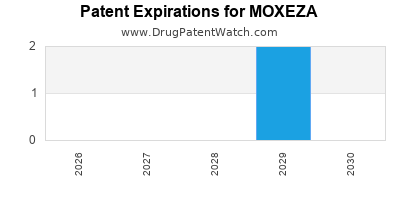
Moxeza is a drug marketed by Harrow Eye and is included in one NDA. There are two patents protecting this drug and one Paragraph IV challenge.

This drug has twenty-three patent family members in fifteen countries.

The generic ingredient in MOXEZA is moxifloxacin hydrochloride. There are eighteen drug master file entries for this compound. Thirty-five suppliers are listed for this compound. Additional details are available on the moxifloxacin hydrochloride profile page.

AI Deep Research
Questions you can ask:
  • What is the 5 year forecast for MOXEZA?
  • What are the global sales for MOXEZA?
  • What is Average Wholesale Price for MOXEZA?
Summary for MOXEZA
Recent Clinical Trials for MOXEZA

Identify potential brand extensions & 505(b)(2) entrants

SponsorPhase
Usona InstitutePhase 1

See all MOXEZA clinical trials

Paragraph IV (Patent) Challenges for MOXEZA
Tradename Dosage Ingredient Strength NDA ANDAs Submitted Submissiondate
MOXEZA Ophthalmic Solution moxifloxacin hydrochloride 0.5% 022428 1 2012-02-29

US Patents and Regulatory Information for MOXEZA

MOXEZA is protected by two US patents.

Applicant Tradename Generic Name Dosage NDA Approval Date TE Type RLD RS Patent No. Patent Expiration Product Substance Delist Req. Exclusivity Expiration
Harrow Eye MOXEZA moxifloxacin hydrochloride SOLUTION/DROPS;OPHTHALMIC 022428-001 Nov 19, 2010 DISCN Yes No 9,114,168 ⤷  Start Trial Y ⤷  Start Trial
Harrow Eye MOXEZA moxifloxacin hydrochloride SOLUTION/DROPS;OPHTHALMIC 022428-001 Nov 19, 2010 DISCN Yes No 8,450,311 ⤷  Start Trial Y ⤷  Start Trial
>Applicant >Tradename >Generic Name >Dosage >NDA >Approval Date >TE >Type >RLD >RS >Patent No. >Patent Expiration >Product >Substance >Delist Req. >Exclusivity Expiration

Supplementary Protection Certificates for MOXEZA

Patent Number Supplementary Protection Certificate SPC Country SPC Expiration SPC Description
0350733 300111 Netherlands ⤷  Start Trial
0350733 SPC/GB03/034 United Kingdom ⤷  Start Trial PRODUCT NAME: MOXIFLOXACIN AND PHARMACEUTICALLY USABLE HYDRATES AND ACID ADDITION SALTS THEREOF AND THE ALKALI METAL, ALKALINE EARTH METAL, SILVER AND GUANIDINIUM SALTS OF THE UNDERLYING CARBOXYLIC ACIDS AND THE RACEMATES THEREOF; REGISTERED: DE 45263.00.00 19990621; UK PL 000 10/0291 20030313
0350733 2001C/030 Belgium ⤷  Start Trial PRODUCT NAME: MOXIFLOXACINE CHLORHYDRATE (CORRESPONDANT A MOXIFLOXACINE); NATL. REGISTRATION NO/DATE: 187 IS 328 F 3 20010507; FIRST REGISTRATION: DE 45263.00.00 19990621
0350733 11/2000 Austria ⤷  Start Trial PRODUCT NAME: MOXIFLOXACIN, DESSEN PHARMAZEUTISCH VERWENDBARE HYDRATE UND SAEUREADDITIONSSALZE, DESSEN ALKALI-ERDALKALI-SILBER- UND GUANIDINIUMSALZE, SOWIE DESSEN C1 - C4 ALKYL- ODER; NAT. REGISTRATION NO/DATE: 1-23494, 1-23495, 1-23496 20000215; FIRST REGISTRATION: DE 45263.00.00 19990621
0350733 C300111 Netherlands ⤷  Start Trial PRODUCT NAME: MOXIFLOXACINE, DESGEWENST IN DE VORM VAN EEN FARMACEUTISCH AANVAARDBAAR ZOUT, IN HET BIJZONDER MOXIFLOXACINEHYDROCHLORIDE; NAT. REGISTRATION NO/DATE: RVG 28118 RVG 28119 20021017; FIRST REGISTRATION: DE 45263.00.00 19990621
0780390 PA2004012,C0780390 Lithuania ⤷  Start Trial PRODUCT NAME: MOXIFLOXACINI HYDROCHLORIDUM (1-CIKLOPROPIL-6-FLUOR-1,4-DIHIDRO-8-METOKSI-7-((4AS, 7AS)-OKTAHIDRO-6H-PIROLO(3,4-B)PIRIDIN-6-IL)-4-OKSO-3-CHINOLINKARBOKSIRUGSTIES HIDROCHLORIDAS); REGISTRATION NO/DATE: 04/8383/3 20040309
>Patent Number >Supplementary Protection Certificate >SPC Country >SPC Expiration >SPC Description

MOXEZA (moxifloxacin ophthalmic solution): Market dynamics and financial trajectory

Last updated: April 24, 2026

What is MOXEZA and where does it sit commercially?

MOXEZA is a brand of moxifloxacin ophthalmic solution (antibiotic for ocular bacterial infections). Commercially, it competes in the U.S. ophthalmic antibiotic market where prescribers choose among fluoroquinolone eye drops, and where pricing and contracting determine profitability more than clinical differentiation.

MOXEZA’s market behavior is shaped by three fixed forces:

  1. Class competition (other fluoroquinolone brands and generics)
  2. Formulation and dosing convenience (once-daily regimens can win share)
  3. Channel economics (wholesale pricing, WAC-to-NET compression, rebate pressure, and payer contracting)

How does MOXEZA’s market dynamics change with generics and contracting?

In ophthalmics, the generic substitution cycle hits fast after patent expiry and generic entry. Once generics are established, brand manufacturers usually respond with:

  • Price concessions through rebates and trade terms
  • Patient and prescriber pull via co-pay support (where allowed)
  • Portfolio shifts to defend share where clinical pathways remain stable

The practical outcome for an Rx ophthalmic antibiotic brand like MOXEZA is typically NET revenue compression even when unit volume holds. That is driven by a lower achievable WAC and higher effective rebate rates required to maintain formulary position.

What is the competitive set that governs MOXEZA’s sales velocity?

MOXEZA’s performance depends on how it stacks up against other moxifloxacin-based and broader fluoroquinolone ophthalmics in:

  • Efficacy category (clinician prescribing habits)
  • Dosing frequency (adherence and office workflows)
  • Formulary tiering (managed care)
  • Availability of authorized generics and standard generics

Once a generic moxifloxacin product is fully entrenched, MOXEZA’s market position shifts from “choice” to “covered preferred” where rebate and contracting can keep it on formularies.

How do hospital/clinic buying patterns translate into brand-level financials?

Ophthalmic antibiotic prescribing often flows through:

  • Retail pharmacy scripts
  • Ocular procedure clinics (direct-to-patient dispensing or preferred sourcing)

These channels convert into financial outcomes through:

  • Script volume vs. ASP/NAP erosion: units can remain stable while pricing drops
  • Distribution constraints: shortages or supply reliability change fill rates
  • Payer controls: prior authorization and step edits reduce marginal sales

For a brand like MOXEZA, the most important financial lever is effective net price, not list price, because rebate intensity rises when generics or competing brands discount to preserve share.


What financial trajectory does a MOXEZA-like ophthalmic brand typically follow?

The trajectory for a mature ophthalmic antibiotic brand usually moves through four phases:

1) Pre-generic intensity: growth or stable share with premium pricing

  • Brand competes on dosing and physician preference
  • Higher gross-to-net ratio

2) Generic entry: revenue peak transitions into net compression

  • Brand unit share can erode gradually
  • Net revenue per script declines faster than volume

3) Mature generic: stabilization at lower revenue base

  • Brand survives on formulary placement, contracting, and co-pay programs
  • Cost structure and SG&A become key for margin

4) Portfolio drift or discontinuation risk

  • Brand may lose relevance if newer or more advantaged products win payer preference

MOXEZA’s financial shape follows this typical path because the competitive set is structurally similar: ophthalmic fluoroquinolones are substitutable and payers manage them tightly once generic availability expands.


What do patent and regulatory milestones imply for the revenue curve?

MOXEZA’s long-run revenue curve depends on:

  • Exclusivity over moxifloxacin ophthalmic solution
  • Patent coverage around formulation, method of use, and composition
  • Orphaning of exclusivity by manufacturing and labeling

After exclusivity ends, generic manufacturing and ANDA submissions usually accelerate. The brand sees a lag between filing announcements and actual market share loss, but the earnings impact typically shows up in:

  • ASP decline
  • Gross-to-net deterioration
  • Sustained volume loss or forced rebate escalation

How can investors and R&D leaders model MOXEZA’s financial trajectory without guesswork?

A robust modeling approach for a brand like MOXEZA is to anchor on net revenue drivers and map scenario changes around generic entry and contracting.

Core financial driver mapping for MOXEZA

Driver What to watch Financial impact
Net price (ASP/NAP proxy) WAC-to-NET compression after competitive entrants Revenue per script declines
Script volume Share loss after generic uptake Revenue falls with time lag
Formulary status Tier placement and rebate required to remain preferred Sustains or erodes volume
Channel mix Retail vs clinic dispensing changes Margin and working capital profile changes
Supply stability Fill rate and backorders Missed prescriptions reduce quarterly revenue

Scenario mechanics (high-level)

Scenario When it hits Typical outcome
Competitive shock (generic expansion) Following market entry Sharp net price drop; volume decline
Contract reset Next contracting cycle Rebate intensity rises; margins compress
Share stabilization If formulary preference holds Volume stabilizes; net revenue remains depressed
Portfolio replacement If newer products win Brand revenue declines without margin recovery

This framework converts market dynamics into a financial trajectory without relying on narrative.


What does this mean for profitability and cash flow?

For mature ophthalmic brands, cash flow usually comes under pressure when net price falls faster than variable cost can adjust. Key margin outcomes:

  • Gross margin erosion: list-to-net compression and price concessions
  • SG&A inefficiency: continued sales force and contracting costs even as share declines
  • Working capital changes: distributor inventory behavior can affect quarter-to-quarter revenue recognition

A common pattern is that brand profitability declines after generic entry even if revenue falls more slowly at first, due to rebate rate changes and the cost to defend coverage.


What are the business implications for continuing MOXEZA’s presence?

The decision to defend or reduce brand investment depends on whether MOXEZA can:

  • Maintain formulary coverage with acceptable rebate economics
  • Offset generic share loss through co-pay support and prescriber reinforcement
  • Manage supply risk and manufacturing costs during competitive pricing pressure

For manufacturers, the strategic question is less “can MOXEZA still sell” and more “can it sell profitably relative to the cost of defending coverage.”


Key Takeaways

  • MOXEZA competes in a structurally substitutable category where pricing and rebates drive the financial trajectory after generic entry.
  • Market dynamics shift from premium pricing to rebate-heavy coverage defense once generics and competing fluoroquinolones gain scale.
  • Financial performance typically follows a predictable curve: net price compression precedes or outpaces volume erosion, pulling down margins and cash flow.
  • Modeling should focus on net price drivers (ASP/NAP proxy and gross-to-net) and script volume under contracting cycles.

FAQs

1) Is MOXEZA a “differentiated” product or a class-substitutable antibiotic?

MOXEZA is an ophthalmic antibiotic within the fluoroquinolone class where substitutability is high and payer contracting largely determines net economics.

2) Why does MOXEZA’s revenue often decline faster than unit volume after generics enter?

Because list price-to-net price compresses quickly through rebates, discounts, and formulary pressure, while volume erosion can lag.

3) What matters more for MOXEZA profitability: price or volume?

Net price typically matters more once rebate intensity rises post-competition; margins can fall even if volumes stabilize.

4) How do contracting cycles affect quarter-to-quarter MOXEZA performance?

Rebate resets and formulary decisions often cause step changes in net revenue even when prescribing behavior changes more gradually.

5) What is the main strategic lever for defending MOXEZA share?

Maintaining preferred formulary status at economically viable rebate levels, supported by dosing convenience and channel execution.


References

[1] FDA. MOXEZA (moxifloxacin ophthalmic solution) product information and labeling. U.S. Food and Drug Administration. https://www.accessdata.fda.gov/

More… ↓

⤷  Start Trial

Make Better Decisions: Try a trial or see plans & pricing

Drugs may be covered by multiple patents or regulatory protections. All trademarks and applicant names are the property of their respective owners or licensors. Although great care is taken in the proper and correct provision of this service, thinkBiotech LLC does not accept any responsibility for possible consequences of errors or omissions in the provided data. The data presented herein is for information purposes only. There is no warranty that the data contained herein is error free. We do not provide individual investment advice. This service is not registered with any financial regulatory agency. The information we publish is educational only and based on our opinions plus our models. By using DrugPatentWatch you acknowledge that we do not provide personalized recommendations or advice. thinkBiotech performs no independent verification of facts as provided by public sources nor are attempts made to provide legal or investing advice. Any reliance on data provided herein is done solely at the discretion of the user. Users of this service are advised to seek professional advice and independent confirmation before considering acting on any of the provided information. thinkBiotech LLC reserves the right to amend, extend or withdraw any part or all of the offered service without notice.