Exelixis Company Profile
✉ Email this page to a colleague
What is the competitive landscape for EXELIXIS
EXELIXIS has two approved drugs.
There are eleven US patents protecting EXELIXIS drugs.
Summary for Exelixis
| US Patents: | 11 |
| Tradenames: | 2 |
| Ingredients: | 1 |
| NDAs: | 2 |
| Patent Litigation for Exelixis: | See patent lawsuits for Exelixis |
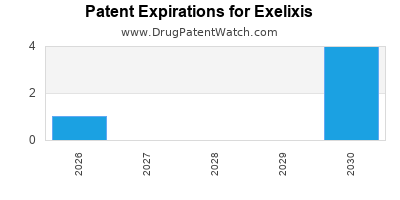
Drugs and US Patents for Exelixis
| Applicant | Tradename | Generic Name | Dosage | NDA | Approval Date | TE | Type | RLD | RS | Patent No. | Patent Expiration | Product | Substance | Delist Req. | Exclusivity Expiration |
|---|---|---|---|---|---|---|---|---|---|---|---|---|---|---|---|
| Exelixis Inc | CABOMETYX | cabozantinib s-malate | TABLET;ORAL | 208692-002 | Apr 25, 2016 | RX | Yes | No | ⤷ Start Trial | ⤷ Start Trial | |||||
| Exelixis Inc | CABOMETYX | cabozantinib s-malate | TABLET;ORAL | 208692-003 | Apr 25, 2016 | RX | Yes | Yes | 11,091,440 | ⤷ Start Trial | Y | ⤷ Start Trial | |||
| Exelixis Inc | CABOMETYX | cabozantinib s-malate | TABLET;ORAL | 208692-001 | Apr 25, 2016 | RX | Yes | No | 11,098,015 | ⤷ Start Trial | ⤷ Start Trial | ||||
| Exelixis Inc | CABOMETYX | cabozantinib s-malate | TABLET;ORAL | 208692-002 | Apr 25, 2016 | RX | Yes | No | 11,091,440 | ⤷ Start Trial | Y | ⤷ Start Trial | |||
| Exelixis Inc | CABOMETYX | cabozantinib s-malate | TABLET;ORAL | 208692-002 | Apr 25, 2016 | RX | Yes | No | 9,724,342 | ⤷ Start Trial | Y | ⤷ Start Trial | |||
| Exelixis Inc | CABOMETYX | cabozantinib s-malate | TABLET;ORAL | 208692-003 | Apr 25, 2016 | RX | Yes | Yes | 11,298,349 | ⤷ Start Trial | Y | ⤷ Start Trial | |||
| Exelixis | COMETRIQ | cabozantinib s-malate | CAPSULE;ORAL | 203756-002 | Nov 29, 2012 | RX | Yes | Yes | 8,877,776 | ⤷ Start Trial | Y | Y | ⤷ Start Trial | ||
| >Applicant | >Tradename | >Generic Name | >Dosage | >NDA | >Approval Date | >TE | >Type | >RLD | >RS | >Patent No. | >Patent Expiration | >Product | >Substance | >Delist Req. | >Exclusivity Expiration |
Expired US Patents for Exelixis
| Applicant | Tradename | Generic Name | Dosage | NDA | Approval Date | Patent No. | Patent Expiration |
|---|---|---|---|---|---|---|---|
| Exelixis Inc | CABOMETYX | cabozantinib s-malate | TABLET;ORAL | 208692-003 | Apr 25, 2016 | 8,497,284 | ⤷ Start Trial |
| Exelixis | COMETRIQ | cabozantinib s-malate | CAPSULE;ORAL | 203756-001 | Nov 29, 2012 | 7,579,473 | ⤷ Start Trial |
| Exelixis Inc | CABOMETYX | cabozantinib s-malate | TABLET;ORAL | 208692-003 | Apr 25, 2016 | 7,579,473 | ⤷ Start Trial |
| Exelixis | COMETRIQ | cabozantinib s-malate | CAPSULE;ORAL | 203756-002 | Nov 29, 2012 | 7,579,473 | ⤷ Start Trial |
| Exelixis Inc | CABOMETYX | cabozantinib s-malate | TABLET;ORAL | 208692-001 | Apr 25, 2016 | 7,579,473 | ⤷ Start Trial |
| Exelixis Inc | CABOMETYX | cabozantinib s-malate | TABLET;ORAL | 208692-001 | Apr 25, 2016 | 8,497,284 | ⤷ Start Trial |
| Exelixis Inc | CABOMETYX | cabozantinib s-malate | TABLET;ORAL | 208692-002 | Apr 25, 2016 | 8,497,284 | ⤷ Start Trial |
| >Applicant | >Tradename | >Generic Name | >Dosage | >NDA | >Approval Date | >Patent No. | >Patent Expiration |
International Patents for Exelixis Drugs
| Country | Patent Number | Estimated Expiration |
|---|---|---|
| Eurasian Patent Organization | 201391145 | ⤷ Start Trial |
| Singapore | 173014 | ⤷ Start Trial |
| Japan | 5980894 | ⤷ Start Trial |
| Taiwan | 201920110 | ⤷ Start Trial |
| European Patent Office | 2409704 | ⤷ Start Trial |
| South Korea | 20250123237 | ⤷ Start Trial |
| South Africa | 201306072 | ⤷ Start Trial |
| >Country | >Patent Number | >Estimated Expiration |
Supplementary Protection Certificates for Exelixis Drugs
| Patent Number | Supplementary Protection Certificate | SPC Country | SPC Expiration | SPC Description |
|---|---|---|---|---|
| 2213661 | CR 2014 00039 | Denmark | ⤷ Start Trial | PRODUCT NAME: CABOZANTINIB, INKLUSIVE FARMACEUTISK ACCEPTABLE SALTE HERAF, HERUNDER CABOZANTINIB (S)-MALAT; REG. NO/DATE: EU/1/13/890/001-003 20140326 |
| 2213661 | C20140029 00117 | Estonia | ⤷ Start Trial | PRODUCT NAME: KABOSANTINIIB;REG NO/DATE: K(2014)2043 (LOPLIK) 26.03.2014 |
| 2213661 | 122014000091 | Germany | ⤷ Start Trial | PRODUCT NAME: CABOZANTINIB UND JEDES THERAPEUTISCHE AEQUIVALENT HIERVON WIE DURCH DAS GRUNDPATENT GESCHUETZT, EINSCHLIESSLICH PHARMAZEUTISCH ANNEHMBARER SALZE; REGISTRATION NO/DATE: EU/1/13/890/001-003 20140321 |
| 2213661 | 92508 | Luxembourg | ⤷ Start Trial | PRODUCT NAME: CABOZANTINIB ET TOUTES LES FORMES THERAPEUTIQUEMENT EQUIVALENTES QUI EN DERIVENT TELLES QUE PROTEGEES PAR LE BREVET DE BASE, Y COMPRIS LES SELS PHARMACEUTIQUEMENT ACCEPTABLES. FIRST REGISTRATION: 20140326 |
| 2213661 | C 2014 036 | Romania | ⤷ Start Trial | PRODUCT NAME: CABOZANTINIB SI ORICE FORMA ECHIVALENTA TERAPEUTIC AACESTUIA, INCLUSIV SARURILE ACCEPT DATE OF NATIONAL AUTHORISATION: 20140321; NUMBER OF FIRST AUTHORISATION IN EUROPEAN ECONOMIC AREA (EEA): EU/1/13/890/001, EU/1/13/890/002, EU/1/13/890/003; DATE OF FIRST AUTHORISATION IN EEA: 20140321 ABILE FARMACEUTIC; NATIONAL AUTHORISATION NUMBER: EU/1/13/890/001, EU/1/13/890/002, EU/1/13/890/003; |
| 2213661 | 583 | Finland | ⤷ Start Trial | |
| 2213661 | 43/2014 | Austria | ⤷ Start Trial | PRODUCT NAME: CABOZANTINIB ODER EIN PHARMAZEUTISCH AKZEPTABLES SALZ DAVON; REGISTRATION NO/DATE: EU/1/13/890/001-003 (MITTEILUNG) 20140326 |
| >Patent Number | >Supplementary Protection Certificate | >SPC Country | >SPC Expiration | >SPC Description |
Similar Applicant Names
Applicants may be listed under multiple names.
Here is a list of applicants with similar names.
Here is a list of applicants with similar names.
