COMETRIQ Drug Patent Profile
✉ Email this page to a colleague
Which patents cover Cometriq, and when can generic versions of Cometriq launch?
Cometriq is a drug marketed by Exelixis and is included in one NDA. There are eight patents protecting this drug.
The generic ingredient in COMETRIQ is cabozantinib s-malate. There is one drug master file entry for this compound. One supplier is listed for this compound. Additional details are available on the cabozantinib s-malate profile page.
DrugPatentWatch® Generic Entry Outlook for Cometriq
Cometriq was eligible for patent challenges on November 29, 2016.
By analyzing the patents and regulatory protections it appears that the earliest date
for generic entry will be January 15, 2030. This may change due to patent challenges or generic licensing.
There have been eighteen patent litigation cases involving the patents protecting this drug, indicating strong interest in generic launch. Recent data indicate that 63% of patent challenges are decided in favor of the generic patent challenger and that 54% of successful patent challengers promptly launch generic drugs.
Indicators of Generic Entry
AI Deep Research
Questions you can ask:
- What is the 5 year forecast for COMETRIQ?
- What are the global sales for COMETRIQ?
- What is Average Wholesale Price for COMETRIQ?
Summary for COMETRIQ
| US Patents: | 8 |
| Applicants: | 1 |
| NDAs: | 1 |
| Finished Product Suppliers / Packagers: | 1 |
| Raw Ingredient (Bulk) Api Vendors: | 79 |
| Clinical Trials: | 55 |
| Drug Prices: | Drug price information for COMETRIQ |
| Patent Litigation and PTAB cases: | See patent lawsuits and PTAB cases for COMETRIQ |
| What excipients (inactive ingredients) are in COMETRIQ? | COMETRIQ excipients list |
| DailyMed Link: | COMETRIQ at DailyMed |
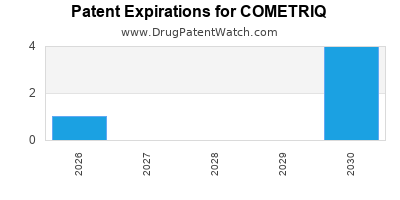

DrugPatentWatch® Estimated Loss of Exclusivity (LOE) Date for COMETRIQ
Generic Entry Date for COMETRIQ*:
Constraining patent/regulatory exclusivity:
NDA:
Dosage:
CAPSULE;ORAL |
*The generic entry opportunity date is the latter of the last compound-claiming patent and the last regulatory exclusivity protection. Many factors can influence early or later generic entry. This date is provided as a rough estimate of generic entry potential and should not be used as an independent source.
Recent Clinical Trials for COMETRIQ
Identify potential brand extensions & 505(b)(2) entrants
| Sponsor | Phase |
|---|---|
| Children's Oncology Group | Phase 2/Phase 3 |
| National Cancer Institute (NCI) | Phase 2/Phase 3 |
| OHSU Knight Cancer Institute | Phase 2 |
Pharmacology for COMETRIQ
| Drug Class | Kinase Inhibitor |
| Mechanism of Action | Protein Kinase Inhibitors |
US Patents and Regulatory Information for COMETRIQ
COMETRIQ is protected by eight US patents.
Based on analysis by DrugPatentWatch, the earliest date for a generic version of COMETRIQ is ⤷ Start Trial.
This potential generic entry date is based on patent ⤷ Start Trial.
Generics may enter earlier, or later, based on new patent filings, patent extensions, patent invalidation, early generic licensing, generic entry preferences, and other factors.
| Applicant | Tradename | Generic Name | Dosage | NDA | Approval Date | TE | Type | RLD | RS | Patent No. | Patent Expiration | Product | Substance | Delist Req. | Exclusivity Expiration |
|---|---|---|---|---|---|---|---|---|---|---|---|---|---|---|---|
| Exelixis | COMETRIQ | cabozantinib s-malate | CAPSULE;ORAL | 203756-001 | Nov 29, 2012 | RX | Yes | No | ⤷ Start Trial | ⤷ Start Trial | Y | Y | ⤷ Start Trial | ||
| Exelixis | COMETRIQ | cabozantinib s-malate | CAPSULE;ORAL | 203756-001 | Nov 29, 2012 | RX | Yes | No | ⤷ Start Trial | ⤷ Start Trial | Y | Y | ⤷ Start Trial | ||
| Exelixis | COMETRIQ | cabozantinib s-malate | CAPSULE;ORAL | 203756-001 | Nov 29, 2012 | RX | Yes | No | ⤷ Start Trial | ⤷ Start Trial | Y | ⤷ Start Trial | |||
| Exelixis | COMETRIQ | cabozantinib s-malate | CAPSULE;ORAL | 203756-002 | Nov 29, 2012 | RX | Yes | Yes | ⤷ Start Trial | ⤷ Start Trial | Y | ⤷ Start Trial | |||
| >Applicant | >Tradename | >Generic Name | >Dosage | >NDA | >Approval Date | >TE | >Type | >RLD | >RS | >Patent No. | >Patent Expiration | >Product | >Substance | >Delist Req. | >Exclusivity Expiration |
Expired US Patents for COMETRIQ
| Applicant | Tradename | Generic Name | Dosage | NDA | Approval Date | Patent No. | Patent Expiration |
|---|---|---|---|---|---|---|---|
| Exelixis | COMETRIQ | cabozantinib s-malate | CAPSULE;ORAL | 203756-001 | Nov 29, 2012 | ⤷ Start Trial | ⤷ Start Trial |
| Exelixis | COMETRIQ | cabozantinib s-malate | CAPSULE;ORAL | 203756-002 | Nov 29, 2012 | ⤷ Start Trial | ⤷ Start Trial |
| >Applicant | >Tradename | >Generic Name | >Dosage | >NDA | >Approval Date | >Patent No. | >Patent Expiration |
International Patents for COMETRIQ
When does loss-of-exclusivity occur for COMETRIQ?
Based on analysis by DrugPatentWatch, the following patents block generic entry in the countries listed below:
Argentina
Patent: 5025
Estimated Expiration: ⤷ Start Trial
Australia
Patent: 10204619
Estimated Expiration: ⤷ Start Trial
Patent: 13203780
Estimated Expiration: ⤷ Start Trial
Patent: 16262732
Estimated Expiration: ⤷ Start Trial
Brazil
Patent: 1006812
Estimated Expiration: ⤷ Start Trial
Canada
Patent: 58030
Estimated Expiration: ⤷ Start Trial
Patent: 95880
Estimated Expiration: ⤷ Start Trial
China
Patent: 2388024
Estimated Expiration: ⤷ Start Trial
Patent: 6083714
Estimated Expiration: ⤷ Start Trial
Patent: 0818633
Estimated Expiration: ⤷ Start Trial
Croatia
Patent: 0130458
Estimated Expiration: ⤷ Start Trial
Cyprus
Patent: 14007
Estimated Expiration: ⤷ Start Trial
Denmark
Patent: 87563
Estimated Expiration: ⤷ Start Trial
Eurasian Patent Organization
Patent: 9959
Estimated Expiration: ⤷ Start Trial
Patent: 6425
Estimated Expiration: ⤷ Start Trial
Patent: 8195
Estimated Expiration: ⤷ Start Trial
Patent: 1170941
Estimated Expiration: ⤷ Start Trial
Patent: 1400110
Estimated Expiration: ⤷ Start Trial
Patent: 1692224
Estimated Expiration: ⤷ Start Trial
European Patent Office
Patent: 87563
Estimated Expiration: ⤷ Start Trial
Hong Kong
Patent: 64305
Estimated Expiration: ⤷ Start Trial
Israel
Patent: 4086
Estimated Expiration: ⤷ Start Trial
Patent: 4097
Estimated Expiration: ⤷ Start Trial
Japan
Patent: 77318
Estimated Expiration: ⤷ Start Trial
Patent: 80894
Estimated Expiration: ⤷ Start Trial
Patent: 42456
Estimated Expiration: ⤷ Start Trial
Patent: 42429
Estimated Expiration: ⤷ Start Trial
Patent: 31372
Estimated Expiration: ⤷ Start Trial
Patent: 12515220
Estimated Expiration: ⤷ Start Trial
Patent: 15096543
Estimated Expiration: ⤷ Start Trial
Patent: 17014232
Estimated Expiration: ⤷ Start Trial
Patent: 18154633
Estimated Expiration: ⤷ Start Trial
Patent: 19194205
Estimated Expiration: ⤷ Start Trial
Patent: 21191756
Estimated Expiration: ⤷ Start Trial
Mexico
Patent: 0898
Patent: SAL DE MALATO DE N(4-{[6,7-BIS(METILOXI) QUINOLIN-4-IL]OXI}FENIL)- N'-(4-FLUOROFENIL)CICLOPROPANO-1,1-DICARBOXAMIDA, Y SUS FORMAS CRISTALINAS PARA EL TRATAMIENTO DE CANCER. (MALATE SALT OF N- (4- { [ 6, 7-BIS (METHYLOXY) QUIN0LIN-4-YL] OXY}PHENYL)-N' - (4 -FLUOROPHENYL) CYCLOPROPANE-1,1-DICARBOXAMID E, AND CRYSTALLINE FORMS THEROF FOR THE TREATMENT OF CANCER.)
Estimated Expiration: ⤷ Start Trial
Patent: 11007620
Patent: SAL DE MALATO DE N(4-{[6,7-BIS(METILOXI)QUINOLIN-4-IL]OXI}FENIL)-N '-(4-FLUOROFENIL) CICLOPROPANO-1,1-DICARBOXAMIDA, Y SUS FORMAS CRISTALINAS PARA EL TRATAMIENTO DE CANCER. (MALATE SALT OF N- (4- { [ 6, 7-BIS (METHYLOXY) QUIN0LIN-4-YL] OXY}PHENYL)-N' - (4 -FLUOROPHENYL) CYCLOPROPANE-1,1-DICARBOXAMID E, AND CRYSTALLINE FORMS THEROF FOR THE TREATMENT OF CANCER.)
Estimated Expiration: ⤷ Start Trial
Patent: 22014444
Patent: SAL DE MALATO DE N-(4-{[6,7-BIS(METILOXI) QUINOLIN-4-IL] OXI}FENIL)-N'-(4-FLUOROFENIL) CICLOPROPANO-1,1-DICARBOXAMIDA, Y SUS FORMAS CRISTALINAS PARA EL TRATAMIENTO DE CANCER. (MALATE SALT OF N- (4- { [ 6, 7-BIS (METHYLOXY) QUIN0LIN-4-YL] OXY}PHENYL)-N' - (4 -FLUOROPHENYL) CYCLOPROPANE-1,1-DICARBOXAMID E, AND CRYSTALLINE FORMS THEROF FOR THE TREATMENT OF CANCER.)
Estimated Expiration: ⤷ Start Trial
New Zealand
Patent: 4594
Patent: MALATE SALT OF N-(4-{ [6,7-BIS(METHYLOXY)QUINOLIN-4-YL]OXY} PHENYL)-N'-(4-FLUOROPHENYL)CYCLOPROPANE-1,1-DICARBOXAMIDE, AND CRYSTALLINE FORMS THEREOF FOR THE TREATMENT OF CANCER
Estimated Expiration: ⤷ Start Trial
Patent: 8004
Patent: Malate salt of n-(4-{ [6,7-bis(methyloxy)quinolin-4-yl]oxy} phenyl)-n’-(4-fluorophenyl)cyclopropane-1,1-dicarboxamide, and crystalline forms thereof for the treatment of cancer
Estimated Expiration: ⤷ Start Trial
Patent: 1931
Patent: Malate salt of n-(4-{ [6,7-bis(methyloxy)quinolin-4-yl] oxy} phenyl)-n’-(4-fluorophenyl)cyclopropane-1,1-dicarboxamide, and crystalline forms thereof for the treatment of cancer
Estimated Expiration: ⤷ Start Trial
Patent: 9754
Patent: Malate salt of n-(4-{ [6,7-bis(methyloxy)quinolin-4-yl] oxy} phenyl)-n’-(4-fluorophenyl)cyclopropane-1,1-dicarboxamide, and crystalline forms thereof for the treatment of cancer
Estimated Expiration: ⤷ Start Trial
Poland
Patent: 87563
Estimated Expiration: ⤷ Start Trial
Portugal
Patent: 87563
Estimated Expiration: ⤷ Start Trial
San Marino
Patent: 01300050
Patent: Sale di malato di n-(4-{[6,7-bis(metilossi)chinolin-4-il]ossi}fenil-n'-(4-fluorofenil) ciclopropan-1,1-dicarbossammide, e sue forme cristalline per iltrattamento del cancro
Estimated Expiration: ⤷ Start Trial
Serbia
Patent: 754
Patent: MALAT SO N-(4- {[6,7-BIS(METILOKSI)HINOLIN-4-IL]OKSI}FENIL-N'- (4-FLUOROFENIL) CIKLOPROPAN-1,1-DIKARBOKSAMID-a, I NJENI KRISTALNI OBLICI ZA LEČENJE KARCINOMA (MALATE SALT OF N- (4-{ [6,7-BIS (METHYLOXY)QUINOLIN-4-YL]OXY}PHENYL-N'- (4-FLUOROPHENYL) CYCLOPROPANE-1,1-DICARBOXAMIDE, AND CRYSTALLINE FORMS THEREOF FOR THE TREATMENT OF CANCER)
Estimated Expiration: ⤷ Start Trial
Singapore
Patent: 3014
Patent: MALATE SALT OF N- (4- { [ 6, 7-BIS (METHYLOXY) QUIN0LIN-4-YL] OXY}PHENYL)-N' - (4 -FLUOROPHENYL) CYCLOPROPANE-1,1-DICARBOXAMIDE, AND CRYSTALLINE FORMS THEROF FOR THE TREATMENT OF CANCER
Estimated Expiration: ⤷ Start Trial
Slovenia
Patent: 87563
Estimated Expiration: ⤷ Start Trial
South Africa
Patent: 1105167
Patent: MALATE SALT OF N-(4-{[6,7-BIS(METHYLOXY)QUINOLIN-4-YL]OXY}PHENYL)-N'-(4-FLUOROPHENYL)CYCLOPROPANE-1,1-DICARBOXAMIDE,AND CRYSTALLINE FORMS THEREOF FOR THE TREATMENT OF CANCER
Estimated Expiration: ⤷ Start Trial
South Korea
Patent: 1733773
Estimated Expiration: ⤷ Start Trial
Patent: 2088588
Estimated Expiration: ⤷ Start Trial
Patent: 2187034
Estimated Expiration: ⤷ Start Trial
Patent: 120013301
Patent: N-(4-{〔6,7-비스(메틸옥시)퀴놀린-4-일〕옥시}페닐)-N'-(4-플루오로페닐)사이클로프로판-1,1-디카르복사미드의 말산염 및 그 결정형 (----4-----11- MALATE SALT OF N-4-[67-BISMETHYLOXYQUINOLIN-4-YL]OXYPHENYL-N'-4-FLUOROPHENYLCYCLOPROPANE-11-DICARBOXAMIDE AND CRYSTALLINE FORMS THEREOF FOR THE TREATMENT OF CANCER)
Estimated Expiration: ⤷ Start Trial
Patent: 170052702
Patent: N-(4-{〔6,7-비스(메틸옥시)퀴놀린-4-일〕옥시}페닐)-N'-(4-플루오로페닐)사이클로프로판-1,1-디카르복사미드의 말산염 및 그 결정형 (----4-----11- MALATE SALT OF N-4-[67-BISMETHYLOXYQUINOLIN-4-YL]OXYPHENYL-N'-4-FLUOROPHENYLCYCLOPROPANE-11-DICARBOXAMIDE AND CRYSTALLINE FORMS THEREOF FOR THE TREATMENT OF CANCER)
Estimated Expiration: ⤷ Start Trial
Patent: 180105259
Patent: N-(4-{〔6,7-비스(메틸옥시)퀴놀린-4-일〕옥시}페닐)-N'-(4-플루오로페닐)사이클로프로판-1,1-디카르복사미드의 말산염 및 그 결정형 (----4-----11- MALATE SALT OF N-4-[67-BISMETHYLOXYQUINOLIN-4-YL]OXYPHENYL-N'-4-FLUOROPHENYLCYCLOPROPANE-11-DICARBOXAMIDE AND CRYSTALLINE FORMS THEREOF FOR THE TREATMENT OF CANCER)
Estimated Expiration: ⤷ Start Trial
Patent: 200027580
Patent: N-(4-{〔6,7-비스(메틸옥시)퀴놀린-4-일〕옥시}페닐)-N'-(4-플루오로페닐)사이클로프로판-1,1-디카르복사미드의 말산염 및 그 결정형 (----4-----11- MALATE SALT OF N-4-[67-BISMETHYLOXYQUINOLIN-4-YL]OXYPHENYL-N'-4-FLUOROPHENYLCYCLOPROPANE-11-DICARBOXAMIDE AND CRYSTALLINE FORMS THEREOF FOR THE TREATMENT OF CANCER)
Estimated Expiration: ⤷ Start Trial
Patent: 200137052
Patent: 암의 치료를 위한 N-(4-{〔6,7-비스(메틸옥시)퀴놀린-4-일〕옥시}페닐)-N'-(4-플루오로페닐)사이클로프로판-1,1-디카르복사미드의 말산염 및 그 결정형 (----4-----11- MALATE SALT OF N-4-[67-BISMETHYLOXYQUINOLIN-4-YL]OXYPHENYL-N'-4-FLUOROPHENYLCYCLOPROPANE-11-DICARBOXAMIDE AND CRYSTALLINE FORMS THEREOF FOR THE TREATMENT OF CANCER)
Estimated Expiration: ⤷ Start Trial
Patent: 210151988
Patent: 암의 치료를 위한 N-(4-{〔6,7-비스(메틸옥시)퀴놀린-4-일〕옥시}페닐)-N'-(4-플루오로페닐)사이클로프로판-1,1-디카르복사미드의 말산염 및 그 결정형 (----4-----11- MALATE SALT OF N-4-[67-BISMETHYLOXYQUINOLIN-4-YL]OXYPHENYL-N'-4-FLUOROPHENYLCYCLOPROPANE-11-DICARBOXAMIDE AND CRYSTALLINE FORMS THEREOF FOR THE TREATMENT OF CANCER)
Estimated Expiration: ⤷ Start Trial
Patent: 230008268
Patent: 암의 치료를 위한 N-(4-{〔6,7-비스(메틸옥시)퀴놀린-4-일〕옥시}페닐)-N'-(4-플루오로페닐)사이클로프로판-1,1-디카르복사미드의 말산염 및 그 결정형 (----4-----11- MALATE SALT OF N-4-[67-BISMETHYLOXYQUINOLIN-4-YL]OXYPHENYL-N'-4-FLUOROPHENYLCYCLOPROPANE-11-DICARBOXAMIDE AND CRYSTALLINE FORMS THEREOF FOR THE TREATMENT OF CANCER)
Estimated Expiration: ⤷ Start Trial
Patent: 240011244
Patent: 암의 치료를 위한 N-(4-{〔6,7-비스(메틸옥시)퀴놀린-4-일〕옥시}페닐)-N'-(4-플루오로페닐)사이클로프로판-1,1-디카르복사미드의 말산염 및 그 결정형 (----4-----11- MALATE SALT OF N-4-[67-BISMETHYLOXYQUINOLIN-4-YL]OXYPHENYL-N'-4-FLUOROPHENYLCYCLOPROPANE-11-DICARBOXAMIDE AND CRYSTALLINE FORMS THEREOF FOR THE TREATMENT OF CANCER)
Estimated Expiration: ⤷ Start Trial
Patent: 250123237
Patent: 암의 치료를 위한 N-(4-{〔6,7-비스(메틸옥시)퀴놀린-4-일〕옥시}페닐)-N'-(4-플루오로페닐)사이클로프로판-1,1-디카르복사미드의 말산염 및 그 결정형 (----4-----11- MALATE SALT OF N-4-[67-BISMETHYLOXYQUINOLIN-4-YL]OXYPHENYL-N'-4-FLUOROPHENYLCYCLOPROPANE-11-DICARBOXAMIDE AND CRYSTALLINE FORMS THEREOF FOR THE TREATMENT OF CANCER)
Estimated Expiration: ⤷ Start Trial
Spain
Patent: 02524
Estimated Expiration: ⤷ Start Trial
Taiwan
Patent: 1036948
Patent: Malate salts of N-(4-{[6,7-bis(methyloxy)quinolin-4-yl]oxy}phenyl)-N'-(4-fluorophenyl)cyclopropane-1,1-dicarboxamide, and crystalline forms thereof
Estimated Expiration: ⤷ Start Trial
Patent: 1437199
Patent: Method for preparing N-(4-{[6,7-bis(methyloxy)quinolin-4-yl]oxy}phenyl)-N'-(4-fluorophenyl)cyclopropane-1,1-dicarboxamide
Estimated Expiration: ⤷ Start Trial
Patent: 1546049
Patent: Method for preparing N-(4-{[6,7-bis(methyloxy)quinolin-4-yl]oxy}phenyl)-N'-(4-fluorophenyl)cyclopropane-1,1-dicarboxamide
Estimated Expiration: ⤷ Start Trial
Patent: 1726627
Patent: Method for preparing N-(4-{[6,7-bis(methyloxy)quinolin-4-yl]oxy}phenyl)-N'-(4-fluorophenyl)cyclopropane-1,1-dicarboxamide
Estimated Expiration: ⤷ Start Trial
Patent: 1920110
Patent: Pharmaceutical composition comprising malate salt of N-(4-{[6,7-bis(methyloxy)quinolin-4-yl]oxy}phenyl)-N'-(4-fluorophenyl)cyclopropane-1,1-dicarboxamide and use thereof
Estimated Expiration: ⤷ Start Trial
Patent: 2112751
Patent: Pharmaceutical composition comprising malate salt of N-(4-{[6,7-bis(methyloxy)quinolin-4-yl]oxy}phenyl)-N'-(4-fluorophenyl)cyclopropane-1,1-dicarboxamide and use thereof
Estimated Expiration: ⤷ Start Trial
Patent: 2241853
Patent: Pharmaceutical composition comprising malate salt of N-(4-{[6,7-bis(methyloxy)quinolin-4-yl]oxy}phenyl)-N'-(4-fluorophenyl)cyclopropane-1,1-dicarboxamide and use thereof
Estimated Expiration: ⤷ Start Trial
Patent: 47108
Estimated Expiration: ⤷ Start Trial
Patent: 11956
Estimated Expiration: ⤷ Start Trial
Patent: 77664
Estimated Expiration: ⤷ Start Trial
Patent: 41593
Estimated Expiration: ⤷ Start Trial
Generics may enter earlier, or later, based on new patent filings, patent extensions, patent invalidation, early generic licensing, generic entry preferences, and other factors.
See the table below for additional patents covering COMETRIQ around the world.
| Country | Patent Number | Title | Estimated Expiration |
|---|---|---|---|
| Argentina | 075025 | ⤷ Start Trial | |
| Australia | 2010204619 | ⤷ Start Trial | |
| Australia | 2013203780 | ⤷ Start Trial | |
| Australia | 2016262732 | ⤷ Start Trial | |
| >Country | >Patent Number | >Title | >Estimated Expiration |
Supplementary Protection Certificates for COMETRIQ
| Patent Number | Supplementary Protection Certificate | SPC Country | SPC Expiration | SPC Description |
|---|---|---|---|---|
| 2213661 | C300678 | Netherlands | ⤷ Start Trial | PRODUCT NAME: CABOZANTINIB EN ELKE THERAPEUTISCH EQUIVALENTE VORM DAARVAN ZOALS BESCHERMD DOOR HET BASISOCTROOI, WAARONDER FARMACEUTISCH AANVAARDBARE ZOUTEN; REGISTRATION NO/DATE: EU/1/13/890/001-003 20140326 |
| 2213661 | CA 2014 00039 | Denmark | ⤷ Start Trial | PRODUCT NAME: CABOZANTINIB, INKLUSIVE FARMACEUTISK ACCEPTABLE SALTE HERAF, HERUNDER CABOZANTINIB (S)-MALAT; REG. NO/DATE: EU/1/13/890/001-003 20140321 |
| 2213661 | PA2014033 | Lithuania | ⤷ Start Trial | PRODUCT NAME: CABOZANTINIBUM; REGISTRATION NO/DATE: EU/1/13/890/001 - EU/1/13/890/003 20140321 |
| 2213661 | C20140029 00117 | Estonia | ⤷ Start Trial | PRODUCT NAME: KABOSANTINIIB;REG NO/DATE: K(2014)2043 (LOPLIK) 26.03.2014 |
| >Patent Number | >Supplementary Protection Certificate | >SPC Country | >SPC Expiration | >SPC Description |
COMETRIQ Market Dynamics, Patent Estate, Exclusivity and Financial Trajectory
More… ↓
Make Better Decisions: Try a trial or see plans & pricing
Drugs may be covered by multiple patents or regulatory protections. All trademarks and applicant names are the property of their respective owners or licensors. Although great care is taken in the proper and correct provision of this service, thinkBiotech LLC does not accept any responsibility for possible consequences of errors or omissions in the provided data. The data presented herein is for information purposes only. There is no warranty that the data contained herein is error free. We do not provide individual investment advice. This service is not registered with any financial regulatory agency. The information we publish is educational only and based on our opinions plus our models. By using DrugPatentWatch you acknowledge that we do not provide personalized recommendations or advice. thinkBiotech performs no independent verification of facts as provided by public sources nor are attempts made to provide legal or investing advice. Any reliance on data provided herein is done solely at the discretion of the user. Users of this service are advised to seek professional advice and independent confirmation before considering acting on any of the provided information. thinkBiotech LLC reserves the right to amend, extend or withdraw any part or all of the offered service without notice.
ISSN: 2162-2639

Privacy and Cookies
Terms & Conditions
Site Map
DrugPatentWatch Alternatives
LOE / Major Patent Expirations 2026 - 2027
NCE-1 Patent Challenge Dates 2026 - 2027
Friedman, Yali. "DrugPatentWatch" DrugPatentWatch, thinkBiotech, 2026, www.DrugPatentWatch.com.
See Primary Research Papers Citing DrugPatentWatch