Last Updated: November 9, 2026

CABOMETYX Drug Patent Profile

« Back to Dashboard


Which patents cover Cabometyx, and what generic alternatives are available?

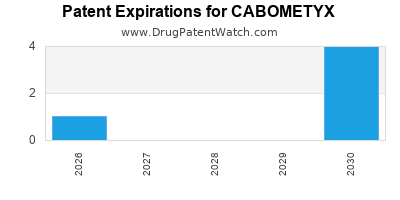
Cabometyx is a drug marketed by Exelixis Inc and is included in one NDA. There are ten patents protecting this drug and one Paragraph IV challenge.

The generic ingredient in CABOMETYX is cabozantinib s-malate. There is one drug master file entry for this compound. One supplier is listed for this compound. Additional details are available on the cabozantinib s-malate profile page.

DrugPatentWatch® Litigation and Generic Entry Outlook for Cabometyx

A generic version of CABOMETYX was approved as cabozantinib s-malate by MSN on August 14th, 2026.

  Start Trial

AI Deep Research
Questions you can ask:
  • What is the 5 year forecast for CABOMETYX?
  • What are the global sales for CABOMETYX?
  • What is Average Wholesale Price for CABOMETYX?
Recent Clinical Trials for CABOMETYX

Identify potential brand extensions & 505(b)(2) entrants

SponsorPhase
Jun Zhang, MD, PhDPhase 2
Mirati Therapeutics Inc.Phase 1
Kura Oncology, Inc.Phase 1

See all CABOMETYX clinical trials

Pharmacology for CABOMETYX
Drug ClassKinase Inhibitor
Mechanism of ActionProtein Kinase Inhibitors
Paragraph IV (Patent) Challenges for CABOMETYX
Tradename Dosage Ingredient Strength NDA ANDAs Submitted Submissiondate
CABOMETYX Tablets cabozantinib s-malate 20 mg, 40 mg and 60 mg 208692 1 2019-08-16

US Patents and Regulatory Information for CABOMETYX

CABOMETYX is protected by twenty US patents and three FDA Regulatory Exclusivities.

Applicant Tradename Generic Name Dosage NDA Approval Date TE Type RLD RS Patent No. Patent Expiration Product Substance Delist Req. Exclusivity Expiration
Exelixis Inc CABOMETYX cabozantinib s-malate TABLET;ORAL 208692-002 Apr 25, 2016 AB RX Yes No 11,091,440 ⤷  Start Trial Y ⤷  Start Trial
Exelixis Inc CABOMETYX cabozantinib s-malate TABLET;ORAL 208692-003 Apr 25, 2016 AB RX Yes Yes 12,128,039 ⤷  Start Trial Y ⤷  Start Trial
Exelixis Inc CABOMETYX cabozantinib s-malate TABLET;ORAL 208692-003 Apr 25, 2016 AB RX Yes Yes 8,877,776 ⤷  Start Trial Y Y ⤷  Start Trial
Exelixis Inc CABOMETYX cabozantinib s-malate TABLET;ORAL 208692-002 Apr 25, 2016 AB RX Yes No ⤷  Start Trial ⤷  Start Trial ⤷  Start Trial
Exelixis Inc CABOMETYX cabozantinib s-malate TABLET;ORAL 208692-003 Apr 25, 2016 AB RX Yes Yes 11,098,015 ⤷  Start Trial ⤷  Start Trial
Exelixis Inc CABOMETYX cabozantinib s-malate TABLET;ORAL 208692-002 Apr 25, 2016 AB RX Yes No 10,039,757 ⤷  Start Trial ⤷  Start Trial
Exelixis Inc CABOMETYX cabozantinib s-malate TABLET;ORAL 208692-001 Apr 25, 2016 AB RX Yes No 10,039,757 ⤷  Start Trial ⤷  Start Trial
>Applicant >Tradename >Generic Name >Dosage >NDA >Approval Date >TE >Type >RLD >RS >Patent No. >Patent Expiration >Product >Substance >Delist Req. >Exclusivity Expiration

Expired US Patents for CABOMETYX

Applicant Tradename Generic Name Dosage NDA Approval Date Patent No. Patent Expiration
Exelixis Inc CABOMETYX cabozantinib s-malate TABLET;ORAL 208692-003 Apr 25, 2016 7,579,473 ⤷  Start Trial
Exelixis Inc CABOMETYX cabozantinib s-malate TABLET;ORAL 208692-003 Apr 25, 2016 8,497,284 ⤷  Start Trial
Exelixis Inc CABOMETYX cabozantinib s-malate TABLET;ORAL 208692-002 Apr 25, 2016 8,497,284 ⤷  Start Trial
Exelixis Inc CABOMETYX cabozantinib s-malate TABLET;ORAL 208692-002 Apr 25, 2016 7,579,473 ⤷  Start Trial
Exelixis Inc CABOMETYX cabozantinib s-malate TABLET;ORAL 208692-001 Apr 25, 2016 7,579,473 ⤷  Start Trial
Exelixis Inc CABOMETYX cabozantinib s-malate TABLET;ORAL 208692-001 Apr 25, 2016 8,497,284 ⤷  Start Trial
>Applicant >Tradename >Generic Name >Dosage >NDA >Approval Date >Patent No. >Patent Expiration

International Patents for CABOMETYX

When does loss-of-exclusivity occur for CABOMETYX?

Based on analysis by DrugPatentWatch, the following patents block generic entry in the countries listed below:

Argentina

Patent: 5025
Estimated Expiration: ⤷  Start Trial

Australia

Patent: 10204619
Estimated Expiration: ⤷  Start Trial

Patent: 13203780
Estimated Expiration: ⤷  Start Trial

Patent: 16262732
Estimated Expiration: ⤷  Start Trial

Brazil

Patent: 1006812
Estimated Expiration: ⤷  Start Trial

Canada

Patent: 58030
Estimated Expiration: ⤷  Start Trial

Patent: 95880
Estimated Expiration: ⤷  Start Trial

China

Patent: 2388024
Estimated Expiration: ⤷  Start Trial

Patent: 6083714
Estimated Expiration: ⤷  Start Trial

Patent: 0818633
Estimated Expiration: ⤷  Start Trial

Croatia

Patent: 0130458
Estimated Expiration: ⤷  Start Trial

Cyprus

Patent: 14007
Estimated Expiration: ⤷  Start Trial

Denmark

Patent: 87563
Estimated Expiration: ⤷  Start Trial

Eurasian Patent Organization

Patent: 9959
Estimated Expiration: ⤷  Start Trial

Patent: 6425
Estimated Expiration: ⤷  Start Trial

Patent: 8195
Estimated Expiration: ⤷  Start Trial

Patent: 1170941
Estimated Expiration: ⤷  Start Trial

Patent: 1400110
Estimated Expiration: ⤷  Start Trial

Patent: 1692224
Estimated Expiration: ⤷  Start Trial

European Patent Office

Patent: 87563
Estimated Expiration: ⤷  Start Trial

Hong Kong

Patent: 64305
Estimated Expiration: ⤷  Start Trial

Israel

Patent: 4086
Estimated Expiration: ⤷  Start Trial

Patent: 4097
Estimated Expiration: ⤷  Start Trial

Japan

Patent: 77318
Estimated Expiration: ⤷  Start Trial

Patent: 80894
Estimated Expiration: ⤷  Start Trial

Patent: 42456
Estimated Expiration: ⤷  Start Trial

Patent: 42429
Estimated Expiration: ⤷  Start Trial

Patent: 31372
Estimated Expiration: ⤷  Start Trial

Patent: 12515220
Estimated Expiration: ⤷  Start Trial

Patent: 15096543
Estimated Expiration: ⤷  Start Trial

Patent: 17014232
Estimated Expiration: ⤷  Start Trial

Patent: 18154633
Estimated Expiration: ⤷  Start Trial

Patent: 19194205
Estimated Expiration: ⤷  Start Trial

Patent: 21191756
Estimated Expiration: ⤷  Start Trial

Mexico

Patent: 0898
Patent: SAL DE MALATO DE N(4-{[6,7-BIS(METILOXI) QUINOLIN-4-IL]OXI}FENIL)- N'-(4-FLUOROFENIL)CICLOPROPANO-1,1-DICARBOXAMIDA, Y SUS FORMAS CRISTALINAS PARA EL TRATAMIENTO DE CANCER. (MALATE SALT OF N- (4- { [ 6, 7-BIS (METHYLOXY) QUIN0LIN-4-YL] OXY}PHENYL)-N' - (4 -FLUOROPHENYL) CYCLOPROPANE-1,1-DICARBOXAMID E, AND CRYSTALLINE FORMS THEROF FOR THE TREATMENT OF CANCER.)
Estimated Expiration: ⤷  Start Trial

Patent: 11007620
Patent: SAL DE MALATO DE N(4-{[6,7-BIS(METILOXI)QUINOLIN-4-IL]OXI}FENIL)-N '-(4-FLUOROFENIL) CICLOPROPANO-1,1-DICARBOXAMIDA, Y SUS FORMAS CRISTALINAS PARA EL TRATAMIENTO DE CANCER. (MALATE SALT OF N- (4- { [ 6, 7-BIS (METHYLOXY) QUIN0LIN-4-YL] OXY}PHENYL)-N' - (4 -FLUOROPHENYL) CYCLOPROPANE-1,1-DICARBOXAMID E, AND CRYSTALLINE FORMS THEROF FOR THE TREATMENT OF CANCER.)
Estimated Expiration: ⤷  Start Trial

Patent: 22014444
Patent: SAL DE MALATO DE N-(4-{[6,7-BIS(METILOXI) QUINOLIN-4-IL] OXI}FENIL)-N'-(4-FLUOROFENIL) CICLOPROPANO-1,1-DICARBOXAMIDA, Y SUS FORMAS CRISTALINAS PARA EL TRATAMIENTO DE CANCER. (MALATE SALT OF N- (4- { [ 6, 7-BIS (METHYLOXY) QUIN0LIN-4-YL] OXY}PHENYL)-N' - (4 -FLUOROPHENYL) CYCLOPROPANE-1,1-DICARBOXAMID E, AND CRYSTALLINE FORMS THEROF FOR THE TREATMENT OF CANCER.)
Estimated Expiration: ⤷  Start Trial

New Zealand

Patent: 4594
Patent: MALATE SALT OF N-(4-{ [6,7-BIS(METHYLOXY)QUINOLIN-4-YL]OXY} PHENYL)-N'-(4-FLUOROPHENYL)CYCLOPROPANE-1,1-DICARBOXAMIDE, AND CRYSTALLINE FORMS THEREOF FOR THE TREATMENT OF CANCER
Estimated Expiration: ⤷  Start Trial

Patent: 8004
Patent: Malate salt of n-(4-{ [6,7-bis(methyloxy)quinolin-4-yl]oxy} phenyl)-n’-(4-fluorophenyl)cyclopropane-1,1-dicarboxamide, and crystalline forms thereof for the treatment of cancer
Estimated Expiration: ⤷  Start Trial

Patent: 1931
Patent: Malate salt of n-(4-{ [6,7-bis(methyloxy)quinolin-4-yl] oxy} phenyl)-n’-(4-fluorophenyl)cyclopropane-1,1-dicarboxamide, and crystalline forms thereof for the treatment of cancer
Estimated Expiration: ⤷  Start Trial

Patent: 9754
Patent: Malate salt of n-(4-{ [6,7-bis(methyloxy)quinolin-4-yl] oxy} phenyl)-n’-(4-fluorophenyl)cyclopropane-1,1-dicarboxamide, and crystalline forms thereof for the treatment of cancer
Estimated Expiration: ⤷  Start Trial

Poland

Patent: 87563
Estimated Expiration: ⤷  Start Trial

Portugal

Patent: 87563
Estimated Expiration: ⤷  Start Trial

San Marino

Patent: 01300050
Patent: Sale di malato di n-(4-{[6,7-bis(metilossi)chinolin-4-il]ossi}fenil-n'-(4-fluorofenil) ciclopropan-1,1-dicarbossammide, e sue forme cristalline per iltrattamento del cancro
Estimated Expiration: ⤷  Start Trial

Serbia

Patent: 754
Patent: MALAT SO N-(4- {[6,7-BIS(METILOKSI)HINOLIN-4-IL]OKSI}FENIL-N'- (4-FLUOROFENIL) CIKLOPROPAN-1,1-DIKARBOKSAMID-a, I NJENI KRISTALNI OBLICI ZA LEČENJE KARCINOMA (MALATE SALT OF N- (4-{ [6,7-BIS (METHYLOXY)QUINOLIN-4-YL]OXY}PHENYL-N'- (4-FLUOROPHENYL) CYCLOPROPANE-1,1-DICARBOXAMIDE, AND CRYSTALLINE FORMS THEREOF FOR THE TREATMENT OF CANCER)
Estimated Expiration: ⤷  Start Trial

Singapore

Patent: 3014
Patent: MALATE SALT OF N- (4- { [ 6, 7-BIS (METHYLOXY) QUIN0LIN-4-YL] OXY}PHENYL)-N' - (4 -FLUOROPHENYL) CYCLOPROPANE-1,1-DICARBOXAMIDE, AND CRYSTALLINE FORMS THEROF FOR THE TREATMENT OF CANCER
Estimated Expiration: ⤷  Start Trial

Slovenia

Patent: 87563
Estimated Expiration: ⤷  Start Trial

South Africa

Patent: 1105167
Patent: MALATE SALT OF N-(4-{[6,7-BIS(METHYLOXY)QUINOLIN-4-YL]OXY}PHENYL)-N'-(4-FLUOROPHENYL)CYCLOPROPANE-1,1-DICARBOXAMIDE,AND CRYSTALLINE FORMS THEREOF FOR THE TREATMENT OF CANCER
Estimated Expiration: ⤷  Start Trial

South Korea

Patent: 1733773
Estimated Expiration: ⤷  Start Trial

Patent: 2088588
Estimated Expiration: ⤷  Start Trial

Patent: 2187034
Estimated Expiration: ⤷  Start Trial

Patent: 120013301
Patent: N-(4-{〔6,7-비스(메틸옥시)퀴놀린-4-일〕옥시}페닐)-N'-(4-플루오로페닐)사이클로프로판-1,1-디카르복사미드의 말산염 및 그 결정형 (----4-----11- MALATE SALT OF N-4-[67-BISMETHYLOXYQUINOLIN-4-YL]OXYPHENYL-N'-4-FLUOROPHENYLCYCLOPROPANE-11-DICARBOXAMIDE AND CRYSTALLINE FORMS THEREOF FOR THE TREATMENT OF CANCER)
Estimated Expiration: ⤷  Start Trial

Patent: 170052702
Patent: N-(4-{〔6,7-비스(메틸옥시)퀴놀린-4-일〕옥시}페닐)-N'-(4-플루오로페닐)사이클로프로판-1,1-디카르복사미드의 말산염 및 그 결정형 (----4-----11- MALATE SALT OF N-4-[67-BISMETHYLOXYQUINOLIN-4-YL]OXYPHENYL-N'-4-FLUOROPHENYLCYCLOPROPANE-11-DICARBOXAMIDE AND CRYSTALLINE FORMS THEREOF FOR THE TREATMENT OF CANCER)
Estimated Expiration: ⤷  Start Trial

Patent: 180105259
Patent: N-(4-{〔6,7-비스(메틸옥시)퀴놀린-4-일〕옥시}페닐)-N'-(4-플루오로페닐)사이클로프로판-1,1-디카르복사미드의 말산염 및 그 결정형 (----4-----11- MALATE SALT OF N-4-[67-BISMETHYLOXYQUINOLIN-4-YL]OXYPHENYL-N'-4-FLUOROPHENYLCYCLOPROPANE-11-DICARBOXAMIDE AND CRYSTALLINE FORMS THEREOF FOR THE TREATMENT OF CANCER)
Estimated Expiration: ⤷  Start Trial

Patent: 200027580
Patent: N-(4-{〔6,7-비스(메틸옥시)퀴놀린-4-일〕옥시}페닐)-N'-(4-플루오로페닐)사이클로프로판-1,1-디카르복사미드의 말산염 및 그 결정형 (----4-----11- MALATE SALT OF N-4-[67-BISMETHYLOXYQUINOLIN-4-YL]OXYPHENYL-N'-4-FLUOROPHENYLCYCLOPROPANE-11-DICARBOXAMIDE AND CRYSTALLINE FORMS THEREOF FOR THE TREATMENT OF CANCER)
Estimated Expiration: ⤷  Start Trial

Patent: 200137052
Patent: 암의 치료를 위한 N-(4-{〔6,7-비스(메틸옥시)퀴놀린-4-일〕옥시}페닐)-N'-(4-플루오로페닐)사이클로프로판-1,1-디카르복사미드의 말산염 및 그 결정형 (----4-----11- MALATE SALT OF N-4-[67-BISMETHYLOXYQUINOLIN-4-YL]OXYPHENYL-N'-4-FLUOROPHENYLCYCLOPROPANE-11-DICARBOXAMIDE AND CRYSTALLINE FORMS THEREOF FOR THE TREATMENT OF CANCER)
Estimated Expiration: ⤷  Start Trial

Patent: 210151988
Patent: 암의 치료를 위한 N-(4-{〔6,7-비스(메틸옥시)퀴놀린-4-일〕옥시}페닐)-N'-(4-플루오로페닐)사이클로프로판-1,1-디카르복사미드의 말산염 및 그 결정형 (----4-----11- MALATE SALT OF N-4-[67-BISMETHYLOXYQUINOLIN-4-YL]OXYPHENYL-N'-4-FLUOROPHENYLCYCLOPROPANE-11-DICARBOXAMIDE AND CRYSTALLINE FORMS THEREOF FOR THE TREATMENT OF CANCER)
Estimated Expiration: ⤷  Start Trial

Patent: 230008268
Patent: 암의 치료를 위한 N-(4-{〔6,7-비스(메틸옥시)퀴놀린-4-일〕옥시}페닐)-N'-(4-플루오로페닐)사이클로프로판-1,1-디카르복사미드의 말산염 및 그 결정형 (----4-----11- MALATE SALT OF N-4-[67-BISMETHYLOXYQUINOLIN-4-YL]OXYPHENYL-N'-4-FLUOROPHENYLCYCLOPROPANE-11-DICARBOXAMIDE AND CRYSTALLINE FORMS THEREOF FOR THE TREATMENT OF CANCER)
Estimated Expiration: ⤷  Start Trial

Patent: 240011244
Patent: 암의 치료를 위한 N-(4-{〔6,7-비스(메틸옥시)퀴놀린-4-일〕옥시}페닐)-N'-(4-플루오로페닐)사이클로프로판-1,1-디카르복사미드의 말산염 및 그 결정형 (----4-----11- MALATE SALT OF N-4-[67-BISMETHYLOXYQUINOLIN-4-YL]OXYPHENYL-N'-4-FLUOROPHENYLCYCLOPROPANE-11-DICARBOXAMIDE AND CRYSTALLINE FORMS THEREOF FOR THE TREATMENT OF CANCER)
Estimated Expiration: ⤷  Start Trial

Patent: 250123237
Patent: 암의 치료를 위한 N-(4-{〔6,7-비스(메틸옥시)퀴놀린-4-일〕옥시}페닐)-N'-(4-플루오로페닐)사이클로프로판-1,1-디카르복사미드의 말산염 및 그 결정형 (----4-----11- MALATE SALT OF N-4-[67-BISMETHYLOXYQUINOLIN-4-YL]OXYPHENYL-N'-4-FLUOROPHENYLCYCLOPROPANE-11-DICARBOXAMIDE AND CRYSTALLINE FORMS THEREOF FOR THE TREATMENT OF CANCER)
Estimated Expiration: ⤷  Start Trial

Spain

Patent: 02524
Estimated Expiration: ⤷  Start Trial

Taiwan

Patent: 1036948
Patent: Malate salts of N-(4-{[6,7-bis(methyloxy)quinolin-4-yl]oxy}phenyl)-N'-(4-fluorophenyl)cyclopropane-1,1-dicarboxamide, and crystalline forms thereof
Estimated Expiration: ⤷  Start Trial

Patent: 1437199
Patent: Method for preparing N-(4-{[6,7-bis(methyloxy)quinolin-4-yl]oxy}phenyl)-N'-(4-fluorophenyl)cyclopropane-1,1-dicarboxamide
Estimated Expiration: ⤷  Start Trial

Patent: 1546049
Patent: Method for preparing N-(4-{[6,7-bis(methyloxy)quinolin-4-yl]oxy}phenyl)-N'-(4-fluorophenyl)cyclopropane-1,1-dicarboxamide
Estimated Expiration: ⤷  Start Trial

Patent: 1726627
Patent: Method for preparing N-(4-{[6,7-bis(methyloxy)quinolin-4-yl]oxy}phenyl)-N'-(4-fluorophenyl)cyclopropane-1,1-dicarboxamide
Estimated Expiration: ⤷  Start Trial

Patent: 1920110
Patent: Pharmaceutical composition comprising malate salt of N-(4-{[6,7-bis(methyloxy)quinolin-4-yl]oxy}phenyl)-N'-(4-fluorophenyl)cyclopropane-1,1-dicarboxamide and use thereof
Estimated Expiration: ⤷  Start Trial

Patent: 2112751
Patent: Pharmaceutical composition comprising malate salt of N-(4-{[6,7-bis(methyloxy)quinolin-4-yl]oxy}phenyl)-N'-(4-fluorophenyl)cyclopropane-1,1-dicarboxamide and use thereof
Estimated Expiration: ⤷  Start Trial

Patent: 2241853
Patent: Pharmaceutical composition comprising malate salt of N-(4-{[6,7-bis(methyloxy)quinolin-4-yl]oxy}phenyl)-N'-(4-fluorophenyl)cyclopropane-1,1-dicarboxamide and use thereof
Estimated Expiration: ⤷  Start Trial

Patent: 47108
Estimated Expiration: ⤷  Start Trial

Patent: 11956
Estimated Expiration: ⤷  Start Trial

Patent: 77664
Estimated Expiration: ⤷  Start Trial

Patent: 41593
Estimated Expiration: ⤷  Start Trial

Generics may enter earlier, or later, based on new patent filings, patent extensions, patent invalidation, early generic licensing, generic entry preferences, and other factors.

See the table below for additional patents covering CABOMETYX around the world.

Country Patent Number Title Estimated Expiration
Argentina 082252 ⤷  Start Trial
Argentina 122724 ⤷  Start Trial
Australia 2011278950 ⤷  Start Trial
Australia 2016247044 ⤷  Start Trial
Australia 2018220045 ⤷  Start Trial
Australia 2020203645 ⤷  Start Trial
Brazil 112013000980 ⤷  Start Trial
>Country >Patent Number >Title >Estimated Expiration

Supplementary Protection Certificates for CABOMETYX

Patent Number Supplementary Protection Certificate SPC Country SPC Expiration SPC Description
2213661 C300678 Netherlands ⤷  Start Trial PRODUCT NAME: CABOZANTINIB EN ELKE THERAPEUTISCH EQUIVALENTE VORM DAARVAN ZOALS BESCHERMD DOOR HET BASISOCTROOI, WAARONDER FARMACEUTISCH AANVAARDBARE ZOUTEN; REGISTRATION NO/DATE: EU/1/13/890/001-003 20140326
2213661 CA 2014 00039 Denmark ⤷  Start Trial PRODUCT NAME: CABOZANTINIB, INKLUSIVE FARMACEUTISK ACCEPTABLE SALTE HERAF, HERUNDER CABOZANTINIB (S)-MALAT; REG. NO/DATE: EU/1/13/890/001-003 20140321
2213661 PA2014033 Lithuania ⤷  Start Trial PRODUCT NAME: CABOZANTINIBUM; REGISTRATION NO/DATE: EU/1/13/890/001 - EU/1/13/890/003 20140321
2213661 C20140029 00117 Estonia ⤷  Start Trial PRODUCT NAME: KABOSANTINIIB;REG NO/DATE: K(2014)2043 (LOPLIK) 26.03.2014
2213661 1490053-4 Sweden ⤷  Start Trial PRODUCT NAME: CABOZANTINIB AND PHARMACEUTICALLY ACCEPTABLE SALTS THEREOF; REG. NO/DATE: EU/1/13/890 20140326
2213661 14C0067 France ⤷  Start Trial PRODUCT NAME: CABOZANTINIB ET TOUTE FORME THERAPEUTIQUEMENT EQUIVALENTE COUVERTE PAR LE BREVET DE BASE,INCLUANT SES SELS PHARMACEUTIQUEMENT EQUIVALENTS.; REGISTRATION NO/DATE: EU/1/13/890 20140326
2213661 92508 Luxembourg ⤷  Start Trial PRODUCT NAME: CABOZANTINIB ET TOUTES LES FORMES THERAPEUTIQUEMENT EQUIVALENTES QUI EN DERIVENT TELLES QUE PROTEGEES PAR LE BREVET DE BASE, Y COMPRIS LES SELS PHARMACEUTIQUEMENT ACCEPTABLES. FIRST REGISTRATION: 20140326
>Patent Number >Supplementary Protection Certificate >SPC Country >SPC Expiration >SPC Description

CABOMETYX Market Dynamics, Patent Exclusivity, Revenue Trajectory, and Generic Entry Risk

Last updated: October 25, 2026

CABOMETYX, the oral cabozantinib tablet marketed by Exelixis, is a high-value oncology product with durable revenue growth, broad renal-cell-carcinoma use, and patent protection that extends into the early 2030s. Exelixis has expanded the product from second-line renal cell carcinoma into hepatocellular carcinoma and first-line renal cell carcinoma in combination with nivolumab. The principal commercial risks are competition from immune checkpoint combinations, future generic cabozantinib entry, payer pressure, and concentration in renal-cell-carcinoma treatment.

Exelixis generated approximately $1.83 billion in total revenue in 2023 and approximately $2.16 billion in 2024. CABOMETYX remained the company’s primary product and accounted for most product revenue, while the CABOMETYX-plus-nivolumab regimen expanded its addressable market in first-line advanced renal cell carcinoma.[1][2]

What is CABOMETYX and how does it work?

CABOMETYX is a tablet containing cabozantinib, a multikinase inhibitor. The drug inhibits tyrosine kinases including MET, VEGFR2, AXL, RET, and related signaling pathways involved in tumor growth, angiogenesis, invasion, and resistance to prior therapy.[3]

FDA-approved indications for CABOMETYX

FDA indication Approval status Treatment setting
Advanced renal cell carcinoma after prior anti-angiogenic therapy Approved 2016 Later-line RCC
Hepatocellular carcinoma after prior sorafenib Approved 2019 Later-line HCC
Advanced RCC in combination with nivolumab Approved 2021 First-line advanced RCC

The RCC combination with nivolumab is the most important market expansion. In the CheckMate-9ER trial, cabozantinib plus nivolumab improved progression-free survival and overall survival compared with sunitinib in previously untreated advanced RCC.[4]

CABOMETYX is distinct from COMETRIQ, another Exelixis cabozantinib product. COMETRIQ is a capsule formulation approved for progressive metastatic medullary thyroid cancer. CABOMETYX is a tablet formulation with separate labeling, commercial positioning, and patent coverage.

How large is the CABOMETYX market?

CABOMETYX is one of the largest commercial oncology products in the tyrosine kinase inhibitor category. Its core market is advanced clear-cell RCC, where it competes across first-line and later-line treatment sequences.

CABOMETYX revenue trajectory

The following figures summarize Exelixis’s reported company revenue and the commercial trajectory of CABOMETYX. Exelixis reports revenue by product and collaboration category, and the exact presentation of CABOMETYX revenue can vary by reporting period.

Fiscal year Exelixis total revenue CABOMETYX commercial position
2021 Approximately $1.4 billion First-line nivolumab combination launched
2022 Approximately $1.4 billion RCC growth offset by oncology competition and royalty changes
2023 Approximately $1.83 billion Strong product sales and milestone/collaboration contribution
2024 Approximately $2.16 billion Continued CABOMETYX growth and expanded commercial scale

Source: Exelixis annual reports and Form 10-K filings.[1][2]

The financial trajectory has several drivers:

  1. First-line RCC adoption of CABOMETYX plus nivolumab.
  2. Continued use after prior immunotherapy or VEGF-targeted treatment.
  3. Durable treatment duration in selected patients.
  4. Exelixis’s control of U.S. commercialization.
  5. Limited near-term direct generic competition in the branded tablet market.

U.S. sales are particularly important because Exelixis commercializes CABOMETYX directly in the United States, while Ipsen has commercial rights in territories outside the United States and Japan under a regional collaboration arrangement.[1]

What drives CABOMETYX demand in renal cell carcinoma?

CABOMETYX demand is tied to the shift from single-agent VEGF tyrosine kinase inhibitors toward immune checkpoint combinations and sequential treatment.

First-line RCC opportunity

The combination of CABOMETYX and nivolumab competes with:

  • Nivolumab plus ipilimumab
  • Pembrolizumab plus axitinib
  • Pembrolizumab plus lenvatinib
  • Avelumab plus axitinib
  • Other emerging immunotherapy and targeted-therapy regimens

CABOMETYX plus nivolumab has a differentiated position because cabozantinib retains activity against MET and AXL, pathways associated with tumor progression and treatment resistance. Clinicians also value the availability of cabozantinib as a later-line monotherapy after immunotherapy exposure.

The principal limitation is treatment sequencing. A patient treated with cabozantinib plus nivolumab in first line may have fewer remaining cabozantinib-naive options in later lines. This can increase first-line sales but compress future monotherapy use per patient.

Later-line RCC opportunity

CABOMETYX remains a standard option after prior VEGF-targeted therapy and immune checkpoint treatment. The product’s later-line position is supported by the METEOR study, which showed improved overall survival and progression-free survival versus everolimus in previously treated advanced RCC.[5]

The later-line market is smaller than the total first-line market but has greater dependence on established physician experience. That supports persistent use even as first-line treatment becomes more competitive.

How does CABOMETYX compare with competing kidney cancer drugs?

Drug or regimen Company Main commercial strength Competitive pressure on CABOMETYX
CABOMETYX plus nivolumab Exelixis/Bristol Myers Squibb First-line RCC and later-line cabozantinib use Reference product
Keytruda plus axitinib Merck/Pfizer Broad first-line adoption and mature commercial infrastructure High
Keytruda plus lenvatinib Merck/Eisai Strong efficacy and broad oncology presence High
Opdivo plus Yervoy Bristol Myers Squibb Established immunotherapy combination Moderate to high
Lenvima Eisai Later-line and combination use Moderate
Inlyta Pfizer Established VEGFR inhibitor Moderate
Fotivda Aveo, acquired by LG Chem Later-line RCC positioning Moderate
Generic sunitinib and pazopanib Multiple manufacturers Low-cost VEGFR therapy High payer pressure, lower clinical differentiation

CABOMETYX competes more on efficacy, sequencing, and combination utility than on price. Its principal commercial vulnerability is not a single competing product but the increasing use of alternative first-line immunotherapy combinations.

What patents protect CABOMETYX?

CABOMETYX is protected by a layered patent estate covering cabozantinib, pharmaceutical compositions, tablet formulations, and methods of treating cancer.

Core CABOMETYX patent categories

Protection category Covered subject matter Commercial relevance
Active pharmaceutical ingredient Cabozantinib chemical entity and salts Foundational protection
Pharmaceutical composition Cabozantinib-containing compositions Supports product protection
Tablet formulation Solid oral dosage form and formulation attributes Relevant to generic ANDAs
Method of treatment RCC, HCC, and related oncology uses Supports Orange Book use-code protection
Combination therapy Cabozantinib with nivolumab or other agents Relevant to first-line RCC
Manufacturing and process claims Preparation and purification of cabozantinib Raises technical barriers but may not block all generic manufacture

Exelixis’s issued U.S. patent estate includes composition and formulation patents associated with cabozantinib. The relevant patents have expiration dates that extend into the late 2020s and early 2030s, with patent-term adjustment and potential pediatric exclusivity affecting effective regulatory protection.[1][6]

A precise Orange Book analysis must distinguish between:

  • Patent expiration date
  • Patent-term adjustment
  • Patent-term extension
  • Pediatric exclusivity
  • Listed method-of-use patents
  • Litigation-triggered regulatory stays
  • Settlement-based launch dates

These dates do not always produce the same commercial entry date.

What is the Orange Book status of CABOMETYX?

The FDA Orange Book lists CABOMETYX patents and associated approved uses. The listed patents can include formulation, composition, and method-of-use claims. Generic applicants must address listed patents through Paragraph I, II, III, or IV certifications when submitting an abbreviated new drug application.[6]

A Paragraph IV certification alleges that a listed patent is invalid, unenforceable, or will not be infringed by the proposed generic product. Exelixis may file patent litigation after receiving a Paragraph IV notice. A timely lawsuit can impose a 30-month stay on FDA approval, subject to statutory exceptions and court action.

The regulatory position is strongest for patents that cover the specific tablet product, dosage form, or approved use proposed in the ANDA. Method-of-use patents can be designed around if the generic label omits the protected indication, although physicians may still prescribe the product for that use under ordinary medical practice.

When does CABOMETYX lose exclusivity?

CABOMETYX does not have one single loss-of-exclusivity date. Its commercial exclusivity depends on the specific patent, dosage form, indication, and generic litigation outcome.

Exclusivity timeline

Year Event
2012 FDA approves COMETRIQ capsules for metastatic medullary thyroid cancer
2016 FDA approves CABOMETYX tablets for advanced RCC after prior anti-angiogenic therapy
2019 FDA approves CABOMETYX for HCC after prior sorafenib
2021 FDA approves CABOMETYX plus nivolumab for first-line advanced RCC
Late 2020s Earlier cabozantinib and formulation protections begin to approach expiration
Early 2030s Later-expiring product, formulation, and use protections may continue to affect generic entry
After final patent resolution FDA approval and commercial launch depend on settlements, court rulings, and remaining claims

The core commercial patent estate is generally viewed as extending into approximately 2030 or later, although individual patent claims and products may have different effective dates. Exelixis’s filings identify patent protection and potential generic challenges as material risks to CABOMETYX revenue.[1][2]

Which companies are challenging CABOMETYX patents?

Generic manufacturers have an economic incentive to challenge CABOMETYX because the product has substantial U.S. revenue and a technically feasible oral small-molecule formulation.

Potential or reported ANDA challengers can include large generic manufacturers and specialty pharmaceutical companies that seek approval for cabozantinib tablets. The competitive set can change as companies submit ANDAs, amend certifications, settle litigation, or abandon applications.

The commercial impact of a Paragraph IV challenge depends on:

  • The exact strength and formulation proposed.
  • Whether the generic seeks all CABOMETYX indications.
  • Whether Exelixis sues within the 45-day statutory period.
  • Whether the challenged patent is upheld.
  • Whether the parties settle for a later launch date.
  • Whether multiple generic applicants receive approval.
  • Whether authorized-generic supply is introduced.

A patent challenge alone does not establish an imminent generic launch. The meaningful trigger is an ANDA approval combined with resolved or expired patent barriers.

What generic entry risks exist for CABOMETYX?

CABOMETYX faces a classic small-molecule erosion profile. Once a generic tablet is approved and marketed, net pricing can fall rapidly, particularly if several manufacturers launch concurrently.

Generic launch scenarios

Scenario Timing effect Revenue effect
Patent claims upheld Entry delayed until final patent expiry Preserves branded revenue
Settlement with permitted launch Entry occurs before ultimate expiry Gradual revenue erosion
Single first-filer launch Limited initial competition Moderate erosion, possible 180-day exclusivity
Multiple generic launches Rapid price and volume pressure Severe erosion
Authorized generic Exelixis retains some economics Reduces third-party share but lowers market price
Narrow label carve-out Generic competes in selected indications Slower erosion of protected uses

The largest revenue risk is a multi-generic launch before the full patent estate expires. A narrow method-of-use challenge may produce less damage than a successful challenge to the core tablet or composition claims.

How strong is the CABOMETYX patent estate?

The estate is commercially strong but not immune to challenge.

Strengths

  • High-value oncology product with significant remaining sales.
  • Multiple protection layers rather than a single composition patent.
  • Tablet and formulation claims that may be difficult to avoid without changing the product.
  • Method-of-use protection for RCC and HCC.
  • First-line combination indication with substantial clinical value.
  • Exelixis experience litigating and managing cabozantinib intellectual property.

Weaknesses

  • Cabozantinib is a small molecule, making ANDA entry legally available.
  • Generic manufacturers can challenge validity, infringement, and enforceability.
  • Method-of-use claims may be avoided through label carve-outs.
  • Some formulation claims may not prevent alternative formulations.
  • Patent expiration creates a defined long-term erosion point.
  • The commercial value of a patent can decline before expiration if payers pressure the brand or physicians shift treatment sequencing.

The estate is more defensible than a single-use patent portfolio but less durable than a biologic exclusivity profile. CABOMETYX has no biosimilar pathway because it is a chemically synthesized small molecule. Generic applicants use the ANDA pathway rather than the biosimilar pathway.

What patent litigation affects CABOMETYX?

CABOMETYX litigation risk centers on Paragraph IV ANDA filings and Exelixis enforcement of listed patents. Litigation may involve claims covering cabozantinib tablets, dosage strengths, formulation properties, and approved oncology uses.

Patent litigation can produce four commercial outcomes:

  1. Exelixis wins and generic approval is delayed.
  2. The generic wins and launches before expected expiry.
  3. The parties settle for a negotiated entry date.
  4. The generic launches at risk while litigation continues.

Settlement agreements are especially important because they can convert uncertain court outcomes into a fixed launch date. The financial value of a settlement depends on the permitted entry date, the number of settling applicants, any royalty arrangement, and whether the agreement allows an authorized generic.

What licensing deals affect CABOMETYX economics?

Exelixis retains U.S. rights to CABOMETYX. Ipsen has commercial rights in territories outside the United States and Japan under the companies’ collaboration arrangements. Exelixis receives economics through product supply, collaboration revenue, royalties, or other contractual payments depending on the territory and agreement structure.[1]

The international structure has two effects:

  • It reduces Exelixis’s direct selling cost outside the United States.
  • It limits Exelixis’s capture of total global product economics.

The U.S. market remains the central value driver because of higher drug pricing, direct commercialization, and the size of the advanced RCC market.

What is the FDA regulatory status of CABOMETYX?

CABOMETYX is FDA-approved for advanced RCC, HCC after prior sorafenib, and advanced RCC in combination with nivolumab. Its regulatory profile is mature, with multiple completed pivotal trials and established safety monitoring requirements.[3]

Key risks include diarrhea, fatigue, palmar-plantar erythrodysesthesia, hypertension, decreased appetite, weight loss, hepatotoxicity, hemorrhage, gastrointestinal perforation, and impaired wound healing. Combination use with nivolumab adds immune-mediated adverse-event risk attributable to the checkpoint inhibitor.[3]

Regulatory expansion into new solid tumors could extend commercial growth, but failed trials or limited incremental benefit would increase dependence on RCC.

What is the long-term financial outlook for CABOMETYX?

CABOMETYX should remain a major Exelixis revenue contributor through the late 2020s. Growth is likely to moderate as RCC treatment becomes more crowded and the product approaches patent-related risk.

Revenue upside factors

  • Greater penetration of first-line CABOMETYX plus nivolumab.
  • Continued later-line use after immunotherapy.
  • International growth through Ipsen.
  • New indications or label expansions.
  • Higher treatment duration in selected RCC populations.
  • Favorable outcomes in real-world sequencing studies.

Revenue downside factors

  • Competitive displacement by pembrolizumab-based combinations.
  • Reimbursement restrictions and step edits.
  • Treatment sequencing that reduces later-line cabozantinib use.
  • Paragraph IV litigation losses.
  • Settlement-based generic entry.
  • Price concessions to maintain formulary access.
  • Clinical setbacks in new indications.

The most likely base-case pattern is continued growth or stability before patent-driven erosion, followed by a steep decline after broad generic entry. The decline could begin before nominal patent expiry if settlement launches, authorized generics, or payer substitution accelerate conversion.

How does CABOMETYX compare with biologic oncology products?

CABOMETYX has a shorter and more predictable erosion profile than a biologic because generic manufacturers can pursue the ANDA pathway. A successful ANDA entrant can substitute at the pharmacy level, subject to state substitution law and payer policy.

By contrast, biologic competitors such as checkpoint inhibitors face biosimilar development, interchangeability, manufacturing, and regulatory barriers. CABOMETYX’s oral tablet format simplifies distribution and manufacturing but increases exposure to conventional generic competition.

Key Takeaways

  • CABOMETYX is Exelixis’s primary commercial product and a major advanced RCC therapy.
  • The 2021 nivolumab combination approval expanded the product into first-line RCC.
  • Exelixis revenue increased from approximately $1.83 billion in 2023 to approximately $2.16 billion in 2024.
  • The product competes against Keytruda-based regimens, Opdivo-Yervoy, Lenvima, Inlyta, Fotivda, and low-cost VEGFR generics.
  • Patent protection is layered across composition, formulation, dosage form, and methods of use.
  • Effective protection extends into approximately 2030 or later depending on the specific patent and regulatory adjustment.
  • Generic risk is driven by Paragraph IV ANDA challenges and potential settlement-based entry.
  • CABOMETYX is a small molecule, so biosimilar risk does not apply.
  • The principal valuation question is the timing and structure of generic entry, not the existence of eventual competition.
  • First-line RCC growth can support near-term revenue, but sequencing and competitive combination therapy constrain long-term expansion.

FAQs

Does CABOMETYX have orphan-drug exclusivity?

CABOMETYX’s principal commercial protection comes from patents, FDA approvals, and market adoption rather than a single orphan-drug exclusivity period covering the entire product.

Is cabozantinib the same as CABOMETYX?

Cabozantinib is the active ingredient. CABOMETYX is the branded tablet formulation. COMETRIQ is a separate cabozantinib capsule product with different labeling.

Can a generic cabozantinib launch for only one CABOMETYX indication?

Yes. A generic applicant may use a label carve-out for patented methods of use, provided the proposed labeling and marketing conduct comply with applicable law.

Does Exelixis manufacture CABOMETYX itself?

Exelixis controls commercialization but uses contract manufacturing and supply-chain arrangements for pharmaceutical production. Manufacturing and process patents may add technical barriers but do not necessarily block every alternative manufacturing route.

What would cause the fastest CABOMETYX revenue decline?

A successful challenge to core tablet or formulation patents followed by approval of multiple generic manufacturers would create the fastest erosion. A single generic launch under a settlement would generally produce a slower decline.

References

  1. Exelixis, Inc. (2025). Annual report on Form 10-K for the fiscal year ended December 31, 2024. U.S. Securities and Exchange Commission.

  2. Exelixis, Inc. (2024). Annual report on Form 10-K for the fiscal year ended December 31, 2023. U.S. Securities and Exchange Commission.

  3. U.S. Food and Drug Administration. (2024). CABOMETYX (cabozantinib) prescribing information. FDA.

  4. Motzer, R. J., Tannir, N. M., McDermott, D. F., Arén Frontera, O., Melichar, B., Choueiri, T. K., Plimack, E. R., Barthelemy, P., Ravaud, A., Gravis-Mescam, G., Roland, F., Chang, Y.-H., Gurney, H., de Giorgi, U., et al. (2021). Nivolumab plus cabozantinib versus sunitinib for advanced renal-cell carcinoma. New England Journal of Medicine, 384(9), 829-841.

  5. Choueiri, T. K., Escudier, B., Powles, T., Mainwaring, P. N., Rini, B. I., Donskov, F., Hammers, H., Hutson, T. E., Lee, J.-L., Peltola, K., Roth, B. J., Pantuck, A. J., Scheulen, M. E., Li, J., et al. (2016). Cabozantinib versus everolimus in advanced renal-cell carcinoma. New England Journal of Medicine, 373(19), 1814-1823.

  6. U.S. Food and Drug Administration. (2025). Approved drug products with therapeutic equivalence evaluations: Orange Book. FDA.

More… ↓

⤷  Start Trial

Make Better Decisions: Try a trial or see plans & pricing

Drugs may be covered by multiple patents or regulatory protections. All trademarks and applicant names are the property of their respective owners or licensors. Although great care is taken in the proper and correct provision of this service, thinkBiotech LLC does not accept any responsibility for possible consequences of errors or omissions in the provided data. The data presented herein is for information purposes only. There is no warranty that the data contained herein is error free. We do not provide individual investment advice. This service is not registered with any financial regulatory agency. The information we publish is educational only and based on our opinions plus our models. By using DrugPatentWatch you acknowledge that we do not provide personalized recommendations or advice. thinkBiotech performs no independent verification of facts as provided by public sources nor are attempts made to provide legal or investing advice. Any reliance on data provided herein is done solely at the discretion of the user. Users of this service are advised to seek professional advice and independent confirmation before considering acting on any of the provided information. thinkBiotech LLC reserves the right to amend, extend or withdraw any part or all of the offered service without notice.