Last updated: August 20, 2026
Zonisamide is a mature antiseizure medicine with broad generic availability and limited remaining originator protection. The U.S. market is driven by low-cost capsules, while branded Zonegran revenue has declined from its peak as generic substitution expanded. Commercial opportunities remain in differentiated formulations, supply reliability, pediatric dosing, and selected international markets. Zonisamide has no biosimilar exposure because it is a small-molecule drug.
What is the current market position of zonisamide?
Zonisamide is an oral sulfonamide anticonvulsant used primarily as adjunctive therapy for partial-onset seizures. In the United States, the reference product is Zonegran, originally developed and commercialized by Eisai. Generic zonisamide capsules are available from multiple manufacturers.
The FDA approved Zonegran in the United States in 2000 for adjunctive treatment of partial seizures in adults. The product had already been marketed in Japan, where zonisamide was developed by Dainippon Pharmaceutical, now part of Sumitomo Pharma. Eisai obtained rights to commercialize zonisamide in several markets and became the principal global originator company.[1]
Zonisamide competes with both older and newer antiseizure medicines:
| Drug |
Primary commercial position |
Generic status |
Competitive effect on zonisamide |
| Levetiracetam |
Broad first-line and adjunctive use |
Generic |
Strong price and prescribing pressure |
| Lamotrigine |
Broad epilepsy use and maintenance therapy |
Generic |
Competes in focal and generalized epilepsy |
| Topiramate |
Epilepsy and migraine prevention |
Generic |
Closest pharmacologic and weight-loss-adjacent competitor |
| Lacosamide |
Focal seizures |
Generic and branded legacy products |
Competes in newer focal-epilepsy treatment |
| Valproate |
Broad-spectrum seizure control |
Generic |
Important efficacy comparator, with safety limitations |
| Zonisamide |
Adjunctive focal-seizure treatment |
Generic |
Low-cost, established option with differentiated pharmacology |
The market has shifted from originator-led sales to generic volume. Zonisamide retains clinical demand because of once- or twice-daily oral dosing, long clinical experience, and use across several seizure-management settings. Its growth rate is constrained by generic pricing and the availability of alternative anticonvulsants.
What patents protect zonisamide and Zonegran?
The core composition-of-matter patent for zonisamide has expired. The product is no longer protected in the United States by meaningful compound-level exclusivity.
The principal U.S. patent and exclusivity milestones are:
| Protection category |
Status |
| Active ingredient patent |
Expired |
| Original U.S. FDA approval |
2000 |
| New chemical entity exclusivity |
Expired |
| Core Zonegran capsule protection |
Expired |
| Generic capsule entry |
Established |
| Biosimilar protection |
Not applicable |
| Current commercial protection |
Primarily manufacturing, formulation, trademark, and regulatory barriers |
The FDA Orange Book is the relevant source for listed patents and regulatory exclusivity associated with approved drug products.[2] For a mature small-molecule capsule such as zonisamide, the commercial patent estate is materially weaker than the estate surrounding a recently approved branded medicine.
The most relevant surviving intellectual-property opportunities are usually narrower than the expired compound patent. They may include:
- liquid or suspension formulations;
- taste-masked pediatric products;
- modified-release dosage forms;
- manufacturing processes;
- impurity-control methods;
- crystal forms or polymorphs;
- combination products;
- narrowly defined treatment methods.
These rights generally do not prevent generic capsule competition unless they are listed in the Orange Book and successfully asserted against an ANDA applicant.
When did zonisamide lose exclusivity?
Zonisamide lost practical U.S. market exclusivity after the expiration of its original regulatory and patent protection. Generic zonisamide capsules have been available for many years, and current sales are therefore largely generic.
FDA approval of generic zonisamide capsules created a multi-supplier market. The regulatory pathway is an abbreviated new drug application, or ANDA, because the generic products rely on the established safety and efficacy of the reference product.
The remaining commercial distinction between Zonegran and generic zonisamide is limited. Prescribers may retain the branded product for continuity, formulary reasons, or patient preference, but payers generally favor generic substitution.
What is the Orange Book status of zonisamide?
Zonisamide is listed in the Orange Book through approved reference products and generic equivalents. The principal U.S. dosage form is the immediate-release capsule.
The Orange Book framework matters for three reasons:
- It identifies the reference listed drug.
- It identifies patents and regulatory exclusivities that may affect ANDA approval.
- It establishes therapeutic-equivalence designations for approved generic products.
For mature zonisamide capsules, the key commercial conclusion is that generic entry is established rather than prospective. Paragraph IV litigation risk is therefore more relevant to later formulations than to the original capsule market.
Which companies manufacture or market zonisamide?
The market includes Eisai’s Zonegran brand and multiple generic manufacturers. Generic suppliers have included large U.S. and international manufacturers active in oral solid-dose products. Manufacturer participation can change because of procurement contracts, product discontinuations, supply constraints, and ANDA portfolio decisions.
The branded and generic market structure is:
| Segment |
Products |
Commercial characteristics |
| Originator brand |
Zonegran |
Residual brand demand; declining share |
| Generic capsules |
Zonisamide capsules |
Mainstream U.S. volume; price competition |
| Branded generic or specialty formulation |
Zonisade oral suspension |
Differentiated liquid dosage form |
| International brands |
Zonegran and country-specific products |
Pricing and reimbursement vary by market |
| Hospital and institutional supply |
Generic capsules and selected liquid products |
Contract-driven purchasing |
Zonisade, an oral suspension product, expanded the dosage-form market beyond capsules. The FDA approved Zonisade for oral administration in patients with partial seizures, creating a differentiated product opportunity based on administration rather than new pharmacology.[3]
What formulations are protected by zonisamide patents?
The primary formulation opportunity is an oral suspension for patients who cannot swallow capsules, including certain pediatric, neurologically impaired, and institutional-care populations.
A liquid formulation can create commercial differentiation through:
- ease of administration;
- dose flexibility;
- suitability for feeding-tube administration;
- pediatric dosing;
- hospital and long-term-care use;
- potential reduction in capsule manipulation.
The formulation market remains exposed to substitution if competing liquid products obtain approval. A formulation patent must protect a technically meaningful feature, such as stability, particle size, taste masking, preservative systems, or manufacturing controls. A simple liquid presentation may receive limited patent protection if the formulation is routine.
Zonisamide has also been studied for modified-release and combination approaches. These products have not displaced immediate-release generic capsules in the mainstream market.
Are there Paragraph IV challenges to zonisamide?
Paragraph IV challenges are most commercially relevant to any later-listed formulation patents, not to the expired core capsule product.
An ANDA applicant files a Paragraph IV certification when it asserts that an Orange Book-listed patent is invalid, unenforceable, or will not be infringed. The reference-product sponsor may then file patent litigation, triggering a 30-month stay of FDA approval under the Hatch-Waxman framework, subject to statutory exceptions.[4]
For the mature zonisamide capsule market:
- generic entry is already established;
- core-patent litigation is no longer a central barrier;
- formulation-specific patents may generate targeted disputes;
- litigation value depends on the size of the liquid or specialty market;
- settlement economics are weaker than for high-revenue chronic therapies.
No major current U.S. Paragraph IV dispute appears to define the commercial outlook for the established zonisamide capsule market.
What is the FDA regulatory status of zonisamide?
FDA-approved zonisamide products are prescription anticonvulsants. Zonegran and generic zonisamide capsules are approved for adjunctive treatment of partial seizures in adults. Zonisade oral suspension provides a liquid dosage form for the same broad seizure indication.
Important labeling issues include:
- sulfonamide hypersensitivity;
- metabolic acidosis;
- kidney stones;
- oligohidrosis and hyperthermia;
- serious skin reactions;
- cognitive and psychiatric adverse effects;
- weight loss;
- renal-function considerations.
These safety issues affect prescribing and monitoring but do not eliminate zonisamide’s role in epilepsy treatment. They can favor alternative agents in patients with renal, metabolic, dermatologic, or heat-regulation risks.[1,3]
Zonisamide is also used off label for weight management and migraine prevention. Those uses do not create FDA-approved exclusivity and are not reliable foundations for branded pricing.
How strong is the zonisamide patent estate?
The patent estate is weak for the core product and potentially moderate for selected delivery systems.
| Patent category |
Estimated commercial strength |
| Composition of matter |
None of practical relevance |
| Original capsule formulation |
Low |
| Standard generic capsule manufacture |
Low to moderate |
| Oral suspension |
Moderate, depending on claim scope and listing status |
| Pediatric dosing method |
Low to moderate |
| Modified release |
Potentially moderate, if clinically differentiated |
| Manufacturing and impurity controls |
Moderate as a process barrier, limited as a market exclusivity tool |
| Trademark protection |
Useful for brand identity, not generic exclusion |
A process patent can complicate supply but usually does not prevent a generic manufacturer from developing a non-infringing process. Formulation patents are more commercially relevant when they cover a product that cannot be readily substituted by the existing capsule.
What is the financial trajectory for zonisamide?
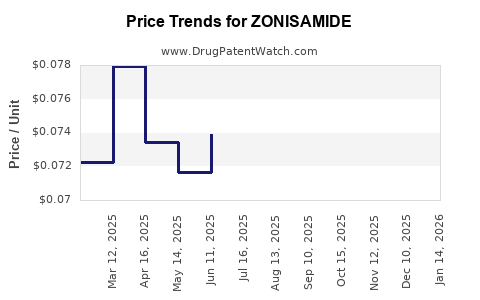
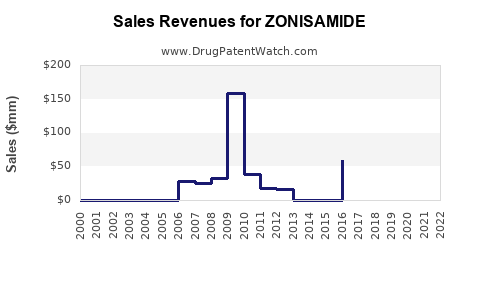
Zonisamide’s financial trajectory is characterized by originator erosion, generic volume growth, and limited formulation-led recovery.
Originator revenue
Eisai’s Zonegran revenue has been affected by:
- generic entry;
- price reductions;
- loss of exclusive distribution;
- reimbursement pressure;
- market-specific patent expiry;
- migration to competing anticonvulsants.
Eisai does not consistently disclose a single globally comparable, current Zonegran revenue line in the same detail as its largest strategic products. Reported figures can be embedded in regional or product-category disclosures, which limits precise product-level forecasting.[5]
The financial profile is therefore more consistent with a mature legacy product than with a growth asset. Brand revenue can persist in markets with slower generic substitution, but the overall direction is downward or stable at a low base.
Generic revenue
Generic zonisamide revenue is fragmented across manufacturers. Individual suppliers generally face:
- low unit prices;
- pharmacy-benefit-manager pressure;
- tender competition;
- inventory and shortage risk;
- limited brand loyalty;
- substitution by levetiracetam and other generic antiseizure drugs.
The generic opportunity is volume-based. Margin expansion depends on manufacturing efficiency, reliable supply, and disciplined portfolio management rather than premium pricing.
Formulation revenue
Liquid zonisamide products have a higher potential price per unit than standard capsules because they address administration needs that capsules do not fully solve. Their addressable market is smaller, but the product can obtain better reimbursement in pediatric, institutional, and medically complex populations.
The main financial risks are:
- rapid generic or branded-generic competition;
- limited clinical differentiation;
- payer restrictions;
- low patient volume;
- formulation-patent challenges;
- manufacturing complexity;
- substitution through capsule opening or compounding.
What generic entry risks exist for Zonegran?
Generic entry risk is already realized for capsules. The remaining risk to branded Zonegran is share loss rather than a future launch event.
For differentiated formulations, the risk profile is different:
| Risk |
Impact |
| Additional liquid-formulation ANDAs |
Erodes specialty-product pricing |
| Formulation patent invalidation |
Accelerates competition |
| Pharmacy substitution |
Reduces brand retention |
| Payer formulary exclusion |
Limits access |
| Supply interruption |
Can shift contracts to competitors |
| Clinical preference for newer drugs |
Reduces treatment starts |
| Safety-related label concerns |
Restricts use in selected patients |
A generic manufacturer can launch capsules with relatively limited commercial friction because the dosage form is established. A liquid product requires additional formulation development, stability data, manufacturing controls, and device or dosing considerations.
How does zonisamide compare with topiramate?
Zonisamide and topiramate have overlapping pharmacologic characteristics and both are associated with weight loss and metabolic adverse effects. Topiramate has broader historical use, including FDA approval for migraine prevention and combination treatment for obesity. That wider approved market gives topiramate greater commercial scale.
| Factor |
Zonisamide |
Topiramate |
| Core epilepsy use |
Partial seizures and adjunctive therapy |
Broad epilepsy indications |
| Migraine approval |
No U.S. FDA approval |
Approved for prevention |
| Obesity approval |
No |
Combination product approved |
| Generic competition |
Extensive |
Extensive |
| Commercial scale |
Smaller |
Larger |
| Formulation opportunity |
Capsules and suspension |
Tablets, capsules, sprinkle products |
| Safety overlap |
Metabolic acidosis, stones, cognitive effects |
Metabolic acidosis, stones, cognitive effects |
| Patent outlook |
Mature generic |
Mature generic, with product-specific legacy rights |
Topiramate’s broader indication base and larger historical patient population make it the stronger commercial comparator. Zonisamide can remain competitive where clinicians value its dosing profile or prior patient response.
What licensing deals affect zonisamide?
Zonisamide’s commercial history includes regional licensing and commercialization arrangements involving the original Japanese developer, Dainippon Pharmaceutical, and Eisai. These arrangements enabled development and distribution outside the original Japanese market.
The principal licensing value has declined as patents expired and generic substitution expanded. Current deal economics are more likely to concern regional distribution, supply, or specialty formulations than global exclusivity.
No recent transaction appears to have repositioned zonisamide as a major growth asset. The product is more likely to be included in legacy portfolios, generic businesses, or specialty-dose-formulation strategies.
What geographic markets remain commercially attractive?
Geographic opportunity is uneven.
United States
The U.S. capsule market is mature and price-sensitive. Commercial value is concentrated in supply reliability, liquid formulations, and institutional channels. Brand expansion is difficult without a new indication or differentiated delivery system.
Japan
Japan remains strategically important because zonisamide originated there and has a long clinical history. The market has its own reimbursement, regulatory, and branded-generic dynamics. Local brand recognition can support persistence, but pricing controls limit long-term growth.
Europe
European markets are highly fragmented. Generic penetration varies by country, and national tendering can produce rapid price erosion. Liquid or pediatric presentations may have greater value in markets with structured hospital procurement.
Emerging markets
Demand can grow with epilepsy diagnosis and treatment access, but pricing is generally low. Regulatory registration, local manufacturing, and distribution capability determine profitability.
What manufacturing and intellectual-property barriers affect zonisamide?
Manufacturing barriers are more relevant than core patent barriers. Suppliers must control:
- active pharmaceutical ingredient quality;
- polymorphic and particle-size characteristics;
- impurity profiles;
- capsule content uniformity;
- suspension stability;
- taste and palatability for liquid products;
- packaging and dosing accuracy;
- regulatory consistency across sites.
Supply concentration or API disruption can temporarily improve pricing for remaining suppliers, but mature generic markets typically normalize once alternative sources qualify.
For a liquid formulation, manufacturing and stability performance can create a practical barrier even when patent protection is limited. That barrier is commercial rather than absolute because competitors can develop alternative formulations.
What is the outlook for zonisamide through 2030?
The base-case outlook is:
- Generic capsules remain the dominant U.S. product.
- Originator Zonegran revenue continues to decline or remains limited to loyal and regionally protected markets.
- Liquid zonisamide products capture a small specialty segment.
- Generic price competition restricts industry revenue growth.
- No biosimilar or biologic competition affects the product.
- New value depends on formulation, pediatric use, supply reliability, or a new approved indication.
- Large revenue expansion is unlikely without clinical differentiation or regulatory exclusivity.
Key Takeaways
- Zonisamide is a mature small-molecule anticonvulsant with expired core exclusivity.
- Generic capsules dominate the U.S. market and create sustained pricing pressure.
- Zonegran is a legacy branded product rather than a major growth asset.
- Zonisade oral suspension is the principal differentiated formulation opportunity.
- Formulation and manufacturing patents may provide narrower protection than the expired composition patent.
- Paragraph IV risk is concentrated in later formulations, not the established capsule market.
- Zonisamide has no biosimilar risk.
- The strongest commercial opportunities are specialty formulations, pediatric administration, institutional care, and reliable generic supply.
- Revenue growth through 2030 is unlikely without a new FDA-approved use or materially differentiated delivery system.
FAQs About Zonisamide Market and Patent Risk
Does zonisamide still have patent protection?
The original compound and core capsule protection have expired. Any remaining protection is likely to be formulation-, process-, method-, or trademark-specific.
Is Zonegran still sold in the United States?
Zonegran and generic zonisamide products have been marketed in the United States, but generic products account for the main competitive volume. Brand availability and distribution can vary by market and supplier.
Can a generic manufacturer launch a zonisamide oral suspension?
A manufacturer would need FDA approval for the specific suspension product and must address formulation, stability, bioequivalence, labeling, manufacturing, and any applicable listed patents or exclusivities.
Is zonisamide approved for weight loss?
No. Weight loss is a recognized effect and zonisamide has been studied or used off label in weight-management settings, but zonisamide itself is not FDA approved as a standalone weight-loss drug.
Which drug is the main commercial competitor to zonisamide?
Topiramate is the closest commercial and pharmacologic comparator, while levetiracetam is a major competitive alternative in generic epilepsy treatment.
References
- U.S. Food and Drug Administration. (2023). Zonegran (zonisamide) prescribing information. FDA.
- U.S. Food and Drug Administration. (2024). Approved drug products with therapeutic equivalence evaluations: Orange Book. FDA.
- U.S. Food and Drug Administration. (2022). Zonisade (zonisamide) oral suspension prescribing information. FDA.
- U.S. Food and Drug Administration. (2024). ANDA submissions: Refuse-to-receive standards and patent certifications. FDA.
- Eisai Co., Ltd. (2024). Annual report and financial results materials. Eisai.