Last updated: August 7, 2026
Valsartan is a mature, globally genericized angiotensin II receptor blocker marketed for hypertension, heart failure, and post-myocardial-infarction care. The originator brand, Diovan, lost meaningful exclusivity years ago. Current value is concentrated in high-volume generic supply, combination products, hospital contracts, private-label portfolios, and regulated-market manufacturing capacity rather than in branded pricing power.
The market’s financial profile is shaped by four factors: large chronic-use demand, intense generic competition, low unit prices, and recurring supply and quality-control risk. The 2018 nitrosamine recalls damaged several manufacturers and temporarily disrupted supply, but they did not restore durable pricing power to valsartan.
What is valsartan and how is it used?
Valsartan is an oral, nonpeptide angiotensin II type 1 receptor antagonist. It reduces vasoconstriction and aldosterone activity by blocking the AT1 receptor.
| Attribute |
Valsartan |
| Drug class |
Angiotensin II receptor blocker |
| Primary indications |
Hypertension, heart failure, post-myocardial infarction |
| Common dosage forms |
Tablets, capsules, oral solutions in selected markets |
| Key combination products |
Valsartan/hydrochlorothiazide; sacubitril/valsartan |
| Originator brand |
Diovan |
| Major originator company |
Novartis |
| Regulatory status |
Approved small-molecule prescription medicine |
| Biosimilar pathway |
Not applicable |
| Current market structure |
Predominantly generic and combination-product driven |
Valsartan is used alone and with other antihypertensive agents. Its highest-volume use is chronic blood-pressure treatment. The drug is also a component of Entresto, the fixed-dose combination of sacubitril and valsartan. Entresto is commercially distinct from generic valsartan because its value is driven by the combination product, clinical positioning, and remaining product-specific exclusivity rather than by valsartan alone.
How large is the valsartan market?
No single audited source reports global valsartan revenue across all manufacturers, countries, hospital tenders, pharmacies, and combination products. Commercial market-research estimates vary materially because some count only valsartan monotherapy while others include valsartan/hydrochlorothiazide and sacubitril/valsartan.
The addressable market is nevertheless large in volume. Hypertension affects approximately 1.28 billion adults worldwide, according to the World Health Organization, creating a broad chronic-treatment base for antihypertensive medicines.[1] Valsartan competes within the ARB class against losartan, irbesartan, candesartan, olmesartan, telmisartan, and azilsartan.
The market is best divided into four segments:
| Segment |
Economic profile |
Competitive intensity |
| Generic valsartan monotherapy |
Low-price, high-volume |
Very high |
| Valsartan/hydrochlorothiazide |
Low-price combination product |
Very high |
| Branded or authorized-generic valsartan |
Limited premium potential |
High |
| Sacubitril/valsartan |
Higher-value branded combination |
Lower than standalone valsartan, but product-specific |
Generic valsartan is a commodity-like product in most developed markets. Procurement decisions often prioritize price, regulatory compliance, reliability of supply, and approved manufacturing sites. Brand loyalty has limited influence in mature markets.
What was Diovan’s financial trajectory?
Diovan was a major cardiovascular product for Novartis before generic competition. Its commercial decline followed the loss of U.S. market exclusivity and subsequent generic entry.
| Period |
Commercial development |
| 1990s to early 2000s |
Expansion as a branded ARB for hypertension |
| 2007 |
Global Diovan sales approached the high-single-digit billions of dollars for the broader valsartan franchise, according to Novartis reporting |
| 2012 |
U.S. composition-of-matter patent protection expired |
| 2012 onward |
Generic entry sharply reduced branded valsartan revenue |
| 2013 onward |
Diovan became a mature, residual brand in many markets |
| 2018 |
Global valsartan recalls disrupted supply and altered manufacturer economics |
| 2020s |
Standalone valsartan value shifted primarily to generics and combination products |
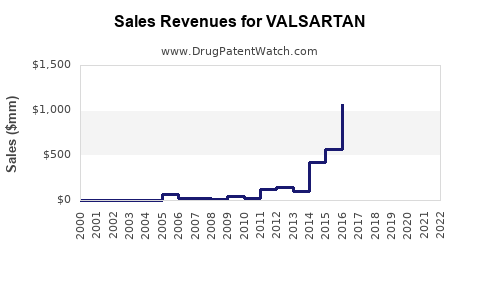
Novartis reported Diovan sales of approximately $2.3 billion in 2012, down from its earlier peak as generic competition developed.[2] The decline illustrates the standard small-molecule loss-of-exclusivity pattern: rapid price erosion, loss of formulary preference, and migration from originator product to multiple generic suppliers.
The financial trajectory of valsartan itself is therefore different from the financial trajectory of Entresto. Entresto became the strategic growth product associated with the valsartan molecule, while Diovan became a mature legacy brand. In 2023, Novartis reported Entresto sales of approximately $6 billion, reflecting the commercial value of sacubitril/valsartan as a combination therapy rather than standalone valsartan.[3]
When did valsartan lose patent exclusivity?
The principal U.S. valsartan patent expired in 2012. Generic versions entered the U.S. market after abbreviated new drug application approvals and patent litigation resolutions.
| Patent or exclusivity issue |
Market effect |
| Core valsartan composition-of-matter protection |
Expired in the United States in 2012 |
| U.S. pediatric exclusivity |
Extended certain regulatory protections for a limited period |
| Diovan brand protection |
Substantially eroded after generic launch |
| Hydrochlorothiazide combination protection |
Depended on specific formulation and patent claims, but did not preserve broad valsartan exclusivity |
| Sacubitril/valsartan patents |
Separate product estate with later-expiring protection |
The relevant distinction is between valsartan patents and patents covering specific combinations, formulations, manufacturing processes, or uses. Expiration of the core active-ingredient patent did not eliminate every patent claim associated with every product. It did remove the principal barrier to generic standalone valsartan.
What patents protect valsartan today?
Standalone valsartan is no longer protected by a commercially meaningful core compound patent in the United States. The remaining patent landscape is product-specific.
Standalone valsartan
Relevant historical patent categories included:
- Composition-of-matter patents covering valsartan.
- Salt, crystalline-form, and polymorph claims.
- Processes for synthesis and purification.
- Formulation claims involving tablets, excipients, or dissolution profiles.
- Fixed-dose combinations with hydrochlorothiazide or other antihypertensive agents.
- Method-of-use claims for cardiovascular conditions.
Most such claims either expired, were narrowed, were jurisdiction-specific, or have limited ability to block ordinary generic valsartan products. Process patents can still affect manufacturing economics, but they rarely create broad market exclusivity when alternative synthesis routes are available.
Sacubitril/valsartan
Sacubitril/valsartan has a separate intellectual-property position. Novartis has identified patents covering Entresto and related pharmaceutical compositions in regulatory and litigation filings. The relevant claims can include:
- The combination of sacubitril and valsartan.
- Pharmaceutical compositions.
- Treatment methods for heart failure.
- Dosing regimens.
- Certain crystalline or formulation characteristics.
The legal and commercial analysis for Entresto should not be used as a proxy for standalone valsartan. A generic company may be able to market valsartan while remaining unable to launch a competing sacubitril/valsartan product without addressing the separate Entresto patent estate.
What is the FDA Orange Book status of valsartan?
FDA-approved valsartan products are listed in the Orange Book under individual new drug applications and abbreviated new drug applications. The Orange Book identifies approved products, reference listed drugs, therapeutic equivalence information, and patents or exclusivity where applicable.[4]
The Orange Book is most important for:
- Identifying the reference listed drug for generic applications.
- Reviewing therapeutic-equivalence codes.
- Checking listed patents for branded combination products.
- Assessing whether a patent certification or Paragraph IV notice may be required.
- Distinguishing standalone valsartan from valsartan-containing combination products.
For mature standalone valsartan products, the Orange Book does not provide a meaningful barrier to generic entry because the core exclusivity period has ended. The practical risk is regulatory approval, supplier qualification, and market access rather than a single blocking patent.
Which companies compete in the valsartan market?
Competition is fragmented across generic manufacturers, vertically integrated pharmaceutical companies, contract manufacturers, and regional suppliers. Companies that have marketed valsartan or valsartan-containing products in major markets have included:
- Teva Pharmaceutical Industries.
- Sandoz.
- Mylan, now part of Viatris.
- Dr. Reddy’s Laboratories.
- Lupin.
- Zydus Lifesciences.
- Torrent Pharmaceuticals.
- Sun Pharmaceutical Industries.
- Aurobindo Pharma.
- Cipla.
- Accord Healthcare.
- Zhejiang Huahai Pharmaceutical, primarily as an API supplier and manufacturer associated with valsartan supply.
The competitive landscape varies by country. In the United States, products may be supplied by large generic companies, contract manufacturers, and pharmacy-label suppliers. In Europe, national reimbursement systems and tender purchasing produce sharp price competition. In emerging markets, local manufacturers and branded-generics companies often retain more control over prescribing and distribution.
What caused the 2018 valsartan recalls?
In 2018, regulators identified N-nitrosodimethylamine, or NDMA, in valsartan active pharmaceutical ingredient supplied by Zhejiang Huahai Pharmaceutical. The contamination was associated with changes in the manufacturing process. Recalls expanded across multiple manufacturers and countries as regulators evaluated affected batches and supply chains.[5]
The recalls had four major market effects:
- They removed affected lots from distribution.
- They forced manufacturers to qualify alternative API suppliers.
- They increased testing, documentation, and regulatory costs.
- They created temporary shortages and procurement instability.
The FDA later identified additional nitrosamine contamination risks involving valsartan, losartan, and irbesartan products. The incident demonstrated that valsartan’s low-margin economics are exposed to manufacturing concentration and process-change risk.
The recalls did not materially improve the long-term financial position of the originator brand. Instead, they shifted value toward manufacturers with compliant supply, validated analytical methods, and access to alternative API sources.
How strong is the valsartan patent estate?
The patent estate for standalone valsartan is weak from an exclusivity perspective and moderate from a manufacturing-control perspective.
| Dimension |
Assessment |
| Core molecule protection |
Expired |
| Broad generic blocking power |
Low |
| Formulation protection |
Limited and product-specific |
| Process patents |
Potentially relevant to cost and supply, rarely broad |
| Combination-product protection |
More relevant for specific products |
| Regulatory exclusivity |
Expired for standalone valsartan |
| Litigation leverage |
Low for ordinary generic valsartan |
| Manufacturing barriers |
Moderate because of quality, validation, and supply requirements |
The strongest remaining commercial protections are not classic compound patents. They are manufacturing know-how, regulatory approvals, supplier qualification, quality systems, scale, distribution access, and hospital or pharmacy contracts.
Are there Paragraph IV challenges for valsartan?
Paragraph IV litigation was relevant when generic manufacturers challenged Diovan patents before core exclusivity expired. That litigation supported the transition from branded valsartan to generic supply.
For standalone valsartan today, Paragraph IV activity is unlikely to create a material market event because the main compound patent has expired. Paragraph IV remains relevant for newer valsartan-containing products, including certain combination therapies, dosage forms, or patents associated with sacubitril/valsartan.
A generic applicant challenging a listed patent can make a Paragraph IV certification under the Hatch-Waxman Act. The patent holder may then sue within the statutory period, potentially triggering a stay of FDA approval for up to 30 months, subject to statutory exceptions.[6] The commercial significance depends on whether the challenged patent covers the exact product the applicant intends to launch.
What generic launch risks exist for valsartan?
Generic launch risk is primarily operational and commercial.
Regulatory risks
Manufacturers must demonstrate pharmaceutical equivalence and bioequivalence, maintain compliant production sites, and manage post-approval changes. FDA inspection findings or unresolved data-integrity concerns can delay approval or interrupt supply.
Supply risks
Valsartan API production is geographically concentrated. A recall, plant shutdown, process-change problem, or regulatory import restriction can affect several finished-dose manufacturers at once.
Pricing risks
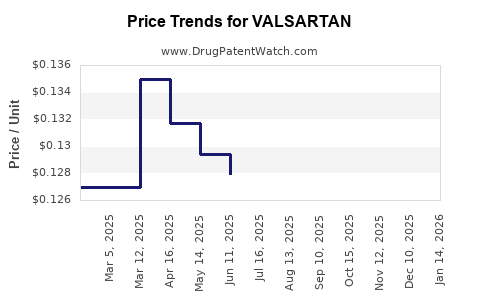
Multiple approved suppliers can produce rapid price erosion. A new entrant may gain volume but still generate limited profit if pharmacy benefit managers, wholesalers, or public tenders demand aggressive discounts.
Quality risks
Nitrosamine controls remain relevant. Manufacturers must test risk-based batches, assess process impurities, and maintain documented controls over API and excipient suppliers.
Market-access risks
Approval does not guarantee commercial uptake. Generic manufacturers need wholesaler contracts, formulary placement, pharmacy substitution, government-tender access, and reliable fill rates.
What formulations are protected by valsartan patents?
Formulation protection is narrower than molecule protection. Relevant product categories include:
- Immediate-release tablets.
- Valsartan/hydrochlorothiazide tablets.
- Oral solutions or pediatric formulations in selected jurisdictions.
- Modified-release or specialty dosage forms, where approved.
- Sacubitril/valsartan tablets.
- Fixed-dose products combining valsartan with other cardiovascular agents.
The commercial strength of a formulation patent depends on claim breadth and whether a generic can design around the claim while preserving bioequivalence. Tablet excipient claims are often easier to avoid than patents covering a required active-ingredient combination or clinically defined dosing regimen.
Entresto remains the most important valsartan-containing product from an intellectual-property and revenue perspective. Its patent disputes and generic-entry timing are separate from ordinary Diovan or generic valsartan analysis.
Is biosimilar risk relevant to valsartan?
No. Valsartan is a chemically synthesized small molecule, not a biologic. Biosimilar rules do not apply.
The relevant competitive threat is generic substitution under abbreviated new drug application pathways in the United States and equivalent generic approval systems in other jurisdictions. The absence of biosimilar complexity makes regulatory entry comparatively straightforward once patents, exclusivity, bioequivalence, and manufacturing requirements are satisfied.
What licensing deals affect valsartan?
Valsartan’s commercial history includes originator licensing and collaboration arrangements associated with development and regional commercialization. Novartis developed and commercialized Diovan globally, while local partners and licensees have participated in selected markets.
For mature standalone valsartan, licensing has limited strategic value because the product is genericized. Licensing remains more relevant to:
- Regional distribution rights.
- Authorized generics.
- API supply agreements.
- Co-marketing of combination products.
- Entresto commercialization and local market access.
- Manufacturing transfers and contract-development arrangements.
The value of a valsartan license today depends on territory, regulatory approvals, supply guarantees, quality history, and combination-product rights. A license covering only the standalone molecule has limited negotiating leverage in markets with many approved suppliers.
What is the geographic coverage of valsartan patents and products?
The core compound patent expired in major markets, including the United States. Patent status for formulations, combinations, and manufacturing processes remains jurisdiction-specific.
| Region |
Market status |
| United States |
Mature generic market; Orange Book relevant for product-specific patents |
| European Union |
Generic competition across national reimbursement systems |
| Japan |
Mature market with local regulatory and pricing requirements |
| India |
Strong branded-generic and API manufacturing presence |
| China |
Large domestic market with centralized procurement pressure |
| Latin America |
Mixed generic and branded-generic dynamics |
| Middle East and Africa |
Import dependence varies by country; local registration and supply reliability matter |
Geographic value is driven less by patent exclusion than by registration portfolios, local manufacturing, government procurement, and distribution capacity.
What financial trajectory should investors expect?
Standalone valsartan is a mature, low-growth pharmaceutical asset. Revenue growth is unlikely to come from price increases or new indication expansion. The principal financial scenarios are:
| Scenario |
Financial outcome |
| Stable generic demand |
High unit volume, continued low pricing |
| Supplier exit or recall |
Temporary price and volume opportunity for compliant suppliers |
| New combination approval |
Potentially higher margin than standalone valsartan |
| Entresto generic entry |
Material pressure on sacubitril/valsartan revenue, subject to patent outcomes |
| Manufacturing consolidation |
Better utilization for surviving suppliers, but greater supply concentration |
| Regulatory failure |
Loss of approvals, recall costs, and customer migration |
The economics favor manufacturers with low-cost API access, multiple approved sites, strong quality systems, and broad distribution. Smaller suppliers can remain viable through regional niches, tenders, or combination products, but standalone valsartan generally lacks the margin profile of a protected specialty medicine.
For Novartis, the molecule’s strategic value shifted from Diovan to Entresto. For generic manufacturers, valsartan is a portfolio product that can support cardiovascular scale, pharmacy relationships, and combination-product sales. Its standalone revenue is unlikely to be a major growth driver unless supply disruption temporarily reduces competition.
Key Takeaways
- Valsartan is a mature generic ARB with broad global demand and limited standalone pricing power.
- The core U.S. valsartan patent expired in 2012, ending meaningful compound-level exclusivity.
- Diovan revenue declined sharply after generic entry; Novartis’ later value creation came primarily from sacubitril/valsartan, marketed as Entresto.
- The 2018 NDMA recalls exposed API concentration and process-control risks across the supply chain.
- Patent risk for standalone valsartan is low, while formulation, combination, and manufacturing patents remain product-specific.
- Paragraph IV litigation is largely historical for ordinary valsartan but remains relevant to newer valsartan-containing products.
- Biosimilar risk does not apply because valsartan is a small molecule.
- The strongest commercial barriers are regulatory compliance, supply reliability, cost position, and distribution access.
- Generic valsartan is a volume business. Sacubitril/valsartan is the higher-value product requiring a separate patent and exclusivity analysis.
FAQs
Does valsartan still have patent protection?
The core valsartan compound patent has expired in major markets. Certain combination, formulation, use, and manufacturing patents may remain relevant for specific products or jurisdictions.
Can a generic company launch valsartan without a Paragraph IV challenge?
Yes. Because the principal compound exclusivity has expired, an applicant can generally pursue approval without challenging an active core valsartan patent. Product-specific listed patents must still be evaluated.
Is valsartan more valuable as a standalone drug or in Entresto?
Entresto has substantially greater commercial value because it combines sacubitril with valsartan and occupies a differentiated heart-failure market. Standalone valsartan is primarily a low-priced generic product.
Did the NDMA recall permanently increase valsartan prices?
No. The recall caused temporary supply disruption and pricing changes, but generic competition continued to limit long-term pricing power.
Which manufacturing capabilities matter most for valsartan suppliers?
The key capabilities are validated API sourcing, nitrosamine control, regulatory compliance, reliable finished-dose capacity, bioequivalence support, and access to pharmacy, hospital, and government-purchasing channels.
References
- World Health Organization. (2023). Hypertension. https://www.who.int/news-room/fact-sheets/detail/hypertension
- Novartis AG. (2012). Annual report 2012. https://www.novartis.com/investors/financial-data/annual-report
- Novartis AG. (2023). Annual report 2023. https://www.novartis.com/investors/financial-data/annual-report
- U.S. Food and Drug Administration. (n.d.). Orange Book: Approved drug products with therapeutic equivalence evaluations. https://www.accessdata.fda.gov/scripts/cder/ob/
- U.S. Food and Drug Administration. (2018). FDA updates on valsartan recalls. https://www.fda.gov/drugs/drug-safety-and-availability
- U.S. Food and Drug Administration. (2024). Abbreviated new drug application approvals and patent certifications. https://www.fda.gov/drugs/abbreviated-new-drug-application-anda/anda-basics