Share This Page
Drug Price Trends for TWYNEO
✉ Email this page to a colleague
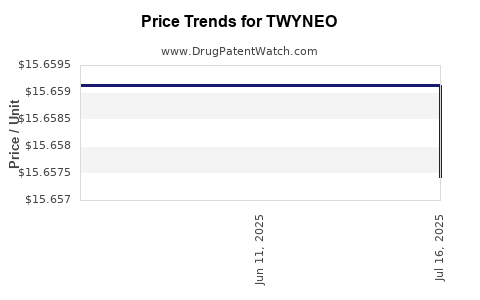
Average Pharmacy Cost for TWYNEO
| Drug Name | NDC | Price/Unit ($) | Unit | Date |
|---|---|---|---|---|
| TWYNEO 0.1%-3% CREAM PUMP | 00299-5945-30 | 31.65680 | GM | 2026-08-01 |
| TWYNEO 0.1%-3% CREAM PUMP | 51862-0771-30 | 31.65680 | GM | 2026-08-01 |
| TWYNEO 0.1%-3% CREAM PUMP | 00299-5945-30 | 30.14934 | GM | 2026-07-22 |
| TWYNEO 0.1%-3% CREAM PUMP | 51862-0771-30 | 30.14934 | GM | 2026-07-22 |
| TWYNEO 0.1%-3% CREAM PUMP | 00299-5945-30 | 30.14934 | GM | 2026-06-17 |
| TWYNEO 0.1%-3% CREAM PUMP | 51862-0771-30 | 30.14934 | GM | 2026-06-17 |
| TWYNEO 0.1%-3% CREAM PUMP | 00299-5945-30 | 30.04995 | GM | 2026-05-20 |
| >Drug Name | >NDC | >Price/Unit ($) | >Unit | >Date |
TWYNEO Market Analysis and Price Projections
TWYNEO, a topical combination treatment for acne vulgaris, is positioned to capture significant market share within the dermatology sector. The drug's unique formulation, combining tretinoin and benzoyl peroxide, addresses key unmet needs in acne management, particularly for inflammatory lesions and post-inflammatory hyperpigmentation. This analysis projects market growth and outlines pricing considerations based on current data and competitive landscapes.
What is TWYNEO's Core Value Proposition?
TWYNEO's core value proposition is its dual-acting mechanism targeting both inflammatory and non-inflammatory acne. The tretinoin component, a retinoid, regulates keratinization and reduces microcomedone formation, while benzoyl peroxide provides antimicrobial and anti-inflammatory effects. This combination offers a comprehensive approach to acne treatment, potentially leading to faster and more complete clearance of lesions compared to monotherapies or less optimized combination products. The fixed-dose combination aims to improve patient adherence by simplifying the treatment regimen.
Who are TWYNEO's Primary Target Patient Populations?
TWYNEO is indicated for the topical treatment of acne vulgaris in patients 12 years of age and older. Key target patient populations include:
- Adolescents with moderate to severe acne: This demographic frequently experiences significant inflammatory lesions and is receptive to simplified treatment regimens.
- Adults with persistent acne: Many adults struggle with ongoing acne, often seeking effective and convenient treatment options.
- Patients with post-inflammatory hyperpigmentation (PIH): The depigmenting action of tretinoin, combined with the anti-inflammatory properties of benzoyl peroxide, makes TWYNEO particularly suitable for patients concerned with PIH, a common sequela of acne.
- Patients seeking an alternative to oral medications: For those who cannot tolerate or prefer to avoid oral antibiotics or isotretinoin, TWYNEO offers a potent topical alternative.
What is the Current Market Landscape for Topical Acne Treatments?
The topical acne treatment market is competitive and segmented, featuring a range of active ingredients and formulations.
Major Topical Acne Treatment Categories
- Retinoids: Tretinoin (Retin-A, Atralin), adapalene (Differin), tazarotene (Tazorac, Fabior). These are considered first-line therapy for many acne types.
- Benzoyl Peroxide (BPO): Available in various concentrations (2.5% to 10%), often used alone or in combination.
- Topical Antibiotics: Clindamycin, erythromycin. Typically used in combination with BPO or retinoids to reduce resistance.
- Azelaic Acid: Effective for inflammatory acne and PIH.
- Salicylic Acid: A beta-hydroxy acid used for mild to moderate acne.
- Combination Products: Pre-existing fixed-dose combinations include clindamycin/benzoyl peroxide (BenzaClin, Onexton), adapalene/benzoyl peroxide (Epiduo).
Competitive Positioning of TWYNEO
TWYNEO differentiates itself by combining tretinoin with benzoyl peroxide in specific, optimized concentrations (0.04% tretinoin and 3% benzoyl peroxide). This combination aims to leverage the synergistic effects of both agents while potentially mitigating some of the common side effects associated with higher concentrations or separate application. The formulation is designed for enhanced tolerability and efficacy.
- Key Competitors (Fixed-Dose Topical Combinations):
- Epiduo (0.1% adapalene / 2.5% benzoyl peroxide)
- Epiduo Forte (0.3% adapalene / 2.5% benzoyl peroxide)
- BenzaClin (1% clindamycin / 5% benzoyl peroxide)
- Onexton (1.2% clindamycin / 5% benzoyl peroxide)
TWYNEO's specific concentrations of tretinoin (a first-generation retinoid with robust clinical data) and benzoyl peroxide are designed to offer a distinct efficacy and tolerability profile within this competitive set.
What are TWYNEO's Projected Market Growth Drivers?
Several factors are expected to drive TWYNEO's market growth:
- Increasing Incidence of Acne: Acne vulgaris remains a highly prevalent skin condition, particularly among adolescents and young adults. Global estimates suggest it affects up to 95% of individuals aged 11 to 30 to some degree.
- Demand for Effective and Convenient Treatments: Patients and physicians seek treatments that offer rapid, visible results with a simplified application process to improve adherence.
- Focus on Combination Therapies: The understanding that combination therapy offers synergistic benefits and can mitigate resistance has led to a greater adoption of multi-active ingredient products.
- Growing Concern for Post-Inflammatory Hyperpigmentation: As aesthetic concerns rise, treatments that address both acne lesions and PIH are in higher demand.
- Off-Patent Tretinoin and Benzoyl Peroxide: The availability of these active ingredients as generics can influence pricing strategies and market penetration for novel combinations.
- Physician Education and Adoption: Targeted educational initiatives by the manufacturer can drive prescription rates among dermatologists and primary care physicians.
What are the Key Factors Influencing TWYNEO's Pricing Strategy?
TWYNEO's pricing will be determined by a confluence of factors, including manufacturing costs, R&D investment recovery, competitive pricing, perceived clinical value, and market access dynamics.
Pricing Benchmarks and Considerations
- Manufacturer's Suggested Retail Price (MSRP): This is typically the starting point for pricing discussions.
- Payer Reimbursement: Insurance coverage and co-pay structures will significantly impact patient out-of-pocket costs and overall market access. TWYNEO's ability to secure broad formulary placement will be critical.
- Competitor Pricing: The prices of established combination therapies like Epiduo, Epiduo Forte, BenzaClin, and Onexton will serve as a primary reference.
- Example Pricing Range (Subject to Fluctuation and Geographic Variation):
- Epiduo (0.1% adapalene/2.5% BPO) typically ranges from $150-$250 for a 45g tube, with out-of-pocket costs often lower with insurance.
- Onexton (1.2% clindamycin/5% BPO) may be priced similarly, around $200-$300 for a 50g tube.
- Example Pricing Range (Subject to Fluctuation and Geographic Variation):
- Prescription Volume and Patient Assistance Programs: The manufacturer's strategy for patient assistance programs can influence net pricing and patient affordability.
- Cost of Goods Sold (COGS): The expenses associated with manufacturing, formulation, and packaging.
- Clinical Efficacy and Tolerability Data: Strong clinical trial results demonstrating superior efficacy or improved tolerability over existing treatments can support premium pricing.
- Market Size and Demand Elasticity: The overall size of the addressable market and the sensitivity of demand to price changes.
What are the Price Projections for TWYNEO?
Based on the competitive landscape and market dynamics, TWYNEO is projected to be priced in line with or at a slight premium to existing premium combination topical acne treatments.
Projected Pricing Scenarios
-
Scenario 1: Parity Pricing
- Projection: TWYNEO is priced competitively with leading combination products, such as Epiduo Forte or Onexton.
- Estimated Price Range (per 45-50g tube): $220 - $280 (MSRP).
- Rationale: This strategy aims for broad market adoption by not creating a significant price barrier compared to established alternatives. The differentiated formulation and potential for improved outcomes would be the primary drivers of market share gain.
-
Scenario 2: Premium Pricing
- Projection: TWYNEO is priced at a 5-10% premium to existing market leaders, reflecting a novel formulation or superior clinical benefits.
- Estimated Price Range (per 45-50g tube): $240 - $300 (MSRP).
- Rationale: This approach assumes TWYNEO demonstrates a clear clinical advantage (e.g., significantly faster clearance of inflammatory lesions, superior PIH reduction, or enhanced tolerability) that justifies a higher price point. Strong clinical data and effective marketing highlighting these advantages would be essential.
-
Scenario 3: Value-Based Pricing (with robust patient access programs)
- Projection: While MSRP may align with premium pricing, aggressive patient assistance programs and payer negotiations drive significant out-of-pocket savings for patients.
- Estimated Out-of-Pocket Cost (with insurance/assistance): $20 - $60 per tube.
- Rationale: This strategy prioritizes patient access and physician adoption over maximizing upfront revenue. It acknowledges the cost sensitivity of acne treatment, especially for younger demographics, and aims to achieve high prescription volumes through affordability.
Key Considerations for Pricing:
- Launch Date: The timing of TWYNEO's launch relative to patent expirations of key components or competitor products.
- Regulatory Exclusivity: The duration of any market exclusivity granted by regulatory bodies.
- Marketing and Sales Force Effectiveness: The ability of the sales team to educate physicians and drive prescriptions.
What are TWYNEO's Potential Market Share Projections?
TWYNEO's market share will depend on its clinical performance, physician acceptance, payer coverage, and the manufacturer's commercialization strategy.
Market Share Estimates
- Year 1-2 Post-Launch: 3% - 7% of the topical prescription acne market.
- Drivers: Initial physician awareness, early adoption by dermatologists, and initial formulary placements.
- Year 3-5 Post-Launch: 8% - 15% of the topical prescription acne market.
- Drivers: Growing body of real-world evidence, expanded payer coverage, increased physician confidence, and patient-driven demand due to marketing and positive word-of-mouth.
- Year 5+: 10% - 20%+ of the topical prescription acne market.
- Drivers: Sustained market presence, potential for expanded indications, and continued differentiation from competitors.
Factors Influencing Market Share:
- Clinical Differentiation: Superior efficacy or tolerability compared to established treatments like Epiduo Forte or Onexton.
- Payer Access: Broad formulary coverage by major insurance providers.
- Physician Education and Detailing: Effective outreach to dermatologists and primary care physicians.
- Patient Adherence: The formulation's ease of use and tolerability directly impact adherence.
- Marketing and Brand Awareness: Successful campaigns to reach both healthcare professionals and patients.
- Competition: The introduction of new, highly effective therapies by competitors.
What are the Regulatory and Intellectual Property Considerations?
Understanding the regulatory pathway and intellectual property landscape is crucial for long-term market protection and profitability.
Key Regulatory and IP Aspects
- FDA Approval: TWYNEO received FDA approval on July 27, 2021 [1]. This approval signifies its demonstrated safety and efficacy for its indicated use.
- Patent Landscape: The patent strategy surrounding TWYNEO is critical for protecting its market exclusivity. While tretinoin and benzoyl peroxide are old compounds, patents can be secured for specific formulations, delivery systems, methods of use, and combinations that offer novelty and non-obviousness.
- Composition of Matter Patents: Claims related to the specific combination and concentrations of active ingredients.
- Formulation Patents: Patents covering the unique excipients or manufacturing processes that enhance stability, delivery, or tolerability.
- Method of Use Patents: Claims directed to treating specific dermatological conditions or patient subgroups with TWYNEO.
- Patent Expiry: The duration of patent protection will dictate the period of market exclusivity before generic competition can enter. Generic manufacturers may challenge existing patents or develop their own formulations that circumvent existing IP.
- Orange Book: The listing of TWYNEO and its associated patents in the FDA's Orange Book is essential for identifying patent protection and potential launch dates for generics.
Key Takeaways
TWYNEO enters a competitive yet robust topical acne treatment market with a clear value proposition of dual-action efficacy and improved patient convenience. Its success will hinge on its demonstrated clinical superiority, strategic pricing aligned with market expectations, and effective market access through payer negotiations and physician adoption. While precise market share and pricing are contingent on real-world performance and commercial execution, projections indicate TWYNEO can capture a significant segment of the prescription topical acne market, potentially reaching 10-20% within five years, with pricing likely to be competitive with premium existing combination therapies.
FAQs
-
What are the specific concentrations of tretinoin and benzoyl peroxide in TWYNEO? TWYNEO contains 0.04% tretinoin and 3% benzoyl peroxide.
-
What is the primary difference between TWYNEO and Epiduo? The primary difference lies in their active ingredients and concentrations. TWYNEO combines tretinoin (0.04%) and benzoyl peroxide (3%), while Epiduo combines adapalene (0.1% or 0.3% in Epiduo Forte) and benzoyl peroxide (2.5%). Tretinoin and adapalene are both retinoids but belong to different generations and have distinct pharmacological profiles.
-
How is TWYNEO expected to impact the pricing of other topical acne treatments? TWYNEO's introduction at a competitive or premium price point reinforces the value of combination therapies. It is unlikely to dramatically lower prices across the board but may pressure manufacturers of less differentiated or older combination products to adjust their pricing or focus on niche markets.
-
What are the main side effects associated with TWYNEO? As with other topical retinoids and benzoyl peroxide, common side effects include skin dryness, redness, peeling, burning, and stinging. These are generally manageable by adjusting application frequency or using emollients.
-
When is TWYNEO expected to face generic competition? The timing of generic competition will depend on the expiry of relevant patents listed in the FDA's Orange Book and any potential patent litigation. Without specific patent expiry dates, it is challenging to provide an exact timeline, but typical patent protection for novel formulations can extend for many years post-approval.
Citations
[1] U.S. Food & Drug Administration. (2021, July 27). Drug Approval Packages: TWYNEO. Retrieved from https://www.accessdata.fda.gov/drugsatfda_docs/appletter/2021/215660Orig1s000l.pdf
More… ↓
