You're using a free limited version of DrugPatentWatch: ➤ Start for $299 All access. No Commitment.

Last Updated: January 29, 2026

RIVAROXABAN Drug Patent Profile


✉ Email this page to a colleague

« Back to Dashboard


Which patents cover Rivaroxaban, and what generic alternatives are available?

Rivaroxaban is a drug marketed by Alkem Labs Ltd, Lupin Ltd, Aiping Pharm Inc, Alembic, Apotex, Ascent Pharms Inc, Aurobindo Pharma Ltd, Biocon Pharma, Breckenridge, Dr Reddys, Invagen Pharms, Macleods Pharms Ltd, MSN, Regcon Holdings, Sciegen Pharms Inc, Sunshine, and Taro. and is included in nineteen NDAs.

The generic ingredient in RIVAROXABAN is rivaroxaban. There are thirty-five drug master file entries for this compound. Nineteen suppliers are listed for this compound. Additional details are available on the rivaroxaban profile page.

DrugPatentWatch® Litigation and Generic Entry Outlook for Rivaroxaban

A generic version of RIVAROXABAN was approved as rivaroxaban by LUPIN LTD on March 3rd, 2025.

  Get Started Free

AI Deep Research
Questions you can ask:
  • What is the 5 year forecast for RIVAROXABAN?
  • What are the global sales for RIVAROXABAN?
  • What is Average Wholesale Price for RIVAROXABAN?
Drug patent expirations by year for RIVAROXABAN
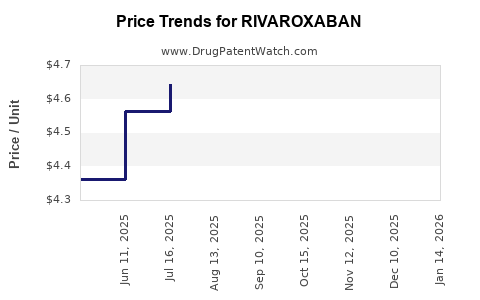
Drug Prices for RIVAROXABAN

See drug prices for RIVAROXABAN

Recent Clinical Trials for RIVAROXABAN

Identify potential brand extensions & 505(b)(2) entrants

SponsorPhase
University of MelbournePHASE4
Emily McDonaldPHASE4
McMaster UniversityPHASE3

See all RIVAROXABAN clinical trials

Pharmacology for RIVAROXABAN
Drug ClassFactor Xa Inhibitor
Mechanism of ActionFactor Xa Inhibitors
Medical Subject Heading (MeSH) Categories for RIVAROXABAN
Paragraph IV (Patent) Challenges for RIVAROXABAN
Tradename Dosage Ingredient Strength NDA ANDAs Submitted Submissiondate
XARELTO Capsules rivaroxaban 10 mg, 15 mg and 20 mg 022406 1 2022-06-17
XARELTO Tablets rivaroxaban 2.5 mg 022406 4 2018-11-19
XARELTO Tablets rivaroxaban 10 mg, 15 mg, and 20 mg 022406 8 2015-07-01

US Patents and Regulatory Information for RIVAROXABAN

Applicant Tradename Generic Name Dosage NDA Approval Date TE Type RLD RS Patent No. Patent Expiration Product Substance Delist Req. Exclusivity Expiration
Macleods Pharms Ltd RIVAROXABAN rivaroxaban TABLET;ORAL 213114-002 May 14, 2025 AB RX No No ⤷  Get Started Free ⤷  Get Started Free ⤷  Get Started Free
Dr Reddys RIVAROXABAN rivaroxaban TABLET;ORAL 208534-004 May 14, 2025 AB RX No No ⤷  Get Started Free ⤷  Get Started Free ⤷  Get Started Free
Regcon Holdings RIVAROXABAN rivaroxaban TABLET;ORAL 218445-002 Aug 11, 2025 AB RX No No ⤷  Get Started Free ⤷  Get Started Free ⤷  Get Started Free
Taro RIVAROXABAN rivaroxaban TABLET;ORAL 208557-002 Oct 7, 2025 AB RX No No ⤷  Get Started Free ⤷  Get Started Free ⤷  Get Started Free
>Applicant >Tradename >Generic Name >Dosage >NDA >Approval Date >TE >Type >RLD >RS >Patent No. >Patent Expiration >Product >Substance >Delist Req. >Exclusivity Expiration

EU/EMA Drug Approvals for RIVAROXABAN

Company Drugname Inn Product Number / Indication Status Generic Biosimilar Orphan Marketing Authorisation Marketing Refusal
Accord Healthcare S.L.U. Rivaroxaban Accord rivaroxaban EMEA/H/C/005279Prevention of venous thromboembolism (VTE) in adult patients undergoing elective hip or knee replacement surgery.Treatment of deep vein thrombosis (DVT) and pulmonary embolism (PE), and prevention of recurrent DVT and PE in adults. (See section 4.4 for haemodynamically unstable PE patients.Treatment of deep vein thrombosis (DVT) and pulmonary embolism (PE), and prevention of recurrent DVT and PE in adults. (See section 4.4 for haemodynamically unstable PE patients).AdultsPrevention of stroke and systemic embolism in adult patients with non valvular atrial fibrillation with one or more risk factors, such as congestive heart failure, hypertension, age ≥ 75 years, diabetes mellitus, prior stroke or transient ischaemic attack.Treatment of deep vein thrombosis (DVT) and pulmonary embolism (PE), and prevention of recurrent DVT and PE in adults. (See section 4.4 for haemodynamically unstable PE patients.)Paediatric populationTreatment of venous thromboembolism (VTE) and prevention of VTE recurrence in children and adolescents aged less than 18 years and weighing from 30 kg to 50 kg after at least 5 days of initial parenteral anticoagulation treatment.Rivaroxaban Accord, co administered with acetylsalicylic acid (ASA) alone or with ASA plus ticlopidine, is indicated for the prevention of atherothrombotic events in adult patients after an acute coronary syndrome (ACS) with elevated cardiac biomarkers (see sections 4.3, 4.4 and 5.1).Rivaroxaban Accord, co administered with acetylsalicylic acid (ASA), is indicated for the prevention of atherothrombotic events in adult patients with coronary artery disease (CAD) or symptomatic peripheral artery disease (PAD) at high risk of ischaemic events.AdultsPrevention of stroke and systemic embolism in adult patients with non-valvular atrial fibrillation with one or more risk factors, such as congestive heart failure, hypertension, age ≥ 75 years, diabetes mellitus, prior stroke or transient ischaemic attack.Treatment of deep vein thrombosis (DVT) and pulmonary embolism (PE), and prevention of recurrent DVT and PE in adults. (See section 4.4 for haemodynamically unstable PE patients.)Paediatric populationTreatment of venous thromboembolism (VTE) and prevention of VTE recurrence in children and adolescents aged less than 18 years and weighing more than 50 kg after at least 5 days of initial parenteral anticoagulation treatment. Authorised yes no no 2020-11-16
Mylan Ireland Limited Rivaroxaban Viatris (previously Rivaroxaban Mylan) rivaroxaban EMEA/H/C/005600Rivaroxaban Mylan co-administered with acetylsalicylic acid (ASA) alone or with ASA plus clopidogrel or ticlopidine, is indicated for the prevention of atherothrombotic events in adult patients after an acute coronary syndrome (ACS) with elevated cardiac biomarkers. Rivaroxaban Mylan co-administered with acetylsalicylic acid (ASA), is indicated for the prevention of atherothrombotic events in adult patients with coronary artery disease (CAD) or symptomatic peripheral artery disease (PAD) at high risk of ischaemic events. ------Prevention of venous thromboembolism (VTE) in adult patients undergoing elective hip or knee replacement surgery. Treatment of deep vein thrombosis (DVT) and pulmonary embolism (PE), and prevention of recurrent DVT and PE in adults.-------Adults Prevention of stroke and systemic embolism in adult   patients with non-valvular atrial fibrillation with one or more risk factors, such as congestive heart failure, hypertension, age ≥ 75 years, diabetes mellitus, prior stroke or transient ischaemic attack.Paediatric population Treatment of venous thromboembolism (VTE) and prevention of VTE recurrence in children and adolescents aged less than 18 years and weighing from 30 kg to 50 kg after at least 5 days of initial parenteral anticoagulation treatment.Paediatric population Treatment of venous thromboembolism (VTE) and prevention of VTE recurrence in children and adolescents aged less than 18 years and weighing more than 50 kg after at least 5 days of initial parenteral anticoagulation treatment.  Authorised yes no no 2021-11-12
Bayer AG Xarelto rivaroxaban EMEA/H/C/000944Xarelto, co-administered with acetylsalicylic acid (ASA) alone or with ASA plus clopidogrel or ticlopidine, is indicated for the prevention of atherothrombotic events in adult patients after an acute coronary syndrome (ACS) with elevated cardiac biomarkers.Xarelto, co-administered with acetylsalicylic acid (ASA), is indicated for the prevention of atherothrombotic events in adult patients with coronary artery disease (CAD) or symptomatic peripheral artery disease (PAD) at high risk of ischaemic events.Prevention of venous thromboembolism (VTE) in adult patients undergoing elective hip or knee replacement surgery.Treatment of deep vein thrombosis (DVT) and pulmonary embolism (PE), and prevention of recurrent DVT and PE in adults.AdultsPrevention of stroke and systemic embolism in adult patients with non-valvular atrial fibrillation with one or more risk factors, such as congestive heart failure, hypertension, age ≥ 75 years, diabetes mellitus, prior stroke or transient ischaemic attack.Paediatric population Treatment of venous thromboembolism (VTE) and prevention of VTE recurrence in children and adolescents aged less than 18 years and weighing from 30 kg to 50 kg after at least 5 days of initial parenteral anticoagulation treatment.Paediatric population Treatment of venous thromboembolism (VTE) and prevention of VTE recurrence in children and adolescents aged less than 18 years and weighing more than 50 kg after at least 5 days of initial parenteral anticoagulation treatment. Authorised no no no 2008-09-30
>Company >Drugname >Inn >Product Number / Indication >Status >Generic >Biosimilar >Orphan >Marketing Authorisation >Marketing Refusal

Market Dynamics and Financial Trajectory for Rivaroxaban

Last updated: January 12, 2026

Executive Summary

Rivaroxaban, marketed primarily under the brand name Xarelto, is a direct oral anticoagulant (DOAC) developed by Janssen Pharmaceuticals (Johnson & Johnson). Since its approval in 2011, rivaroxaban has cemented its pivotal role in thrombosis management, including atrial fibrillation (AF), deep vein thrombosis (DVT), and pulmonary embolism (PE). Its unique pharmacological profile, market penetration, competitive landscape, and evolving regulatory environment collectively influence its financial trajectory and future growth prospects. This comprehensive analysis elucidates key market dynamics, financial forecasts, competitive factors, and strategic considerations for stakeholders.


1. Introduction to Rivaroxaban and Its Therapeutic Indications

Pharmacological Profile

Feature Details
Mechanism of Action Direct Factor Xa inhibitor
Onset of Action Rapid; within 2-4 hours
Half-Life 5-9 hours (young) / up to 13 hours (elderly)
Dosing Once daily or twice daily, depending on indication
Metabolism Hepatic (CYP3A4, CYP2J2 pathways)
Reversal Agent Andexanet alfa (approved in 2018)

Major Clinical Uses

  • Stroke prevention in non-valvular atrial fibrillation
  • Treatment and secondary prevention of DVT and PE
  • Post-operative thromboprophylaxis following hip or knee replacement

2. Market Dynamics

2.1 Global Market Size and Growth

The global anticoagulant market, estimated at $8.8 billion in 2022, is projected to reach $13.2 billion by 2030, exhibiting a compound annual growth rate (CAGR) of approximately 6.1% (2023-2030) [1].

Rivaroxaban’s market share among DOACs accounted for roughly 44% in 2022, constituting the second-largest segment after apixaban (Eliquis). Its sales volume notably increased post-approval, driven by expanding indications and clinical data confirming its efficacy and safety.

2.2 Regional Market Distribution

Region Market Share (2022) Growth Drivers
North America 45% High adoption in AF and DVT, extensive healthcare infrastructure
Europe 30% Reimbursement policies, aging population
Asia-Pacific 15% Rapidly increasing prevalence of thrombotic conditions, rising awareness
Rest of World 10% Emerging economies, limited accessibility

2.3 Key Market Drivers

  • Innovative clinical data confirming rivaroxaban’s efficacy over warfarin
  • Simplified dosing schedule enhancing patient adherence
  • Expanding indications including use in cancer-associated thrombosis
  • Regulatory approvals granting expanded use in multiple jurisdictions

2.4 Market Challenges

  • Competition from other DOACs: apixaban (Eliquis), dabigatran (Pradaxa), edoxaban (Savaysa)
  • Patent expirations: imminent in certain markets (e.g., 2024-2025 in U.S.)
  • Pricing pressures and reimbursement hurdles
  • Blood coagulation reversal concerns post-administration

3. Competitive Landscape

Competitor Key Features Market Share (2022) Unique Advantages
Eliquis (apixaban) Factor Xa inhibitor, high safety profile 42% Lower bleeding risk, preferred by cardiology specialists
Pradaxa (dabigatran) Direct thrombin inhibitor 8% First oral anticoagulant approval, effective in stroke prevention
Edoxaban (Savaysa) Factor Xa inhibitor 4% Cost-effective, approved for EVAR (Ecarxaban)

Market Positioning of Rivaroxaban

  • Strengths: Once-daily dosing, broad indications, extensive clinical validation
  • Weaknesses: Patent cliff approaching, competition from apixaban with better safety profile

4. Regulatory and Policy Environment

4.1 Approvals Timeline & Key Regulatory Decisions

Year Event Impact
2011 FDA approval for DVT/PE treatment Breakthrough in oral anticoagulation therapy
2012 EMA approval for stroke prevention in AF Expanded market access
2018 Approval of Andexanet alfa as reversal agent Addressed bleeding risk concerns
2020+ Expansion of indications (e.g., PCI, cancer-related thrombosis) Diversified revenue streams

4.2 Reimbursement Policies

  • Accessibility varies by region; high reimbursement in the U.S. and Europe supports volume growth
  • Price negotiations and patent expirations pose potential barriers

5. Financial Trajectory and Revenue Forecasts

5.1 Revenue Trends (2011–2022)

Year Global Sales (in Billion USD) Key Factors
2011 $0.1 Initial launch
2015 $2.1 Broader indications, increased adoption
2020 $4.5 Pandemic-driven healthcare shifts, digital marketing
2022 $5.2 Market maturing, increased competition

5.2 Projected Revenue Outlook (2023–2030)

Year Forecasted Sales (in Billion USD) Assumptions
2023 $6.0 Growing indications, expanding in Asia-Pacific
2025 $8.0 Patent cliff impacts, biosimilar competition begins
2030 $12.8 Market expansion and consolidations

5.3 Key Factors Influencing Financial Trajectory

  • Patent expiration: European patent expiry in 2024; U.S. patents in 2025
  • Biosimilar and generic entry: Potential price erosion
  • Innovation pipeline: New formulations, oral anticoagulants, and combination therapies
  • Strategic alliances: Licensing and co-marketing agreements

6. Strategic Considerations for Stakeholders

6.1 Opportunities

  • Expansion in emerging markets, especially China and India
  • Development of next-generation formulations with improved safety/efficacy
  • Strategic partnerships for biosimilar or generic versions

6.2 Risks

  • Patent expirations resulting in revenue decline
  • Market share erosion due to competing DOACs
  • Regulatory hurdles and reimbursement challenges
  • Long-term safety concerns (e.g., bleeding risks)

6.3 Innovation and R&D Outlook

  • Focused on developing reversal agents with broader applicability
  • Personalized medicine approaches to optimize dosing and reduce adverse events
  • Digital health integration for adherence monitoring

7. Comparative Analysis: Rivaroxaban versus Key Competitors

Parameter Rivaroxaban (Xarelto) Apixaban (Eliquis) Dabigatran (Pradaxa) Edoxaban (Savaysa)
Approved Indications Stroke, DVT, PE, PCI Stroke, DVT, PE Stroke, DVT, PE Stroke, DVT
Dosing Frequency Once daily Twice daily Twice daily Once daily
Bleeding Risk Moderate Lower Moderate to high Moderate
Reversal Agent Andexanet alfa Andexanet alfa Idarucizumab Andexanet alfa
Patent Status in US Expires 2025 Active until 2031 Active until 2030 Active until 2029

8. Frequently Asked Questions

Q1: What factors determine rivaroxaban's market share relative to other DOACs?

Market share is influenced by efficacy, safety profile, dosing convenience (once vs. twice daily), clinician familiarity, regulatory approvals, and reimbursement policies.

Q2: How will patent expiration affect rivaroxaban’s revenue?

Patent expiry, particularly in major markets (2024-2025), will open the market to biosimilars and generics, likely causing significant price erosion and revenue decline unless offset by new indications or formulations.

Q3: What are the primary regulatory hurdles faced by rivaroxaban?

Regulatory challenges include approving new indications, ensuring safety monitoring, and gaining acceptance for biosimilar entries, especially amidst concerns about bleeding risks and reversal options.

Q4: How do biosimilars influence rivaroxaban's future?

While biosimilars are less common for small molecules like rivaroxaban, generic versions post-patent expiration will increase market competition, lowering prices but risking profitability.

Q5: What emerging trends could reshape rivaroxaban's market?

Innovations include personalized dosing algorithms, safer formulations, enhanced reversal agents, and integration with digital health tools for compliance monitoring.


9. Key Takeaways

  • Market Positioning: Rivaroxaban remains a significant player in anticoagulant therapy, driven by broad indications and clinical data; however, its growth margin faces pressure from patent expirations and competing products.

  • Revenue Forecast: Anticipate a peak in sales around 2024-2025, followed by potential decline due to biosimilar entry, unless metastatic growth opportunities emerge in niche segments or new indications.

  • Strategic Focus: Enhancing formulation safety, developing next-generation reversal agents, and expanding into emerging markets are essential to sustain revenue streams.

  • Competitive Dynamics: Apixaban remains rivaroxaban’s closest competitor, often outperforming in safety, emphasizing the importance of clinical evidence in market share retention.

  • Regulatory Landscape: Rapid approval of indications and biosimilars will shape future revenues, necessitating proactive regulatory strategies.


References

[1] Clarivate. "Global Oral Anticoagulants Market Report," 2023.
[2] IQVIA. "Pharmaceutical Market Dynamics RX," 2022.
[3] Johnson & Johnson. "Xarelto Prescribing Information," 2022.
[4] European Medicines Agency (EMA). "Regulatory updates on anticoagulants," 2022.
[5] FDA. "Approval of Andexanet alfa," 2018.


This analysis aims to arm industry professionals with comprehensive insights into rivaroxaban’s market trajectory, aiding strategic decision-making in a competitive, evolving landscape.

More… ↓

⤷  Get Started Free

Make Better Decisions: Try a trial or see plans & pricing

Drugs may be covered by multiple patents or regulatory protections. All trademarks and applicant names are the property of their respective owners or licensors. Although great care is taken in the proper and correct provision of this service, thinkBiotech LLC does not accept any responsibility for possible consequences of errors or omissions in the provided data. The data presented herein is for information purposes only. There is no warranty that the data contained herein is error free. We do not provide individual investment advice. This service is not registered with any financial regulatory agency. The information we publish is educational only and based on our opinions plus our models. By using DrugPatentWatch you acknowledge that we do not provide personalized recommendations or advice. thinkBiotech performs no independent verification of facts as provided by public sources nor are attempts made to provide legal or investing advice. Any reliance on data provided herein is done solely at the discretion of the user. Users of this service are advised to seek professional advice and independent confirmation before considering acting on any of the provided information. thinkBiotech LLC reserves the right to amend, extend or withdraw any part or all of the offered service without notice.