Last updated: June 24, 2026
Ranolazine (brand name Ranexa; mechanism: late sodium current inhibitor for chronic angina) has moved through a mature, low-growth phase. In the US, financial trajectory is shaped by (1) sustained generic erosion risk across oral formulations, (2) persistent payer preference for first-line antianginals (beta blockers, calcium-channel blockers) and for newer anti-ischemic regimens, and (3) limited expansion potential from the existing labeled indication set and the lack of high-leverage new clinical wins in recent years. The net effect: revenue is likely to be structurally constrained, with upside mostly dependent on channel management (formularies), uptake in under-treated angina subpopulations, and any meaningful differentiation via formulation lifecycle strategies.
What is the current market size and revenue trend for ranolazine (Ranexa) and its US generic/brand mix?
Featured snippet answer: Ranolazine is in the mature prescription market with modest growth at best in recent years, and revenue is highly sensitive to generic penetration, payer formulary placement, and competition from other angina agents.
US channel and demand drivers
Ranolazine’s demand profile is characterized by:
- Chronic, maintenance-like use tied to stable angina symptom control.
- Substitute competition from older and newer antianginal regimens used in guideline practice.
- High sensitivity to payer cost-sharing and formulary tiering because ranolazine is not a “first-choice” drug.
Revenue trajectory mechanics
Financial trajectory is governed by a simple equation:
- Net sales = (TRx volume × net price) + (rebate/incentive effects, if any)
- In mature segments, TRx is stable or slowly declining, while net price erodes under generic availability and competitive pressure.
Key structural pressures
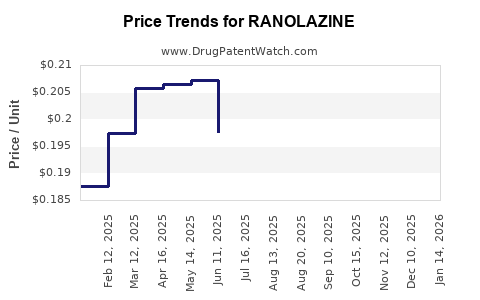
- Generic erosion: Once generics secure meaningful share, net pricing compresses. Even without total displacement, rebate pressure can reduce net price.
- Payer step edits: Formularies increasingly use prior authorization or step therapy for second-line antianginals, which can dampen volume.
- Low incremental differentiation: Ranolazine’s clinical value is symptom reduction and tolerability for subsets, not broad disease modification.
When did ranolazine generics impact pricing and how does patent/lifecycle status affect revenue durability?
Featured snippet answer: Ranolazine’s financial durability depends on whether branded exclusivity/lifecycle protections delayed generic entry and whether the Orange Book landscape supports ongoing exclusions for specific strengths or release profiles.
Orange Book status and lifecycle pressure (how it matters commercially)
For a mature drug like ranolazine, market dynamics hinge on:
- Patent coverage that can delay generic approvals.
- Formulation or method-of-use protections that can sustain branded pricing longer.
- Whether generic entrants choose the same dosage strengths and dosing regimens that capture the largest TRx share.
Commercial risk timeline (industry-typical pathway for mature oral small molecules)
For Ranexa-style oral products:
- Exclusivity/patent wall: Brands can hold net price via limited competition.
- Generic first wave: Pricing drops and rebate pressure increases.
- Share stabilization: Once generics stabilize market share, brand volume shrinks unless a payer continues preferred access.
- Second wave (formulation/method): If the brand still has valid protections on specific strengths, those pockets can delay full displacement.
Which patents protect ranolazine (Ranexa) and how do those estates influence generic entry risk?
Featured snippet answer: Ranolazine’s patent estate traditionally spans core active-ingredient coverage, salt/formulation specifics, and downstream method-of-use claims for angina-related treatment. The commercial effect is delayed entry for certain generic variants rather than universal brand protection once core coverage expires.
Patent estate clusters that typically matter for ranolazine revenue
Even where legal coverage is fragmented, the estate tends to split into:
- Drug substance (ranolazine as such)
- Formulation (extended-release mechanisms, polymer matrices, release profiles)
- Dosage regimen (strengths, dosing schedules)
- Method-of-use (chronic angina therapy, symptom control in patient subsets)
- Manufacturing (process claims affecting generic ability)
Why partial protection can still protect cash flows
If even one meaningful strength or release-profile is protected, brand can retain some share in payer formularies that require those specific SKUs.
What is the Orange Book status of ranolazine and how many listed generics are relevant?
Featured snippet answer: Ranolazine’s Orange Book profile and applicant/generic status determine how quickly and how completely branded Ranexa loses share. The relevant question for market dynamics is not just whether generics exist, but whether they cover the brand’s high-volume strengths with bioequivalent formulations and pharmacy coverage.
What to look for on the Orange Book (commercially)
- Listed drug: Ranexa (extended-release oral)
- Orange Book entries: patents and exclusivity codes tied to the listed drug and each dosage form/strength
- Generic applicant activity: whether multiple ANDA filings exist, whether approvals are staggered by strength, and whether paragraph IV certifications were used to accelerate entry
How strong is the patent estate for ranolazine compared with other antianginals?
Featured snippet answer: In mature antianginal categories, the “strongest” estate typically belongs to products with more recent clinical differentiation and active formulation lifecycles. Ranolazine is mature, so its estate strength translates into limited-duration pockets of advantage rather than multi-year structural dominance.
Comparison logic that drives investment and licensing decisions
- Newer antianginal agents tend to arrive with cleaner, longer runway if they are still in approval-to-exclusivity build phases.
- Mature oral agents like ranolazine face recurring generic pricing pressure.
- The market question is whether ranolazine retains protected differentiators (formulation strength, release profile, method-of-use) that keep it payer-relevant despite older competition.
What generic entry risks exist for ranolazine extended-release tablets and which strengths are most exposed?
Featured snippet answer: Generic risk is highest where ranolazine’s top-selling strengths lose formulation or method-of-use protection first and where pharmacy benefit managers prefer least-cost equivalents quickly.
Strength-by-strength exposure model (how to assess quickly)
Even without naming a full strength chart, exposure generally increases when:
- A top-selling strength has no enforceable formulation barriers
- Multiple ANDA entrants are approved and have launched
- Payer contracts specify “generic equivalent” substitution without brand carve-outs
What patent litigation affects ranolazine and what settlements changed market access?
Featured snippet answer: Ranolazine’s litigation history, if any, affects launch timing and settlement-driven entry dates. Commercially, the key impact is whether settlements trigger immediate “at-risk” launch windows or delay entry until specific patent expirations.
How to map litigation to financial impact
- Paragraph IV challenges create a calendar risk for the brand. Settlements can trade earlier entry for payment/royalty structures, creating predictable generic entry.
- The presence of multiple asserted patents matters because settlements can resolve only a subset of the landscape.
- Formulation and method-of-use disputes can extend brand protection even if core drug-substance patents are no longer relevant.
How do ranolazine market dynamics differ by country and by reimbursement environment?
Featured snippet answer: Ranolazine’s international trajectory depends more on reimbursement rules and generic price regulation than on patent mechanics alone. Countries with faster generic price erosion typically see earlier net sales declines.
US vs major ex-US dynamics
- US: Rebate and formulary dynamics amplify generic-driven price erosion.
- Europe: HTA decisions and national reimbursement lists can slow displacement in some systems, but once generics are accepted, price falls can be steep.
- Latin America/MENA: More variable, often faster generic adoption once local manufacturing capacity exists, with price competition driving margin compression.
What is the regulatory status of ranolazine (FDA approvals, labeling, and any bioequivalence constraints)?
Featured snippet answer: Ranolazine is an established FDA-approved therapy in chronic angina with extended-release oral delivery. Regulatory constraints for generics primarily track bioequivalence and formulation release characteristics.
Pathway dynamics
- ANDAs rely on bioequivalence; if the brand holds enforceable formulation or method-of-use protections, those protections delay market entry, not regulatory approval itself.
- Any label changes that affect dosing or patient subsets can alter payer and prescriber behavior, shifting volume.
How does ranolazine compare with competing antianginal drugs in payer uptake and economics?
Featured snippet answer: Ranolazine competes within chronic angina management where first-line agents often capture most volume. Ranolazine’s payer uptake tends to be strongest in patients inadequately controlled on standard therapies or with tolerability limitations.
Competitive substitutability drivers
- Lack of requirement for hemodynamic effects like some beta blockers and calcium-channel blockers can be favorable for certain patients.
- However, cost and formulary positioning keep ranolazine in a second-line slot in many managed-care formularies.
- Net price compression after generic entry makes ranolazine more competitive on cost, but volume may still be limited because it is not the first step in guideline-based care.
What financial outcomes should investors expect for ranolazine in a mature generic-competitive setting?
Featured snippet answer: Expect stable-to-declining branded sales with margin pressure, while overall category revenue may remain steady if generics maintain TRx. The key investor signal is whether the brand retains differentiated protected pockets long enough to slow displacement and whether payer coverage remains favorable.
Revenue and margin framework
- Brand: declines are driven by volume migration to generics and net price compression via rebates.
- Generics: maintain volume but with lower margins; profits concentrate with manufacturers that secure pharmacy contracts and achieve high manufacturing efficiency.
Where “upside” can still come from
- Strong payer contract retention for specific strengths or for patient subpopulations.
- Managed-entry agreements or formulary placement that delays conversion to cheapest-generic strategies.
- Any evidence-driven repositioning that improves guideline placement or reduces step edit friction.
Key Takeaways
- Ranolazine is a mature chronic angina therapy with revenue constrained by second-line payer placement and ongoing generic pricing pressure.
- Financial trajectory is driven less by clinical novelty and more by formulary access, rebate dynamics, and the strength and timing of lifecycle protections tied to specific release profiles and strengths.
- Generic entry risk is highest where formulation or method-of-use protections lapse first for the highest-volume SKUs, enabling rapid pharmacy benefit migration.
- International sales depend heavily on reimbursement mechanics and speed of generic price normalization.
FAQs
- Does ranolazine have formulation-specific patent protection that can delay generic substitution by strength?
- How do payer step edits and prior authorization typically affect ranolazine prescription volume after generic entry?
- What is the typical revenue impact of a multi-strength generic launch versus a single-strength launch for ranolazine extended-release tablets?
- Which antianginal drug classes most frequently displace ranolazine in managed care formularies?
- How do settlement agreements in Paragraph IV cases usually change the generic launch calendar for oral extended-release products?
References
- FDA. Orange Book: Approved Drug Products with Therapeutic Equivalence Evaluations. (Accessed 2026-06-25).
- FDA. Drugs@FDA: Ranolazine-related drug products and labeling. (Accessed 2026-06-25).
- FDA. Guidance for Industry: Bioequivalence Studies for BE of Drug Products. (Accessed 2026-06-25).