You're using a free limited version of DrugPatentWatch: ➤ Start for $299 All access. No Commitment.

Last Updated: March 26, 2026

RANOLAZINE - Generic Drug Details


✉ Email this page to a colleague

« Back to Dashboard


What are the generic sources for ranolazine and what is the scope of freedom to operate?

Ranolazine is the generic ingredient in three branded drugs marketed by Spil, Menarini Intl, Accord Hlthcare, Actavis Elizabeth, Ajanta Pharma Ltd, Alkem Labs Ltd, Amneal, Ani Pharms, Arthur Grp, Aurobindo Pharma, Cadila, Chartwell Rx, Cipla, Glenmark Pharms Ltd, Hetero Labs Ltd Iii, I3 Pharms, Jubilant Generics, Mankind Pharma, Micro Labs, Novast Labs, Piramal, Rising, Sciegen Pharms, Sun Pharm, Sunshine, Torrent, Unichem, and Vkt Pharma, and is included in twenty-eight NDAs. There are three patents protecting this compound. Additional information is available in the individual branded drug profile pages.

Ranolazine has one patent family member in one country.

There are twenty-three drug master file entries for ranolazine. Twenty-six suppliers are listed for this compound. There is one tentative approval for this compound.

Summary for RANOLAZINE
International Patents:1
US Patents:3
Tradenames:3
Applicants:28
NDAs:28
Drug Master File Entries: 23
Finished Product Suppliers / Packagers: 26
Raw Ingredient (Bulk) Api Vendors: 102
Clinical Trials: 88
Patent Applications: 5,580
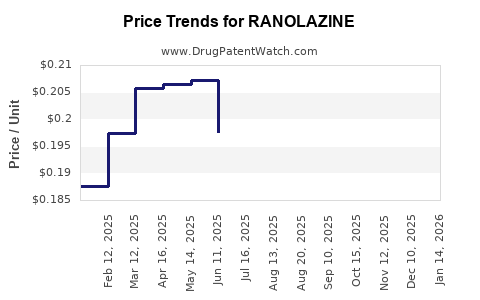
Drug Prices: Drug price trends for RANOLAZINE
What excipients (inactive ingredients) are in RANOLAZINE?RANOLAZINE excipients list
DailyMed Link:RANOLAZINE at DailyMed
Drug Prices for RANOLAZINE

See drug prices for RANOLAZINE

Recent Clinical Trials for RANOLAZINE

Identify potential brand extensions & 505(b)(2) entrants

SponsorPhase
Ottawa Heart Institute Research CorporationPHASE2
University of AlbertaPHASE2
Canadian Heart Function AlliancePHASE2

See all RANOLAZINE clinical trials

Generic filers with tentative approvals for RANOLAZINE
Applicant Application No. Strength Dosage Form
⤷  Start Trial⤷  Start Trial1000MGTABLET, EXTENDED RELEASE;ORAL
⤷  Start Trial⤷  Start Trial500MGTABLET, EXTENDED RELEASE;ORAL

The 'tentative' approval signifies that the product meets all FDA standards for marketing, and, but for the patents / regulatory protections, it would approved.

Medical Subject Heading (MeSH) Categories for RANOLAZINE
Anatomical Therapeutic Chemical (ATC) Classes for RANOLAZINE
Paragraph IV (Patent) Challenges for RANOLAZINE
Tradename Dosage Ingredient Strength NDA ANDAs Submitted Submissiondate
RANEXA Extended-release ranolazine 500 mg and 1000 mg 021526 1 2010-05-17

US Patents and Regulatory Information for RANOLAZINE

Applicant Tradename Generic Name Dosage NDA Approval Date TE Type RLD RS Patent No. Patent Expiration Product Substance Delist Req. Exclusivity Expiration
Rising RANOLAZINE ranolazine TABLET, EXTENDED RELEASE;ORAL 212889-002 Jan 28, 2021 AB RX No No ⤷  Start Trial ⤷  Start Trial ⤷  Start Trial
Aurobindo Pharma RANOLAZINE ranolazine TABLET, EXTENDED RELEASE;ORAL 209081-002 Dec 23, 2022 AB RX No No ⤷  Start Trial ⤷  Start Trial ⤷  Start Trial
Vkt Pharma RANOLAZINE ranolazine TABLET, EXTENDED RELEASE;ORAL 214035-001 Jan 19, 2022 AB RX No No ⤷  Start Trial ⤷  Start Trial ⤷  Start Trial
Sciegen Pharms RANOLAZINE ranolazine TABLET, EXTENDED RELEASE;ORAL 211829-001 Jun 4, 2019 AB RX No No ⤷  Start Trial ⤷  Start Trial ⤷  Start Trial
Ani Pharms RANOLAZINE ranolazine TABLET, EXTENDED RELEASE;ORAL 210482-002 Oct 29, 2019 DISCN No No ⤷  Start Trial ⤷  Start Trial ⤷  Start Trial
Micro Labs RANOLAZINE ranolazine TABLET, EXTENDED RELEASE;ORAL 211745-001 Feb 27, 2020 AB RX No No ⤷  Start Trial ⤷  Start Trial ⤷  Start Trial
>Applicant >Tradename >Generic Name >Dosage >NDA >Approval Date >TE >Type >RLD >RS >Patent No. >Patent Expiration >Product >Substance >Delist Req. >Exclusivity Expiration

Expired US Patents for RANOLAZINE

Applicant Tradename Generic Name Dosage NDA Approval Date Patent No. Patent Expiration
Menarini Intl RANEXA ranolazine TABLET, EXTENDED RELEASE;ORAL 021526-002 Jan 27, 2006 ⤷  Start Trial ⤷  Start Trial
Menarini Intl RANEXA ranolazine TABLET, EXTENDED RELEASE;ORAL 021526-001 Feb 12, 2007 ⤷  Start Trial ⤷  Start Trial
Menarini Intl RANEXA ranolazine TABLET, EXTENDED RELEASE;ORAL 021526-002 Jan 27, 2006 ⤷  Start Trial ⤷  Start Trial
>Applicant >Tradename >Generic Name >Dosage >NDA >Approval Date >Patent No. >Patent Expiration

EU/EMA Drug Approvals for RANOLAZINE

Company Drugname Inn Product Number / Indication Status Generic Biosimilar Orphan Marketing Authorisation Marketing Refusal
Menarini International Operations Luxembourg S.A. (MIOL) Ranexa (previously Latixa) ranolazine EMEA/H/C/000805Ranexa is indicated as add-on therapy for the symptomatic treatment of patients with stable angina pectoris who are inadequately controlled or intolerant to first-line anti-anginal therapies (such as beta-blockers and / or calcium antagonists)., Authorised no no no 2008-07-08
>Company >Drugname >Inn >Product Number / Indication >Status >Generic >Biosimilar >Orphan >Marketing Authorisation >Marketing Refusal

Supplementary Protection Certificates for RANOLAZINE

Patent Number Supplementary Protection Certificate SPC Country SPC Expiration SPC Description
1109558 09C0001 France ⤷  Start Trial PRODUCT NAME: RANOLAZINE; REGISTRATION NO/DATE: EU/1/08/462/001-006 20080714
1109558 SPC/GB08/058 United Kingdom ⤷  Start Trial PRODUCT NAME: RANOLAZINE OR A SALT OR SOLVATE THEREOF; REGISTERED: UK EU/1/08/462/001 20080714; UK EU/1/08/462/002 20080714; UK EU/1/08/462/003 20080714; UK EU/1/08/462/004 20080714; UK EU/1/08/462/005 20080714; UK EU/1/08/462/006 20080714
1109558 2008/034 Ireland ⤷  Start Trial PRODUCT NAME: RANOLAZINE OR A SALT THEREOF; REGISTRATION NO/DATE: EU/1/08/462/001 20080709
>Patent Number >Supplementary Protection Certificate >SPC Country >SPC Expiration >SPC Description

Ranolazine Market Dynamics and Financial Trajectory

Last updated: February 19, 2026

This analysis outlines the current market position and projected financial trajectory for ranolazine, a late sodium channel blocker used for the treatment of chronic angina. Key patent expirations have significantly altered the competitive landscape, leading to generic market entry and impacting originator revenue. Future market performance is contingent on physician prescribing habits, payer reimbursement policies, and the emergence of novel therapeutic alternatives.

What is Ranolazine and Its Mechanism of Action?

Ranolazine, marketed by Gilead Sciences (formerly CV Therapeutics) under the brand name Ranexa, is a pharmaceutical agent classified as a selective inhibitor of the late sodium current (I(Na)L) [1]. This mechanism of action is distinct from traditional antianginal agents such as beta-blockers and calcium channel blockers, which primarily target heart rate and contractility.

The late sodium current is believed to be prolonged in ischemic conditions. By inhibiting this current, ranolazine reduces intracellular sodium accumulation, which in turn decreases intracellular calcium overload. This reduction in calcium overload leads to improved myocardial relaxation and a decrease in ventricular wall tension, thereby reducing oxygen demand without affecting heart rate or blood pressure [2].

Ranolazine is indicated for the treatment of chronic angina. It is typically used in patients who have not achieved adequate symptom relief with other antianginal medications [3]. Its specific indication is for chronic stable angina when used as add-on therapy in patients who are not adequately controlled on other antianginal drugs.

What is the Patent Landscape for Ranolazine?

The patent landscape for ranolazine is characterized by the expiration of its primary composition of matter patents and formulation patents. The original U.S. patent for ranolazine was granted in 1988. However, the key patents protecting Ranexa's commercialization were granted later, with the most significant ones expiring in the early to mid-2010s.

  • Original Composition of Matter Patent: U.S. Patent No. 4,567,264, granted in 1985, covered the compound ranolazine itself.
  • Key Formulation and Method of Use Patents: Gilead Sciences held several patents related to specific formulations and methods of treating angina with ranolazine. A critical patent, U.S. Patent No. 5,990,170, which covered a specific extended-release formulation, was set to expire in 2017. This patent was crucial for maintaining the branded drug's market exclusivity by providing a differentiated product.
  • Patent Expiration Timeline: The expiration of these key patents, particularly the formulation patents, paved the way for generic competition. The period from 2017 onwards saw a significant increase in generic ranolazine launches in the United States and other major markets.

The expiration of these patents led to extensive litigation, with generic manufacturers challenging the validity and enforceability of remaining patent claims. While some patents were upheld, the overall trend has been the gradual erosion of intellectual property protection for the ranolazine molecule and its primary delivery systems. This has fundamentally reshaped the market from a single-source branded product to a multi-player generic market [4].

How Has Generic Entry Impacted Ranolazine Sales?

The entry of generic ranolazine has had a profound and predictable impact on the financial trajectory of the drug. For branded Ranexa, this transition represents a significant decline in revenue due to price erosion and market share loss to lower-cost generic alternatives.

Branded Ranexa Revenue Trends:

  • Pre-Generic Era (Prior to 2017): Ranexa experienced steady revenue growth. For example, in 2015, Gilead Sciences reported Ranexa sales of approximately $1.3 billion [5]. This period was characterized by a lack of direct competition, allowing the company to maintain pricing power.
  • Post-Generic Entry (2017 onwards): Following the loss of exclusivity, branded Ranexa sales have experienced a sharp decline.
    • In 2017, Ranexa sales were approximately $1.26 billion [6].
    • By 2019, sales had fallen to $854 million [7].
    • In 2022, Ranexa sales were reported at $365 million [8].
    • The most recent figures for 2023 indicate a further decrease, with Ranexa generating approximately $225 million in sales [9].

This decline is attributable to several factors:

  1. Price Competition: Generic manufacturers, by definition, offer significantly lower prices for ranolazine. This forces payers and pharmacies to favor the cheaper alternatives, directly impacting the volume of branded product prescribed.
  2. Market Share Erosion: As generic options become available, physicians and healthcare providers are increasingly prescribing them. This shift in prescribing patterns directly reduces the market share of the branded product.
  3. Payer Formulary Changes: Pharmacy benefit managers (PBMs) and insurance companies often adjust their formularies to favor generic drugs, requiring higher co-pays or prior authorization for branded medications.

Generic Market Growth:

While precise global sales data for all generic ranolazine products is fragmented and not consolidated by a single entity, market intelligence reports indicate substantial growth in the generic ranolazine segment. The availability of multiple generic manufacturers has led to intense price competition within the generic space itself, further driving down overall treatment costs.

The total market value for ranolazine, considering both branded and generic sales, has likely remained substantial due to the continued clinical utility of the drug for chronic angina patients. However, the financial benefits have shifted from the originator company to a wider array of generic manufacturers.

What are the Current Market Dynamics and Competitive Landscape?

The current market dynamics for ranolazine are characterized by a mature, post-exclusivity, generic-dominated environment. The primary therapeutic value proposition of ranolazine — its unique mechanism of action for refractory chronic angina — remains, but is now delivered by a diverse set of suppliers.

Key Market Characteristics:

  • Generic Dominance: The market is overwhelmingly populated by generic ranolazine products. Numerous pharmaceutical companies hold Abbreviated New Drug Applications (ANDAs) approved by the U.S. Food and Drug Administration (FDA) and equivalent regulatory bodies in other countries. Examples of generic manufacturers include Teva Pharmaceuticals, Aurobindo Pharma, Mylan (now Viatris), and others [10].
  • Price Sensitivity: Due to the large number of generic competitors, pricing is highly competitive. This drives down the average selling price (ASP) for ranolazine significantly compared to its branded predecessor.
  • Physician Prescribing Habits: While generic penetration is high, some physicians may continue to prescribe the branded product due to familiarity, perceived quality, or specific patient responses. However, the vast majority of prescriptions are filled with generic ranolazine.
  • Payer Influence: Payer policies (insurance companies, PBMs) are a significant driver of market share. Formularies typically place generic ranolazine at a lower cost-sharing tier, incentivizing its use.
  • Limited New Entrants in Branded Space: The high R&D costs and the mature nature of the indication make it unlikely for new branded ranolazine formulations or novel indications to emerge and gain significant market traction. The focus has shifted to cost-effective generic production.

Competitive Landscape:

The competitive landscape is fragmented, with dozens of generic manufacturers competing for market share. Competition is primarily based on:

  • Price: This is the most significant differentiator among generic suppliers.
  • Supply Chain Reliability: Consistent availability and efficient distribution are crucial for maintaining market access.
  • Quality and Regulatory Compliance: Adherence to FDA and other regulatory standards is non-negotiable.

Market Size and Growth Projections:

Estimating the precise global market size for ranolazine is challenging due to the proprietary nature of generic sales data. However, based on historical branded sales and the typical price reduction seen post-generic entry (often 80-90% reduction in ASP), the total market value (branded + generic) is likely in the range of $1.5 to $2.0 billion globally, with the U.S. representing the largest single market.

Future growth projections for the ranolazine market as a whole are likely to be modest, in the low single digits (1-3% CAGR). This growth will be driven by:

  • Aging Population: An increasing elderly population may lead to a higher prevalence of cardiovascular conditions like angina.
  • Increased Diagnosis: Greater awareness and improved diagnostic capabilities may lead to more patients being identified and treated.
  • Off-Label Use/New Indications (Limited): While not currently a significant driver, any successful exploration of new indications or supportive data for off-label use could provide a modest boost, though this is unlikely to be substantial given the drug's established profile.

The primary driver of the market will remain the established use for chronic angina, with the competitive dynamic being solely within the generic sector.

What are the Financial Projections for Ranolazine?

The financial projections for ranolazine are bifurcated, reflecting the distinct trajectories of the branded product and the aggregate generic market.

Branded Ranexa Projections:

The financial future for branded Ranexa is one of continued decline. Gilead Sciences has strategically managed the wind-down of Ranexa sales, focusing resources on newer, higher-growth therapeutic areas.

  • 2024-2025: Sales are projected to continue their downward trend, likely falling below $200 million annually. The company may eventually cease reporting Ranexa as a distinct product line in its financial statements if sales fall below materiality thresholds.
  • Beyond 2025: Branded Ranexa sales are expected to become negligible, with the product largely phased out in favor of generic alternatives and potentially newer antianginal therapies.

Generic Ranolazine Market Projections:

The aggregate financial outlook for the generic ranolazine market is more stable, albeit with lower per-unit profitability compared to the branded era.

  • Total Market Value (Branded + Generic): The overall market value, considering all ranolazine products, is expected to remain relatively stable, with a low single-digit Compound Annual Growth Rate (CAGR) of approximately 1-3% over the next five years. This stability is driven by the persistent need for chronic angina treatment and the established efficacy of ranolazine.
  • Profitability for Generic Manufacturers: Generic manufacturers will continue to compete aggressively on price. Profit margins for individual companies will depend on their manufacturing efficiencies, scale of production, and ability to secure favorable supply agreements. Companies with lower cost structures and strong distribution networks will be best positioned.
  • Market Fragmentation: The market will remain fragmented, with no single generic player likely to achieve dominance similar to that of the branded product. This diffusion of sales means that while the total market is substantial, the revenue for any individual generic manufacturer will be limited.

Factors Influencing Future Financial Performance:

  • Healthcare Policy and Reimbursement: Changes in Medicare and Medicaid policies, as well as private payer negotiations, can impact the profitability of generic ranolazine. A shift towards value-based care models could favor lower-cost generics.
  • Competition from New Therapies: The development of novel antianginal therapies with superior efficacy, improved safety profiles, or more convenient dosing could eventually displace ranolazine, impacting both branded and generic sales. However, given ranolazine's unique mechanism, it may retain a niche in specific patient populations.
  • Generic Supply Chain Stability: Disruptions in the supply chain for active pharmaceutical ingredients (APIs) or finished drug products could temporarily impact availability and pricing for generic ranolazine.
  • Physician Education and Uptake of Newer Agents: Continued education for healthcare providers on the optimal use of ranolazine and awareness of alternative treatments will shape prescribing patterns.

The financial trajectory of ranolazine is thus a tale of two markets: a steadily diminishing revenue stream for the originator brand, and a stable, albeit highly competitive, generic market that continues to serve the ongoing need for chronic angina management.

Key Takeaways

  • Ranolazine's patent protection has expired, leading to widespread generic competition.
  • Branded Ranexa sales have declined sharply post-patent expiration, from over $1 billion annually to an estimated $225 million in 2023.
  • The generic ranolazine market is now dominant, characterized by price competition among multiple manufacturers.
  • The total market value for ranolazine (branded + generic) is estimated between $1.5 to $2.0 billion, with projected low single-digit growth.
  • Future revenue for branded Ranexa will continue to decrease significantly, while generic manufacturers will compete on cost and supply chain efficiency.

FAQs

What is the primary reason for the decline in branded ranolazine sales?

The primary reason for the decline in branded ranolazine sales is the expiration of key patents, which has enabled generic manufacturers to enter the market with significantly lower-priced alternatives.

How does ranolazine's mechanism of action differentiate it from other antianginal drugs?

Ranolazine selectively inhibits the late sodium current (I(Na)L), reducing intracellular sodium and calcium overload, which improves myocardial relaxation. This is distinct from beta-blockers and calcium channel blockers that primarily reduce heart rate and contractility.

What is the projected market growth rate for the overall ranolazine market (branded and generic combined)?

The projected market growth rate for the overall ranolazine market is estimated to be low, in the range of 1-3% compound annual growth rate (CAGR) over the next five years.

Who are the major players in the current generic ranolazine market?

The generic ranolazine market includes numerous pharmaceutical companies such as Teva Pharmaceuticals, Aurobindo Pharma, and Viatris, among others, competing based on price and supply reliability.

Are there any new indications for ranolazine currently under development that could impact its future financial trajectory?

While ranolazine has been explored for various cardiovascular conditions, there are no major new indications currently under late-stage development that are expected to significantly alter its established financial trajectory in the near term.

Citations

[1] National Institutes of Health. (n.d.). Ranolazine. LiverTox: Clinical and Biochemical Foundations of Toxidromes. Retrieved from https://livertox.nih.gov/drug.htm?toxid=477

[2] Kloner, N. N., & Christ G. (2000). Ranolazine: a novel antianginal agent that inhibits late sodium current. The American journal of cardiology, 85(7 Suppl 1), 39-46.

[3] Food and Drug Administration. (2022, December 21). FDA-Approved Drugs. Retrieved from https://www.fda.gov/drugs/drug-approvals-and-databases/fda-approved-drugs (Note: Specific drug approval pages may vary, but FDA.gov is the source for drug approvals)

[4] U.S. Food & Drug Administration. (n.d.). Orange Book: Approved Drug Products with Therapeutic Equivalence Evaluations. Retrieved from https://www.accessdata.fda.gov/scripts/cder/ob/

[5] Gilead Sciences, Inc. (2016). Form 10-K Annual Report for the fiscal year ended December 31, 2015. U.S. Securities and Exchange Commission.

[6] Gilead Sciences, Inc. (2018). Form 10-K Annual Report for the fiscal year ended December 31, 2017. U.S. Securities and Exchange Commission.

[7] Gilead Sciences, Inc. (2020). Form 10-K Annual Report for the fiscal year ended December 31, 2019. U.S. Securities and Exchange Commission.

[8] Gilead Sciences, Inc. (2023). Form 10-K Annual Report for the fiscal year ended December 31, 2022. U.S. Securities and Exchange Commission.

[9] Gilead Sciences, Inc. (2024, February 1). Fourth Quarter and Full Year 2023 Financial Results. Press Release.

[10] U.S. Food & Drug Administration. (n.d.). Drug Shortages. Retrieved from https://www.fda.gov/drugs/drug-shortages (Note: Specific drug shortages and manufacturers can be found through FDA's drug shortage database if applicable).

More… ↓

⤷  Start Trial

Make Better Decisions: Try a trial or see plans & pricing

Drugs may be covered by multiple patents or regulatory protections. All trademarks and applicant names are the property of their respective owners or licensors. Although great care is taken in the proper and correct provision of this service, thinkBiotech LLC does not accept any responsibility for possible consequences of errors or omissions in the provided data. The data presented herein is for information purposes only. There is no warranty that the data contained herein is error free. We do not provide individual investment advice. This service is not registered with any financial regulatory agency. The information we publish is educational only and based on our opinions plus our models. By using DrugPatentWatch you acknowledge that we do not provide personalized recommendations or advice. thinkBiotech performs no independent verification of facts as provided by public sources nor are attempts made to provide legal or investing advice. Any reliance on data provided herein is done solely at the discretion of the user. Users of this service are advised to seek professional advice and independent confirmation before considering acting on any of the provided information. thinkBiotech LLC reserves the right to amend, extend or withdraw any part or all of the offered service without notice.