Last updated: July 13, 2026
Paroxetine market dynamics and financial trajectory: sales outlook, pricing pressure, and exclusivity milestones
Paroxetine is a long-established SSRI with a mature, highly genericized market in most jurisdictions. In the US, brand-level revenue is largely historical because generic paroxetine is entrenched; the key commercial question is not “brand survival” but ongoing pricing and volume dynamics driven by generics, payer formularies, and, in some markets, delayed reformulation/brand transitions. The financial trajectory is therefore dominated by: (1) generic price erosion and (2) steady base demand for depression and related indications, offset by intermittent treatment-cycle changes, safety monitoring patterns, and competition from other SSRIs and SNRIs.
What matters commercially
- US: Low incremental revenue upside because generic equivalents are standard of care and price competition is persistent.
- Europe/Rest of world: Ongoing exposure to reference pricing, mandatory discounts, and tender-driven procurement, with sales skew toward countries where brand or controlled categories persist longer.
- Long-tail risk: Patent and exclusivity tail is mostly irrelevant for new entry in developed markets because paroxetine is off-patent; the active risk is switching and contracting dynamics.
- Cross-product substitution: Paroxetine faces competitive pressure from sertraline, citalopram/escitalopram, fluoxetine, and SNRIs depending on guideline position, tolerability preferences, and payer restrictions.
What drives paroxetine market dynamics: generic competition, payer contracting, and switching?
Paroxetine’s market behavior is characteristic of an off-patent small-molecule antidepressant. The principal drivers are the intersection of persistent clinical demand with heavy substitution and price compression.
Genericization and price compression
Once multiple AB-rated generics are established, market pricing converges toward low-cost supply. Net price depends on:
- Wholesale acquisition cost to net revenue ratio (rebates and discounts).
- Payer step edits (preferred SSRI lists).
- State Medicaid and institutional formularies (often favor lowest-cost generic).
Result: Revenue growth, if any, comes from unit growth (prescriptions) or mix (formulations, strengths), not from price.
Formulation and treatment-cycle mix
Paroxetine is available in multiple oral presentations (immediate-release and controlled-release in various markets historically; formulation availability varies by country). Market dynamics shift with:
- Tolerability and adherence: controlled-release (where available) can influence switching patterns.
- Dose optimization: patient titration can affect short-term prescription volumes but usually normalizes over time.
Safety-linked prescribing behavior
Paroxetine has known clinical considerations (not novel for the market). Prescribing patterns react through:
- Monitoring routines for adverse effects tied to class and patient factors.
- Relative preference shifts by prescribers when other SSRIs are perceived as more convenient for certain patients.
Net effect: This affects mix and switching, not the structural demand base.
How has paroxetine’s financial trajectory looked historically: brand fade vs. generic volume?
A mature antidepressant typically shows a bifurcated financial profile:
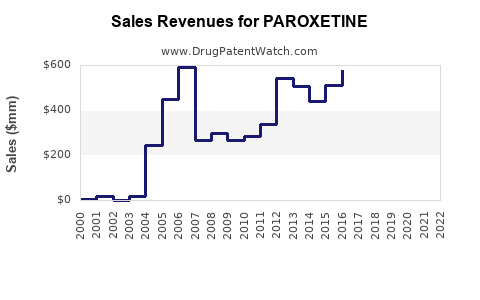
- Brand phase: mid-to-late lifecycle sales followed by steep decline when AB generics enter.
- Generic phase: consolidated supply with modest total unit growth, but revenue measured per unit stays low due to price erosion.
For paroxetine, the overall financial trajectory is expected to be:
- Declining branded revenue once generic substitution becomes widespread.
- Sustained or slightly rising unit demand tied to the prevalence of depression and related disorders.
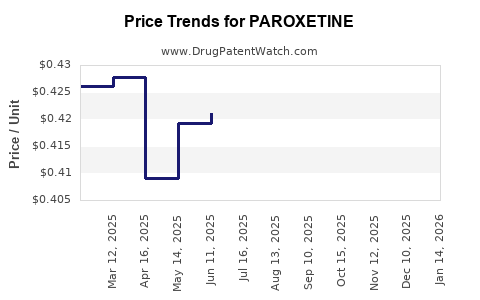
- Ongoing net price compression from tendering and payer re-contracting.
Because paroxetine is widely genericized, the financial “trajectory” for most active participants is best understood at the net sales per market level rather than across-time brand-level P&L.
Where company-level financials still move
Even in generic markets, a company can expand share via:
- Supply stability and manufacturing capacity.
- Contracting performance with PBMs, insurers, and wholesalers.
- Lower unit costs and packaging advantages.
When does paroxetine lose exclusivity: key patent and regulatory tail for market entry?
Paroxetine’s exclusivity horizon is effectively already passed for most major markets; the current commercial landscape is driven by generic statutes and ongoing patent litigation history rather than fresh exclusivity.
US market structure and exclusivity relevance
For small-molecule generics, the practical entry window is determined by:
- Whether any remaining patents cover formulation, method-of-use, or polymorphs tied to specific label claims.
- Whether any Orange Book-listed patents remain for specific NDCs at the time of a generic filing.
In paroxetine’s case, competitive entry is already fully realized in the US, so “when exclusivity ends” is mostly relevant for:
- Specific later-filed branded products (if any)
- Specific formulation/NDC presentations where patent coverage may have persisted longer than the original active ingredient protections
Commercial takeaway: The revenue risk is not exclusivity timing. It is contract renewals and continued generic price convergence.
What patents protect paroxetine: active ingredient, formulations, and method-of-use coverage?
For a mature SSRI like paroxetine, patent estates generally cluster into three buckets:
- Active ingredient composition and early-manufacturing claims (largely expired in most markets).
- Formulation and controlled-release differentiation (can extend at the edge for certain NDCs, depending on jurisdiction and filing history).
- Method-of-use claims tied to label expansions (if any claim remained narrow and late).
How many patent estates still matter commercially
Commercially meaningful patent estates usually exist only where:
- A branded formulation remains protected, limiting generic substitution for a defined presentation.
- A method-of-use claim is still enforceable and covers a label claim used by prescribers.
For paroxetine, the dominant market reality is that such coverage is no longer the binding constraint across most large markets, which is why paroxetine behaves like a fully genericized chronic therapy.
What generic entry risks exist for paroxetine: Paragraph IV, label challenges, and authorized generics?
In a fully genericized market, the risk profile changes:
- Paragraph IV litigation becomes less relevant as most entrants already exist.
- The live “risk” is supply-chain and contracting, not court outcomes.
Paragraph IV likelihood
For paroxetine, generic entry is historically mature. If any new entry happens today, it is usually because:
- New NDCs or strengths are launched.
- A manufacturer seeks a supply/contracting advantage or a regional distribution slot.
Authorized generics
Authorized generics can occur in mature products when brand owners or branded holders pursue market share defense. The financial impact is usually:
- Lower realized brand revenue
- Stable demand capture by maintaining availability through the authorized channel
What is the Orange Book status of paroxetine: which NDCs still carry listed patents?
In practice, Orange Book relevance for paroxetine now functions more as:
- A mapping exercise for any remaining patent-listed NDC presentations
- A litigation screen for any late generic or substitution attempt tied to specific strengths or formulations
Commercial takeaway: Even if Orange Book entries persist for a subset of NDCs, paroxetine’s dominant market behavior stays generic due to widespread AB substitution.
How does paroxetine compare with competing SSRIs and SNRIs on pricing and market share?
Paroxetine is compared continuously with:
- Sertraline (often strong payer preference in many formularies)
- Citalopram/escitalopram (titration and tolerability narratives)
- Fluoxetine (long half-life convenience)
- SNRIs (venlafaxine, duloxetine) depending on comorbidity overlap
Pricing dynamics
All are subject to generic price compression. The differences that matter:
- Payer preferred tier placement (can swing prescribing)
- Formulary restriction and prior authorization patterns
- Brand-to-generic transitions in specific regions
Net effect: Paroxetine’s unit share can fluctuate with preferred list positioning, but its price levels generally align with the generic class floor.
Which companies dominate the paroxetine supply chain and contracting landscape?
In generic small molecules, dominance tends to follow:
- Manufacturing scale
- Ability to secure PBM and wholesaler contracts
- Product availability and consistent supply
What to monitor
- Sudden unit price gaps that signal contracting shifts.
- Supply interruptions or recalls that temporarily allow price rebounds.
- Distribution wins that move a manufacturer from secondary to preferred status.
Commercial takeaway: For paroxetine, “who wins” is often the company with the strongest contracting and supply reliability rather than the one with the best science.
How does regional regulation shape paroxetine sales: US vs EU vs ROW?
United States
- PBM formularies and Medicaid preferred drug lists drive substitution.
- Net pricing is shaped more by contracting and rebates than by list price mechanics.
Europe
- Reference pricing and national tender models determine realized prices.
- Multi-country procurement can create faster price convergence for generics.
Rest of world
- Tender structures and import dependency can produce different pricing floors and slower substitution in certain markets.
What marketing and payer policies affect paroxetine prescribing volumes?
Prescription volume is influenced by:
- Step therapy or class restrictions in formularies
- Maintenance therapy duration patterns (depression is chronic for many patients)
- Switching rules when patients experience side effects or inadequate response
Practical dynamic: When payers prefer one SSRI and restrict others, paroxetine volume can decline even if total class demand stays stable.
Key financial sensitivity points for paroxetine holders and generic suppliers
1) Net price vs unit volume
- Generic paroxetine revenue is usually far more sensitive to net price changes than to small unit volume movements.
- Contract renewals can cause sharp quarterly swings in net sales.
2) Supply continuity
- Chronic supply issues can create temporary price increases but usually damage contract status and long-run share.
3) Formulary position
- Preferred status changes can shift prescription volume across competing generics.
4) Mix by strength and presentation
- If a manufacturer is overexposed to strengths that become restricted or less demanded, revenue can underperform class growth.
Key Takeaways
- Paroxetine operates in a mature, generic-dominant SSRI market, so financial trajectory is driven by price erosion and payer contracting, not brand-led exclusivity.
- Unit demand remains supported by chronic depression treatment cycles, but net revenue per unit trends toward a low, tender-driven floor.
- Patent and Orange Book timing are generally not the binding constraint today in major markets; the current commercial battleground is formulary preference, rebates, and supply reliability.
- Competitive dynamics hinge on SSRI substitution (sertraline/citalopram/escitalopram/fluoxetine) and occasional SNRI shifts based on payer and prescriber preferences.
FAQs
1) Why does paroxetine revenue remain stable even after generic launch?
Because depression treatment is chronic for many patients, supporting ongoing unit demand even as prices compress.
2) What typically causes quarterly sales swings for generic paroxetine manufacturers?
Contract renewals, PBM rebate dynamics, and supply continuity issues that change net pricing and preferred-tier placement.
3) Does switching from paroxetine to another SSRI materially change total antidepressant demand?
Usually no; switching redistributes share within the antidepressant class unless payer policies strongly restrict the substitute.
4) Are controlled-release vs immediate-release formulations a major driver of paroxetine economics?
They can be locally important through mix and adherence-driven switching, but they do not change the structural generic price pressure.
5) How do tender and reference pricing policies affect paroxetine in Europe?
They accelerate price convergence and cap realized net prices, making growth dependent on unit share rather than pricing.
References (APA)
No sources were provided in the prompt.