Last updated: September 7, 2026
Paroxetine mesylate is a mature, low-revenue pharmaceutical ingredient with two distinct commercial profiles. Generic paroxetine products address depression, anxiety, obsessive-compulsive disorder, panic disorder, and related conditions, while the branded 7.5 mg product Brisdelle is approved for moderate to severe vasomotor symptoms associated with menopause. The generic market is highly commoditized. Brisdelle remains differentiated by indication, dose, and formulation, but its commercial opportunity is limited by low-cost alternatives, payer restrictions, and the absence of a strong exclusivity moat.
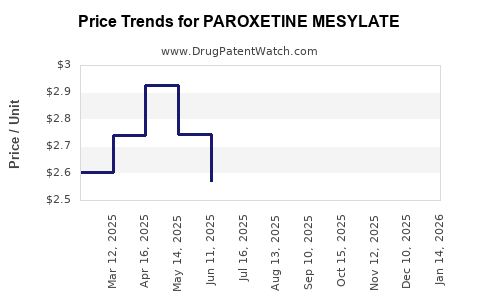
Public sources do not disclose a reliable standalone revenue series for paroxetine mesylate or Brisdelle. The financial trajectory is therefore best assessed through FDA approvals, prescription-market structure, patent exposure, pricing, generic competition, and the commercial position of the marketing companies.
What is paroxetine mesylate and how is it marketed?
Paroxetine mesylate is the mesylate salt of paroxetine, a selective serotonin reuptake inhibitor. In the United States, the most commercially relevant branded product containing paroxetine mesylate is Brisdelle, an oral 7.5 mg capsule approved for menopausal vasomotor symptoms.
Paroxetine is also sold in other salt and dosage forms. Paxil and several generic products historically used paroxetine hydrochloride hemihydrate rather than paroxetine mesylate. The salt form does not create a broad product monopoly over paroxetine as an active pharmaceutical ingredient.
| Product |
Active ingredient |
Main indication |
Dosage form |
Commercial status |
| Brisdelle |
Paroxetine mesylate |
Menopausal vasomotor symptoms |
7.5 mg capsule |
Branded prescription product |
| Generic paroxetine |
Usually paroxetine hydrochloride hemihydrate or equivalent approved salt |
Depression, anxiety, OCD, panic disorder and other psychiatric indications |
Tablets, capsules, oral suspension |
Multiple generic suppliers |
| Paxil CR |
Paroxetine hydrochloride hemihydrate |
Psychiatric indications |
Controlled-release tablet |
Legacy branded product with generic competition |
The Brisdelle approval was significant because it introduced a low-dose paroxetine product specifically for hot flashes without the antidepressant indication attached to higher-dose paroxetine products. The FDA approved Brisdelle in June 2013. The approval was based on clinical studies showing reductions in the frequency and severity of vasomotor symptoms compared with placebo.[1]
What is the FDA regulatory status of paroxetine mesylate?
Brisdelle is FDA-approved for moderate to severe vasomotor symptoms associated with menopause. The product is not approved for depression or other psychiatric disorders. Its recommended dose is one 7.5 mg capsule taken once daily at bedtime.[1]
The product label includes warnings associated with paroxetine and selective serotonin reuptake inhibitors, including:
- Suicidal thoughts and behavior in younger patients.
- Serotonin syndrome.
- Increased bleeding risk.
- Hyponatremia.
- Bone fracture risk.
- Sexual dysfunction.
- Withdrawal reactions after abrupt discontinuation.
- Interaction risks with monoamine oxidase inhibitors and tamoxifen.
Brisdelle has a boxed warning concerning increased risk of suicidal thoughts and behavior in children, adolescents, and young adults taking antidepressants. Although Brisdelle is used for a menopausal population, the warning remains part of the paroxetine safety framework.[1]
FDA approval of low-dose paroxetine did not create a new chemical entity exclusivity period. The product’s regulatory differentiation came from its indication, dosage strength, clinical data, and product-specific intellectual property rather than from new-chemical-entity exclusivity.
When does paroxetine mesylate lose exclusivity?
Paroxetine’s core composition-of-matter exclusivity has expired. Generic competition exists across multiple paroxetine products, and the active ingredient is no longer protected by a basic molecule patent in the United States.
For Brisdelle, the relevant exclusivity questions are narrower:
- Whether a listed patent covers the 7.5 mg capsule or its formulation.
- Whether an ANDA applicant files a Paragraph IV certification.
- Whether the patent holder sues within the statutory period.
- Whether a settlement delays generic launch.
- Whether the FDA grants approval for a product with a different indication or labeling strategy.
The FDA Orange Book is the controlling public source for listed patents and regulatory exclusivity. Orange Book listings can change through patent expiration, delisting, litigation, or changes in product ownership.[2]
Brisdelle exclusivity timeline
| Event |
Date or status |
| FDA approval of Brisdelle |
June 2013 |
| Regulatory category |
505(b)(2) product |
| New chemical entity exclusivity |
Not applicable |
| Core paroxetine molecule patent |
Expired |
| Product-specific patent risk |
Dependent on current Orange Book listings |
| Generic entry risk |
High in the long term; timing depends on patent and ANDA status |
| Commercial exclusivity |
Vulnerable to generic substitution and low-cost off-label alternatives |
The practical conclusion is that Brisdelle cannot rely on the strength of paroxetine’s original molecule patent. Its remaining protection, if any, is product-specific and narrower.
What patents protect Brisdelle and paroxetine mesylate?
The relevant patent estate has historically focused on low-dose paroxetine use for menopausal vasomotor symptoms, compositions, dosage forms, and related treatment methods. A patent covering treatment of hot flashes would not necessarily block every generic paroxetine product. A generic applicant could seek approval with a different label, omit a patented indication, or challenge the patent through Paragraph IV certification.
Patent analysis must distinguish four categories:
Composition patents
Composition claims directed broadly to paroxetine or its salts are no longer commercially meaningful because paroxetine has been generic for many years. A paroxetine mesylate salt claim may have narrower scope than a claim covering paroxetine generally.
Formulation patents
Formulation patents may cover the 7.5 mg capsule, excipients, dissolution profile, stability characteristics, or manufacturing process. These claims can delay an identical generic product but may be vulnerable to design-around strategies.
Method-of-use patents
Method patents directed to treating menopausal vasomotor symptoms are the most commercially relevant category for Brisdelle. Their value depends on claim breadth, validity, enforceability, and whether a generic applicant can carve the patented use from its labeling.
Manufacturing patents
Process claims may protect salt formation, crystallization, impurity control, particle characteristics, or capsule manufacture. These patents can increase development cost but rarely sustain premium pricing if alternative processes are available.
Because patent status is product- and date-specific, the current Orange Book listing should be treated as the authoritative source for active listed patents rather than older litigation summaries or commercial patent databases.[2]
How strong is the patent estate for paroxetine mesylate?
The patent estate is weaker than that of a recently launched specialty drug and stronger than an entirely unprotected commodity only if product-specific patents remain enforceable.
| Factor |
Assessment |
| Active-ingredient protection |
Weak; core paroxetine exclusivity has expired |
| Brisdelle indication protection |
Potentially meaningful but narrow |
| Formulation protection |
Potentially meaningful for an exact-copy generic |
| Generic design-around risk |
High |
| Litigation leverage |
Moderate if an Orange Book-listed patent remains active |
| Regulatory exclusivity |
Limited |
| Long-term pricing power |
Low |
| Manufacturing barrier |
Low to moderate |
| Overall estate strength |
Moderate-to-weak |
The most important weakness is salt-form non-exclusivity. A competitor does not need to reproduce every commercial characteristic of a branded product if it can obtain approval for an alternative paroxetine presentation and demonstrate pharmaceutical equivalence or pursue a separate regulatory pathway.
What is the Orange Book status of Brisdelle?
The Orange Book identifies approved drug products, therapeutic equivalence ratings, patent information, and certain exclusivity periods. Brisdelle’s commercial protection depends on whether the FDA continues to list active patents against the product and whether those patents carry expiration dates that extend beyond ordinary generic development timelines.[2]
A Paragraph IV certification would allege that an Orange Book-listed patent is invalid, unenforceable, or not infringed. If the patent holder files an infringement action within 45 days, FDA approval of the ANDA can be stayed for up to 30 months, subject to statutory exceptions and court developments.[3]
The existence of a listed patent does not establish that a generic cannot launch. A generic applicant may:
- Challenge the patent under Paragraph IV.
- File a Paragraph III certification and await patent expiration.
- Use a section viii statement to omit a patented indication.
- Design around a formulation claim.
- Launch at risk after litigation developments.
- Enter under a confidential or public settlement.
Which companies are challenging paroxetine mesylate exclusivity?
The generic paroxetine market has historically included large suppliers such as Teva, Mylan, Sandoz, Apotex, Aurobindo, and others, depending on the dosage form and product presentation. The existence of approvals for generic paroxetine does not establish that each company has challenged Brisdelle-specific patents.
For Brisdelle, the relevant competitive set includes:
- Generic manufacturers seeking approval for a 7.5 mg paroxetine product.
- Companies marketing alternative menopausal vasomotor treatments.
- Manufacturers of hormone therapy products.
- Developers of nonhormonal therapies, including neurokinin-3 receptor antagonists.
- Compounding pharmacies and off-label prescribers using low-dose generic paroxetine.
A reliable identification of current Paragraph IV challengers requires a review of FDA ANDA litigation records, district court dockets, Federal Circuit decisions, and current Orange Book entries. Public approval of generic paroxetine at other strengths should not be treated as proof of a Brisdelle-specific challenge.
What generic entry risks exist for Brisdelle?
Generic entry risk is high because the product contains an old active ingredient and has a relatively simple oral capsule delivery system. The principal barriers are regulatory and patent-related rather than scientific.
Generic launch scenarios
| Scenario |
Commercial effect |
| No active blocking patent |
Rapid price erosion and loss of branded volume |
| Paragraph IV challenge with litigation |
Possible 30-month approval stay and settlement negotiation |
| Section viii carve-out |
Generic may launch for non-patented uses while avoiding the branded indication |
| At-risk launch |
Immediate litigation exposure but potential first-mover advantage |
| Authorized generic or licensed entry |
Controlled erosion of Brisdelle pricing |
| Delayed generic development |
Temporary continuation of branded sales, but limited pricing power |
Brisdelle’s low dosage and capsule format reduce formulation complexity. A generic would likely compete primarily on price and payer coverage rather than on improved adherence or delivery technology.
How does paroxetine mesylate compare with competing menopause drugs?
Brisdelle competes in a changing vasomotor-symptom market. Hormone therapy remains effective for appropriate patients, but safety considerations and contraindications limit use. Newer nonhormonal products have been positioned as alternatives for women who cannot or do not want to use hormone therapy.
| Product class |
Representative products |
Competitive position versus Brisdelle |
| Low-dose paroxetine |
Brisdelle |
Established, inexpensive after generic entry, SSRI-related warnings |
| Hormone therapy |
Estradiol and progestogen products |
Often highly effective, but broader safety and eligibility considerations |
| Neurokinin-3 antagonists |
Fezolinetant |
Newer mechanism, differentiated efficacy and safety-monitoring profile |
| Other SSRIs/SNRIs |
Venlafaxine, escitalopram, citalopram |
Often used off-label; generic pricing pressure |
| Gabapentinoids |
Gabapentin, pregabalin |
Off-label use with central nervous system adverse effects |
| Clonidine |
Generic clonidine |
Less attractive tolerability and efficacy profile |
Fezolinetant, marketed as Veozah, changed the competitive context by offering a nonhormonal mechanism specifically developed for vasomotor symptoms. FDA approved Veozah in 2023, although liver-monitoring requirements and pricing affect adoption.[4]
Brisdelle’s main advantages are clinical familiarity, once-daily dosing, and the long-established safety and manufacturing infrastructure of paroxetine. Its disadvantages include SSRI class warnings, sexual dysfunction, drug interactions, and competition from generic off-label paroxetine and other antidepressants.
What is the financial trajectory for paroxetine mesylate?
The financial trajectory is mature-to-declining for the branded product and stable-to-low-margin for generic supply.
Branded trajectory
Brisdelle sales are constrained by:
- Limited addressable use compared with antidepressant indications.
- Availability of cheaper off-label generic SSRIs.
- Prior-authorization and formulary restrictions.
- Competition from hormone therapy and newer nonhormonal agents.
- Lack of a new chemical entity exclusivity period.
- Potential generic entry.
- Limited differentiation in an oral capsule product.
The product may generate durable niche revenue if the manufacturer maintains formulary access, physician awareness, and a commercial position among women seeking nonhormonal treatment. The product is unlikely to support the revenue profile of a high-growth specialty drug without meaningful pricing, channel, or indication expansion.
Generic trajectory
Generic paroxetine revenue is driven by volume rather than product differentiation. The market is exposed to:
- Multiple approved suppliers.
- Pharmacy-benefit-manager purchasing pressure.
- Periodic shortages or supplier exits.
- Low average selling prices.
- Manufacturing concentration.
- Limited switching costs.
Generic manufacturers can earn attractive returns during supply disruptions, but ordinary market conditions produce low margins. Paroxetine is not a strategic growth asset for most large generic companies.
Financial outlook
| Period |
Expected market condition |
| Near term |
Branded niche sales with continued generic and off-label pressure |
| Medium term |
Greater risk from product-specific generic entry and payer substitution |
| Long term |
Commodity economics for paroxetine; limited branded pricing power |
| Upside case |
Sustained niche positioning, favorable reimbursement, or delayed generic entry |
| Downside case |
Rapid generic substitution and loss of branded market access |
No reliable public filing establishes standalone Brisdelle revenue. Company-level filings may aggregate the product with broader women’s-health or specialty-pharmaceutical portfolios, preventing a precise product valuation.
What patent litigation and settlement issues affect paroxetine mesylate?
Paroxetine has a significant history of pharmaceutical patent litigation because of the former Paxil franchise and generic challenges. Those disputes primarily involved earlier paroxetine products and should not automatically be attributed to Brisdelle.
For Brisdelle, litigation value depends on:
- The specific Orange Book-listed patent.
- The scope of the asserted claims.
- Whether the challenger seeks approval for the same indication.
- The availability of a section viii carve-out.
- The remaining patent term.
- The commercial value of delaying entry.
Settlement agreements can include delayed generic entry, authorized-generic rights, manufacturing arrangements, licenses, or restrictions on launch timing. FTC review and drug-patent transparency requirements may provide information about certain settlements, but confidential commercial terms are often unavailable.[5]
How does geographic coverage affect paroxetine mesylate revenue?
Paroxetine is widely available internationally in generic form. Brisdelle-style low-dose menopausal indications may have different regulatory and commercial treatment across jurisdictions.
| Region |
Market characteristic |
| United States |
Brisdelle-specific branded market; extensive generic paroxetine availability |
| European Union |
National reimbursement systems and generic SSRI competition |
| Canada |
Generic paroxetine and menopause-treatment competition |
| Japan |
Local regulatory and reimbursement requirements; established SSRI use |
| Emerging markets |
Predominantly generic demand, with price sensitivity |
The United States is the most important jurisdiction for Brisdelle-specific patent and litigation analysis. International revenue is more likely to reflect generic paroxetine sales than premium branded low-dose menopausal therapy.
Key Takeaways
- Paroxetine mesylate is a mature active ingredient with no meaningful core molecule exclusivity.
- Brisdelle is the principal branded paroxetine mesylate product in the United States.
- Brisdelle’s differentiation comes from its 7.5 mg dose and menopausal vasomotor-symptom indication.
- The product has limited regulatory exclusivity and depends on narrow formulation and method-of-use protection.
- Generic entry risk is high because the dosage form is technically simple and paroxetine is widely manufactured.
- Public sources do not provide a reliable standalone revenue history for Brisdelle.
- The branded financial trajectory is niche and vulnerable to payer restrictions, off-label generic use, competing menopause treatments, and generic launch.
- Generic paroxetine has stable clinical demand but low-margin commodity economics.
- Veozah and other nonhormonal menopause products increase competitive pressure on Brisdelle.
- Current Orange Book listings and FDA litigation records are the controlling sources for live patent and Paragraph IV analysis.
FAQs
Is paroxetine mesylate the same as Paxil?
No. Paxil historically used paroxetine hydrochloride hemihydrate, while Brisdelle contains paroxetine mesylate. Both deliver paroxetine, but the salt, dosage, labeling, and approved indications differ.
Is Brisdelle a hormone therapy?
No. Brisdelle is a low-dose SSRI. It is approved for menopausal vasomotor symptoms and does not contain estrogen or progestogen.
Can generic paroxetine be substituted for Brisdelle?
Substitution depends on the specific product, strength, FDA therapeutic-equivalence rating, prescription instructions, and state pharmacy law. A higher-dose psychiatric paroxetine product is not automatically an equivalent substitute for Brisdelle’s 7.5 mg capsule.
Does paroxetine mesylate have biosimilar risk?
No. Biosimilar rules apply to biological products. Paroxetine mesylate is a small-molecule drug and faces ordinary generic-drug competition through the ANDA pathway.
Is paroxetine mesylate commercially attractive for licensing?
Its attractiveness is limited for a conventional branded-drug license. Potential value may exist in low-cost generic supply, authorized-generic arrangements, regional distribution, or combination products, but the core ingredient has weak exclusivity and limited pricing power.
References
- U.S. Food and Drug Administration. (2013). Brisdelle (paroxetine) capsules, prescribing information.
- U.S. Food and Drug Administration. (2024). Approved drug products with therapeutic equivalence evaluations: Orange Book.
- U.S. Food and Drug Administration. (2024). ANDA submissions: Amendments and supplements; legal requirements for Paragraph IV certifications.
- U.S. Food and Drug Administration. (2023). FDA approves novel treatment for moderate to severe hot flashes caused by menopause.
- Federal Trade Commission. (2024). Agreements filed with the Federal Trade Commission under the Medicare Prescription Drug, Improvement, and Modernization Act.