Last updated: August 25, 2026
Pantoprazole sodium has moved from a high-value branded proton-pump inhibitor to a mature, low-margin generic medicine. The U.S. brand Protonix lost commercial exclusivity after generic entry, while pantoprazole remains widely used in delayed-release oral and intravenous formulations. Revenue has shifted from originator sales to fragmented generic volume across hospitals, retail pharmacies, public tenders and international markets.
What is the current market position of pantoprazole sodium?
Pantoprazole sodium is the sodium salt of pantoprazole, a proton-pump inhibitor that suppresses gastric acid secretion by inhibiting the gastric H+/K+-ATPase enzyme. FDA-approved uses include erosive esophagitis associated with gastroesophageal reflux disease, maintenance of healing, pathological hypersecretory conditions such as Zollinger-Ellison syndrome, and short-term treatment of gastroesophageal reflux disease in some patient populations.[1]
The commercial market has two principal dosage forms:
| Dosage form |
Main setting |
Commercial characteristics |
| Delayed-release tablets |
Retail, mail order, outpatient care |
High generic competition and low unit prices |
| Intravenous injection |
Hospitals and inpatient care |
More concentrated supplier base and greater supply-chain sensitivity |
Protonix, originally commercialized by Wyeth and later owned by Pfizer, established pantoprazole as a major branded PPI. The current market is dominated by generic pantoprazole sodium products. The brand has limited economic relevance in U.S. outpatient prescribing, although Protonix may retain institutional recognition and some contract-based hospital demand.
When did pantoprazole lose exclusivity?
Pantoprazole lost its principal U.S. branded market protection through a combination of patent expiration, generic challenges and patent settlements. The commercial transition began before the full expiration of every listed patent because generic manufacturers challenged Protonix patents under the Hatch-Waxman Paragraph IV process.
U.S. exclusivity timeline
| Milestone |
Approximate timing |
Commercial effect |
| Original pantoprazole patent family |
Mid-1980s filings |
Established compound and pharmaceutical protection |
| FDA approval of Protonix |
2000 |
Created the U.S. branded market |
| Generic patent challenges |
2000s |
Initiated litigation and settlement negotiations |
| First significant generic launches |
Late 2000s to early 2010s |
Reduced brand pricing power |
| Broad generic availability |
Early 2010s |
Shifted market economics to commodity pricing |
| Current status |
2026 |
Mature generic market with limited originator leverage |
The exact commercial entry date varied by formulation and manufacturer. Delayed-release tablets and intravenous products did not necessarily experience identical competitive timing.
What patents protect pantoprazole sodium?
Pantoprazole’s original patent estate included compound, salt, pharmaceutical composition, formulation and use-related claims. The commercially important U.S. protections have expired or no longer prevent routine generic competition.
Patent categories
Compound and salt patents
Early patent families covered substituted benzimidazole compounds, including pantoprazole and related salts. These patents formed the foundation of Protonix protection but reached the end of their ordinary patent terms years ago.
Formulation patents
Pantoprazole is acid-labile. Oral products therefore require delayed-release protection, typically through enteric-coated tablets or equivalent delivery systems. Formulation patents historically addressed:
- Enteric coatings
- Core and coating composition
- Stability in acidic conditions
- Release profiles
- Pantoprazole sodium pharmaceutical compositions
- Manufacturing processes for delayed-release products
The formulation challenge was commercially meaningful because a generic product had to demonstrate pharmaceutical equivalence and appropriate dissolution performance, not merely contain pantoprazole sodium.
Method-of-use patents
Protonix labeling covered treatment of erosive esophagitis, gastroesophageal reflux disease and hypersecretory disorders. Method-of-use claims did not preserve substantial commercial exclusivity after broad generic entry because the core molecule and major dosage forms were already widely available.
What is the Orange Book status of pantoprazole?
The FDA Orange Book has historically listed Protonix products and relevant patents, including delayed-release oral and intravenous presentations. Current commercial exposure is limited because the core exclusivity barriers have expired.
The FDA’s Approved Drug Products with Therapeutic Equivalence Evaluations remains the authoritative source for:
- Listed Protonix reference products
- Approved abbreviated new drug applications
- Therapeutic-equivalence ratings
- Patent and exclusivity information
- Dosage-form-specific approvals[2]
Pantoprazole sodium products approved through the ANDA pathway are generally positioned as therapeutically equivalent alternatives when assigned the applicable FDA rating. This status supports pharmacy substitution and reinforces price competition.
How many patents cover pantoprazole sodium today?
The relevant question is no longer the number of historical patents but whether any unexpired, commercially enforceable patent blocks generic competition. For standard pantoprazole sodium delayed-release tablets and injection, the market is effectively open to generic competition in the United States.
Potential residual rights may exist in narrow areas such as:
- Specific manufacturing processes
- Alternative formulations
- Device or packaging configurations
- Combination products
- Jurisdiction-specific claims
- New therapeutic uses
These rights do not appear to recreate broad product exclusivity for conventional pantoprazole sodium tablets or injection. A company evaluating a new formulation would still need a current patent and regulatory search because narrow formulation claims can affect launch strategy even after compound patents expire.
Which companies manufacture pantoprazole sodium?
Pantoprazole is supplied by a broad group of generic pharmaceutical companies. U.S. and international suppliers have included major generic manufacturers, regional producers and contract manufacturers. The precise supplier set changes by dosage form, national market, hospital contract and regulatory status.
Typical competitive participants include:
- Teva Pharmaceutical Industries
- Sandoz
- Viatris and legacy Mylan operations
- Dr. Reddy’s Laboratories
- Sun Pharmaceutical Industries
- Lupin
- Zydus Lifesciences
- Cipla
- Hikma Pharmaceuticals
- Fresenius Kabi and other injectable-focused suppliers
Retail tablet supply is more fragmented than intravenous supply. Injectable products face higher manufacturing, quality-control and shortage-management requirements, which can reduce the number of reliable suppliers in a given hospital channel.
What patent litigation affected Protonix?
Protonix became involved in Hatch-Waxman litigation after generic applicants submitted Paragraph IV certifications alleging that listed patents were invalid, unenforceable or not infringed. Wyeth and related entities pursued litigation against generic challengers, while generic companies sought market access through settlement or court outcomes.
The litigation had three financial effects:
- It delayed or structured generic entry.
- It transferred value from ordinary brand sales to settlement economics and authorized-generic arrangements.
- It created uncertainty over the duration of Protonix’s high-margin revenue period.
The principal litigation cycle is historical rather than an active barrier to ordinary pantoprazole generic launches. Current entry analysis should focus on product-specific FDA approvals, supply reliability, procurement contracts and any narrow formulation patent rather than the expired core Protonix estate.
Were there Paragraph IV settlements for pantoprazole?
Yes. Protonix was among the branded drugs affected by generic patent challenges and settlement arrangements during the period when pharmaceutical patent settlements received heightened antitrust scrutiny.
The Federal Trade Commission examined pharmaceutical agreements involving delayed generic entry and payments or other value transfers. The agency’s broader analysis of reverse-payment settlements identified Protonix-related conduct as part of the historical debate over whether brand manufacturers improperly compensated generic challengers to delay competition.[3]
The commercial importance of the settlements was substantial because even a limited delay in generic entry for a high-volume PPI could preserve hundreds of millions of dollars in branded revenue. Once multiple generic suppliers entered, the economic effect reversed rapidly.
How did pantoprazole revenue change after generic entry?
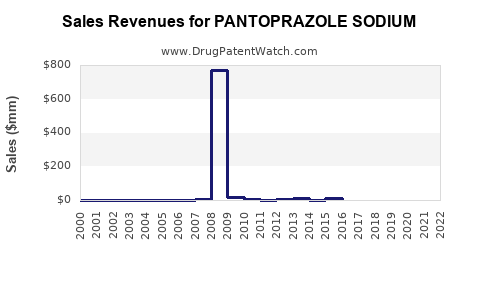
Protonix revenue followed the standard small-molecule loss-of-exclusivity pattern: strong branded growth, a protected peak, rapid erosion after generic entry and subsequent replacement by low-priced generic volume.
Wyeth reported Protonix as one of its major products before Pfizer acquired the company in 2009. Protonix generated approximately $1 billion in annual sales near its mature branded period, although reported totals varied by year, geography and accounting treatment.[4]
After generic competition expanded:
- Brand share fell sharply.
- Net price declined as rebates and generic substitution increased.
- Generic suppliers captured prescription volume but at lower prices.
- Hospital tenders compressed intravenous pricing.
- Retail sales became dependent on scale, wholesaler access and manufacturing cost.
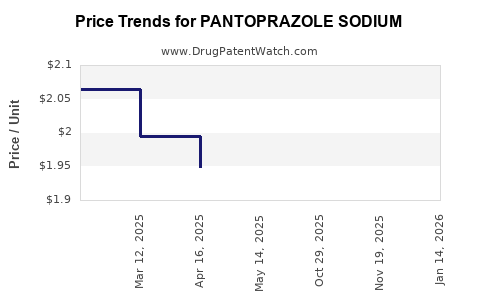
Pfizer does not provide a current standalone pantoprazole revenue line in its public reporting. Generic manufacturers also generally do not disclose pantoprazole sales separately. As a result, current drug-level revenue estimates depend on commercial databases rather than audited company disclosures.
Financial trajectory
| Period |
Revenue profile |
Key driver |
| 2000-2005 |
Rapid branded expansion |
FDA approval and physician adoption |
| 2006-2009 |
High-value mature brand |
Protonix scale and patent protection |
| 2009-2012 |
Sharp erosion |
Generic launches and substitution |
| 2013-2019 |
Mature generic market |
Volume growth and price compression |
| 2020-2026 |
Stable, low-margin demand |
Chronic use, hospital demand and tender pricing |
What is the global market outlook for pantoprazole?
Global demand remains durable because acid-related disorders are common and pantoprazole is established in primary care, gastroenterology and inpatient medicine. Growth is constrained by the maturity of the molecule and competition from omeprazole, esomeprazole, lansoprazole, rabeprazole and vonoprazan in some markets.
Regional dynamics
United States
The U.S. market is characterized by:
- Generic substitution
- Pharmacy benefit manager price pressure
- Hospital purchasing contracts
- Multiple approved suppliers
- Limited brand loyalty
- Periodic injectable supply disruptions
Europe
European markets rely heavily on national reimbursement systems and tendering. Pantoprazole has broad recognition and is commonly prescribed, but prices are generally controlled through reference pricing and generic competition.
China and emerging markets
Demand is supported by expanding healthcare access and increasing diagnosis of gastrointestinal disorders. Local manufacturers compete aggressively on price. Regulatory and procurement reforms can produce abrupt price reductions, especially where centralized purchasing is used.
Hospital markets
Intravenous pantoprazole has a different risk profile from oral tablets. Hospital buyers prioritize validated supply, product quality, delivery reliability and shortage performance. A manufacturer with a dependable injectable plant can preserve share even when tablet pricing is highly commoditized.
What generic entry risks exist for pantoprazole sodium?
Generic entry risk is already realized for conventional pantoprazole sodium products. The principal business risks now concern margin and supply rather than loss of exclusivity.
Key risks for manufacturers
| Risk |
Impact |
| Additional ANDA approvals |
Further price compression |
| Tender consolidation |
Lower net pricing |
| API concentration |
Exposure to manufacturing disruptions |
| FDA warning letters or recalls |
Loss of hospital and wholesaler contracts |
| Product shortages |
Temporary volume gains or reputational damage |
| Formulation similarity |
Limited product differentiation |
| Reimbursement changes |
Reduced pharmacy profitability |
Manufacturers can defend economics through scale, vertical integration, reliable API sourcing and differentiated hospital service. Patent-based pricing power is generally unavailable for standard pantoprazole products.
Is there biosimilar risk for pantoprazole?
No. Pantoprazole sodium is a chemically synthesized small molecule, not a biologic. Biosimilar regulation does not apply. The relevant competitive pathway is the FDA ANDA generic pathway, with competition based on pharmaceutical equivalence, bioequivalence, manufacturing quality and price.
The absence of biosimilar risk does not reduce competitive pressure. Generic competition is typically more direct and more rapid than biosimilar competition once the reference product’s patents and exclusivity expire.
How does pantoprazole compare with competing PPIs?
| Drug |
Competitive position |
Main commercial pressure |
| Pantoprazole |
Mature generic; strong hospital presence |
Price competition and tendering |
| Omeprazole |
Very broad generic and OTC presence |
Extreme commoditization |
| Esomeprazole |
Formerly branded Nexium; now generic and OTC in some markets |
Brand-to-generic substitution |
| Lansoprazole |
Mature generic market |
Low differentiation |
| Rabeprazole |
Generic, with some regional strength |
Smaller scale |
| Vonoprazan |
Newer potassium-competitive acid blocker |
Potential premium alternative in selected indications |
Pantoprazole’s relative strength is its established inpatient and intravenous use. Omeprazole and esomeprazole have greater consumer and OTC visibility in some markets. Vonoprazan may compete where rapid or sustained acid suppression is clinically prioritized, but it does not eliminate pantoprazole’s role in routine generic therapy.
What is the commercial investment case for pantoprazole sodium?
Pantoprazole is a volume and execution opportunity, not a conventional innovation or exclusivity opportunity.
Attractive characteristics
- Established clinical demand
- Broad regulatory history
- Multiple dosage forms
- Low development risk for standard generic products
- Recurring hospital and retail volume
- Potential value in emerging markets
Limiting characteristics
- Low selling prices
- Numerous competitors
- Limited product differentiation
- Weak patent-based barriers
- Procurement-driven margin pressure
- Limited standalone revenue disclosure
A new entrant is most likely to create value through manufacturing efficiency, supply reliability, geographic expansion or a differentiated delivery system. A conventional tablet launch without a cost or channel advantage is unlikely to support premium economics.
What manufacturing and intellectual-property barriers remain?
The main barriers are operational and regulatory.
For oral tablets, manufacturers must control:
- Pantoprazole sodium stability
- Enteric coating performance
- Dissolution behavior
- Batch uniformity
- Packaging and moisture protection
- Bioequivalence requirements
For intravenous products, manufacturers must manage:
- Sterility assurance
- Lyophilization or powder handling, where applicable
- Container-closure integrity
- Reconstitution performance
- Particulate and endotoxin controls
- Injectable manufacturing capacity
These requirements can limit reliable competition even when patents no longer block entry. A supplier with repeated quality failures can lose access to hospital contracts despite holding an approved product.
Key Takeaways
- Pantoprazole sodium is a mature generic PPI with broad global use.
- Protonix generated roughly $1 billion in annual branded sales near its peak period, but current originator revenue is not separately disclosed.
- Core compound and formulation exclusivity no longer support broad branded pricing power.
- Historical Paragraph IV litigation and settlements shaped the timing of generic entry.
- U.S. competition is governed primarily by ANDA approvals, therapeutic equivalence and procurement economics.
- Oral tablets are highly commoditized; intravenous products retain greater supply-chain and manufacturing barriers.
- There is no biosimilar pathway because pantoprazole is a small-molecule drug.
- Commercial value depends on cost, quality, supply reliability and regional access rather than patent exclusivity.
FAQs
Is pantoprazole sodium still a profitable drug?
It can be profitable at scale, particularly for manufacturers with efficient API sourcing and reliable production. Unit margins are generally low because of extensive generic competition.
Does Protonix still have meaningful market exclusivity?
No. Protonix no longer has the broad market protection that supported its branded peak. Any remaining rights would be narrow, product-specific or jurisdiction-specific.
Can a company obtain a new patent on pantoprazole sodium?
A new patent generally cannot cover the old molecule itself. Protection may be possible for a genuinely novel formulation, manufacturing process, combination or therapeutic use that meets patentability requirements.
Why does intravenous pantoprazole retain commercial value?
Hospitals require sterile injectable supply and often maintain approved supplier relationships. Manufacturing complexity and quality requirements reduce the number of dependable suppliers compared with oral tablets.
Is pantoprazole available over the counter in the United States?
Prescription pantoprazole sodium is widely available in the United States. OTC PPI availability is more strongly associated with omeprazole, esomeprazole and lansoprazole products. OTC status should be assessed by specific product and labeling rather than by the molecule’s prescription history.
References
- U.S. Food and Drug Administration. (2022). Protonix (pantoprazole sodium) prescribing information.
- U.S. Food and Drug Administration. (2026). Approved drug products with therapeutic equivalence evaluations: Orange Book.
- Federal Trade Commission. (2013). Pay-for-delay: How drug company pay-offs cost consumers billions.
- Wyeth. (2008). Annual report for the fiscal year ended December 31, 2008.