Last updated: August 13, 2026
Protonix, the branded formulation of pantoprazole sodium, moved from a high-value prescription proton-pump inhibitor franchise to a mature generic market after U.S. generic entry in 2007. Its commercial peak occurred before loss of exclusivity, with annual sales above $2 billion for Wyeth. Revenue then fell sharply as generic pantoprazole gained formulary preference and pharmacy substitution. Pfizer, which acquired Wyeth in 2009, no longer reports Protonix as a separate material product, and current commercial value is concentrated in generic pantoprazole rather than the Protonix brand.
What is Protonix and how does it compete in the acid-reflux market?
Protonix contains pantoprazole, a proton-pump inhibitor used to reduce gastric acid secretion. The product was approved by the U.S. Food and Drug Administration in 2000 for erosive esophagitis associated with gastroesophageal reflux disease and later received additional indications, including maintenance therapy and pathological hypersecretory conditions such as Zollinger-Ellison syndrome.[1]
Protonix was marketed in several prescription forms:
- Delayed-release tablets, commonly 20 mg and 40 mg
- Delayed-release oral suspension, generally 40 mg
- Intravenous formulation, generally 40 mg, for hospital use when oral therapy is not appropriate
The competitive set included AstraZeneca’s Prilosec and Nexium, Takeda’s Prevacid, Eisai’s AcipHex, and generic omeprazole, lansoprazole, rabeprazole, and pantoprazole. Protonix differentiated itself through pantoprazole’s positioning in hospital formularies and its availability in oral and intravenous dosage forms.
The commercial market was highly price-sensitive. Once proton-pump inhibitors became therapeutically substitutable for many patients, managed-care organizations favored generic products and lower-cost branded alternatives. Protonix retained some institutional demand, but its premium pricing could not withstand broad generic substitution.
How did Protonix revenue change before and after generic entry?
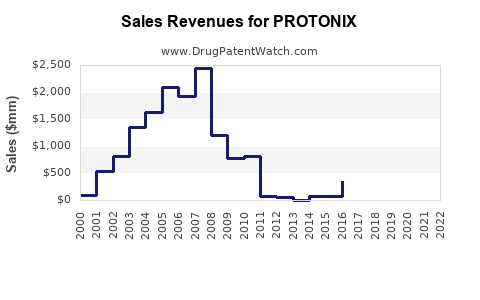
Wyeth’s reported Protonix sales rose to more than $2 billion annually before generic competition. The product was one of Wyeth’s largest commercial assets before Pfizer acquired the company.
| Period |
Commercial position |
Financial trajectory |
| 2000-2003 |
Initial launch and indication expansion |
Rapid prescription uptake |
| 2004-2006 |
Mature branded franchise |
Sales exceeded $1 billion and approached or exceeded $2 billion annually |
| 2007 |
Generic entry begins |
Brand pricing and volume came under pressure |
| 2008 |
Post-exclusivity erosion |
Protonix remained commercially significant but declined from peak levels |
| 2009 onward |
Pfizer ownership after Wyeth acquisition |
Product revenue became progressively less material |
| 2010s-2020s |
Mature generic market |
Pfizer no longer separately discloses Protonix revenue |
Wyeth reported Protonix sales of approximately $2.1 billion in 2006 and approximately $2.2 billion in 2007, according to company annual-report disclosures.[2,3] The 2007 result reflected the strength of the franchise before the full economic impact of generic substitution.
The revenue decline was driven by several factors:
- Generic pantoprazole reduced average selling prices.
- Pharmacy benefit managers increased substitution to generic products.
- Hospitals and integrated delivery networks negotiated lower acquisition costs.
- Other proton-pump inhibitors competed for the same treatment population.
- Protonix lost the ability to support premium pricing after patent barriers weakened.
Pfizer’s public reporting after the Wyeth acquisition grouped Protonix within broader product categories or products that were no longer individually material. No reliable current standalone Protonix revenue figure is available from Pfizer’s annual reports. The relevant financial conclusion is that Protonix changed from a billion-dollar branded asset into a low-growth or declining mature product with limited strategic importance to Pfizer.
When did Protonix lose U.S. exclusivity?
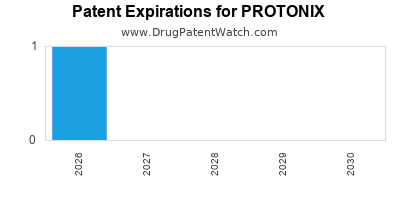
Protonix lost practical U.S. market exclusivity in 2007 when generic pantoprazole entered the market. The timing followed patent litigation and settlements involving Wyeth and generic-drug manufacturers.
The original compound patent had already expired before commercial generic entry. Wyeth relied on later patents covering formulation and dosage-form characteristics to delay or manage generic competition. Those patents became the focus of Paragraph IV challenges filed against Protonix products.
The central economic event was not the expiration of a single patent date. It was the entry of FDA-approved generic pantoprazole and the resulting conversion of prescriptions from Protonix to lower-cost alternatives.
What patents protected Protonix?
Protonix protection included composition, formulation, and dosage-form patents. The most commercially relevant patent disputes concerned delayed-release pantoprazole products rather than the basic clinical concept of acid suppression.
Formulation and dosage-form protection
Protonix delayed-release products use enteric protection because pantoprazole is acid-labile. The formulation prevents degradation in the stomach and enables release in the intestine. This created opportunities for patent claims directed to:
- Enteric-coated tablets
- Oral suspensions
- Pharmaceutical compositions containing pantoprazole
- Stability and release characteristics
- Specific excipient combinations
- Intravenous formulations and manufacturing processes
The Orange Book listed patents associated with Protonix products during the period of branded market protection. Current Orange Book listings must be reviewed by dosage form and product presentation because listed patents and regulatory exclusivity can differ among tablets, oral suspension, and injection.[4]
The practical strength of the estate was limited after generic manufacturers developed non-infringing formulations and successfully pursued abbreviated new drug applications. Formulation patents can delay entry, but they generally do not preserve the brand’s pricing power once an approved generic is available.
Method-of-use patents
Protonix had method-of-use protection associated with approved indications and treatment regimens. Method-of-use patents can support Paragraph IV litigation, but their commercial value depends on whether the patented use represents a significant share of prescriptions and whether generic labeling can omit the protected indication.
For Protonix, broad therapeutic substitution reduced the value of narrow method-of-use claims. Prescriptions for gastroesophageal reflux disease and erosive esophagitis could migrate to other proton-pump inhibitors even where specific use patents remained relevant.
What was the Protonix Paragraph IV litigation?
Generic manufacturers challenged Protonix patents through Abbreviated New Drug Applications containing Paragraph IV certifications. Wyeth responded with patent-infringement litigation, as required to preserve its listed-patent rights.
The disputes involved manufacturers including Teva and other generic applicants. The legal issues included patent validity, infringement, and whether generic pantoprazole formulations practiced the claimed technology. Settlements and court proceedings allowed generic entry earlier than the full expiration of every asserted patent.
The commercial outcome favored generic manufacturers. Once several approved sources entered or became eligible to enter, Protonix could not maintain its previous market economics. Litigation delayed or structured entry, but it did not preserve a durable branded monopoly.
What is the FDA and Orange Book status of Protonix?
Protonix remains an FDA-approved pantoprazole product, but its regulatory position is that of a mature, off-patent prescription medicine rather than a protected innovative product.
| Regulatory issue |
Protonix status |
| Active ingredient |
Pantoprazole sodium |
| FDA pathway |
Original NDA |
| Primary therapeutic category |
Proton-pump inhibitor |
| U.S. patent status |
Core commercial exclusivity lost |
| Generic pathway |
ANDA approvals for pantoprazole products |
| Orange Book relevance |
Product-specific listings and therapeutic-equivalence information |
| Regulatory exclusivity |
No current meaningful new-drug exclusivity |
| Biosimilar exposure |
Not applicable |
Biosimilar risk does not apply because pantoprazole is a small-molecule drug, not a biologic. Competitive risk comes from ANDA-approved generics, authorized generics, hospital contracts, and therapeutic substitution.
The FDA’s Orange Book remains relevant for confirming approved formulations, therapeutic equivalence ratings, and any surviving listed patents.[4] It is not a basis for assuming current commercial exclusivity. Historical listed patents may have expired, been delisted, or become commercially irrelevant.
How strong is the Protonix patent estate?
The Protonix patent estate was commercially strong before generic entry and weak after entry. Its historical value came from protecting a major branded product with substantial prescription volume. Its current defensive value is limited.
| Patent-estate factor |
Assessment |
| Core active ingredient |
Weak after expiry of foundational protection |
| Delayed-release formulation |
Historically important; no longer a durable barrier |
| Oral suspension |
Potential formulation differentiation, but limited market size |
| Intravenous product |
Institutional relevance, but exposed to generic competition |
| Method-of-use claims |
Narrower economic value because of therapeutic substitution |
| Manufacturing know-how |
May create quality and supply advantages, not market exclusivity |
| Litigation leverage |
Highest before first generic entry; low after multiple generic approvals |
| Current brand moat |
Minimal |
Manufacturing know-how may still affect product quality, stability, scale, and supply reliability. It does not recreate patent exclusivity. Generic manufacturers with validated enteric-coating and stability processes can compete without copying every branded manufacturing step.
Which companies challenge Protonix commercially?
The main competitive pressure comes from generic manufacturers rather than new branded entrants. Generic pantoprazole has been marketed or supplied by multiple companies, including Teva, Mylan, Sandoz, Dr. Reddy’s Laboratories, Hikma, and other ANDA holders, depending on product presentation and market period.
The competitive structure has several layers:
- Retail generics compete primarily on price and pharmacy substitution.
- Hospital suppliers compete through contracts, shortages management, and supply reliability.
- Authorized or branded-generic channels can preserve some manufacturer margin.
- Alternative proton-pump inhibitors compete through formulary placement.
- Over-the-counter omeprazole and lansoprazole capture self-care demand.
Competition is therefore broader than a direct Protonix-versus-generic comparison. Protonix also competes against lower-cost products that are therapeutically similar but contain different active ingredients.
What generic launch scenarios affect Protonix?
The first generic launch produced the greatest revenue shock. Later generic entrants increased price pressure but had a smaller incremental effect because the market had already shifted away from Protonix.
Scenario 1: Continued generic erosion
This is the base-case market structure. Generic pantoprazole remains widely available, with low average prices and limited brand loyalty. Protonix prescriptions continue to decline unless supported by institutional contracts or supply disruptions.
Scenario 2: Brand retention in selected channels
Protonix may retain limited use in hospitals, physician practices, or patients stabilized on a branded product. This supports residual revenue but does not restore historical pricing.
Scenario 3: Supply disruption
A shortage affecting generic pantoprazole could temporarily increase demand for Protonix or alternative proton-pump inhibitors. Such an event would be temporary and would not change the underlying patent position.
Scenario 4: Reformulated product
A new formulation, combination product, or delivery system could obtain separate patent protection. That would represent a new product strategy rather than a revival of Protonix’s original exclusivity. Any forecast would depend on FDA approval, clinical differentiation, reimbursement, and patent scope.
How does Protonix compare with Nexium, Prevacid, and Prilosec?
| Product |
Active ingredient |
Original sponsor |
Generic exposure |
Current market profile |
| Protonix |
Pantoprazole |
Wyeth, later Pfizer |
Broad generic competition since 2007 |
Mature prescription and hospital product |
| Nexium |
Esomeprazole |
AstraZeneca |
Generic prescription and OTC competition |
Large historical franchise; broad consumer recognition |
| Prevacid |
Lansoprazole |
Takeda |
Broad generic and OTC competition |
Mature product with declining brand relevance |
| Prilosec |
Omeprazole |
AstraZeneca |
Broad generic and OTC competition |
High-volume, low-price reference product |
Protonix’s commercial trajectory resembles other proton-pump inhibitors: strong branded sales during exclusivity, followed by steep price erosion after generic substitution. Its intravenous presentation gave it institutional relevance, but that did not prevent generic competition.
What is the investment and licensing significance of Protonix?
Protonix has limited residual value as an originator asset. It is unlikely to support a major licensing transaction based solely on historical brand strength. Potential value is more likely to arise from:
- Regional commercialization rights
- Hospital supply contracts
- Generic or branded-generic distribution
- Formulation improvements
- Manufacturing capacity
- Supply reliability
- Combination products with new patent protection
Revenue exposure for Pfizer is low relative to the company’s innovative medicines and vaccine portfolio. The key financial risk is not a future patent cliff. It is the continued decline of a mature off-patent product and the low margin structure of generic competition.
Key Takeaways
- Protonix is pantoprazole, a proton-pump inhibitor approved by the FDA in 2000.
- Wyeth’s Protonix sales exceeded $2 billion annually before generic entry.
- Generic pantoprazole entered the U.S. market in 2007 after Paragraph IV litigation and related patent proceedings.
- The product’s commercial exclusivity depended heavily on delayed-release formulation and dosage-form patents.
- Protonix has no meaningful current biosimilar risk because it is a small-molecule drug.
- Current competitive pressure comes from ANDA-approved generic pantoprazole, alternative proton-pump inhibitors, and OTC products.
- Pfizer does not separately report current Protonix revenue as a material product.
- The patent estate has historical importance but limited present-day exclusionary power.
- Residual value lies in selected institutional channels, supply reliability, and potential reformulation strategies.
FAQs About Protonix Market and Patent Exposure
Is Protonix still a profitable branded drug?
Protonix may generate residual sales, but it is no longer a high-margin branded franchise. Generic substitution and formulary pressure materially reduced its economic value.
Does Protonix have patent protection in Europe?
European patent status varies by country, product presentation, supplementary protection certificate history, and national register. U.S. loss of exclusivity does not establish the legal status in Europe or other jurisdictions.
Can a generic manufacturer launch pantoprazole without copying Protonix?
Yes. An ANDA applicant can use a different formulation or manufacturing process if the product meets FDA requirements and does not infringe enforceable patents.
Is intravenous Protonix more defensible than the tablet?
Intravenous pantoprazole can have different formulation, manufacturing, and market considerations. Its hospital market may be more concentrated, but generic injectable competition still limits long-term pricing power.
Could Pfizer relaunch Protonix as an over-the-counter product?
An OTC switch would require FDA review and compliance with the applicable nonprescription monograph or an approved supplemental application. OTC status alone would not restore the historical prescription-era economics.
References
-
U.S. Food and Drug Administration. (2000). Protonix prescribing information. FDA.
-
Wyeth. (2006). Annual report 2006. Wyeth.
-
Wyeth. (2007). Annual report 2007. Wyeth.
-
U.S. Food and Drug Administration. (2024). Approved drug products with therapeutic equivalence evaluations: Orange Book. FDA.
-
Pfizer Inc. (2009). Annual report 2009. Pfizer.
-
U.S. Food and Drug Administration. (2024). Drugs@FDA: FDA-approved drugs. FDA.